

How to Pitch Video Services to Agency Clients

Most agencies know video is where client campaigns live or die. Yet when it’s time to pitch video services to agency clients, even experienced account managers run into the same wall: clients who see video as a line item instead of a strategic asset. They hesitate on budget, defer to their internal team, or ask whether AI can just handle it. Knowing how to cut through that resistance, frame video’s commercial value, and close with confidence is what separates agencies that grow their production revenue from those that keep leaving it on the table.
Table of Contents
Key Takeaways
Point | Details |
Research before pitching | Map each client’s campaign objectives and decision-making hierarchy before writing a single proposal line. |
Structure proposals around commercial outcomes | Lead with business results and workflow clarity, not just creative capability or equipment specs. |
Use tiered pricing models | Retainer tiers make ongoing video services easier for clients to budget and easier for agencies to sell. |
Address automation concerns directly | Clients want governance and brand control, so show them your approval process before showing your portfolio. |
One CTA closes faster | Proposals with a single clear next step reduce hesitation and speed up client commitment. |
How to pitch video services to agency clients starts with research
Before you build a single slide or write a proposal line, you need to understand what your client is actually trying to accomplish. This sounds obvious, but most agencies skip it. They lead with their reel instead of their research, and clients respond with vague enthusiasm followed by no decision.
Structured client intake is the fix. A pre-pitch questionnaire that covers campaign goals, target audience, budget range, timeline, preferred content style, and distribution channels does two things at once. It gives you the raw material to build a relevant pitch, and it signals to the client that you run a disciplined process. Clients notice when an agency asks smart questions. It builds confidence before you’ve shown a single frame of footage.
Here’s what to dig into before your pitch meeting:
Campaign objective: Is the client driving awareness, conversions, event registrations, or donor engagement? The answer changes every creative and budget recommendation.
Existing brand assets: Logos, style guides, past video content, and brand guidelines tell you what you’re working within.
Decision-making structure: Who has final approval? Is it the CMO, a board committee, or an external stakeholder? Mapping stakeholders before you pitch prevents stalled feedback loops later.
Budget signals: Clients often resist naming a number. Ask instead about prior campaign budgets or comparable projects to calibrate your tiers.
Content distribution plan: Social media, broadcast, website, live events? Distribution determines format, length, and production specs.
Pro Tip: Send a one-page intake form at least 48 hours before any pitch meeting. Clients who complete it are more engaged; clients who don’t are telling you something worth knowing before you invest pitch time.
When you know a client’s approval path before the pitch, you can build it directly into your proposal. That kind of specificity is rare, and clients remember it.
Crafting proposals that win video production work
A strong video production proposal is not a creative lookbook. It’s a business document that happens to include great creative examples. The distinction matters because agency clients, particularly those managing budgets and reporting to leadership, need to justify spending. Your job is to make that justification easy.
A winning proposal includes these core sections: an executive summary tied to the client’s stated goals, your credentials and relevant portfolio work, a clear production workflow with milestones, a pricing section, payment terms, and a single call to action. Each section serves the client’s need to understand what they’re buying and why it’s worth the investment.
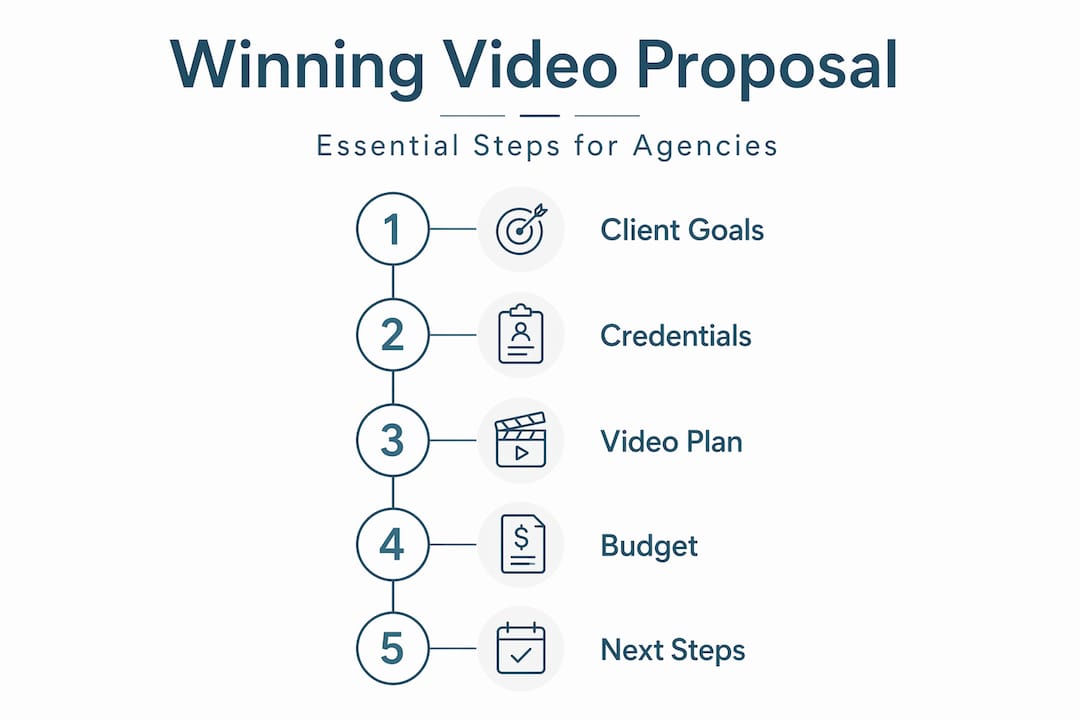
Pricing transparency is where many agencies lose deals they should win. Here’s a comparison of common pricing models and when to use each:
Model | Best for | Typical range | Advantage |
Project-based | One-off campaigns, launches | Varies by scope | Clean scope, easy approval |
Monthly retainer | Ongoing social or content needs | Predictable for both sides | |
Day rate | Coverage, events, interviews | Varies by market | Flexible for scope-uncertain work |
Retainers deserve a specific mention here. When you pitch a retainer as part of your video proposal, you shift the client relationship from transactional to ongoing. A tiered structure, such as a base tier covering two to three short-form videos per month and a mid tier covering five to six plus a monthly strategy call, gives clients options without overwhelming them.
One proposal technique that consistently works: include a short, custom sample. It doesn’t need to be a full production. A rough script concept or a storyboard thumbnail tied to the client’s specific campaign shows relevance in a way that even a polished generic reel cannot match.
Pro Tip: One clear CTA closes faster than three competing options. End every proposal with a single step, such as “Schedule a 30-minute kickoff call,” not “Review the proposal, reply with questions, or book a call.”
Presenting video solutions that move clients to yes
The pitch meeting is where most agencies over-index on creative and under-deliver on strategy. Clients don’t just want to see beautiful footage. They want to trust that your team can execute without creating chaos on their end.
Lead with workflow before you lead with your reel. Walk the client through how a project moves from brief to delivery: intake, scriptwriting, approval checkpoint, production, post-production review, final delivery, and asset handoff. When clients see a clear process, their mental barrier shifts from “this sounds complicated” to “I can see how this works.”
Here’s a sequence that works well for agency pitch presentations:
Open with the client’s problem. Name the specific campaign challenge you heard during intake. This shows you listened.
Connect video to a measurable outcome. For example, a strong visual hook in the first three seconds of a product video, followed by social proof and a clear CTA, drives significantly stronger conversion rates than static ads.
Show your production workflow. One clean slide with milestones and approval checkpoints is more reassuring than five slides of filming locations.
Present your portfolio selectively. Choose two or three pieces directly relevant to the client’s industry or campaign type. Avoid drowning them in volume.
Address automation questions head-on. Many clients have heard about AI-generated video and will ask. Be direct: AI tools have a role in production efficiency, but governance and brand control require human oversight and structured approvals. Clients who care about brand standards are not won over by automation claims alone.
Introduce white-label capacity if relevant. If the client already has some internal production capability, white-label video production lets you scale their output without disrupting their existing workflows.
“Agencies that lead with process and governance win trust faster than those that lead with creative claims. Clients don’t doubt your creativity. They doubt your ability to execute without creating more work for them.”
Positioning video as a revenue-driving tool, not a production service, is the reframe that changes how clients value what you’re offering. A well-structured video for a product launch or a nonprofit fundraising campaign is a sales asset. Price it and pitch it that way.
Managing follow-up, approvals, and closing the deal
The pitch meeting went well. The client seemed engaged. And then three weeks pass with no decision. This is the most common breakdown point in agency video sales, and it’s almost always a process failure, not a relationship failure.
Structured follow-up and clear approval path design are what separate agencies that close video deals from those that lose them to inertia. After your pitch, send a written proposal within 24 hours while the meeting is still fresh. Include a deadline for the pricing, not as pressure, but as a production planning reality.
Before the project kicks off, deploy a detailed video production questionnaire that captures script preferences, talent direction, technical specifications, logistics, and approval contacts. This document reduces the back-and-forth that burns production time and client patience.
A few best practices for keeping deals moving:
Name the approvers explicitly. Ask during intake who signs off on the script, the rough cut, and the final delivery. Document it in the proposal.
Set one follow-up call. After sending the proposal, confirm a specific date and time to review it together. An open-ended “let me know what you think” creates silence.
Handle objections with specifics. If a client says the budget is too high, offer the retainer tier comparison and ask which deliverable set fits their current cycle.
Make commitment frictionless. A proposal with an e-signature option and a single “approve and schedule kickoff” button removes every excuse to delay.
Pro Tip: Brief your production team using the same detail you captured in your intake form. The cleaner your brief, the fewer revision cycles you face, and that protects your margin.
What I’ve learned after years of pitching video to agency clients
I’ve sat across from enough agency account teams to know what actually separates a pitch that closes from one that stalls. And my honest take is this: most agencies pitch their capabilities when they should be pitching their process.
In my experience, the clients who hesitate are not doubting your quality. They’re imagining the internal headache of managing a video production alongside their ten other active campaigns. The moment you show them a clear, documented workflow with defined approval steps, the conversation changes. I’ve seen proposals win not because of a superior reel, but because the client could see exactly how the project would run.
I’ve also learned to be direct about what white-label partnerships can do for agencies. When an agency wants to offer corporate video, social content, and live event coverage but doesn’t have full in-house production capacity, a production partner who operates invisibly under their brand is not a compromise. It’s a growth strategy. The agency keeps the client relationship and the billing; the production team delivers quality without the overhead.
One more thing I’ll say plainly: agencies that win video work consistently are the ones who treat proposals as sales documents, not creative presentations. Real numbers, scoped deliverables, mapped approvals, and a single next step. That’s what closes deals.
Puritano’s video production services for agencies
If you’re ready to back your agency pitches with production capability that clients can see, Puritano Media Group has spent over two decades doing exactly that for agencies and organizations across the Washington D.C. area and nationally. From corporate video production and branded content to music videos and virtual event coverage, Puritano operates as a true creative partner for agencies that want to offer high-quality video without building an in-house production team from scratch. Whether you need white-label production under your agency’s brand or a collaborative approach where Puritano works alongside your team, the process is built around your client’s goals and your agency’s standards. Reach out to explore how a production partnership can strengthen your next pitch and every campaign that follows.
FAQ
What goes into a strong video production proposal for agency clients?
A strong proposal includes an executive summary tied to the client’s goals, your production workflow with approval checkpoints, portfolio samples relevant to their industry, tiered pricing options, and a single clear call to action to schedule the kickoff.
How do you handle agency clients who are concerned about AI and automated video?
Acknowledge the technology directly, then pivot to governance. Clients who care about brand standards want to know who approves content before it goes live. Showing a documented approval and brand control process addresses that concern more effectively than dismissing AI entirely.
What pricing models work best when selling video services to agency clients?
Project-based pricing works for single campaigns, while monthly retainer tiers work best for ongoing content needs. Retainer structures ranging from around $3,000 to $30,000 per month give clients flexibility and give agencies predictable revenue.
How do you keep video pitches from stalling after the presentation?
Send the proposal within 24 hours of the meeting and schedule a specific follow-up call at the same time. Mapping stakeholder approvals in the proposal itself also removes the most common source of post-pitch delays.
What is white-label video production and why does it matter for agencies?
White-label video production lets agencies scale output without overhead by outsourcing execution to a production partner who works under the agency’s brand. The agency retains the client relationship and billing while the production partner handles filming, editing, and delivery.
Recommended
Comments