

What Is a Regulatory Explainer Video for Organizations
Most organizations assume a regulatory explainer video is just a standard animated explainer with some compliance language dropped in. That assumption leads to videos that look polished but fail an audit, confuse employees, or miss the legal requirements they were designed to address. A regulatory explainer video is a different animal entirely. It combines the clarity of visual storytelling with the rigor of documented compliance training, and understanding that difference is what separates organizations that deploy these videos effectively from those that don’t.
Table of Contents
Key takeaways
Point | Details |
Compliance focus changes everything | Regulatory explainer videos require audit trails, version control, and legal review that standard explainers don’t. |
Documentation is non-negotiable | Success is measured by verifiable completions and evidence, not just views. |
Real-world uses span industries | From onboarding to rule change communications, these videos serve businesses, agencies, and associations. |
Production has legal guardrails | Claims, visuals, and language must be anchored to approved regulatory guidelines before filming or animating. |
Updates are part of the product | When regulations change, your video must change with them. Version control isn’t optional. |
What is a regulatory explainer video
A regulatory explainer video is a purpose-built video asset designed to communicate compliance requirements, regulatory changes, or procedurally mandated information to a defined audience. That audience could be employees, regulated businesses, the general public, or agency partners. The explainer video purpose here goes well beyond awareness. It exists to produce a documented, verifiable outcome.
Here’s where the regulatory video definition diverges sharply from a general marketing or corporate explainer. A standard explainer video might walk a prospect through product features using animation and voiceover. A regulatory explainer video does something far more demanding. It must align every claim, visual, and piece of language to approved regulatory guidelines. It must go through review cycles that include legal counsel or compliance officers. And it must generate an audit trail that proves a specific person watched, understood, and acknowledged the content.
The core components that distinguish a regulatory explainer video include:
Learning objectives: Clearly stated goals that map to specific regulatory requirements or compliance outcomes.
Compliance-anchored language: Every claim and statement tied to approved label language, official guidance, or rule text.
Review and approval cycle: Sign-off from legal, compliance, or regulatory affairs before the video is finalized.
Version control: Each iteration tracked, dated, and stored so the organization can demonstrate which version a learner saw and when.
Learner acknowledgment and assessment: Quizzes, knowledge checks, or formal acknowledgment that completion occurred.
Audit trail documentation: Timestamps, completion records, and learner data integrated with an LMS or compliance tracking system.
These elements are essential compliance components, and they fundamentally change how you plan, script, produce, and distribute the video.
Pro Tip: Before scripting begins, build a compliance brief that identifies the specific regulation or rule the video addresses, names the legal reviewer, and defines what “completion” looks like. This single step prevents costly rewrites later.
Where regulatory videos are used
The practical applications stretch across nearly every sector that operates under formal oversight. Government agencies, healthcare organizations, financial institutions, pharmaceutical companies, and trade associations all rely on these videos to meet communication and training obligations.
Consider a few concrete use cases. The U.S. Census Bureau uses instructional video resources to walk respondents through accessing survey requirements, previewing questions, and requesting extensions. That is a textbook regulatory explainer: it lowers friction, shows users exactly what steps to take, and operationalizes compliance guidance into something people can actually follow.

The Advertising Standards Authority produced a short video outlining key therapeutic advertising code changes with specific effective dates to notify regulated businesses of upcoming rule shifts. That is the second major use case: rule change communications. Rather than issuing a PDF that sits unread in an inbox, the agency delivered a watchable, shareable explanation of what was changing and when.
The benefits of regulatory videos come down to four practical outcomes:
Clarity at scale: Complex regulatory language gets translated into plain visuals and plain speech without losing accuracy.
Engagement over documents: Employees and regulated parties are far more likely to watch a three-minute video than read a forty-page guidance document.
Audit readiness: When a regulator asks for proof of training, a documented completion record from a video-based module is far easier to produce than sign-in sheets.
Reduced compliance friction: By showing users where to go and what to do, these videos improve compliance adherence across large populations.
Production considerations for compliant videos
This is where most organizations underestimate the work involved. Knowing what is an explainer video is one thing. Knowing how to create regulatory videos that actually hold up to scrutiny is a different problem entirely.
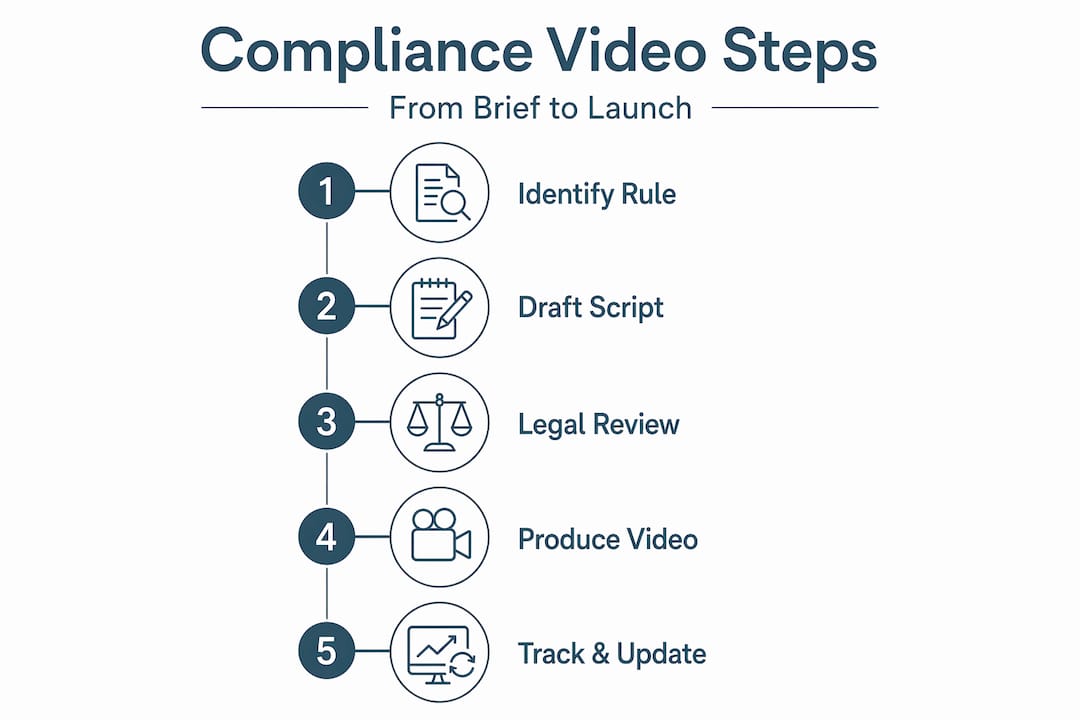
The production process for a regulatory explainer follows a sequence that differs from standard video work:
Compliance brief and regulatory mapping: Identify the exact rule, statute, or guidance the video addresses. Name the accountable reviewer from legal or compliance.
Script drafting with approved language: Writers anchor every line to approved label language or official rule text. For pharmaceutical content, this means teams use claim matrices and legal review to manage risk around off-label promotion and misbranding.
Legal and claims review: The script goes to legal counsel and, where applicable, regulatory affairs before a single frame is designed or shot. No exceptions.
Production with compliance documentation: Visual choices, animations, and on-screen text are all reviewed against the approved script. Changes during production trigger a new review cycle.
Assessment and acknowledgment design: Quizzes, knowledge checks, and formal learner acknowledgments are built in. Audit-ready completion records require these elements integrated from the start, not added as an afterthought.
LMS integration and version logging: The final video is deployed through a learning management system that captures timestamps and individual completion data.
Here is a comparison of a standard explainer versus a regulatory explainer at the production level:
Production factor | Standard explainer video | Regulatory explainer video |
Script review | Creative and client approval | Legal, compliance, and creative approval |
Language source | Brand voice guidelines | Approved regulatory or label language |
Version tracking | Optional | Required and documented |
Completion measurement | Views and watch time | Verified completions with timestamps |
Update cycle | As needed | Triggered by regulatory changes |
Audit trail | Not applicable | Mandatory |
Pro Tip: Schedule a regulatory review checkpoint every six months, not just when a change is announced. Regulations shift in ways that aren’t always broadcast loudly, and your video language can become non-compliant before you realize it.
Best practices for creating effective regulatory videos
The biggest creative mistake in regulatory video production is treating compliance rigor and audience engagement as opposites. They are not. You can produce a video that satisfies a legal review and still holds someone’s attention for four minutes.
Here is what works in practice:
Scenario-based storytelling: Rather than listing rules, show a character navigating a real situation. An employee facing a conflict of interest, a business owner interpreting a new reporting requirement, a regulated party submitting documentation for the first time. Scenarios make abstract rules concrete and improve retention.
Plain language scripting: Regulatory language is dense by design. A skilled writer translates it without changing its meaning. The visual storytelling approach that drives engagement in marketing works equally well in compliance contexts when applied carefully.
Accessibility from the start: Closed captions, audio descriptions, and multi-language versions are not add-ons. Build them into the production plan, especially for public-facing government videos that serve diverse populations.
Modular design: Structure the video in discrete chapters. When a section of the regulation changes, you update that module rather than re-producing the entire video. This cuts cost and shortens the review cycle significantly.
LMS integration planning: Success in compliance training is based on demonstrable completions and evidence, not merely views. Design the video knowing it will live inside a tracking system, not just on a website.
Understanding trade association video strategies also helps here. Associations that regularly communicate regulatory changes to member businesses have refined many of these practices and offer useful benchmarks.
Emerging trends shaping regulatory videos
The production and distribution of regulatory explainer videos are changing quickly. Several developments are worth tracking.
Trend | What it means in practice |
AI-assisted script compliance checking | AI tools flag potentially non-compliant language during drafting, reducing legal review cycles from weeks to days. |
Interactive video elements | Branching scenarios let viewers choose a path, triggering different outcomes and assessments based on their choices. |
Mobile-first delivery | More employees consume compliance training on phones. Short-form, vertical-format regulatory modules are gaining ground. |
Enterprise compliance system integration | Videos connect directly with GRC platforms, feeding completion data into governance and risk reporting automatically. |
Multilingual AI dubbing | On-demand dubbing reduces the cost and time for producing multilingual versions of regulatory content at scale. |
These trends reinforce a core point: regulatory explainer videos are moving away from static, one-size-fits-all content toward adaptive, trackable, and continuously updated compliance assets. Organizations that design their video programs with this trajectory in mind will be better positioned when audits come or regulations shift.
My take on what most organizations get wrong
I’ve worked on regulatory video projects with government agencies, healthcare companies, and trade associations across the country, and the same pattern comes up every time. An organization commissions what they describe as a “compliance explainer,” and what they actually want is a nice animation that mentions the regulation. That is not a regulatory explainer video. That’s a video about a regulation.
The difference matters enormously at audit time. When a regulator asks for proof that your workforce completed anti-money-laundering training, a branded animation with a view count doesn’t answer the question. A documented completion record with timestamps and a quiz score does.
What I’ve learned is that the organizations that do this well treat the video as one component inside a broader compliance documentation system, not a standalone deliverable. They plan the LMS integration before they write the script. They build version control into the project file structure. They schedule the legal review into the production timeline as a fixed milestone, not a last-minute approval. The government production workflow mindset, where documentation and process are built in from the start, is the right model for any organization producing these videos.
The creative challenge I find genuinely interesting is this: you have to honor the legal constraints completely and still make something a person will actually watch without checking their phone. That tension is real, and resolving it well is where production expertise actually earns its cost.
How Puritano Media Group can help with your regulatory video

Puritano Media Group has spent over two decades producing corporate, government, and compliance-related video content for clients in the Washington D.C. area and nationally. We understand the difference between a video that looks good and a video that holds up to regulatory scrutiny, and we build both into every project. From script development through legal review coordination, LMS integration planning, and multi-language production, our team handles the full scope of what regulatory explainer video production actually requires. If you want to see what that work looks like in practice, explore our corporate video services or reach out directly to talk through your compliance communication goals.
FAQ
What makes a regulatory explainer video different from a training video?
A regulatory explainer video is specifically anchored to compliance requirements, with legal review, version control, and audit trail documentation built in. Standard training videos typically lack the formal approval cycles and completion-tracking infrastructure that regulatory contexts demand.
How long should a regulatory explainer video be?
Most regulatory explainers run between two and six minutes, depending on the complexity of the rule being communicated. Modular design, where the video is divided into trackable chapters, works well for longer compliance topics and simplifies future updates.
What does an audit trail in a compliance video look like?
An audit trail includes learner timestamps, quiz scores, formal acknowledgment records, and version identifiers tied to each completion. These records are generated through LMS integration and prove that a specific person completed a specific version of the video on a specific date.
When should an organization update a regulatory explainer video?
An organization should update a regulatory explainer video any time the underlying rule, guidance, or approved language changes. Many compliance teams also schedule periodic reviews every six months to catch incremental shifts that may not be formally announced.
Can regulatory explainer videos be used for external audiences?
Yes. Government agencies regularly use them to guide regulated businesses and the public through procedural requirements. The key difference for external use is that accessibility requirements, multi-language support, and plain-language standards typically need to be even more rigorous than for internal training content.
Recommended

Comments