

How storytelling transforms your corporate video results

Viewers retain 95% of a message when watching it in a video compared to just 10% when reading the same content as text. That single fact reshapes how you should think about every corporate video your organization produces. In Washington D.C.'s market, where associations, agencies, government contractors, and nonprofits compete for the same audience attention, the role of storytelling in corporate video is not a nice-to-have. It is the difference between content that lands and content that gets scrolled past. This guide breaks down why narrative works, which frameworks to use, and how to put them into practice.
Table of Contents
Key Takeaways
Point | Details |
Storytelling boosts retention | Viewers remember 95% of video messages compared to 10% of text, making storytelling essential for impactful corporate videos. |
Emotional connection drives loyalty | Stories that evoke emotion foster trust and increase willingness to pay more for brands. |
Use proven frameworks | Applying frameworks like the Hero’s Journey helps position viewers as heroes, creating stronger engagement. |
Align with audience values | Narratives must reflect the audience’s beliefs and needs to maximize relevance and impact. |
Authenticity matters | Human stories and genuine voices outperform polished scripts and high-tech effects in audience trust. |
Why storytelling is essential in corporate video
Building on why brand engagement matters, let’s get specific about what storytelling actually does for corporate video performance. The numbers are striking. Visual storytelling increases engagement by 650%, and video posts generate 135% greater organic reach on platforms like Facebook compared to text-based content. That is not a marginal gain. That is a structural advantage you either use or hand to someone else.
The importance of storytelling in business comes down to how human brains are wired. We process stories differently than we process data. A statistic about your organization’s reach tells a viewer something. A story about a client whose nonprofit raised twice its fundraising goal because of your campaign makes a viewer feel something. Emotion is what drives memory, and memory is what drives trust.
Here is what story-driven corporate video consistently delivers that feature-heavy content does not:
Emotional connection: Stories trigger empathy and personal identification, which builds loyalty over time.
Message clarity: Narrative structure gives complex ideas a beginning, middle, and end that audiences follow more easily.
Brand differentiation: In a crowded D.C. market, a distinctive story is far harder to copy than a list of services.
Social sharing: Audiences share content that moved them. Data rarely moves people. Stories do.
“Story is not just a communication tool. It is the architecture of memory. What you build with it determines what your audience carries away.”
The corporate video advantages for D.C. metro organizations are well-documented, but those advantages only fully materialize when the video has a real story at its core. For practical visual storytelling tips that you can apply across formats, the fundamentals are the same: anchor everything in human experience, not institutional messaging.
Core storytelling frameworks for corporate videos

Having seen why storytelling matters, let’s break down the frameworks that actually work in practice. Two structures dominate effective corporate video narrative: the Hero’s Journey and the character-challenge-solution arc. Both are proven. The key is knowing when to use which one.
1. The Hero’s Journey
The Hero’s Journey positions the audience as the hero and your brand as the mentor. You are Yoda, not Luke. This is a critical reframe. Most organizations default to making themselves the star of their own video. The 9-stage Hero’s Journey framework flips that instinct entirely, and the result is content that viewers see themselves in. Your client faces a challenge. You guide them through it. They come out transformed. That arc resonates because it mirrors how people actually experience change.
2. The character-challenge-solution arc
The character-challenge-solution arc is a tighter version built for shorter formats. Introduce a specific, relatable character (a staff member, a client, a community member). Establish the real challenge they faced. Show how your brand’s involvement led to a resolution. This structure fits 60-second social clips, two-minute case study videos, and annual report narratives equally well.
3. The transformation story
This format focuses entirely on before and after. It is particularly effective for nonprofits in D.C. who need to show impact to donors and board members. You establish the “before” state with honesty, not polish, and the “after” with evidence.
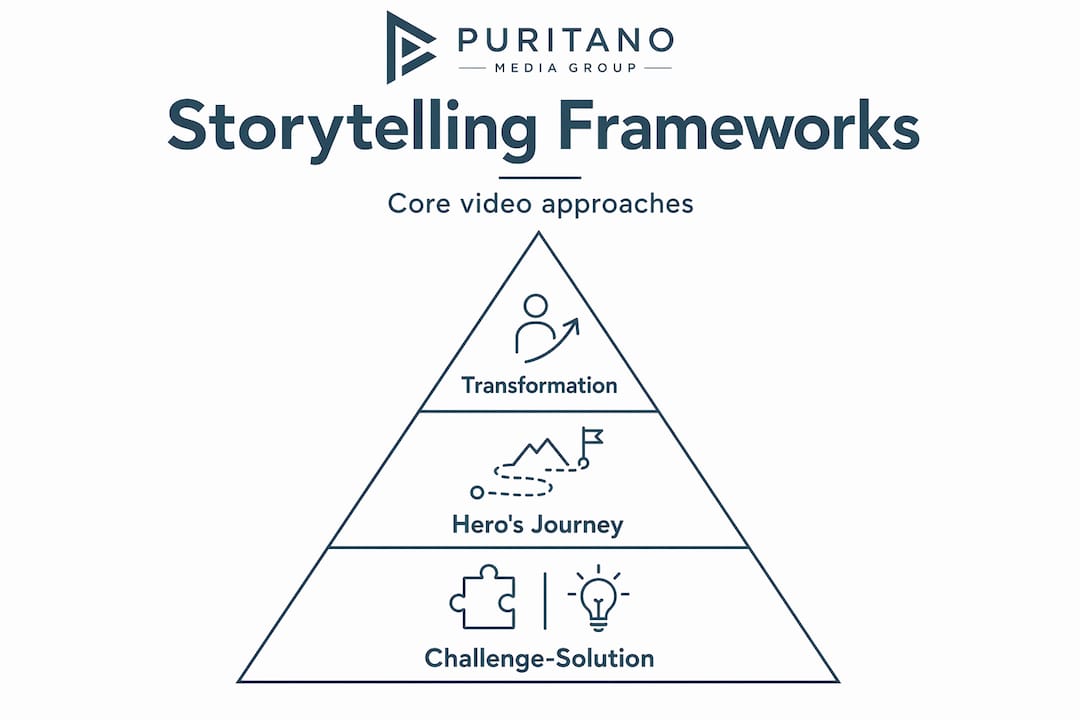
Here is a quick comparison to guide your format decisions:
Framework | Best for | Ideal length | Emotional driver |
Hero’s Journey | Brand films, annual reviews | 3 to 5 minutes | Identity and aspiration |
Character-challenge-solution | Case studies, testimonials | 60 to 120 seconds | Empathy and trust |
Transformation story | Nonprofit impact, campaigns | 2 to 4 minutes | Hope and proof |
Day-in-the-life | Recruitment, culture videos | 2 to 3 minutes | Authenticity and familiarity |
Our branded content storytelling guide goes deeper on format selection for specific brand goals.
Pro Tip: Before choosing a framework, write down the single emotional response you want your viewer to feel at the end. That emotion should determine your structure, not the other way around.
Common storytelling pitfalls and how to avoid them
Understanding frameworks helps, but common mistakes can undercut your storytelling’s power. Here is what we see most often in corporate video projects, especially from organizations in the D.C. area that are sophisticated enough to invest in video but not yet fully committed to narrative-first production.
Leading with features, not feelings
This is the most frequent mistake. A video that opens with your organization’s founding date, headquarters location, and service list is not a story. It is a brochure. Effective brand storytelling focuses on the human story behind the brand rather than features, because authentic human narratives build trust in ways that capability lists simply cannot.
Missing the narrative blind spots
Leaders frequently miss storytelling blind spots that include failing to align stories with what their audience actually values. A D.C. trade association audience cares deeply about policy impact and member outcomes. A government contractor’s audience cares about reliability and mission alignment. Using a generic narrative that does not speak to those specific values is a quiet form of audience neglect.
Overscripted, overproduced content
There is a common misconception that a bigger budget or a more polished script equals a better story. It does not. When every word has been lawyered, approved by six stakeholders, and stripped of any personality, what remains is safe content that no one remembers. Real voices, even imperfect ones, are more persuasive than performed ones.
How to avoid these pitfalls:
Start with your audience’s challenge, not your organization’s history.
Interview real clients and employees before writing a single line of script.
Resist the urge to mention every service or program. One clear story beats ten vague ones.
Test your story concept with someone outside your organization before production begins.
Pro Tip: Use actual client or employee testimonials as your storytelling backbone. Let real people describe the problem in their own words, then show your organization’s role in solving it. That approach consistently outperforms polished scripted narration in both retention and trust.
Our post on storytelling with purpose walks through how to build that kind of authentic narrative from the ground up.
Practical strategies to integrate storytelling in your corporate videos
Now that we know the pitfalls, let’s move into specific steps you can take to embed storytelling effectively into your corporate video projects from the start.
1. Define your core story before touching a camera
Before briefing any production team, answer these questions in writing: Who is the hero of this story? What challenge did they face? What changed because of your organization? What do you want the viewer to feel at the end? Every production decision should serve those answers.
2. Choose formats that fit your narrative goals
Not every story needs a documentary treatment. Testimonial videos, animated explainers, and event recap films each carry different narrative strengths. Video storytelling balances facts with emotion and makes information 22 times more memorable than facts alone, but that only works when the format you choose matches the story you are trying to tell.
3. Distribute where your audience actually is
Platform | Best content type | Optimal length | Primary goal |
Thought leadership, case studies | 1 to 3 minutes | Authority and B2B trust | |
Community stories, event recaps | 1 to 2 minutes | Reach and sharing | |
YouTube | Long-form brand films, tutorials | 3 to 10 minutes | Discovery and depth |
Behind-the-scenes, quick wins | 30 to 60 seconds | Brand personality |
4. Measure narrative impact, not just clicks
Click-through rate tells you how many people started watching. Average watch time tells you whether your story held them. Comments and shares tell you whether it moved them. Track all three to understand whether your storytelling is actually working, not just whether the video got seen.
5. Brief your production team with the story, not just the specs
The difference between a good video and a great one often lives in the briefing. When you hand a production team a story with real stakes and a real human at the center, they can make creative decisions that serve the narrative. For help structuring that conversation, our guide on briefing video production teams is worth reading before your next project kicks off.
You can also find format-specific ideas in our video marketing strategies for associations post, which covers distribution and measurement in more depth.
Pro Tip: Add captions to every video you publish. Captioned videos hold viewers’ attention 12% longer and perform significantly better in silent autoplay environments, which describes most social media feeds.
Why most corporate video storytelling advice misses what really works
Here is what we have seen over more than two decades of producing corporate videos in D.C. and nationally: most organizations are chasing the wrong things. They invest in drone footage, motion graphics, and broadcast-quality lighting because those elements are visible and easy to justify in a budget conversation. They are harder to argue with than “we need a more human story.”
But storytelling humanizes brands and drives deeper engagement than data alone, and that finding is not surprising to anyone who has watched a simple, honest testimonial video outperform a polished brand reel in views, shares, and donor conversions.
The uncomfortable truth is that most corporate video storytelling fails not because of production quality but because organizations design videos for internal approval, not audience impact. They script away the rough edges, trim out the specific details that make a story feel true, and replace genuine moments with corporate language. The result looks professional and says nothing that sticks.
What actually works is giving your audience a story where they recognize themselves. Not a story about how great your organization is, but a story about someone like them who faced a real problem and found their way through it. The role of storytelling in corporate video is not to impress. It is to mirror. When viewers see their own situation reflected in your content, engagement follows naturally.
We have found that the videos our clients get the most mileage from are rarely the most expensive ones. They are the ones where someone said something honest on camera. Our post on brand identity through storytelling explores that relationship between authentic narrative and long-term brand perception in more detail.
Harness expert storytelling and video production with Puritano Media Group
If you are a marketing or communications manager in the D.C. area and you are ready to move beyond videos that check a box and into content that genuinely connects, we are built for exactly that. At Puritano Media Group, we have spent over 20 years helping businesses, associations, nonprofits, and government organizations tell stories that hold attention and drive results.
Our full production services cover everything from concept and scripting through filming, editing, and delivery, with storytelling strategy built into every phase. We are not just a camera crew. We are a creative partner who helps you find the real story before production begins. Whether you need corporate brand films, event coverage, or virtual event video production, we bring the same narrative discipline to every format. Explore our music video portfolio to see the range of storytelling styles we bring to the work. Reach out and let’s talk about what your next video should actually say.
Frequently asked questions
What is the main advantage of storytelling in corporate videos?
Storytelling dramatically increases message retention and emotional engagement, making your content far more memorable and persuasive than plain facts. Viewers retain 95% of a message in video form compared to just 10% through text.
How can I make my corporate video story more authentic?
Feature real employee or client voices, and build your narrative around their actual challenges and outcomes. Focusing on the human story behind your brand, rather than its features, consistently produces more trust and deeper audience connection.
Which storytelling frameworks work best for corporate videos?
The Hero’s Journey and the character-challenge-solution arc are both proven structures. The Hero’s Journey positions your audience as the hero and your brand as the guide, which builds emotional loyalty more effectively than brand-centric narratives.
How important is aligning video stories with audience values?
It is critical. Failing to align stories with what your audience values is one of the most common narrative blind spots, and it directly reduces engagement and trust even when the production quality is high.
What practical steps can marketing managers take to improve corporate video storytelling?
Define your core message and emotional goal before production starts, choose formats that match your story type, feature authentic voices, distribute on platforms where your audience is active, and track watch time and shares alongside click-through rates. Balancing facts with emotion makes your content 22 times more memorable and drives measurable engagement gains.
Recommended
Comments