

Live Event Production Explained for Event Planners
Live event production explained simply: it is the full technical and logistical system that transforms a venue into a functioning, audience-ready experience. Most planners come into their first major event thinking production means renting some speakers and a projector. What they discover is a layered discipline involving audio, video, lighting, staging, rigging, crew management, and real-time show control working in concert. Get any one piece wrong and the audience feels it, even if they can’t name the cause. This article breaks down every major component, from pre-production through strike, so you can plan smarter and partner better.
Table of Contents
Key takeaways
Point | Details |
Production is a technical partnership | Successful events depend on pre-production collaboration, not just day-of equipment setup. |
Audio quality drives audience retention | Poor sound causes audience disengagement faster than any other technical failure. |
Rigging leads load-in | All other technical elements depend on rigging being installed first for safety and positioning. |
Hybrid events need separate content design | Virtual attendees require shorter segments and intentional participation moments every 8-12 minutes. |
Vet vendors by process depth | Professional producers invest 10-40 hours in pre-production planning; commodity vendors invest 3-5. |
What live event production actually covers
What is live event production, really? It is not a single job or a single vendor. It is a collection of specialized technical disciplines that must be designed, coordinated, and executed together. Here is what each core component actually does on the ground.
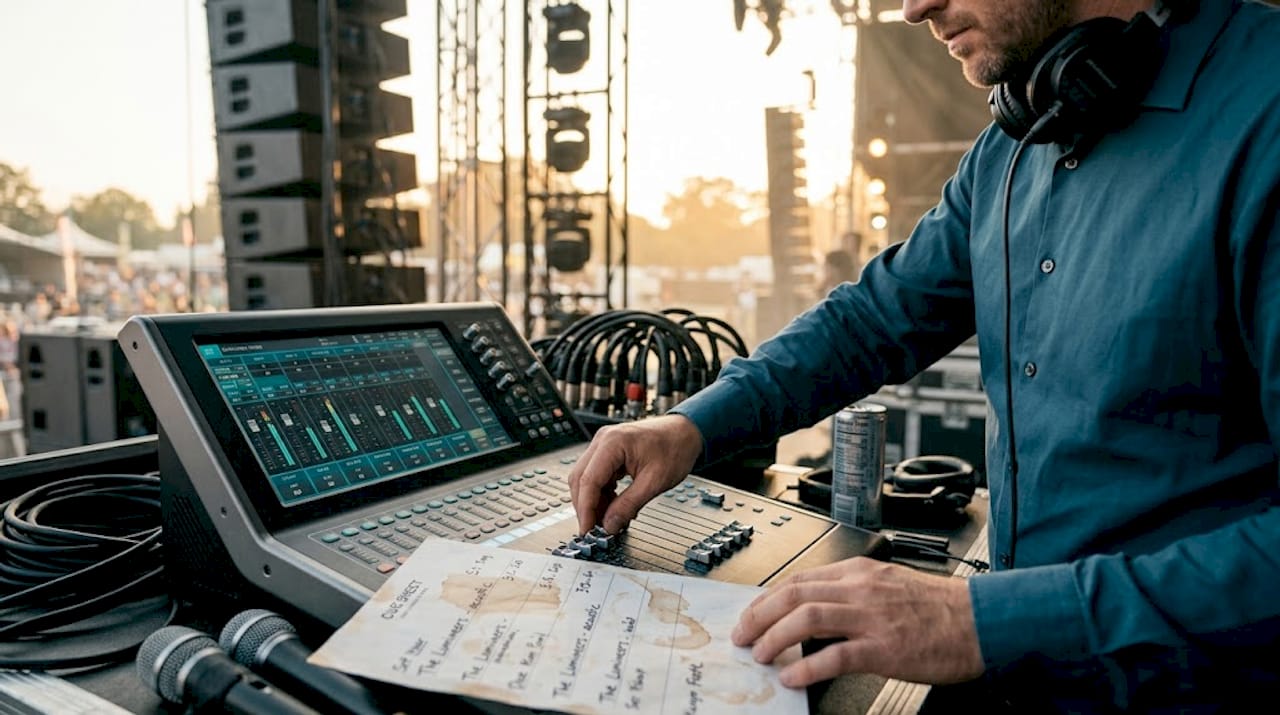
Audio is the workhorse of any live experience. It covers everything from the wireless microphones on your speakers to the front-of-house speaker arrays covering the room and the in-ear monitors keeping your presenters confident. Poor audio causes audience disengagement faster than any video issue, which is why a dedicated audio engineer matters more than most planners expect. For a deeper look at how audio configuration shapes live and broadcast events, Puritano’s audio setup guide walks through the specifics in plain language.
Video includes display systems such as LED walls and projection screens, camera rigs for IMAG (image magnification) so back-row audiences can see the stage clearly, and any graphics playback systems feeding slides or video content to screens. A video director operates this in real time, cutting between camera angles and content sources on the fly.
Lighting does two distinct jobs that planners often conflate. Wash lighting makes the stage look polished and professional. Intelligent, programmable fixtures add drama, color, and energy for concerts, galas, and product launches. A lighting designer programs all of this in advance and executes cues live during the show.
Staging and rigging are the physical infrastructure. Staging raises your speakers and performers to a sightline the audience can actually see. Rigging is a safety-focused discipline that suspends lighting, audio speakers, and video elements from overhead structures. It requires engineering sign-off and must be installed before anything else goes up.
Staging includes risers, podiums, custom set pieces, and pipe-and-drape systems
Rigging involves chain motors, truss structures, and load-rated attachment points
Power distribution connects all technical elements to adequate, protected electrical circuits
Communications systems keep crew connected via intercom (called “comms”) throughout the event
The reason integrated teams outperform fragmented vendor setups comes down to this: when your audio company, lighting company, and staging company are separate entities with no shared plan, they each optimize for their own gear. An integrated production team designs the whole system together, using shared technical drawings called power plots and signal flow diagrams that show exactly how every element connects.
Pro Tip: Ask any production vendor you’re considering whether they provide a technical production document package before the event. If they look at you blankly, that tells you something important about how they work.
The full production lifecycle
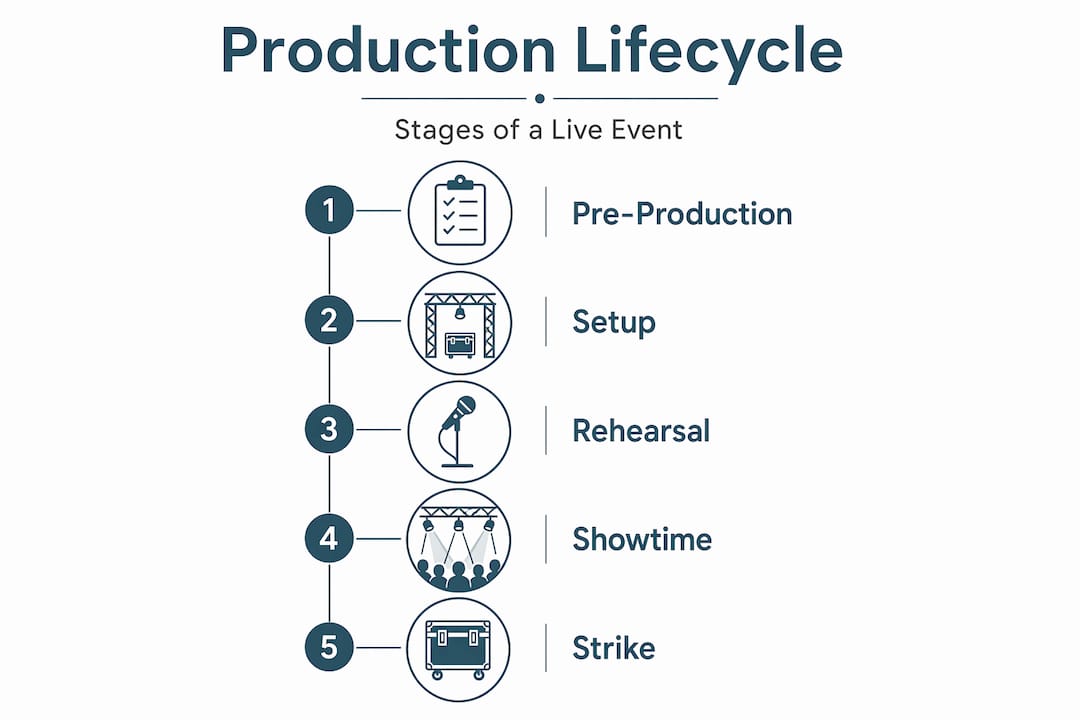
Understanding live event logistics means understanding the timeline. Production does not start the morning of your event. Here is how the full process flows from concept to close.
Pre-production planning. This phase covers everything before the load-in day. A professional production company invests 10-40 hours of planning time for a mid-size event, building technical riders, reviewing the venue’s power and rigging capacity, scheduling crew, and conducting production meetings with the client. Best practice is to begin this process 2-4 weeks ahead of show day to allow full testing and rehearsals. Commodity providers, by comparison, spend 3-5 hours on pre-production. That gap in preparation is exactly where events succeed or fail.
Load-in. This is the physical installation of all equipment. For a 500-person keynote, you are typically looking at 12-20 crew members working 8-12 hours to complete a full install. Load-in for mid-size corporate events generally runs 6-10 hours; large multi-track conferences can require 24-48 hours depending on venue complexity. Rigging leads the sequence because every suspended element must be in place before the teams below can position their equipment accurately.
Systems check and rehearsal. After installation, every technical system is tested independently and then as a connected whole. This is when presenters walk the stage, audio levels are set for individual speakers, lighting cues are programmed and finalized, and any video playback content is tested on the actual screens. Skipping or shortening this phase is the single most common cause of show-day problems.
Show day execution. A dedicated show caller coordinates every technical cue and stage management task in real time. Dedicated roles in audio, video, and lighting consoles run their systems simultaneously, all receiving direction through the comms system. Nothing happens on that stage by accident. Every light change, every graphic, every camera cut has been cued and executed by a specific person.
Strike and load-out. Strike for a 500-person event typically takes 3-6 hours. The venue must be returned to its original condition, which includes removing all rigging points, restoring flooring, and checking for any damage. A post-event debrief and documentation review helps the production team improve for the next event and gives you a clean record of what worked.
Pro Tip: Build a 30-minute buffer between your last scheduled rehearsal and your doors-open time. Technical hiccups during systems checks are normal. That buffer is what separates a smooth opening from a scrambling one.
Hybrid and livestreamed events
Hybrid events are a different animal from in-person only productions, and the gap catches planners off guard more often than it should. When you add a virtual audience, you are essentially producing two shows simultaneously. The in-room experience and the streamed experience have different needs, different technical requirements, and different attention dynamics.
On the technical side, your production infrastructure needs dedicated internet bandwidth, a streaming encoder, broadcast-quality cameras (not just IMAG cameras), and a streaming operator separate from your video director. Technical redundancy in key systems is a non-negotiable at professional level. That means backup streaming encoders, redundant audio feeds, and a failover plan if your primary internet circuit drops.
The best live event production infrastructure is designed to be invisible. When it works, your audience just experiences the event. When it doesn’t, they experience the failure.
The content design matters just as much as the gear. Virtual attendees require planned participation moments every 8-12 minutes. That means building live polls, chat-driven Q&A, and direct camera address into your program script at regular intervals, not as afterthoughts. Hybrid events need shorter segments and intentional transitions to keep online viewers engaged when they have unlimited competing distractions at their fingertips.
Here is what a solid hybrid production checklist covers:
Dedicated streaming operator and broadcast camera operator (separate from in-room video crew)
Backup internet via cellular bonding or secondary ISP circuit
Multiple redundant recordings labeled separately for post-event editing and content reuse
Virtual platform tech checks with remote speakers at least 48 hours before the event
A plan for managing in-room audio bleed on camera microphones
Clear on-screen lower thirds and graphics designed for a 1080p streaming frame, not just a 20-foot projection screen
For planners who want a thorough walkthrough of the streaming-specific side, Puritano’s live stream production guide covers the infrastructure decisions you’ll face when setting up for hybrid delivery.
Choosing the right production partner
The best practices for event production always start with the right partnership. A production company and an AV rental house are not the same thing. Rental houses deliver gear and a technician to set it up. A production company brings a full pre-production process, an integrated crew, a show design, and accountability for the outcome. Knowing which one your event needs is a critical first decision.
For any event where the audience experience is central to your goal, whether that is a conference general session, a product launch, or a gala, you want a production company. For a small internal meeting with a screen and a laptop, a rental house is appropriate. The confusion happens in the middle, and it costs planners real money and stress when they underestimate what a larger event actually requires.
When evaluating production partners, ask these questions directly:
How many hours does your team spend in pre-production for an event this size?
Do you provide technical documentation, including a power plot and signal flow diagram?
What is your redundancy plan for audio, video, and streaming failures?
Will the same crew be on-site from load-in through strike?
Can you walk me through your show day communication structure?
A production company that cannot answer these questions clearly is a red flag. The right partner will have detailed answers and will probably ask you equally specific questions about your event goals, room layout, and audience size.
What to look for | What to avoid |
Pre-production investment of 10+ hours | Vendors who quote without a site survey |
Integrated crew across disciplines | Subcontracting every technical role separately |
Written contingency plans for failures | “We handle it as it comes” responses |
Post-event debrief process | No documentation or review after the event |
Experience in your event type | Generic AV company for a complex production |
Getting your production partner involved early is not just helpful. It directly reduces risk. The more they understand your program, your venue, and your audience, the better their technical design will serve you on show day.
My honest take on production planning
I’ve worked alongside event teams at every level, from small association meetings to large national conferences, and the pattern I see most consistently is this: planners underestimate how much technical planning shapes the audience experience, and they overestimate how much can be fixed on the day.
In my experience, the events that feel effortless to attendees are the ones where the production team was given real information and real time before load-in. The events that feel rough, where the audio feedback happens during the opening remarks, where the slides don’t match the speaker’s laptop, where the livestream drops at the worst possible moment, are almost always the ones where production was treated as a last-mile detail rather than a planning partner.
What I’ve learned is that the value of a good production company is not the gear in their truck. It’s the 30 hours of prep work that happened before that truck arrived. When you invest in thorough pre-production, you are not paying for more equipment. You are paying for a team that has already solved your problems before the audience arrives.
My strong suggestion to every planner reading this: learn enough about technical production to ask informed questions. You do not need to know how to program a lighting console. You do need to know that a lighting console should be programmed before rehearsal, not during it. That kind of knowledge changes every conversation you have with a vendor, and it changes your events.
— Charlie
How Puritano supports your next live event
At Puritano, we have spent over two decades helping organizations in Washington, D.C. and nationally produce events that actually work. Our team approaches live production as a full partnership, not a delivery job. That means we are at the table during pre-production, building technical plans alongside your event schedule, and we stay accountable through load-in, show day, and strike.
Whether you are producing a corporate conference general session, a hybrid town hall with remote viewers across the country, or a live-streamed product launch, our production capabilities cover audio, video, lighting, and streaming under one integrated team. You can explore our virtual and hybrid event work to see how we approach the specific challenges of dual-audience production. For organizations looking for the full picture of what we offer, our production services page covers the scope in detail. We would be glad to talk through your next event and help you scope it correctly from the start.
FAQ
What is live event production?
Live event production is the technical and logistical process of designing, installing, and operating audio, video, lighting, staging, and rigging systems to create a live audience experience. It encompasses pre-production planning through post-event strike, not just day-of equipment setup.
How early should production planning begin?
Best practice is to begin production planning 2-4 weeks before the event to allow time for full systems testing and rehearsals. For large multi-track conferences, production coordination often starts months in advance.
What is the difference between a production company and an AV rental house?
A production company manages the full technical lifecycle including design, crew, show calling, and contingency planning. An AV rental house delivers and sets up equipment but typically does not provide integrated show management or pre-production planning.
Why does audio matter more than video in live events?
Poor audio causes faster abandonment than video quality issues in both in-person and streamed events. Audiences will tolerate an imperfect image, but they disengage immediately when they cannot hear or understand a speaker clearly.
What makes hybrid event production different?
Hybrid events require two parallel technical systems: one for the in-room audience and one for the virtual audience. This includes dedicated streaming operators, broadcast cameras, redundant internet circuits, and content designed to engage both audiences simultaneously.
Recommended
Comments