

Explainer Video vs Promotional Video: Which Wins?

Choosing the wrong video format is one of the most common and costly mistakes marketers make. When clients come to us debating between an explainer video vs promotional video, they often have a gut feeling about which one they want. But gut feelings and marketing strategy don’t always line up. One format educates. The other motivates. Both serve completely different moments in the buyer’s journey, and using one where the other belongs can drain your budget with little to show for it. This article clears up the confusion and gives you a practical framework for making the right call.
Table of Contents
Key Takeaways
Point | Details |
Different goals, different formats | Explainer videos educate; promotional videos motivate. Confusing the two costs you conversions. |
Funnel position matters | Use explainer videos at awareness and consideration stages; use promotional videos closer to the decision stage. |
Explainers drive serious lifts | Landing pages with explainer videos convert 86% better than video-free pages. |
Combine both for best results | A combined video strategy across the buyer journey consistently outperforms relying on a single format. |
Measurement defines success | Track different metrics for each format: engagement and click rates for explainers, conversion and action rates for promos. |
What explainer videos are and when to use them
An explainer video has one job: make something complex easy to understand. These videos walk viewers through a product, service, or concept in a way that removes confusion and builds confidence. They answer the question your prospect is quietly asking before they ever consider buying.
Explainer videos typically run 60 to 90 seconds and appear most often on landing pages, product pages, onboarding sequences, and email campaigns. They perform at the awareness and consideration stages of the funnel, where your audience is still forming an opinion about whether your solution even applies to them.
Here’s what makes them effective in practice:
Format options: Animated explainers, whiteboard videos, screen recordings, and live-action walkthroughs all qualify. The format you choose should match your brand tone and audience expectations.
Audience mindset: Viewers watching an explainer are in learning mode. They want clarity, not a sales pitch. Push too hard and you lose them.
Best industries: Software as a service (SaaS), healthcare, fintech, nonprofits, and any business with a product or service that requires a bit of explanation before the value becomes obvious.
Placement that works: Placing an explainer above the fold on a landing page significantly boosts play rates. Autoplay with sound off reduces friction without being intrusive.
The numbers back this up. Emails with explainer videos improve conversion rates by nearly 70% compared to non-video emails. That’s not a marginal lift. That’s a format doing real work.
The biggest mistake teams make with explainers is scripting them like product brochures. The most common failure is focusing the narrative on features rather than problems. Viewers need to recognize their own pain before they care about your solution. Leading with the human problem, then introducing your product as the answer, is what separates an explainer that converts from one that just informs.
Pro Tip: Before you write a single line of your explainer script, spend time mapping the specific frustration your viewer feels right before they need your product. Build the narrative from that moment outward. A 90-minute narrative mapping session before animation starts pays dividends in conversion.
What promotional videos are and when they deliver
A promotional video is a different animal entirely. Where an explainer teaches, a promotional video creates desire. It builds energy, stirs emotion, and gives viewers a reason to act now. Think of it as the marketing equivalent of a great sales conversation where you already know the prospect understands the basics and you’re there to close.

Promotional videos are high-energy, emotionally engaging, and built around visuals, music, and storytelling that trigger a specific response: excitement, trust, or urgency. They work best lower in the funnel, where your audience has some familiarity with your brand and you’re pushing them toward a decision.
Here’s where you’ll see them used most effectively:
Social media ads: 15 to 30 seconds, designed to stop a scroll and drive clicks.
Trade show displays: Looping visuals and punchy messaging without sound dependency.
Landing pages: 60 to 90 seconds for a product launch or campaign offer where the audience is warm.
TV commercials and pre-roll ads: Brand awareness plays targeting a broader audience with high production value.
Promotional video effectiveness depends heavily on creative strategy. The emotional arc matters. A promotional video that tries to explain too much loses its punch. The goal is to make the viewer feel something and then give them one clear next step.
Pro Tip: For social promotional videos, treat the first three seconds as your entire pitch. If your hook doesn’t create curiosity or emotion immediately, the rest of the video won’t save it. Test multiple intros before scaling spend. You can find more on this in Puritano’s breakdown of high-converting video ads.
The difference between explainer and promotional videos also shows up in tone. Explainers are clear and measured. Promotional videos carry energy and momentum. Forcing an educational script into a promotional format produces something that feels like a corporate infomercial. Neither format, done wrong, forgives the mismatch.
Side-by-side comparison of both formats
Here’s a direct look at how these two formats differ across every dimension that matters to your planning.
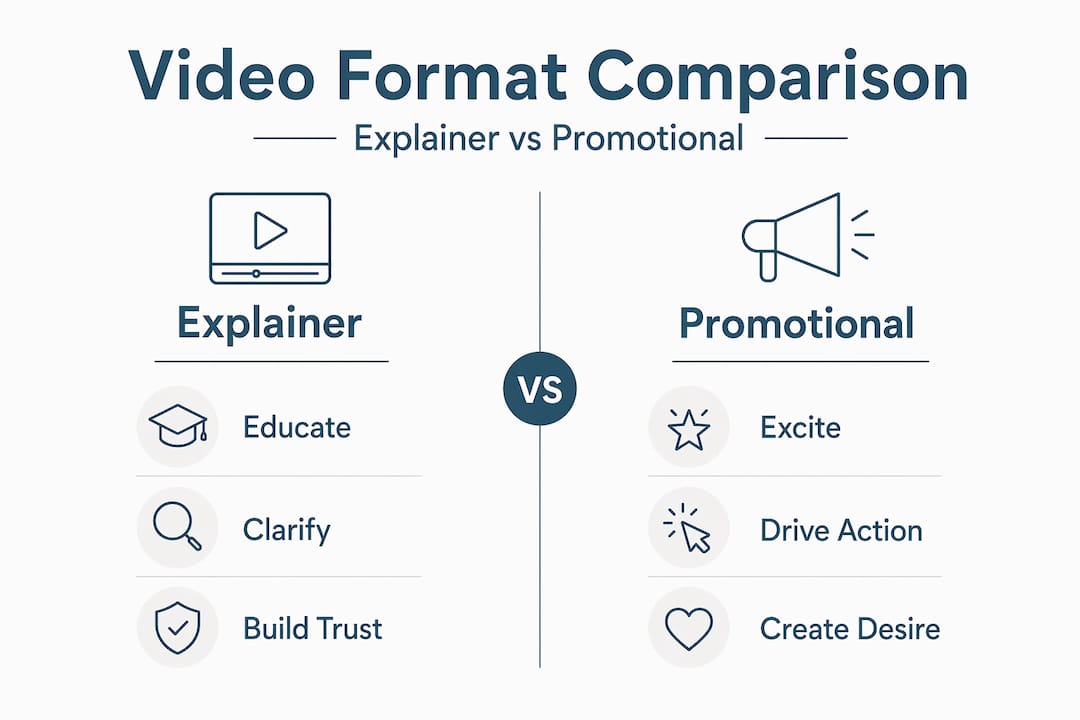
Dimension | Explainer video | Promotional video |
Primary goal | Educate and clarify | Generate excitement and action |
Funnel stage | Awareness, consideration | Consideration, decision |
Typical length | 60 to 90 seconds | 15 to 60 seconds |
Tone | Clear, calm, informative | Energetic, emotional, urgent |
Content focus | Problem and solution | Desire and brand identity |
Call to action | Learn more, try free, watch demo | Buy now, sign up, get started |
Best platforms | Landing pages, email, YouTube | Social ads, TV, trade shows |
Audience mindset | Curious, evaluating | Aware, ready to decide |
A combined video approach across buyer journey stages consistently drives stronger results than relying on either format alone. Promotional videos create awareness and interest at the top. Explainers build understanding in the middle. Testimonial or case study videos close with social proof at the bottom. Each format has its lane, and the strongest marketing strategies use all three.
The practical implication here is that you should rarely produce just one video and expect it to do everything. That’s like asking one employee to run sales, customer service, and product training simultaneously.
How to choose the right format for your goals
The decision comes down to two questions. First, what does your audience already know? Second, what do you want them to do next?
Use this as your decision framework:
Assess audience knowledge. If your product or service requires explanation before someone can appreciate its value, start with an explainer. SaaS products, medical devices, financial services, and complex B2B solutions almost always need this step.
Identify your marketing objective. If the goal is awareness or education, go with an explainer. If the goal is conversions, registrations, or sales from a warm audience, a promotional video is the right tool.
Map to your funnel stage. Cold traffic seeing your brand for the first time benefits from an explainer. Retargeted traffic that already visited your site or engaged with your content responds better to promotional content with a strong offer.
Consider platform behavior. YouTube viewers are in discovery mode, which favors explainers. Instagram and TikTok users are in scroll mode, which favors short promotional formats. Match the format to where and how your audience is consuming content.
Think about budget and production scope. Animated explainers with professional voiceover take time and craft. High-energy promotional videos with on-location shooting, talent, and music licensing carry their own costs. Both are investments; knowing which one serves your goals prevents wasted production spend.
When you launch a new product, consider a two-phase approach. Start with an explainer video in the first few weeks to build understanding and answer objections. Follow it with a promotional video once your audience is warm and primed to act. This sequence reflects how people actually make decisions: they need to understand before they commit.
Pro Tip: If you are creating a social video campaign, short-form formats with tight promotional messaging often outperform long explainers in paid distribution. Save the explainer for your owned channels where intent is higher.
Measuring effectiveness and ROI for each format
Producing a video without a measurement plan is like running a campaign without a budget. You have no idea if it’s working.
For explainer videos, the metrics that matter most are:
Watch-through rate: Are viewers making it to the end? A drop at the 30-second mark tells you the hook isn’t strong enough or the pacing is wrong.
Click-through rate on the next step: Your call to action needs a trackable destination. Homepage explainers convert 25 to 45% of viewers to next-step actions when placed correctly.
Email engagement: If you embed an explainer in a nurture sequence, track open rates and click rates against your baseline.
For promotional videos, focus on:
Conversion rate: Did viewers take the desired action? This is the primary metric.
Cost per acquisition: Especially important for paid social and pre-roll placements where spend scales quickly.
Engagement rate and completion rate: Shorter promotional videos should show high completion. If people are dropping off early, the creative needs work.
Platform matters for tracking too. Wistia’s CRM attribution capabilities let you tie individual viewer behavior to pipeline impact, which is far more meaningful for B2B teams than raw view counts. YouTube and social platforms give you reach data. Wistia gives you revenue data. For high-value conversion videos, that distinction is worth the investment.
91% of businesses use video content now, which means the bar for what counts as “effective” keeps rising. The brands winning with video are those who treat it like any other channel: testing, measuring, and iterating based on real data. Avoid the trap of measuring success by production quality alone. A beautiful video with no trackable outcome is a reel, not a marketing asset.
What two decades of video production have taught me
I’ve seen the same mistake repeat itself across industries. A business spends real money on a promotional video because it looks exciting in the pitch deck, but their audience has never heard of them and has no idea what the product does. The video goes live, performs poorly, and everyone blames the creative. The creative wasn’t the problem. The format was.
In my experience, the explainer video is the most underestimated asset in a marketing stack. Marketers chase the flashy promo because it feels more “brand.” But a well-scripted explainer that walks a confused prospect through their own problem and shows them a clear way out? That video works quietly and consistently for months or years.
Here’s what I’ve also found: combining animated explainers with founder-led live-action videos builds a level of trust that neither format achieves alone. The animation handles clarity. The human element handles credibility. Together, they cover both the rational and emotional sides of a buying decision.
The other thing I’d push back on is the idea that production quality is everything. Authenticity matters more than polish in some formats, particularly for promotional content on social. A raw founder story told genuinely can outperform a cinematic brand spot in a direct response context. Know your audience before you invest in production value.
— Charlie
Ready to produce your next video with Puritano?
At Puritano, we produce both explainer and promotional videos for clients across the DMV area and nationally. Whether you need a clean animated explainer to onboard new customers or a high-energy promotional piece for your next campaign, we handle the full production process from script to final delivery.
Our team brings over two decades of experience to every project, which means we ask the right questions before a single frame is shot. We help you identify which format serves your actual goals and then build it to perform. If you’re ready to put the right video in the right moment of your marketing funnel, explore our video production services or browse our creative portfolio to see the range of work we deliver.
FAQ
What is the main difference between explainer and promotional videos?
Explainer videos educate viewers about a product or concept, while promotional videos generate excitement and drive immediate action. Each format serves a different stage of the buyer’s journey.
When should you use an explainer video?
Use an explainer video when your audience is unfamiliar with your product or needs context before they can evaluate it. They work best on landing pages, in email nurture sequences, and on product pages at the awareness or consideration stage.
How long should an explainer video be?
Most explainer videos run between 60 and 90 seconds, long enough to cover the problem and solution without losing attention. Promotional videos for social ads typically run 15 to 30 seconds.
Can you use both formats in the same campaign?
Yes, and you should. A combined approach using explainer videos early in the funnel and promotional videos closer to the decision stage produces stronger results than relying on either format alone.
How do you measure the ROI of an explainer video?
Track watch-through rates, click-through rates on calls to action, and conversion lifts on the pages where the video lives. Platforms like Wistia support CRM-level attribution that connects viewer behavior directly to pipeline outcomes.
Recommended
Comments