

Music Video Budget for Artists: Realistic Ranges and What You Get
Updated: Aug 12

A realistic U.S. music video budget runs from $0 to $500,000+, and the most useful way to think about it is by tier. According to Tools 4 Music, the four practical bands are:
DIY / phone shoot: $0–$500. You’re trading money for time. The ceiling on production polish is low, but for social-first content with an audience under 1,000, it’s a defensible starting point.
Entry / indie: $500–$2,500. A freelance videographer, basic lighting, and a freelance editor. Expect a clean performance video with one or two locations and a vertical edit for Reels or TikTok.
Mid-tier: $2,500–$20,000. A small professional crew, a director, color grade, and multi-format delivery. This is where most independent artists with a real release campaign should be thinking.
High / mass-budget: $20,000–$500,000+. Full production design, union crew, VFX, and a named director. Billboard reports that Vevo programs a small number of mass-budget projects annually aimed at tier-A artists where spending is justified by scale.
The practical standard in 2026 is multi-format delivery: a full YouTube cut, a 60–90 second vertical edit, an 8-second Spotify Canvas loop, and short teasers. Plan for all of it before the shoot, not after. If your audience is growing past 5,000 followers and you have a strong single, the mid-tier is where the return on investment starts to make sense. When you’re ready to scope a project, Puritano Media Group can help you build a budget that matches your goals.
Key Takeaways
A music video budget is best planned by tier, with multi-format delivery and a 10% contingency built in from the start.
Point | Details |
Match tier to audience and goals | DIY fits audiences under 1,000; mid-tier ($2,500–$20,000) suits most independent release campaigns. |
Plan multi-format before the shoot | Adding vertical edits and a Canvas loop costs $100–$300 when planned up front, far less than retrofitting. |
Always include a 10% contingency | Permits, overtime, and equipment issues are predictable risks; budget for them before they happen. |
Prioritize director and production design | These two line items have the highest impact on perceived production value at any budget level. |
Puritano for campaign-level projects | Puritano delivers full-service music video production with transparent line-item budgets and multi-format outputs. |
What do realistic sample budgets look like at each tier?
Here’s how money actually gets spent at each level, with a worked example at the entry tier.
DIY ($0–$500): Smartphone camera, a ring light ($50–$100), free editing software like DaVinci Resolve, and a friend’s apartment. The output is a single YouTube cut. No color grade, no vertical edit unless you shoot it yourself.
Entry / indie ($500–$2,500): One freelance videographer, one location, basic lighting kit, and a freelance editor. A realistic $2,000 performance video breaks down roughly like this:
Line Item | Estimated Cost |
Videographer (day rate) | $600 |
Freelance editor | $500 |
Lighting rental | $100–$150 |
Location fee | $0–$300 |
Miscellaneous (props, transport) | $100–$200 |
Total | ~$1,850 |
That leaves a small buffer for a vertical edit, which adds roughly $100–$300 in editing time when planned up front.
Mid-tier ($2,500–$20,000): Director, director of photography (DP), small crew, production design, color grade, and multi-format delivery. Expect two shoot days and a narrative or concept-driven treatment.
High-budget ($20,000–$500,000+): Full crew, production designer, art department, VFX, and a director with a track record. Director fees alone can reach $50,000+ on major-label projects. Labels are increasingly splitting these budgets into two smaller videos plus multiple short-form content days, a strategy director Justin Clough has noted publicly as more effective for sustained audience engagement than a single blockbuster.
How is a music video budget allocated across pre-production, production, and post?
Production budgets break into six categories: pre-production, creative team, production, post-production, support services, and contingency. Here’s how those percentages typically land at the entry and mid tiers:
Category | Entry Tier | Mid-Tier |
Pre-production (director prep, scouting, casting) | 5–10% | 10% |
Creative team (director, DP) | 20–30% | 25% |
Production (crew, equipment, location, catering) | 30% | 30% |
Post-production (editing, color, VFX) | 20% | 20% |
Support services (permits, insurance) | 5–10% | 5–10% |
Contingency | 10% | 10% |
The AMW budget calculator recommends a 10% contingency as a standard floor. Skip it and a single permit delay or equipment failure will blow your budget.
What drives up costs, and what can you trade off?
The biggest levers are crew size, shoot days, locations, VFX, and union status. Here’s how each one plays out:
Crew size: Every additional crew member adds a day rate plus meals and transport. A two-person crew (DP + assistant) costs a fraction of a six-person union crew.
Shoot days: Adding a second day often costs less than doubling the crew, but it extends post-production timelines.
Locations: Permitted public locations and private venue rentals add fees fast. A single, well-dressed location with creative blocking is almost always the smarter trade.
VFX: Motion graphics and compositing are expensive in post. Practical effects (colored smoke, mirrors, projections) achieve a similar visual impact at a fraction of the cost.
Union vs. non-union: Union crew (SAG-AFTRA, IATSE) adds significant overhead but is sometimes required for label-funded projects.
Hidden cost red flags to watch:
Permit fees for public spaces (city permits can run $200–$1,000+ per location per day)
Overtime charges when a shoot runs past the agreed hours
Music clearances if you’re sampling or using a cover
Liability insurance gaps that a venue requires you to fill
Pro Tip: Hire an experienced DP over a larger crew. One skilled DP with a well-chosen camera package will outperform three junior crew members on a tight budget, and the footage will grade better in post.
What does a typical production timeline look like?
Timeline and budget are directly linked. Rush fees are real, and reshoots are expensive.
1-day performance shoot (entry tier): 1–2 weeks pre-production (concept, location, wardrobe); 1 shoot day; 1–2 weeks post (edit, color, vertical cut). Total: 3–5 weeks from brief to delivery.
2-day narrative shoot (mid-tier): 3–4 weeks pre-production (director treatment, casting, scouting, permits); 2 shoot days; 3–4 weeks post (edit, color grade, VFX if any, multi-format export). Total: 6–9 weeks.
3-day mid/high shoot: 4–6 weeks pre-production; 3 shoot days; 4–6 weeks post. Total: 10–14 weeks from signed contract to final delivery.
Rush fees typically add 20–30% to crew and post costs. If you’re working toward a release date, build the timeline backward from that date and add two weeks of buffer.
How do you cut costs without the video looking cheap?
The most effective cost-saving moves are structural, not cosmetic.
Plan multi-format from day one. Adding vertical edits and a Canvas loop costs $100–$300 in editing time when planned before the shoot. Retrofitting them afterward can cost three times that.
Use a single location with creative blocking. Change the lighting, wardrobe, or camera angle between setups. Three distinct looks from one location is a production design skill, not a budget limitation.
Batch your social assets during the shoot. Behind-the-scenes footage, stills, and short clips for Instagram and TikTok cost nothing extra when captured on the day.
Prioritize the director and DP over everything else. A strong concept executed by a skilled DP will outperform a mediocre concept with expensive equipment every time.
Consider two smaller videos instead of one large one. Billboard’s reporting on label strategy confirms this approach drives stronger sustained engagement than a single high-spend release. For independent artists, it’s also a way to keep social media presence active across a full release cycle.
Pro Tip: Shoot your vertical content as a separate camera angle during the main shoot, not as a crop of the horizontal frame. A 9:16 crop from a 16:9 frame loses most of the composition. One extra camera or a second shooter for 30 minutes solves it cleanly.
What should you check before hiring a production company?
Use this checklist before you sign anything.
Scope and deliverables:
Exact formats and resolutions included (YouTube 4K, 1080p vertical, Canvas loop, teasers)
Number of revision rounds in post
Turnaround time from shoot day to final delivery
Who owns the footage and the final cut
Budget and payment:
Full line-item budget, not a lump-sum quote
Contingency line included
Payment milestone schedule (see Section 9 below)
Legal and insurance:
Who pulls permits and who pays for them
Proof of general liability insurance
Music clearance responsibility (especially for covers or samples)
Cancellation and reshoot policy
Questions to ask the producer directly:
Can you show me a line-item budget from a comparable project?
What is your payment schedule, and what triggers each milestone?
Who is responsible for location permits and music clearances?
What happens if we go over schedule on shoot day?
What is your cancellation policy if the project is delayed or cancelled?
Contract red flags: vague deliverable descriptions (“a music video”), no contingency line, open-ended overage language, and no mention of insurance.
DIY, freelance crew, or full-service production company: which is right for you?
The right production route depends on your audience size, campaign goals, and how much polish the release actually needs.
DIY makes sense when your audience is under 1,000, the content is social-first, and the concept doesn’t require production design or multiple locations.
Hire a freelance crew when you have 5,000–50,000 followers, one strong concept, and a budget of $1,000–$10,000. A skilled freelance DP and editor can deliver a clean, professional result without full-service overhead.
Book a full-service production company when you’re running a campaign-level release, you need multi-format delivery, or the concept requires production design, casting, and coordinated post-production. Puritano’s music video portfolio reflects this level of work: nationally scoped projects with full crew, multi-format outputs, and transparent budgeting from brief to delivery.
What to bring to a bidding conversation: reference videos you admire, target platforms and formats, your audience size, must-have shots or locations, and your hard budget ceiling.
How do payment structures and schedules typically work?
Most production companies use a milestone-based payment structure. A standard three-milestone schedule looks like this:
Deposit (33–50%): Due at contract signing. Covers pre-production costs, director prep, and location scouting.
Mid-production payment (25–33%): Due before or on the shoot day. Covers crew day rates, equipment rental, and location fees.
Final payment (remaining balance): Due upon delivery of the first cut or final approved deliverables.
Some companies use a 50/50 split (half at signing, half at delivery), which is common for smaller entry-tier projects. For larger mid or high-budget productions, a three- or four-milestone structure protects both parties. Never pay 100% upfront, and never sign a contract that doesn’t specify what triggers each payment.
What does insurance cost, and why does it matter?
Insurance is not optional on a professional shoot. Two types are standard:
General liability insurance covers property damage and third-party injury on set. Most venues and permitted locations require a certificate of insurance before you can shoot. Day rates for a single-day production policy typically run $150–$400 depending on coverage limits and location.
Equipment insurance covers rented camera packages, lighting, and grip gear. Rental houses often require a damage waiver or proof of coverage. This is usually bundled into the equipment rental quote, but confirm it explicitly.
For a mid-tier shoot, budget $300–$600 for insurance across a two-day production. Skipping it to save money is a false economy: one damaged lens or a slip-and-fall on set can cost more than the entire production budget.
What we’ve learned from two decades of music video production
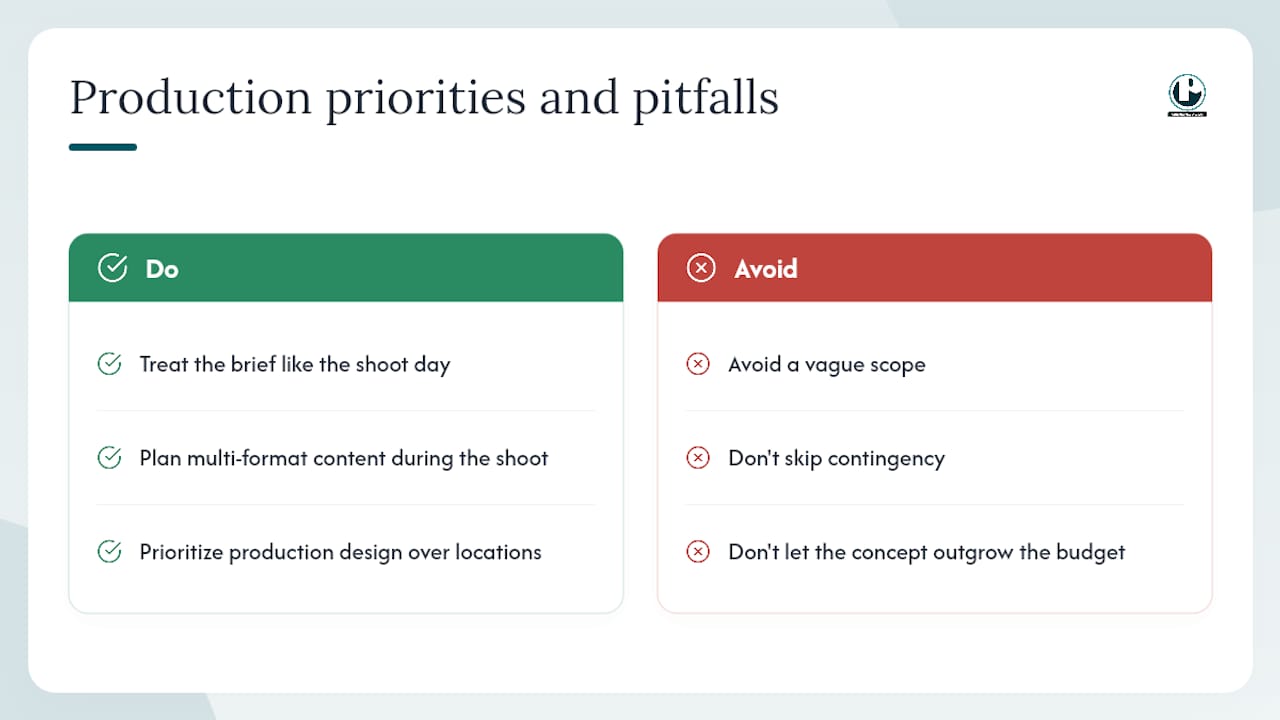
The artists who get the most from their production budget are the ones who treat the brief as seriously as the shoot day. In our experience at Puritano, the projects that go sideways almost always trace back to one of three things: a vague scope, no contingency, or a concept that outgrew the budget before pre-production finished.
Multi-format planning is the single highest-return decision you can make before the camera rolls. Capturing vertical content, behind-the-scenes footage, and short teasers during the main shoot costs almost nothing extra and gives you weeks of release content. We build this into every project brief because retrofitting it in post is expensive and the results are always inferior.
The other lesson: production design punches above its weight. A well-dressed single location with intentional lighting will outperform a poorly planned multi-location shoot every time. Creative ambition is not the same as a large location list. The artists who understand that distinction get more from every dollar they spend.
Our music video portfolio reflects these priorities: transparent line items, multi-format delivery, and a production approach that’s appropriately scoped to the artist’s campaign goals.
Puritano brings full-service music video production to artists nationwide
Puritano Media Group produces music videos for independent and signed artists nationally, with full-service capabilities that cover everything from director sourcing and pre-production planning to multi-format post-production delivery. Where a freelance crew hands you a single file, Puritano delivers a complete asset package: YouTube cut, vertical edit, Canvas loop, and social teasers, all planned from the brief and budgeted transparently by line item.
With over two decades of production experience, the team has built a music video portfolio that spans performance videos, narrative concepts, and campaign-level productions. If you’re planning a release and want a realistic budget scoped to your goals, request an estimate directly through the portfolio page.
Sources
Recommended
Comments