

What Is a Brand Video? Your Guide to Brand Identity
Updated: 3 days ago

Most people assume a brand video is just a polished ad or a corporate overview reel. That assumption leads to a lot of wasted production budgets and confused audiences. A brand video is something more specific and more powerful than either of those things. It’s a short, narrative-driven piece built around your company’s values, mission, and the emotional connection you want your audience to feel. Understanding what it truly is, how it differs from other video types, and how to create one that actually works is what this guide covers.
Table of Contents
Key Takeaways
Point | Details |
Brand videos communicate identity | They focus on values and emotional connection, not product features or direct sales. |
Story starts with the buyer | Effective brand videos open with the audience’s problem, not the company’s history. |
Consistency beats one-off quality | A series of stylistically consistent videos builds recognition faster than a single polished piece. |
Metrics differ from ad metrics | Measure brand recall, engagement depth, and awareness lift, not just clicks or conversions. |
Format variety serves different goals | Brand films, culture videos, and story videos each serve a distinct strategic purpose. |
What a brand video actually is
The industry term you’ll hear alongside “brand video” is branded content. These phrases overlap, but there’s a useful distinction. Branded content is the broader category covering any content your brand produces to communicate its identity. A brand video is the video-specific execution of that intent.
At its core, a brand video is a narrative-driven marketing tool designed to showcase a company’s values and identity rather than sell a specific product or service in the moment. Think of it as the video equivalent of a brand manifesto. The goal is awareness and emotional alignment, not an immediate transaction.
This is what separates brand videos from two types they’re frequently confused with:
Corporate videos are a broader category. They include internal training content, investor relations pieces, event recaps, and executive communications. Corporate video communicates about the company. Brand video communicates for the company’s identity.
Product videos demonstrate features and use cases. They answer “what does this do?” Brand videos answer “who are we and why does that matter to you?”
“The defining factor of a brand video is narrative intent. It’s about what your brand stands for and how you want to be perceived, not just what you do.” — Shopify
Brand videos can serve external marketing purposes, such as a website hero video or a social media awareness campaign. They can also serve internal ones, like onboarding new employees to the company culture. The format adapts. The intent stays the same.
What makes a brand video actually work
A brand video that resonates does several things simultaneously: it tells a story with emotional stakes, it reflects the visual identity of the brand, and it makes the viewer feel something before it asks them to do anything. That sounds straightforward. Executing it well is where most teams struggle.

The foundation is always the narrative. Brand story videos are structured around the buyer’s problem first and the company’s unique solution second. This is the opposite of what most companies naturally want to do. The instinct is to lead with the company’s history, awards, and team size. The viewer doesn’t care about any of that yet. They care about whether you understand their situation.
A reliable framework for structuring the narrative is to answer three questions in order: Who do you help? What problem do they have? Why are you the right solution? When the story answers those questions in that sequence, the video earns the viewer’s attention before it asks for their trust.
Beyond story structure, there are several elements that build fast recognizability through consistent use across all video assets:
Visual style: Color grading, framing choices, and typography that match the brand’s existing identity
Music and sound design: A consistent sonic signature that primes the audience emotionally before dialogue begins
Pacing and rhythm: The edit pace should reflect the brand’s personality. A financial services firm and a creative agency will have very different rhythms.
Tone of voice: Whether the video uses narration, on-camera talent, or no dialogue at all, the tone must feel coherent with every other brand communication
One creative technique that often surprises clients is the power of minimal dialogue storytelling. Some of the most effective brand videos say almost nothing out loud. They rely on strong visuals, music, and rhythm to carry meaning. This approach works across markets and languages. It also performs exceptionally well on social platforms where video autoplay runs without sound. The tradeoff: minimal dialogue requires careful control of typography, framing, and motion to maintain clarity. Without those elements locked down, the message gets lost.
Pro Tip: Build your brand video script around the buyer’s problem, not your company’s story. The moment a viewer sees their own challenge reflected on screen, they’re invested. Save the company history for the “About” page.
Types of brand videos and when to use them
Not every brand video serves the same function. Here’s how the main formats break down and where each fits strategically.
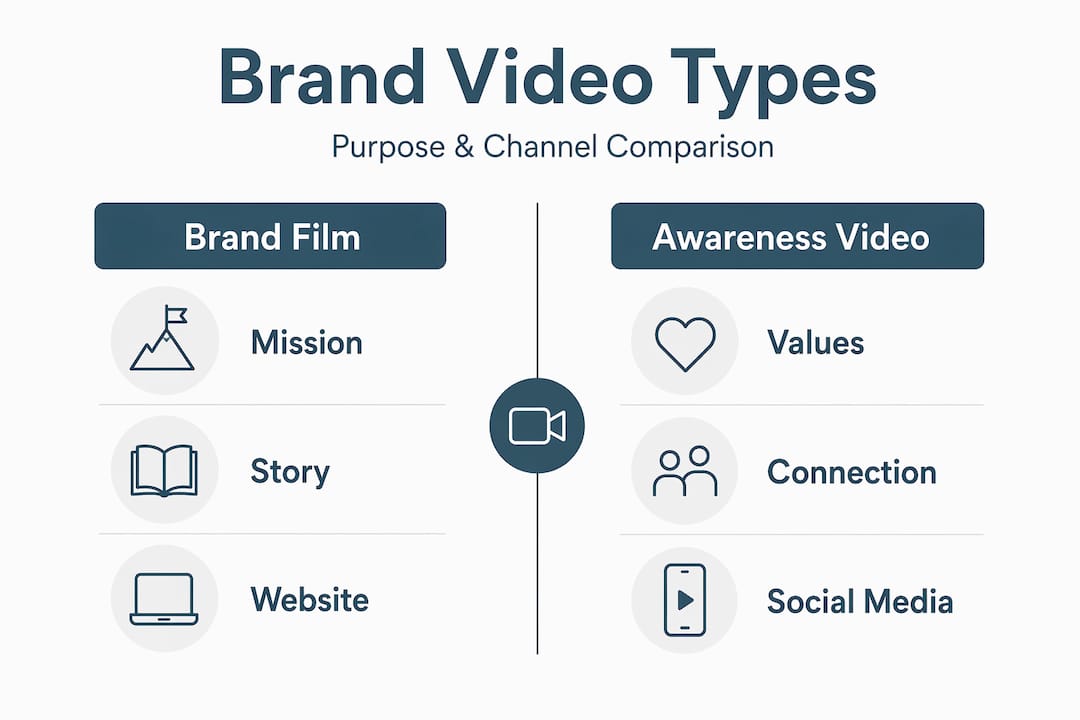
Format | Primary purpose | Best distribution channel |
Brand film | Introduce brand mission and story | Website hero, sales sequences |
Brand story video | Illustrate how the brand solves the buyer’s problem | Social media, email campaigns |
Culture video | Showcase internal values and team for recruitment and trust | Careers page, LinkedIn |
Brand awareness video | Broaden reach to new audiences unfamiliar with the brand | Paid social, pre-roll ads |
Silent or sound-optional video | Drive recognition in scroll-heavy social environments | Instagram, TikTok, Facebook |
The brand film is typically the starting point. It introduces the business’s mission and story at a high level. Think of it as the anchor piece that everything else refers back to. Once that exists, you can produce shorter, more targeted formats, such as a brand story video for a specific campaign or a culture video for recruiting.
Length matters, but not in the way most clients expect. A two-minute brand film is appropriate for a website hero or a sales sequence. A fifteen-second brand awareness video is appropriate for a pre-roll or a social ad. The mistake is producing one length and trying to use it everywhere. Different contexts require different pacing and different levels of message depth.
Distribution is where many brand videos underperform. The video goes live on the website, gets one social post, and then disappears. Effective distribution treats the brand video as the centerpiece of a campaign, not a one-time post. It lives on the website homepage, appears in email sequences, shows up in sales decks, and gets repurposed into shorter social cuts.
How to create a brand video strategically
The production process matters far less than the strategic groundwork. Here’s the sequence that leads to a brand video that actually serves your marketing goals.
Clarify your core message. Before a camera gets picked up, answer this: what is the single most important thing a new viewer should understand about your brand after watching? If you have five answers, you don’t have clarity yet.
Define the narrative around the audience’s problem. Revisit the framework from earlier. Open with the viewer’s world, not yours. The most effective branded videos under-emphasize direct selling and over-emphasize mission clarity and trust-building.
Establish visual and sonic guidelines. Your brand video should be immediately recognizable as yours. That means locking down the color palette, typography style, music genre, and edit pacing before production begins. These aren’t aesthetic preferences; they’re strategic decisions.
Plan for multiple assets from a single shoot. One production day can yield a two-minute brand film, a sixty-second version, a fifteen-second cut, and several social-specific clips. Planning for this in pre-production dramatically reduces the cost per asset.
Build your distribution plan before you produce. Where will this video live? What are the specs for each platform? How will it appear in email? A brand video without a distribution plan is a production expense without a marketing strategy.
Measure the right outcomes. Brand video success is not measured in clicks from day one. Track brand recall, video completion rates, and engagement depth. These are the indicators of whether emotional connection is being built.
Pro Tip: Don’t confuse your brand video with a branded video campaign. The brand video is the identity piece. The campaign uses that identity as fuel for specific marketing objectives. Keep the two roles distinct so neither one gets diluted.
Measuring what brand videos actually do
The reason many organizations undervalue brand videos is that they’re measured against the wrong benchmarks. A brand video is not a direct-response ad. Expecting it to generate immediate leads is like expecting a well-designed storefront to close a sale before anyone walks through the door.
Here’s a more honest framework for understanding what to track and what it signals:
Metric | What it measures | Why it matters |
Video completion rate | How many viewers watch to the end | Signals genuine engagement, not passive autoplay |
Brand recall lift | Whether viewers remember the brand after exposure | Core indicator of awareness-building effectiveness |
Social sharing rate | How often viewers share without prompting | Measures emotional resonance and organic reach |
Website dwell time | How long visitors stay after watching | Indicates whether the video deepens audience interest |
Return viewer rate | How many viewers come back for more content | Reflects developing brand relationship and trust |
Consistent use of visual style, music, colors, and tone across multiple videos compounds over time. Each exposure reinforces the last. A single brand video builds some awareness. A system of brand videos with coherent style builds recognition and trust that translates into long-term brand equity. That compounding effect is what makes video a cornerstone of any serious brand identity strategy.
The practical takeaway: give brand videos a longer measurement window than you would a paid ad campaign. Evaluate them at sixty and ninety days, not seven.
My honest take on where brand videos go wrong
I’ve seen a lot of organizations invest real money in brand video production and walk away with something that looks good and does very little. After two decades in this industry, I’ve traced most of those disappointments to a single root cause: the video was made for the company, not for the audience.
What I mean is this. The team gets excited about showing off the facilities, listing the services, and putting the executive team on camera. The result is technically polished and strategically inert. No one outside the company finds it compelling because it doesn’t address anything they actually care about.
The brand videos that I’ve seen create real impact always open with the viewer’s world. They put the audience’s problem front and center and make the viewer feel understood before they make any claim about the brand. Visual storytelling done this way is what separates a brand film that earns attention from one that asks for it.
My other strong opinion: stop treating brand video as a one-time project. One great video is useful. A suite of videos with consistent style and tone, released over time, is what actually builds brand recognition. Repeated exposure to consistent assets is more valuable than a single high-production piece every eighteen months. Plan for a body of work, not a hero moment.
And when it comes to minimal dialogue, I’m a proponent, but only when the visuals are strong enough to carry the weight. I’ve watched too many silent brand videos leave viewers genuinely confused about what the brand does. The “say less” approach only works when every frame earns its place.
— Charlie
Ready to create a brand video that actually builds your brand?
Understanding what a brand video is and what it should accomplish is the first step. The second step is finding a production partner who understands the difference between making a video and building a brand asset.
At Puritano, we’ve spent over two decades helping businesses, nonprofits, and agencies across the Washington D.C. area and nationally create video content that communicates what makes them worth paying attention to. From brand films and corporate video production to storytelling-driven branded content, we approach every project as a strategic communication challenge, not just a production job. You can explore our work, including our music video portfolio, to see how narrative and visual identity come together. When you’re ready to talk through your brand video goals, we’re here for that conversation.
FAQ
What is a brand video, and how does it differ from an ad?
A brand video is a narrative-driven piece focused on communicating a company’s values and identity rather than promoting a specific product or driving an immediate sale. An ad is designed to convert. A brand video is designed to connect.
What should a brand story video include?
A brand story video should open with the audience’s problem, present the brand as the solution, and answer who you help and why it matters. It should avoid leading with company history or product features.
How long should a brand video be?
Brand films typically run one to three minutes for website and sales use. Brand awareness videos for social platforms often run fifteen to sixty seconds. Length should match the distribution context, not a single standard.
What is video brand identity?
Video brand identity refers to the consistent use of visual style, color, typography, music, and tone across all video content so that audiences recognize your brand instantly, regardless of where they encounter it.
How do you measure the success of a brand video?
Track video completion rates, brand recall lift, social sharing, and website dwell time rather than direct conversions. Brand videos build equity over time, so evaluate results at sixty to ninety days rather than the first week.
Recommended
A brand video should show an organization being itself at its best, which is why we favor real work over staged symbolism. For Bechtel, we filmed the build of the Stonewall Energy Center in Loudoun County, Virginia, following the largest components on site and in transit while interviews with the project team carried the two-minute film. The piece documents a major energy build for the people who built it and the community around it. Nothing in it announces the brand. The work itself is the identity.


Comments