

Government Documentary Video Explained: A Clear Guide
Updated: Jul 25

What is a government documentary video?
A government documentary video is an educational film that explains government structures, policies, laws, and history in plain, accessible language. These videos exist to close the gap between how government actually works and what most citizens understand about it. They cover everything from the U.S. Constitution and the Electoral College to federal budgeting, taxation, and the three branches of government.
Think of them as civics class without the textbook. Whether produced by a federal agency, a public broadcaster, or an independent nonprofit, their core purpose is the same: translate complex public policy into stories that real people can follow and act on.
Explain institutions such as Congress, the Supreme Court, and the Executive Branch
Break down laws, amendments, and constitutional principles
Cover civic processes like elections, legislation, and judicial review
Address public policy topics including immigration, taxation, and federal debt
Serve as tools for classroom instruction and self-directed learning
Core themes you will find in U.S. government documentary videos
These films return to a consistent set of subjects because those subjects shape everyday American life. Constitutional principles anchor most series, with checks and balances, separation of powers, and federalism appearing across nearly every major production. Electoral processes, including the Electoral College’s origins and modern debates, get dedicated episodes because they directly affect how citizens participate in democracy.
Recurring themes include:
The three branches of government and how they interact
The Electoral College, from its 1787 founding through current reform debates
Federal budgeting, mandatory versus discretionary spending, and national debt
Taxation history and how the government raises and spends public money
Civil rights, constitutional amendments, and landmark Supreme Court cases
Civic engagement, voting rights, and democratic participation
Immigration policy and enforcement processes
How government documentaries actually educate viewers
The most effective government films lead with the human story, not the policy mechanics. Narrative arcs centered on relatable characters, whether constituents navigating a bureaucratic process or public servants explaining their work, improve comprehension and retention far better than purely factual presentations. Producers who apply Freytag’s Pyramid to dry policy content transform it into narratives with tension, stakes, and resolution, which keeps viewers watching and learning.
Research published in the Journal of Communication found that social-issue documentaries influence U.S. policy engagement most when audiences perceive them as emotional, factual, and nonpartisan. That combination is not accidental. It is a production choice. Avoiding the “data dump” by filtering content to core narrative relevance prevents viewer overload and sharpens impact.
Pro Tip: The most common mistake in government video production is explaining the “how” before the “why.” Lead with why a policy exists and who it affects, then walk through the mechanics. Viewers connect with purpose before process.
Key educational techniques these productions use:
Relatable characters to anchor abstract policy concepts
Call-to-action prompts at the end of each episode to encourage deeper exploration
Plain language that removes jargon and connects policy to lived experience
Modular episode formats that allow viewers to learn at their own pace
Notable U.S. government documentary series worth watching
Several series stand out for their depth, accessibility, and production quality.
The Constitution EXPLAINED (iCivics): A series of 35 short videos covering the text, history, and relevance of the U.S. Constitution, Bill of Rights, and amendments in everyday language. Each episode ends with a call-to-action question designed to push learners further.
Civics Made Easy (PBS): Ben Sheehan hosts this PBS series, with episodes like “What is the Electoral College?” and “Taxes, Spending & Debt,” running 12 minutes and exploring federal finances with clarity and candor.
Crash Course Government and Politics: A widely used YouTube series that covers the full scope of U.S. government, from constitutional foundations to political parties, in fast-paced, approachable episodes built for students and curious adults alike.
United States of Secrets (PBS Frontline): A two-part investigative documentary examining the NSA’s mass surveillance program, drawing on interviews with insiders and government officials to connect classified policy decisions to their public consequences.
The U.S. Immigration System: Explained (DHS): A government-produced video from the Department of Homeland Security explaining Title 8 enforcement processes directly to the public.
Why watching these videos matters for U.S. citizens
An informed citizen is a more effective one. Government documentary videos give you the context to understand why a law exists, not just that it does. That distinction changes how you vote, how you engage with local officials, and how you interpret news coverage of policy debates.
Benefits of engaging with these films:
Simplify complex legislative and regulatory processes into understandable narratives
Humanize policy by showing its real effects on real people
Encourage civic participation by making government feel accessible rather than distant
Legitimize public programs by documenting their intent and implementation
Build the foundational knowledge needed to hold elected officials accountable
The Griersonian documentary philosophy frames government films as tools for shaping citizens’ perceptions of their own agency. That framing holds up. When viewers understand how a system works, they are far more likely to engage with it.
How government documentary videos get made and funded
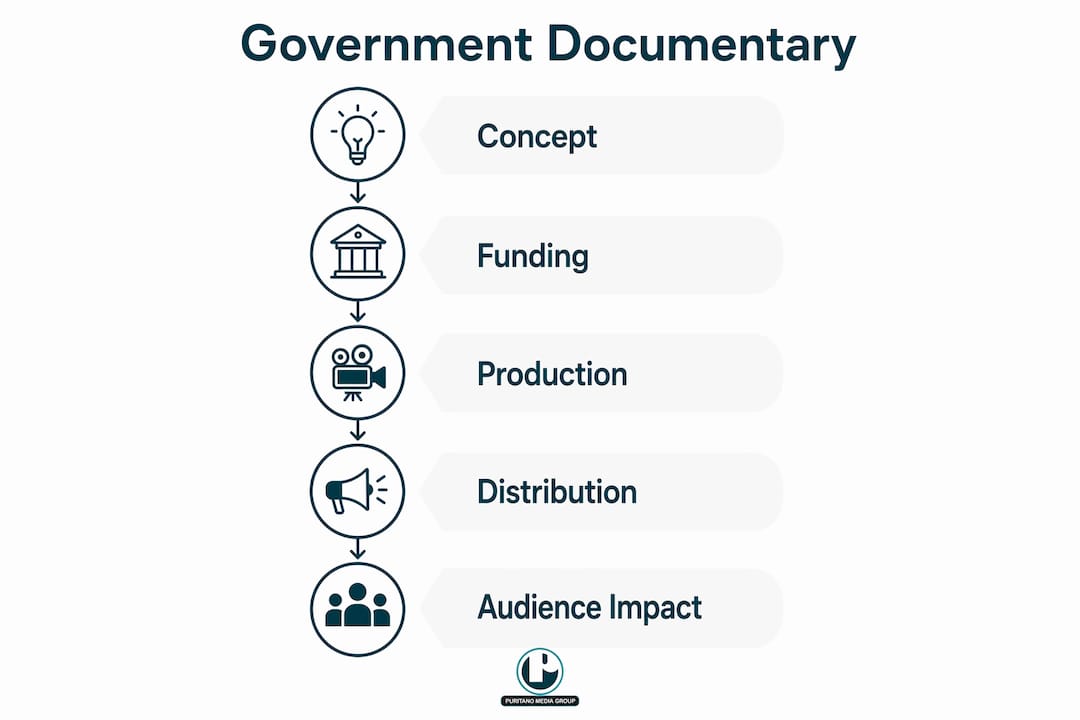
Production typically involves a combination of public funding, nonprofit grants, and broadcaster partnerships. PBS and its member stations fund series like Civics Made Easy and Frontline through a mix of federal appropriations, viewer donations, and foundation grants. Nonprofit education platforms like iCivics fund production through philanthropic support and partnerships with school districts.
Federal agencies produce their own videos in-house or through contracted production companies, drawing on agency communications budgets. Independent documentaries about government, like those distributed through PBS Frontline or the International Documentary Association’s network, often rely on ITVS funding, foundation grants, and festival distribution deals. Understanding government video production from a production standpoint reveals how much craft goes into making policy feel personal.
How audiences receive and respond to these films
Reception research consistently shows that documentaries perceived as credible and nonpartisan generate the strongest civic response. The Journal of Communication study on films like Sin by Silence and Semper Fi found that documentary’s dual character, creative expression combined with factual reporting, is precisely what makes it persuasive in policy contexts. These films function as what researchers call “situated knowledge,” connecting abstract legislation to human experience in ways that news coverage rarely achieves.
The rise of narrative-driven politics has also shaped how audiences engage with government content online, with documentary framing increasingly influencing how viewers interpret civic issues across platforms.
Government-produced vs. independent documentaries about government
These two categories serve different purposes and carry different assumptions. Government-produced videos, like the DHS immigration explainer, aim to inform the public about existing policy and present the government’s own framing of its programs. They prioritize clarity and official accuracy.
Independent documentaries about government, such as United States of Secrets or Barbara Kopple’s Harlan County, U.S.A., challenge the status quo, surface stories that official channels ignore, and often advocate for policy change. As filmmaker Julia Reichert put it, political documentaries “ask us to question the system” rather than accept it. The advocacy video format sits closer to the independent end of that spectrum, using emotional and factual storytelling to move audiences toward action.
Where to find government documentary videos
You do not need a cable subscription or a library card to access most of these films.
PBS.org and the PBS app: Free streaming for Civics Made Easy, Frontline, and P.O.V.
YouTube: Crash Course Government and Politics, iCivics explainers, and TVW’s Civics 101 series are all free
iCivics (ed.icivics.org): The Constitution EXPLAINED series, assignable for classroom use
DHS Media Library (dhs.gov): Official government explainer videos on immigration and homeland security
National Archives (archives.gov): Historical government films and footage dating back to the New Deal era
Internet Archive (archive.org): A vast catalog of public domain government films, including early 20th-century productions
Key Takeaways
Government documentary videos are most effective when they lead with human impact, present policy as nonpartisan and factual, and use narrative structure to make complex civic topics accessible to everyday viewers.
Puritano has spent over two decades producing government and educational videos from the Washington D.C. area. If your agency or organization needs video content that actually connects with audiences, explore Puritano’s video production work or get in touch to discuss your project.
Recommended
Comments