

What Is Advocacy Video Content: A Complete Guide

Advocacy video content is video media created specifically to promote a cause, social issue, or idea with the goal of raising awareness and driving change. Unlike commercial advertising, which promotes products or services, advocacy videos focus on environmental, political, or social objectives. The industry term for this practice is “advocacy communication,” and video has become its most powerful format. Creators, marketers, and educators who understand this distinction produce content that moves people to act, not just to buy.
What is advocacy video content, and how does it differ from ads?
Advocacy video content is a strategic communication tool that promotes causes rather than products. Its purpose is to influence public opinion, shift policy behavior, or inspire community action on issues that matter. That goal separates it entirely from brand advertising, where the bottom line is sales.
The advocacy video definition covers a wide range of content: a documentary about housing insecurity, a testimonial from a patient fighting for healthcare access, or a short social clip urging viewers to contact their representatives. Each piece serves a specific persuasive function. The format changes, but the intent stays the same: create a human connection that motivates a response.
What makes this format particularly powerful is its reach. Viewers retain 95% of a video message, compared to just 10% from text. That retention gap is enormous for anyone trying to move an audience from passive awareness to active engagement. When your message needs to stick, video is the format that delivers.
What types of advocacy videos get results?
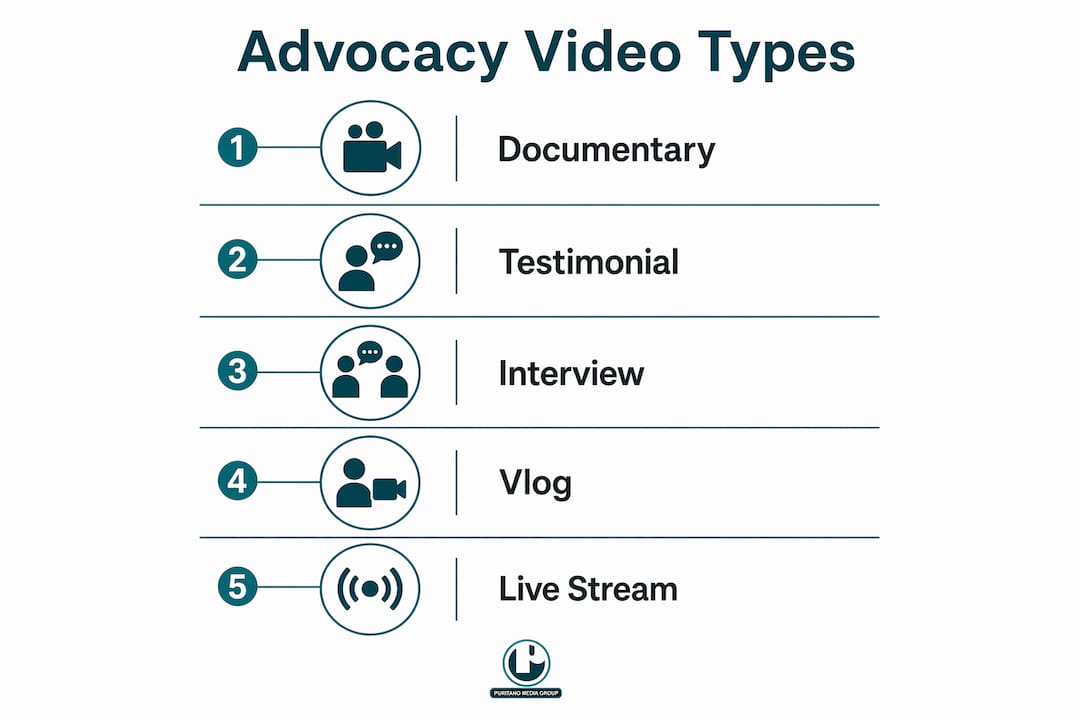
Advocacy videos employ formats including documentaries, testimonials, interviews, vlogs, and live streams. Format choice depends on the audience, the complexity of the message, and the platform where the video will live. A two-minute testimonial works well on social media. A 12-minute documentary fits a legislative briefing or a nonprofit gala.
Here is a breakdown of the most common types and how each one functions:
Video Type | Primary Purpose | Best Platform |
Testimonial video | Personal story to influence decision-makers | Email, legislative meetings |
Documentary-style | Deep-dive storytelling for complex issues | Website, events, YouTube |
Campaign announcement | Launch awareness for a specific initiative | Social media, paid media |
Educational video | Explain a policy or issue clearly | Websites, e-learning, webinars |
Live stream | Real-time community engagement | Facebook Live, YouTube Live |
Every effective advocacy video shares three core elements regardless of format:
Authentic storytelling. Real voices from real people affected by the issue carry more weight than scripted narration.
Emotional clarity. The viewer should feel the stakes within the first 30 seconds.
A clear call to action. Sign a petition, call a legislator, share the video. Ambiguity kills momentum.
Tone and length vary by goal. A video aimed at lawmakers needs precision and brevity. A video designed to go wide on social media needs an emotional hook in the first five seconds. Knowing your audience before you press record is not optional. It is the whole game.
How to create effective advocacy video content
Effective advocacy video production starts with a single, clear message. Before any camera rolls, the team needs to answer one question: what do we want the viewer to do after watching? That answer shapes every creative decision that follows.
Define the core message. Write it in one sentence. If you cannot summarize the ask in one sentence, the video will feel scattered.
Find the right story. Video testimonials featuring real impacted individuals are the most effective outreach for influencing decision-makers. Identify the person whose experience best illustrates the issue.
Script with authenticity in mind. A loose outline works better than a word-for-word script for testimonials. People speak more naturally when they are not reading.
Film with intention. Good lighting and clear audio matter more than expensive cameras. A shaky, poorly lit video loses credibility fast, even if the story is compelling.
Keep it short. For social media, aim for under two minutes. For legislative use, three to five minutes is the ceiling before attention drops.
Build a content intake process. Structured video testimonial portals with automated review and approval create a consistent content pipeline. This is how organizations sustain a campaign over months, not just a single launch.
Pro Tip: Record a B-roll of the environment, community, or issue alongside your interview footage. Cutaway shots add visual depth and keep viewers engaged during longer testimonials.
Authentic, raw storytelling often outperforms polished videos by building deeper trust and credibility. A mother speaking from her kitchen about her child’s medical bills is more persuasive than a slick corporate narrator. Production quality matters, but it should never come at the cost of genuine human connection. The goal is believability, not perfection.
For creators working with nonprofits or associations, branded video content strategies can help align advocacy messaging with organizational identity without sacrificing authenticity.
How do you distribute advocacy videos for maximum impact?
Creating a great video is only half the work. Distribution determines whether that video reaches the people who can act on it. The most effective advocacy campaigns treat distribution as a system, not an afterthought.
Social media channels (Facebook, Instagram, YouTube, LinkedIn) reach broad audiences and allow for targeted paid promotion to specific demographics or geographic areas.
Email campaigns deliver video directly to supporters, donors, and members who are already invested in the cause.
Organizational websites give videos a permanent home and support SEO visibility over time.
Legislative briefings and regulatory submissions put the video in front of the decision-makers who matter most.
Community events and town halls create shared viewing experiences that build collective momentum.
Embedding advocacy videos into legislative meetings or regulatory submissions increases impact compared to only posting on social media. Lawmakers who watch a constituent’s story in a briefing room respond differently than those who scroll past it on a feed. The context of delivery changes the emotional weight of the message.
Nonprofit video campaigns work best as ecosystems. A single campaign might include a hero documentary, a series of short social clips, a testimonial for email, and a version formatted for a legislative packet. Each piece serves a different audience and channel, but all of them reinforce the same core message.
Pro Tip: Repurpose one long-form video into three to five shorter clips for social media. This extends the life of your production budget and keeps your message visible across multiple touchpoints.
Paid media targeting is worth the investment when you need to reach specific decision-makers or geographic communities. Platforms like Facebook and YouTube allow you to target by zip code, interest, job title, and more. For advocacy work focused on a specific district or policy area, that precision is a real advantage. You can also learn more about short-form video strategies that work specifically for nonprofits navigating tight budgets and fast news cycles.
What impact does advocacy video content have on real change?
The evidence for video advocacy is strong. The retention advantage alone makes video the format of choice for any organization trying to move people from awareness to action. But the deeper value is emotional.
“Creating advocacy videos is itself a political act aimed at providing visibility to marginalized or ignored communities. Video activists use filming and sharing as a political act to amplify marginalized voices and contest mainstream narratives.”
That framing matters. When a community films its own story and shares it, the act of production is inseparable from the act of advocacy. The camera becomes a tool for claiming visibility. This is why viral moments in video often carry social weight far beyond their original context.
Congressional staff and policymakers prefer authentic documentary-style advocacy videos over corporate narration for persuasion. That preference reflects a broader truth: people trust people, not institutions. A video that puts a real face on a policy issue cuts through the noise that written briefs and data reports cannot.
Successful advocacy campaigns also think about longevity. Stories shared online have a second life through shares, embeds, and search. A video produced for a specific legislative session can continue building public awareness for years afterward. That extended reach multiplies the return on every dollar spent in production.
Short timelines, clear proof points, and strong emotional clarity are key to advocacy video impact. The videos that move lawmakers and donors share a common structure: they open with a human story, establish the stakes quickly, and close with a specific ask. That structure is not accidental. It is the result of understanding how people process emotion and make decisions under time pressure.
Key Takeaways
Advocacy video content succeeds when authentic storytelling, strategic format selection, and multi-channel distribution work together toward a single, clear call to action.
Point | Details |
Authenticity beats polish | Real voices from affected individuals outperform scripted, high-production narration. |
Format follows audience | Match video type (testimonial, documentary, short clip) to the platform and decision-maker. |
Distribution is a system | Use social media, email, websites, and legislative briefings together for full reach. |
Retention drives action | Viewers retain 95% of video messages, making video the strongest format for persuasion. |
Build a content pipeline | Structured intake and approval processes sustain campaigns beyond a single launch. |
What I’ve learned after years of advocacy video production
Here is the honest truth about advocacy video production: most organizations overthink the production and underthink the strategy. They spend weeks debating camera angles and color grading, then release the video with no distribution plan and wonder why it did not move the needle.
The videos that actually change minds are rarely the most expensive ones. The most powerful piece I have seen in years was filmed on a phone in a hospital waiting room. It was raw, it was real, and it made three legislators cry in a briefing. No amount of post-production polish would have made it more persuasive.
What I tell every client is this: your story is the asset. The camera is just the delivery mechanism. Invest your energy in finding the right voice, crafting the right ask, and getting the video in front of the right people. The technical side matters, but it is a supporting role, not the lead.
The other thing I push hard on is pipeline thinking. One great video is a moment. A library of 12 videos, each serving a different channel and audience, is a campaign. Organizations that build a sustainable content intake process, with clear submission guidelines, review workflows, and approval steps, consistently outperform those that treat each video as a one-off project. That discipline is what separates advocacy programs that grow from those that stall.
Puritano’s approach to advocacy video production
Puritano has spent over two decades producing video content for nonprofits, associations, and cause-driven organizations across the Washington D.C. area and nationally. That experience covers everything from video strategies for nonprofits to full campaign production with multi-channel distribution planning. The team understands that advocacy work demands both creative skill and strategic clarity. If you are building a campaign that needs to move lawmakers, donors, or communities, Puritano brings the production experience and the storytelling instincts to make it count. Browse Puritano’s video portfolio to see the range of work, or reach out directly to talk through your project goals.
FAQ
What is the advocacy video definition in simple terms?
Advocacy video content is video media created to promote a cause, social issue, or idea rather than a product. Its goal is to raise awareness, influence public opinion, or inspire a specific action.
Why are testimonial videos so effective for advocacy?
Legislative staff find personal stories from real, affected individuals more persuasive than data-heavy written presentations. Authentic voices create emotional connection that statistics alone cannot achieve.
How long should an advocacy video be?
For social media, under two minutes works best. For legislative briefings or regulatory submissions, three to five minutes is the practical ceiling before audience attention drops.
Do advocacy videos need high production value?
No. Authentic, raw storytelling consistently builds more trust and credibility than polished corporate production. Clear audio and good lighting matter, but genuine human connection matters more.
What platforms work best for distributing advocacy videos?
Social media, email campaigns, organizational websites, and legislative briefings each serve different audiences. The most effective campaigns use all of these channels together as a coordinated distribution system.
Recommended
Comments