

What is branded video content: A marketing manager's guide
Updated: 3 days ago

Most marketing managers have seen the term “branded video content” used interchangeably with video ads, explainer videos, and social media clips. That confusion is understandable, but it costs you. Branded video content is a fundamentally different animal. It does not interrupt viewers or push a product. It earns attention by telling a story worth watching. If you are working to build stronger brand visibility and engagement in the Washington D.C. market, understanding the real definition of branded video content and how to apply it is one of the most valuable things you can do right now.
Table of Contents
How branded video content differs from ads and content marketing
Crafting effective branded video content: strategy and best practices
Measuring success and applying branded video content in your marketing
Why conventional advertising falls short and branded video wins
Explore branded video production services with Puritano Media Group
Key Takeaways
Point | Details |
Earn attention first | Branded video content prioritizes audience value and storytelling to earn viewer attention before brand persuasion. |
Distinct from ads | It differs from traditional advertising by avoiding direct sales pitches and focusing on building trust and affinity. |
Long-lasting formats | Branded videos often take the form of documentaries, short films, and social series designed for lasting brand recognition. |
Strategic creation | Effective branded videos integrate the brand subtly and align closely with audience interests and brand values. |
Measure engagement | Success is tracked through brand affinity and engagement metrics rather than immediate conversions. |
Defining branded video content and why it matters
At its core, the definition of branded video comes down to one idea: audience first, brand second. Branded video content is video media produced to express a brand’s values, personality, and story, without pitching a product or pushing for an immediate sale. The brand is present, but it plays a supporting role rather than the lead.
This is what separates it from most video marketing you have probably created before. A branded content definition makes clear that branded content “earns attention” because it is genuinely useful or interesting first, and only then does it persuade. That sequence matters enormously.
Think about what this means in practice. When a government agency produces a documentary about the people its programs serve, or a D.C.-based nonprofit creates a short film about community impact, those are not ads. They are stories that happen to be attached to a brand. Viewers choose to watch them, share them, and remember them.
Here is what this type of content typically looks like in execution:
Values-driven storytelling: The video communicates what the organization stands for, not what it sells
Non-interruptive format: Viewers seek it out or choose to keep watching rather than skipping or scrolling past
Education or entertainment as the vehicle: The audience gets something genuinely useful or moving in exchange for their attention
Soft brand presence: Logos, messaging, and brand identity appear naturally, not as a hard sell
Long-term relationship building: The goal is affinity over time, not a click today
When you approach video this way, you stop competing for attention by force and start earning it by merit.
How branded video content differs from ads and content marketing
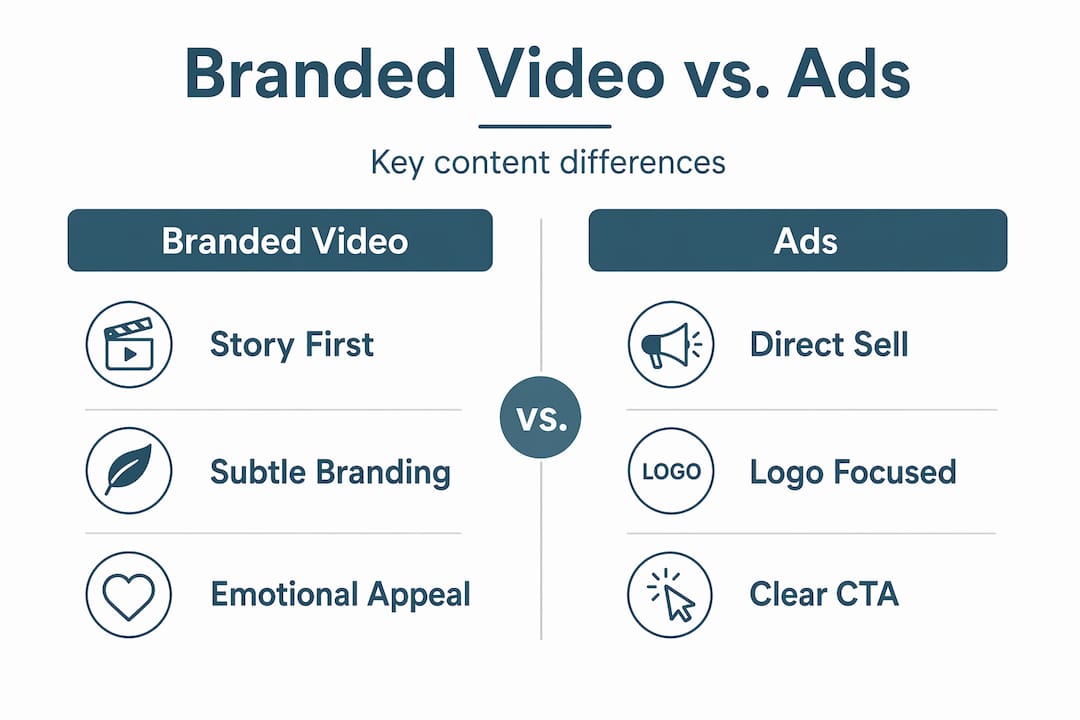
Understanding what branded video is not helps sharpen your strategy considerably. Three categories often get confused: traditional advertising, content marketing, and branded video. They serve different purposes and should never be used interchangeably.
Traditional ads are built around a call to action. They want you to click, call, or buy now. Content marketing is about pipeline: blog posts, whitepapers, and SEO-driven videos that capture leads and move people through a funnel. Branded video content is different from both. As research shows, branded content builds affinity and trust while content marketing focuses on conversion. That is not a small distinction. It is the entire strategic difference.

Here is a direct comparison to keep in front of you:
Format | Primary goal | Brand prominence | Call to action | Success metric |
Traditional ad | Drive immediate sales | High, central | Direct (“Buy now”) | Conversions, clicks |
Content marketing | Generate leads and pipeline | Moderate | Indirect (“Learn more”) | Traffic, leads |
Branded video content | Build long-term affinity | Subtle, supporting | None or very soft | Engagement, brand recall |
A few practical rules that separate branded video from the other two:
No “buy now” language. The moment you add a hard sell, it stops being branded content and becomes an ad.
No product feature rundowns. A branded video is not a demo or an explainer. Features live in other formats.
Brand identity shows through values and tone, not through repeated logo placements.
The story must stand on its own. If the video only makes sense because of the brand, it is probably an ad.
This matters strategically for marketing managers because you need all three approaches in your mix. They are not competing. They serve different stages of the relationship you are building with your audience. See how we compare branded video and ads in more depth if you want a fuller picture of where each belongs.
Popular formats and examples of branded video content
Once you understand the definition, the natural next question is: what does this actually look like? The good news is that branded video content comes in a wide variety of formats, and most of them are well within reach for D.C.-based organizations of all sizes.
As branded films trend data confirms, branded video content is increasingly delivered as longer brand films or short-form storytelling formats, with the shared goal of lasting brand affinity. Both ends of the length spectrum work, depending on your platform and audience.
Common types of branded content videos include:
Mini-documentaries: A 5 to 15-minute film about the people, mission, or impact behind your organization. These work especially well for nonprofits, associations, and government agencies.
Web series: Episodic short videos built around a recurring theme relevant to your audience, not your product.
Brand films: Longer, cinematic storytelling pieces that invest deeply in emotional connection.
Social media shorts: 30 to 90-second stories that deliver a single emotional or informational punch, optimized for platforms like Instagram or LinkedIn.
Behind-the-scenes content: Authentic, unpolished glimpses into your culture, people, or process.
Interview-driven videos: Conversations with real people tied to your brand’s world, where the subject’s story carries the content.
Consider how this plays out in the real world. A D.C. trade association might produce a short documentary series on the professionals in their industry. A federal contractor could develop a brand film showing the human impact of their work. Neither piece asks anyone to buy anything. Both leave a lasting impression.
Here is a practical sequence for building out your formats:
Start with one longer anchor piece (a mini-doc or brand film) that defines your brand story at depth
Repurpose that anchor into shorter social clips for each major platform
Build episodic content around themes your audience genuinely cares about
Layer in behind-the-scenes or interview content to maintain a steady publishing cadence
Pro Tip: You do not need a huge budget to produce genuine branded video content. A well-produced 3-minute brand story filmed in one location will outperform an expensive but overly polished ad every time. Authenticity carries more weight than production excess. Check out branded video examples and trends to see what is working right now.
Crafting effective branded video content: strategy and best practices
Knowing what branded video content is gets you halfway there. Knowing how to create branded videos that actually work gets you the rest of the way. Here is what we have learned over two decades of production work.
The clearest mental model is this: branded video earns attention by being viewer-relevant rather than interruptive, integrating the brand subtly rather than loudly. That means your audience’s interests have to come first in the writing room, not your marketing goals.
Follow this process:
Define your audience’s emotional need. Are they looking to feel understood? Inspired? Informed? Your story serves that need first.
Identify the human story at the center. Real people, real situations, real stakes. The brand exists in the background, not the foreground.
Write a natural brand integration. Ask yourself: if we removed the logo, would this still be a compelling video? If yes, you are on track.
Align tone and visuals with your brand identity. The look, feel, and voice of the video should be consistent with your brand, even when the story itself is not explicitly about you.
Plan for reuse from day one. A 10-minute brand film should yield a 90-second social cut, a 30-second highlight, and a series of still frames. Budget and plan for all of it upfront.
Distribute with intent. Organic reach, paid amplification, email, and owned channels all play a role. Put the video where your audience already spends time.
For branded video creation tips that go deeper on pre-production planning and scripting, we cover that in detail on our site.
Pro Tip: Before you lock your final cut, test it with a small audience outside your marketing team. Ask one question: “What do you remember most?” If the answer is a product feature or a brand name, recut. If the answer is a feeling or a story moment, you have got something real.
Measuring success and applying branded video content in your marketing
One of the biggest hesitations marketing managers have about branded video content is measurement. You are used to tracking clicks, leads, and conversions. Branded video operates on a different timeline and uses different signals, but it is absolutely measurable.
Quality branded video content has staying power across platforms and can be reused across multiple campaigns without losing relevance. That longevity is itself a form of ROI that traditional ad spend cannot replicate.
Key metrics to track:
Watch time and completion rate: Are people watching through to the end? High completion signals genuine engagement.
Shares and saves: These are the strongest indicators that your content resonated emotionally. People share what reflects their values.
Comments and direct feedback: Qualitative signals often reveal more than numbers about whether your story landed.
Brand recall and sentiment lift: Periodic audience surveys can measure whether your brand affinity is actually growing over time.
Organic reach growth: Branded content that earns shares extends your reach without additional spend.
Here is a practical framework for tracking impact across your content calendar:
Metric | What it tells you | Measurement tool |
Watch time (%) | Story engagement depth | YouTube Analytics, Vimeo |
Shares per post | Emotional resonance | Platform native analytics |
Comment sentiment | Audience alignment with brand values | Manual review or social tools |
Brand recall lift | Long-term affinity growth | Audience surveys |
Return views | Content staying power | Platform analytics |
For a fuller look at measuring branded video impact and tying it to your broader brand strategy, we go deeper on that topic separately.
Why conventional advertising falls short and branded video wins
Here is my honest take after more than two decades in video production: traditional advertising is not broken, but it is increasingly a poor fit for building the kind of brand loyalty that sustains organizations over the long term.
Ads interrupt. That is their design. And audiences have gotten very good at skipping, blocking, and mentally tuning out anything that feels like an intrusion. The D.C. market is especially sophisticated. Government contractors, associations, nonprofits, and federal agencies all compete for the attention of audiences who are highly educated, deeply skeptical of marketing language, and resistant to hard sells.
Branded video content works because it removes the adversarial dynamic. You are not fighting for attention. You are offering something worth the viewer’s time. Genuine human stories will always find an audience. And here is the test we always apply: if removing the logo makes the video unwatchable, it is just a long ad.
The best branded videos we have produced put the brand in the background and a human story in the foreground. The brand becomes associated with the feeling the story creates. That association is far more durable than any impression bought through paid placement. We wrote more about this shift in thinking in our piece on why branded video is underused as a marketing asset.
The organizations winning in this space right now are the ones treating branded video as a long game. Not a campaign. A commitment.
Explore branded video production services with Puritano Media Group
If this article has clarified what branded video content can do for your organization, the natural next step is finding a production partner who understands both the craft and the strategy behind it.
At Puritano Media Group, we have spent over 20 years helping businesses, nonprofits, associations, and government-related organizations in the Washington D.C. area and beyond produce video content that tells real stories and builds lasting brand relationships. From full-service video production and corporate storytelling to music video production and virtual event coverage, we bring creative vision and production discipline to every project. We work closely with marketing managers to make sure the story we tell on screen aligns with the brand you are building off it. If you are ready to put branded video to work, we are ready to help you do it right.
Frequently asked questions
What exactly is branded video content?
Branded video content is video media created to promote a brand’s values and identity through storytelling, without direct product selling or hard sales pitches. As research confirms, branded content promotes a brand’s values rather than specific products by focusing on storytelling.
How does branded video content differ from traditional advertising?
Unlike traditional ads that push sales with direct calls to action, branded video content builds trust and affinity by entertaining or informing audiences while subtly integrating the brand. Branded content earns attention by being useful or interesting, not by interrupting viewers with hard sells.
What types of branded videos are most effective?
Effective branded videos include documentaries, short films, social series, and behind-the-scenes content that focus on emotional storytelling and brand relevance rather than product features. Branded video storytelling in both long-form and short-form formats consistently drives lasting brand affinity.
Can branded video content be reused across marketing channels?
Yes, quality branded videos have long-term value and can be repurposed into multiple formats like social clips, email campaigns, and website content to maximize reach and engagement. Branded videos have staying power and can be trimmed into multiple formats for different channels.
What is the best way to measure success for branded video content?
Measure success by tracking brand affinity, engagement like shares and comments, watch time, and long-term audience growth rather than immediate sales conversions. Branded video content aims for lasting brand impressions and affinity over immediate conversion.
Recommended
Documentary is the format we trust most when a brand needs to earn attention instead of buying it. Charlie Puritano produced Smile for the Dead, a PBS documentary built entirely from real people and real stakes, and it went on to collect 42 festival wins. Nothing in it interrupts the viewer or asks for anything. Audiences stay because the story respects them, and the organization behind the film borrows that credibility every time the work is shown. That is branded content at its most durable, a film people choose to watch that happens to carry your name.


Comments