

Why Agencies Invest in Video Content: 2026 Guide

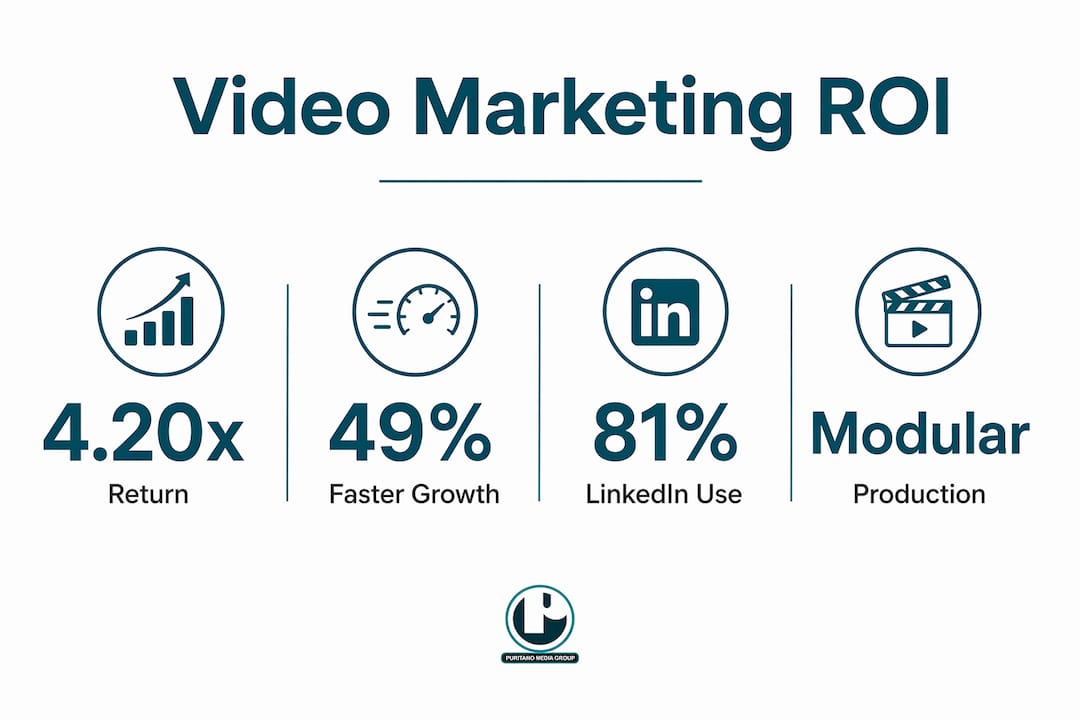
Video content is the highest-returning media format agencies use to grow client revenue, with video marketing delivering an average ROI of $4.20 per $1 spent and 49% faster revenue growth for users over non-users. That number alone explains why agencies invest in video content at a scale no other format can match. But the real story goes deeper than ROI. Platforms like LinkedIn and YouTube are reshaping how audiences consume information, and agencies that understand this shift are building content systems that compound in value over time. This guide breaks down the business outcomes, workflow realities, platform priorities, and production models driving agency video investment in 2026.
What business outcomes drive agencies to invest in video content?
Video content produces measurable results at every stage of the sales funnel. That is the core reason agencies keep allocating budget to it, even as production costs and platform complexity increase.
The ROI case is well established. Video marketing returns $4.20 for every $1 spent, and agencies using video see revenue grow 49% faster than those that do not. Those are not projections. They are observed outcomes from agencies that have made video a central part of their client service model.
Video also accelerates purchase decisions. Buyers who watch a product or service video are significantly more likely to convert than those who only read text. This is because video combines visual demonstration, tone of voice, and storytelling in a way that written copy cannot replicate. For agencies managing clients in competitive categories, that conversion lift is the difference between a campaign that breaks even and one that generates real returns.
The benefits of video marketing extend across the full customer journey:
Top of funnel: Short-form video on social platforms builds brand awareness faster than static ads.
Mid-funnel: Explainer videos and case study content reduce buyer hesitation and answer objections.
Bottom of funnel: Testimonial videos and product demos push undecided prospects toward a decision.
Post-sale: Onboarding and training videos reduce churn and increase customer lifetime value.
Agencies that structure video production around these funnel stages give clients a content system, not just a deliverable. That shift from one-off projects to ongoing content strategy is what drives long-term retainer relationships.
Pro Tip: When pitching video to a client, map each proposed video format to a specific funnel stage and a measurable KPI. Clients approve budgets faster when they see a direct line between content and outcomes.
How have agency roles and workflows evolved with video production?
Agencies are no longer just production houses. Video production is now integrated into company operating models, and agencies have evolved into strategic partners managing complex, high-volume workflows that in-house teams cannot sustain alone. That evolution brings real operational challenges.
The feedback loop is one of the biggest hidden costs in agency video work. Inefficient review processes average 85 review cycles per campaign and consume over 6 hours weekly in coordination time. That is not a minor inconvenience. It is a direct hit to profitability on every project.
Here is how agencies are restructuring their workflows to stay profitable:
Centralize feedback in one platform. Tools like Frame.io and Wipster replace email chains with structured, time-coded comments. This cuts revision cycles and keeps projects moving.
Set revision limits in contracts. Agencies that cap revisions at two or three rounds per deliverable protect their margins without sacrificing quality.
Build pre-production alignment sessions into every project. A 60-minute brief review before production begins eliminates the majority of late-stage change requests.
Separate creative direction from production execution. Assigning a dedicated strategist to manage client communication frees the production team to focus on output quality.
Use templated production workflows. Standardized shot lists, briefing documents, and post-production checklists reduce setup time on repeat project types.
Clients producing content in-house are raising the bar for what they expect from agency partners. When a client’s internal team can produce a decent social video, they need the agency to deliver something they cannot do themselves: strategic direction, production quality, and distribution thinking. Agencies that position themselves this way command higher fees and longer contracts.
Pro Tip: Build a production workflow document for each client at the start of an engagement. It sets expectations, reduces back-and-forth, and signals that you operate at a professional level.
What video content formats and platforms are agencies prioritizing?
Platform selection is now a strategic decision, not a default. Agencies that spread budgets across every channel without a clear rationale waste resources and dilute results.
LinkedIn has become the platform agencies cannot ignore for B2B clients. LinkedIn video usage among marketers jumped from 61% to 81% year-over-year. That growth reflects a fundamental shift in how professionals consume content and how brands build authority in their categories.
LinkedIn vs. YouTube Shorts: where agencies are focusing
The most important insight about platform algorithms in 2026 is this: algorithms prioritize engagement signals over high production value. A well-framed, genuinely useful video shot on a good phone camera will outperform a polished brand film that fails to hold attention past the five-second mark.
Agencies that understand this are shifting their content mix accordingly:
Educational content that teaches something specific performs better than promotional content on LinkedIn and YouTube.
Authentic formats like talking-head videos and behind-the-scenes footage generate stronger engagement than scripted, high-gloss productions.
Subtitles and captions are non-negotiable. Most video is watched without sound, especially on mobile and LinkedIn.
Shorter runtimes win on most platforms. Under 90 seconds for social, under 10 minutes for YouTube educational content.
Educational video on LinkedIn also shapes how AI systems interpret and describe a brand. When a company consistently publishes clear, authoritative video content in its category, AI-driven search tools begin associating that brand with expertise. That is a second-order benefit most agencies have not fully factored into their content recommendations yet.
Why is modular, always-on video content key for agency growth?
The agencies growing fastest in video are not producing more videos. They are producing smarter. The shift is from one-off campaign production to modular content systems that generate multiple assets from a single shoot.
Short-form video enables agencies to build modular, evergreen content ecosystems that support recurring retainers and expanded service lines. A single interview shoot, for example, can yield a LinkedIn video, three YouTube Shorts, a podcast clip, and a social media carousel. That is five deliverables from one production day.
This model benefits agencies in three concrete ways:
Higher margins per shoot. More deliverables per production day means better revenue per hour of crew time.
Stronger client retention. Clients on always-on content retainers stay longer than those who engage project by project.
Clearer service expansion paths. Once a client is on a video retainer, adding distribution strategy, paid amplification, or analytics reporting is a natural next step.
Agencies that systematize short-form video production create new revenue models and improve both client retention and paid creative efficiency. The key word is systematize. Ad hoc production, even high-quality production, does not scale. A repeatable framework does.
The balance agencies must maintain is between volume, quality, and strategic direction. Publishing more content is only valuable if each piece serves a defined audience goal. Agencies that help clients answer the question “why does this video exist?” before production begins are the ones delivering the strongest video content ROI for their clients.
Pro Tip: Pitch modular video production as a retainer service, not a project. Show clients a content calendar with 12 months of planned assets derived from four quarterly shoots. It reframes video from a cost to a content infrastructure investment.
Key takeaways
Agencies invest in video content because it delivers the highest measurable ROI of any media format, and the agencies building modular, platform-specific content systems are the ones growing fastest.
What I’ve learned about video investment after two decades in production
Here is the honest truth about agency video investment: most agencies are still thinking about it wrong. They treat video as a deliverable when it is actually a system. The agencies I have seen struggle are the ones that produce a great video, hand it off, and move on. The agencies that thrive are the ones that ask what happens to that video after delivery.
The workflow question is where I see the most money left on the table. Eighty-five review cycles per campaign is not a client problem. It is a process problem. Agencies that have not built structured pre-production alignment into their contracts are paying for that gap in overtime, revisions, and lost client trust. Fix the process first. The creative quality follows.
On platform strategy, the counterintuitive insight I keep coming back to is this: the best-performing videos I have seen in the past two years were not the most expensive ones. They were the most specific ones. A 90-second LinkedIn video where a subject-matter expert answers one question clearly, with good audio and decent framing, will outperform a $50,000 brand film that tries to say everything to everyone. Specificity is the production value that actually matters now.
For agencies advising clients on where to focus, I recommend starting with one platform and one format. Do it well. Measure it. Then expand. Overextending across TikTok, Instagram, LinkedIn, and YouTube simultaneously without the budget or team to do each one properly is a fast way to produce mediocre content everywhere. Clarity on branded video strategy beats volume every time.
How Puritano supports agencies with production that performs
Puritano Media Group works with marketing professionals and agency teams across the Washington D.C. area and nationally, providing production capacity and creative direction that in-house teams cannot always sustain. With over two decades of experience across corporate video, branded content, and live event coverage, Puritano functions as a production partner that understands agency workflows and client expectations. For agencies looking to expand their video service offerings, Puritano’s music video portfolio and virtual event production capabilities offer a strong starting point for reviewing the quality and range of work available. Reach out to discuss how Puritano can support your next client campaign or ongoing content program.
FAQ
What is the average ROI of video marketing for agencies?
Video marketing delivers an average ROI of $4.20 per $1 spent, with agencies using video seeing 49% faster revenue growth than those that do not.
Why do agencies prioritize LinkedIn for video content?
LinkedIn video usage among marketers grew from 61% to 81% year-over-year, making it the leading platform for B2B brand authority and reaching professional decision-makers.
How does modular video production benefit agency profitability?
Modular production turns a single shoot into multiple platform-specific assets, increasing deliverables per production day and supporting recurring retainer revenue models.
Does production quality determine video performance on social platforms?
Platform algorithms prioritize engagement signals over production value. Authentic, specific, and relevant videos consistently outperform high-budget productions that lack direct audience value.
How can agencies reduce the cost of video feedback loops?
Centralizing feedback in structured review tools like Frame.io, capping revision rounds in contracts, and running pre-production alignment sessions before shooting are the most effective ways to cut the average 85 review cycles per campaign.
Recommended
Comments