

Maximize ROI on Corporate Video Campaigns in 2026

Maximizing ROI from corporate video campaigns is defined as generating measurable business outcomes, such as qualified leads, sales conversions, and reduced onboarding costs, relative to total production and media spend. Most corporate video programs underperform not because the videos are bad, but because they lack clear goals, proper attribution, and a system for continuous improvement. The good news is that AI-powered optimization tools, smarter production planning, and the Media Efficiency Ratio (MER) give marketing managers and executives a concrete framework to boost corporate video investment and turn video from a cost center into a revenue driver.
How to maximize ROI on corporate video campaigns with clear goals
The single biggest reason corporate videos fail to deliver ROI is the absence of measurable business objectives tied to the production. A video brief that says “increase brand awareness” without an associated KPI is not a strategy. It is a wish.
Start by connecting every video project to a specific business outcome. The three most common and trackable outcomes are:
Lead generation: Number of qualified leads attributed to video views or clicks
Sales acceleration: Reduction in sales cycle length when prospects watch a product demo or testimonial video
Onboarding efficiency: Completion rates and time-to-productivity for employee or customer onboarding videos
Once you have a business outcome, build your KPIs around it. A lead generation video should track form submissions, not just view counts. A product demo should track click-through rates to a pricing page. Watch time matters too, but only as a supporting signal, not the headline metric.
The SMART framework applies directly here. Goals should be Specific (generate 50 qualified leads per month), Measurable (tracked via Google Analytics or HubSpot), Achievable (based on current traffic and conversion benchmarks), Relevant (tied to a sales or marketing objective), and Time-bound (within a 90-day campaign window).
Pro Tip: If your video brief does not include a KPI and a measurement tool, stop production and define them first. Every creative decision, from script to distribution channel, should flow from that goal.
What AI tools actually do to optimize video campaign performance
AI-driven optimization is the most significant shift in video marketing ROI strategy over the past three years. The core concept is creative velocity: generating and testing multiple video variants rapidly, then reallocating budget toward the best performers in real time.
Here is how a structured AI optimization workflow operates:
Creative variant generation: AI tools produce multiple versions of a video ad, varying the hook, call to action, or visual format. This replaces the old model of producing one polished video and hoping it works.
Rapid A/B testing: Variants run simultaneously across audience segments. Performance data accumulates within days, not weeks.
Automated bidding: Platform AI adjusts bids in real time based on marginal performance signals, reducing wasted spend.
Portfolio budget reallocation: AI shifts budget dynamically from underperforming creatives to top performers. Companies using AI portfolio budget management improve ROI by 25–35% over manual methods. That gap reflects how much money manual campaigns leave on the table.
Fatigue detection: AI flags when a creative is losing engagement, triggering a refresh cycle.
The platforms you already use have these capabilities built in. Native AI tools like Meta Advantage+, Google Video Action campaigns, and TikTok Smart Performance campaigns deliver 20–30% better return on ad spend (ROAS) with minimal setup. That is a meaningful lift available to any team running paid video today.
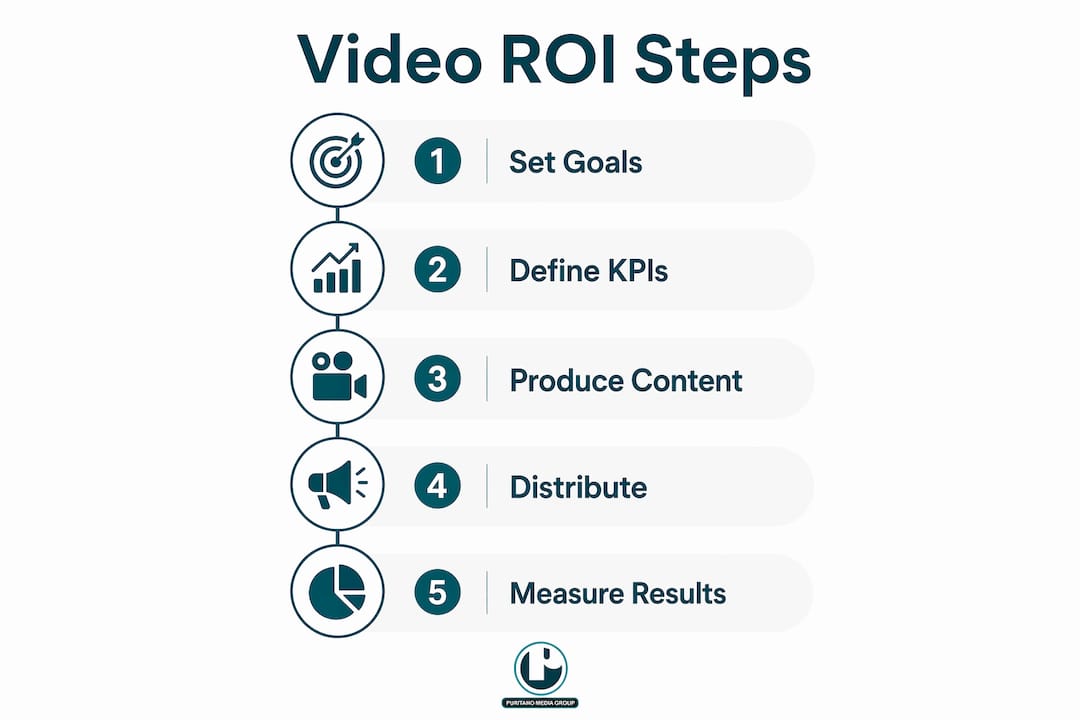
Pro Tip: Start with the native AI features inside Meta, Google, and TikTok before adding third-party platforms. They have the most data and the lowest barrier to entry. Add specialized tools only when you have exhausted what the native systems offer.
How to produce video content that works across multiple channels
The most cost-efficient corporate video programs treat every shoot as a content library, not a single deliverable. Repurposing video content across platforms and funnel stages significantly amplifies reach and cost-efficiency. The key is planning for repurposing before the camera rolls.
Here is what that looks like in practice:
Shoot in multiple aspect ratios. Capture 16:9 for YouTube and website, 9:16 for Instagram Reels and TikTok, and 1:1 for LinkedIn and Facebook feeds. One shoot, four formats.
Record extended interviews. A 60-second testimonial ad can come from a 10-minute interview. The full interview becomes a long-form YouTube video. Clips become social posts. Quotes become graphics.
Plan for multiple audiences. A product launch video can be edited into a sales enablement clip, a customer FAQ video, and a trade show loop. Each serves a different purpose without additional production cost.
Build modular scripts. Structure scripts so individual sections can stand alone. An onboarding video can be broken into five short modules for an LMS platform.
Production quality directly affects engagement and, by extension, ROI. Poor audio is the number one reason viewers abandon corporate videos. Professional sound design, proper lighting, and clean editing signal credibility to your audience. These are not luxuries. They are the baseline for a video that performs.
For a detailed look at how to plan your budget around these decisions, the corporate video budget breakdown guide at Puritano covers the real numbers behind smart production investment.
Which distribution strategies connect video to your sales funnel?
Distribution is where most corporate video strategies fall apart. Producing a great video and posting it once on LinkedIn is not a campaign. A real distribution strategy maps each video type to a specific funnel stage and deploys it through the right channels.
Top of funnel (awareness): Educational videos, thought leadership content, and brand story videos. Deploy on YouTube, LinkedIn, and paid social. Optimize for watch time and reach.
Middle of funnel (consideration): Product demos, case studies, and expert interviews. Use in email sequences, retargeting campaigns, and landing pages. Track click-through rates and time on page.
Bottom of funnel (decision): Customer testimonials, ROI calculators on video, and direct response ads. Place on pricing pages, in sales outreach, and in retargeting to warm audiences. Measure form submissions and sales conversations.
Email remains one of the highest-ROI distribution channels for corporate video. Including a video thumbnail in an email subject line increases open rates, and linking to a video landing page rather than embedding directly keeps your analytics clean and trackable.
Retargeting is the distribution tactic most teams underuse. Someone who watched 75% of your product demo video is a warm lead. Serving them a testimonial or a direct response ad based on that behavior is a straightforward way to boost campaign effectiveness without increasing your production budget.
Track watch time, clicks, and conversions at every stage. Impressions and views tell you reach. They do not tell you whether the video moved anyone closer to a purchase.
How do you measure video marketing ROI beyond vanity metrics?
Accurate ROI measurement starts with a simple formula: subtract total costs from total revenue generated, divide by total costs, and multiply by 100. Total costs include production spend, media spend, and any agency or platform fees. Accurate video ROI calculation must measure direct revenue impact, not vanity metrics like views.
Here is a practical measurement framework:
Set up tracking before launch. Use UTM parameters in every video link. Connect Google Analytics to your CRM so video-attributed leads flow directly into your pipeline reporting.
Use view-through attribution. This model credits a conversion to a video ad even when the viewer did not click directly. It captures the influence of video on purchase decisions that happen later.
Track assisted conversions. In Google Analytics, assisted conversions show how often video appeared in the path to a sale without being the last touchpoint.
Monitor the Media Efficiency Ratio. MER is calculated as total revenue divided by total ad spend. An MER benchmark above 3.0 means you are generating $3 in revenue for every $1 spent. That is the threshold that indicates a healthy video campaign.
Measure downstream outcomes. Onboarding video completion rates, sales cycle length for prospects who watched a demo, and customer retention for accounts that received training videos are all legitimate ROI signals.
Pro Tip: Build your measurement dashboard before the campaign launches, not after. Retroactive tracking misses data and creates gaps that make attribution unreliable.
Key takeaways
Maximizing ROI from corporate video campaigns requires clear business goals, AI-powered optimization, multi-use content production, and revenue-focused measurement working together.
What i’ve learned about video ROI after two decades in production
Here is something I have seen repeatedly over 20-plus years of producing corporate video: the campaigns that fail are almost never the ones with the smallest budgets. They are the ones with no measurement plan.
A client will invest $50,000 in a beautifully produced brand film, distribute it once at a conference, and then wonder why it did not move the needle. The video was not the problem. The strategy was. There was no funnel integration, no retargeting, no KPI tied to a business outcome.
The shift I have watched happen in the past few years is genuinely exciting. Creative velocity through AI tools means you no longer have to bet everything on one polished asset. You can test a dozen variants, find what resonates, and scale the winner. That changes the risk profile of video investment entirely.
What I push every client to do now is treat their video program the way a performance marketing team treats paid search. Test constantly. Refresh creatives every 7–14 days to combat ad fatigue. Kill what is not working. Double down on what is. The teams that adopt this mindset see compounding returns over time.
The other thing I will say plainly: storytelling still matters. AI can optimize distribution and bidding, but it cannot replace a script that connects emotionally with a viewer. The best-performing corporate videos we produce at Puritano combine strong narrative craft with disciplined performance tracking. Neither alone is enough.
How Puritano helps you get real returns from corporate video
At Puritano, we build corporate video programs designed around your business goals, not just your creative brief. Our team combines two decades of production experience with a clear focus on measurable outcomes, from lead generation campaigns to virtual event productions that extend your reach beyond a single room. We plan every shoot with repurposing in mind, so your investment works across multiple channels and funnel stages. If you are ready to treat video as a performance asset rather than a one-time expense, explore our corporate video services or reach out to start a conversation about your next campaign.
FAQ
What is the media efficiency ratio in video marketing?
The Media Efficiency Ratio (MER) measures total revenue divided by total ad spend. An MER of 3.0 or higher indicates a healthy video campaign generating $3 for every $1 invested.
How often should you refresh corporate video creatives?
Refreshing video creatives every 7–14 days combats ad fatigue and maintains campaign performance. AI tools can automate variant generation to keep this cycle manageable.
What metrics actually measure corporate video ROI?
The most reliable metrics are qualified leads, sales cycle length, conversion rates, and onboarding completion rates. Views and impressions measure reach, not revenue impact.
How does AI improve corporate video campaign results?
AI tools like Meta Advantage+ and Google Video Action automate bidding, test creative variants, and reallocate budget in real time. Companies using AI portfolio management improve ROI by 25–35% over manual approaches.
Why do most corporate videos fail to deliver ROI?
Most corporate videos fail because they are created as standalone assets without integration into a sales funnel or tied to measurable business goals. Distribution strategy and goal-setting matter as much as production quality.
Recommended
Comments