

Why Short-Form Video Works for Nonprofits

Short-form video is the most effective format nonprofits have right now for turning a stranger into a donor. Defined broadly as video content under 90 seconds, short-form video works for nonprofits by compressing a real human story into a format that social platforms reward and audiences actually finish watching. Donors who watch fundraising videos are 48% more likely to donate, and 72% say they would give after watching a video about a nonprofit’s work. Those numbers reflect a fundamental shift in how people decide to trust and support a cause. The format is not a trend. It is the new baseline for nonprofit video marketing.
Why short-form video works for nonprofits on social media
Social media algorithms do not treat all content equally. Platforms like Instagram, TikTok, and YouTube Shorts measure completion rate, shares, and saves. Short videos win on all three metrics because viewers are far more likely to watch a 60-second clip to the end than a 10-minute documentary. Short-form video generates about 2.5 times more engagement than long-form content. That engagement gap directly translates into organic reach, which is the one resource most nonprofits are always short on.
The average nonprofit post earns roughly 0.6% engagement organically. Short videos consistently outperform that baseline by a significant margin. When a platform’s algorithm sees high completion and sharing rates, it distributes the video to more people at no additional cost. For a nonprofit with a limited paid media budget, that free amplification is the difference between a campaign that reaches 500 people and one that reaches 50,000.

Audience behavior reinforces what the algorithms reward. Viewers prefer quick, emotionally driven content. They scroll past text posts and skip long videos. A short clip that opens with a child’s face, a before-and-after transformation, or a single urgent question stops that scroll. The emotional hook and the platform mechanics work together, which is exactly why this format has become the workhorse of modern nonprofit awareness campaigns.
Key reasons social platforms favor short video for nonprofits:
Completion rate: Viewers finish short clips, signaling quality to the algorithm.
Shareability: A 60-second video is far easier to share than a 10-minute film.
Native features: Platforms offer donation stickers, progress bars, and give buttons built directly into the video experience.
Discoverability: High engagement pushes content to non-followers, expanding reach without paid spend.
What storytelling strategies make short nonprofit videos land?
The most successful nonprofit videos focus on one person’s transformation, not the organization’s history. Videos that raised significant funds used emotional transformation storytelling rather than generic explanations of programs and budgets. That distinction matters enormously. A donor watching a 60-second video does not need to understand your org chart. They need to feel the gap between where someone was and where they are now because of your work.
Here is a proven structure for short nonprofit video storytelling:
Hook in the first 3 seconds. Open with a face, a question, or a surprising visual. The first 3 seconds determine whether a viewer stays or scrolls. A line like “She had nowhere to sleep last Tuesday” works far better than “Our organization was founded in 2003.”
Introduce one identifiable beneficiary. Let that person speak. Their voice carries more credibility than any narrator. Emotional hooks and identifiable beneficiaries are the two elements that consistently drive fundraising video success.
Show the transformation. Give the viewer a before and after. This does not require expensive production. A side-by-side photo, a brief interview clip, or a simple visual of the outcome is enough.
Add pattern interrupts every 5–10 seconds. Changing camera angles, text overlays, or captions every 5–10 seconds sustains viewer attention through the full clip. This technique is borrowed from broadcast editing and it works just as well on a smartphone-shot video.
Close with a clear, emotional call to action. “Help us do this for 100 more families” outperforms “Donate now.” The call to action should feel like the natural next step in the story, not a transaction.
Pro Tip: Always add captions. A large share of social video is watched without sound, especially on mobile. Captions keep your story intact regardless of the viewer’s environment.
The power of storytelling in video is not about production value. It is about clarity and emotional truth. A shaky smartphone clip of a real beneficiary telling their own story will outperform a polished corporate-style video every time in a nonprofit context.
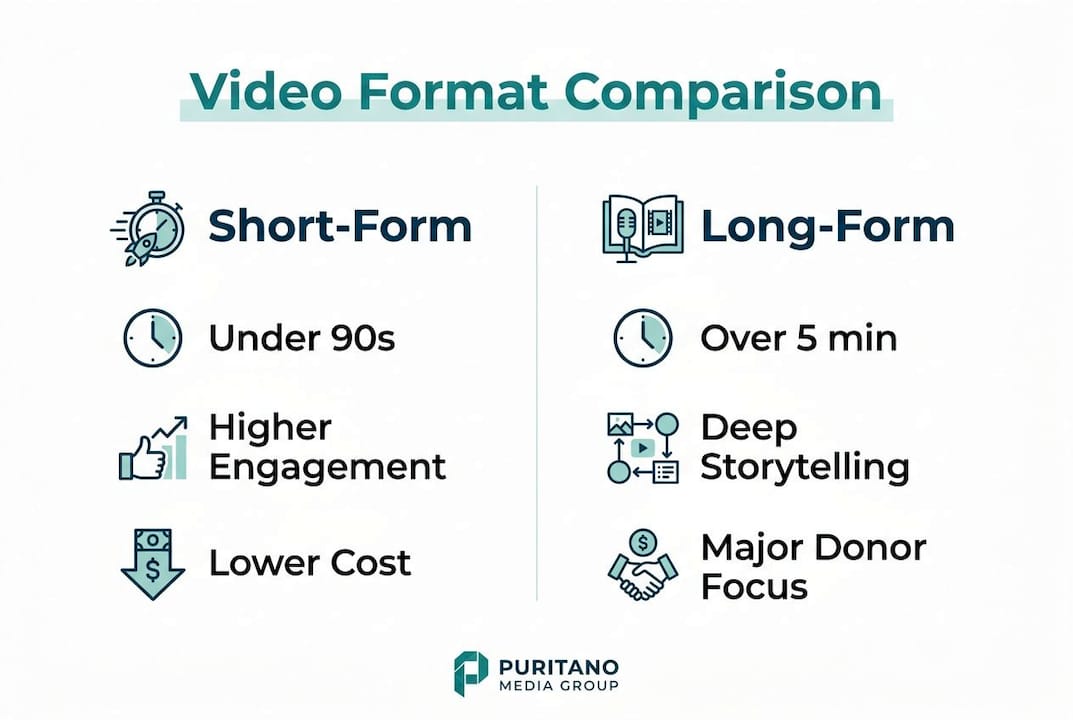
Short vs. long-form nonprofit campaign videos: which format fits which goal?
Both formats have a place in a nonprofit’s content plan. The mistake is using them interchangeably. Short and long-form videos serve different goals, different audiences, and different stages of the donor relationship.
Goal | Short-form video (under 90 seconds) | Long-form video (over 5 minutes) |
Awareness and reach | Strong. Algorithms favor it; new audiences discover it easily. | Weak. Rarely shared; low completion among cold audiences. |
Emotional hook | Strong. Concentrated impact in a tight window. | Moderate. Requires viewer commitment upfront. |
Major donor cultivation | Limited. Too brief for deep relationship building. | Strong. Allows nuanced storytelling and detailed impact reporting. |
Fundraising conversion | Strong with native donation tools. | Moderate. Better for planned giving or capital campaigns. |
Resource requirements | Low. Smartphone and natural light are sufficient. | High. Requires scripting, editing, and longer production time. |
Short videos require fewer resources and are more shareable, making them the right default for social media awareness and quick fundraising pushes. Long-form video earns its place in annual reports, gala presentations, and major donor stewardship packages. A well-run nonprofit uses both, but it builds its social media presence on short-form content because that is where new donors are found.
Video is the most powerful storytelling medium available for building long-term donor relationships. The format you choose should match the relationship stage, not just the message.
How nonprofits can create compelling short videos on a limited budget
Budget is the most common reason nonprofits delay video production. It is also the most overrated obstacle. Smartphones and natural light are sufficient to capture effective nonprofit stories. The production bar for short-form social video is lower than most organizations assume, and authenticity consistently outperforms polish in this format.
Practical steps to produce short videos without a large budget:
Film in natural light. Position your subject near a window or outdoors. Natural light is free and flattering. It removes the single biggest visual problem in low-budget video.
Plan shoots to produce multiple assets. One planned shoot session can yield multiple short clips usable across different campaigns and platforms. Film a beneficiary interview, capture B-roll of your program in action, and record a staff member’s 30-second reflection. That is three distinct videos from one afternoon.
Use platform-native donation features. Instagram donation stickers, YouTube donate buttons, and progress bars are free tools that turn a video view directly into a giving opportunity. Most nonprofits underuse them.
Test your hooks. Post two versions of the same video with different opening lines. The one with higher completion rate in the first 48 hours is your winner. Run it as a paid post if budget allows.
Repurpose footage across channels. A 60-second Instagram Reel can be trimmed to a 30-second YouTube Short and expanded into a 90-second Facebook video. One piece of footage, three distribution points.
Pro Tip: Shoot vertically for Reels and TikTok, and horizontally for YouTube and email embeds. Planning for both orientations during the shoot costs nothing and doubles your distribution options.
For nonprofits that want to go beyond DIY production, working with a professional team does not have to mean a large production budget. Nonprofit video strategies can be scoped to fit real-world constraints while still delivering broadcast-quality results. The key is knowing which moments in your program year are worth capturing professionally and which are well-served by in-house content.
Visual storytelling techniques like framing, pacing, and color grading make a measurable difference in viewer retention, even in short clips. When the stakes are high, such as a year-end campaign or a major awareness push, professional production pays for itself.
Key Takeaways
Short-form video is the highest-return format nonprofits can use for social media fundraising and donor acquisition in 2026.
Point | Details |
Engagement advantage | Short videos generate 2.5 times more engagement than long-form content on social platforms. |
Donor conversion | Viewers who watch nonprofit videos are 48% more likely to donate than those who do not. |
Storytelling structure | Open with a hook, feature one beneficiary, show transformation, and close with an emotional call to action. |
Budget reality | Smartphones and natural light are enough; one shoot session can produce multiple usable clips. |
Format matching | Use short-form for awareness and conversion; reserve long-form for major donor cultivation and deep storytelling. |
What I’ve learned from watching nonprofits get video right and wrong
Here is the honest truth: most nonprofits overthink production and underthink story. I have seen organizations spend months waiting for the “right” budget to make a video, while a volunteer with a phone and a clear message raised thousands in a weekend. The format does not care about your equipment. It cares about whether the viewer feels something in the first five seconds.
The nonprofits that consistently win with short-form content share one trait. They put a real person on camera and let that person speak without a script. Donors are not moved by statistics read aloud. They are moved by a mother describing what it felt like when her child got the help she needed. That is the story. Everything else is packaging.
What I also tell every nonprofit we work with: test relentlessly. The first video you make will not be your best one. The hook that you think is powerful may not stop the scroll. The call to action that feels obvious to you may be invisible to a first-time viewer. Post, measure completion rate, adjust, and post again. The organizations that treat short-form video as an ongoing practice rather than a one-time project are the ones that build real donor communities over time.
Authenticity is not a style choice. It is a strategy. And for nonprofits, it is the most cost-effective one available.
Puritano’s video production work for nonprofits
Puritano Media Group has spent over two decades helping organizations tell stories that move people to act. Nonprofits working on awareness campaigns, fundraising drives, or community impact content can draw on Puritano’s experience across social media video ideas and full-scale production. The team understands that nonprofit budgets are real constraints, not excuses, and scopes every project accordingly. Whether you need a single high-impact short clip or a library of assets built from one shoot day, Puritano brings the production discipline to make every minute of footage count. Explore Puritano’s video production portfolio to see the range of storytelling work the team delivers for mission-driven clients.
FAQ
Why do short videos outperform long videos for nonprofits?
Short videos earn higher completion rates, which social algorithms reward with greater organic reach. Viewers are more likely to share a 60-second clip than a 10-minute film, multiplying a nonprofit’s audience without paid spend.
How long should a nonprofit fundraising video be?
The most effective fundraising videos for social media run under 90 seconds. Longer formats work for major donor cultivation and gala presentations, but short clips drive the highest conversion rates on platforms like Instagram and TikTok.
Do nonprofits need professional equipment to make effective short videos?
No. Smartphones and natural light are sufficient for high-performing short-form nonprofit content. Authenticity and a clear story matter more than production quality in this format.
What is the most important element of a nonprofit short video?
The hook in the first 3 seconds is the single most critical element. If the opening does not stop a viewer from scrolling, the rest of the video will never be seen.
How does short-form video increase donor trust?
Short videos show a nonprofit’s real impact visually, which builds credibility more effectively than text newsletters or static posts. Seeing a beneficiary’s story on screen closes the gap between a donor’s gift and its outcome.
Recommended

Comments