

Video Production Scalability: What It Means in 2026
Updated: Jul 14

Here’s the quick message: Use humans to write, produce and direct your video. Then and only then should you use AI to remix, recut, repurpose and resize your videos.
Video production scalability is defined as the ability to produce consistent, high-quality video content repeatedly and efficiently by using systematic workflows, reusable assets, and clear brand guidelines. The global video production market was valued at $58.7 billion in 2026, with projected growth to $123.34 billion by 2035. That kind of demand does not get met by rebuilding your production process from scratch every time. Marketing professionals, business owners, and project managers who understand what video production scalability means will plan campaigns faster, allocate resources smarter, and deliver more output without burning out their teams.
What is video production scalability and how does it differ from traditional workflows?
Video production scalability is the practice of building repeatable, modular production systems rather than treating every video as a one-off custom project. Traditional video production starts from zero each time: a new brief, a new creative direction, a new round of approvals. Scalable production starts from a proven framework and adapts it to each new need.
The difference shows up most clearly in cost and speed. AI-native workflows drove production costs from $4,500 per finished minute down to $400 per finished minute between 2024 and 2026. That is a 91% cost reduction. Traditional workflows cannot compete with that because they rely on manual labor at every stage.
The table below shows where the two approaches diverge most sharply.
Pro Tip: Scalability does not mean lower quality. Brand guardrails and modular assets enforce consistency rather than dilute it. The misconception that scaling means cutting corners is the single biggest reason teams resist building these systems.
What are the core components of a scalable video production system?
A scalable video operation depends on three pillars: People, Process, and Platform. Each one has a specific job. Miss one and the system breaks down.
Here is how each pillar works in practice:
People set the standards. Someone on your team must define what is fixed and what is variable in every video format. That means deciding which elements, such as logo placement, color palette, and font, can never change, and which elements, such as voiceover copy and background footage, can be swapped freely. Without this decision-making upfront, every video becomes a negotiation.
Process defines the workflow. A documented production workflow tells every team member exactly what happens at each stage, who approves what, and where files live. This removes the coordination drag that kills speed. A well-built process also includes version control, so teams never work from outdated assets.
Platform supports automation and distribution. The right platform integrates creation, operations, and distribution in one place. That includes version control and multi-channel exports, permissions management, and real-time rendering. Without a platform built for volume, your process will hit a ceiling fast.
Beyond the three pillars, reusable templates are the engine of the whole system. A template is not just a visual starting point. It is a set of rules about what can and cannot change. The best templates lock brand-critical elements and leave clearly marked zones for variable content. This lets non-expert team members produce on-brand videos without supervision.
AI tools accelerate the system further. Over a third of teams now use AI in their video workflows for tasks like editing, captioning, and distribution. AI compresses timelines from weeks to minutes on tasks that once required a dedicated editor. The human creative team focuses on strategy and storytelling while automation handles repetitive execution.

Pro Tip: Build a modular asset library before you build your first template. Approved music tracks, B-roll footage, motion graphics, and logo files should all live in one searchable location. Teams waste more time hunting for approved assets than they spend editing.
What are the biggest pitfalls when scaling video production?
Scaling by adding headcount is the most common mistake. Simply adding staff without improving the underlying process leads to burnout and inconsistent output. More people producing videos in different ways creates more variation, not more volume.
The risks multiply when teams are decentralized. Remote or distributed teams working without shared templates and brand guardrails will drift. Each person makes small creative decisions that seem reasonable individually but add up to a brand that looks different across every channel. The fix is not more oversight. The fix is better systems.
Here are the most common pitfalls and how to avoid them:
No brand guardrails. Without locked brand elements in your templates, every editor becomes a creative director. Define what is non-negotiable before you scale.
Approval bottlenecks. Scaling output without scaling your approval process creates a backlog. Map your approval chain and cut any step that does not add genuine quality control.
Treating every video as a project. When teams approach each video as a unique project, they rebuild decisions that should already be made. Shifting to a product mindset means treating each video format as a repeatable framework, not a one-time deliverable.
Skipping version control. Teams that share files over email or messaging apps will eventually publish outdated versions. A proper asset management system with version history is not optional at scale.
Underestimating training time. New team members need to learn the system, not just the tools. Budget time for onboarding people into your templates and workflows, not just your software.
Pro Tip: Treat your video formats as products, not projects. A “30-second social ad” should have a defined structure, a locked template, and a documented production time. When formats are products, your team stops reinventing the wheel and starts shipping.
How does scalable video production deliver measurable ROI?
The return on investment from scaling video production is concrete and well-documented. Companies using enterprise video platforms report 10x ROI and 86% reductions in production time. Those numbers reflect what happens when a system replaces a series of one-off decisions.
Speed is the most immediate benefit. When templates and workflows are in place, a video that once took three weeks to produce can ship in days. That faster time to market matters most during campaign launches, product releases, and time-sensitive news cycles. Teams that can respond quickly win the attention window.
Brand consistency is the second major benefit. Templates with locked brand elements allow rapid localized editing without off-brand risks. A marketing team serving multiple regions or languages can produce localized versions of the same video without involving senior creatives for every adaptation. The brand stays intact. The output multiplies.
The table below summarizes the key benefits of scalable production compared to traditional methods.
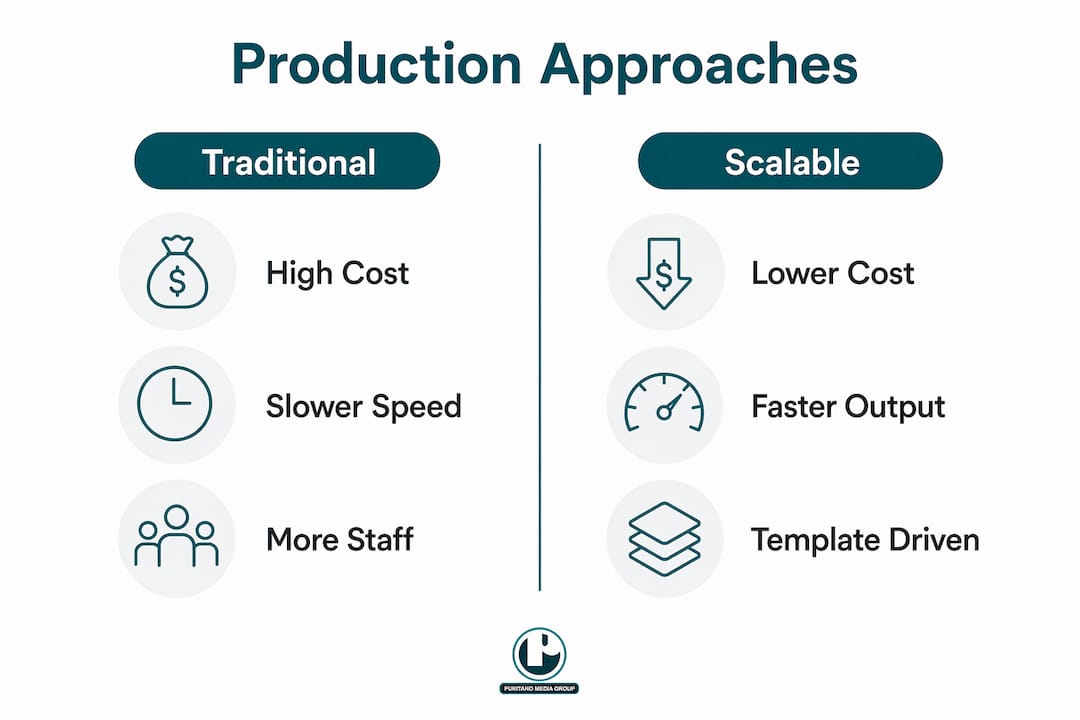
The shift to in-house production reflects this ROI. 59% of brands produced their primary video content in-house in 2026, up from 37% in 2022. That shift happened because scalable systems made in-house production viable at volume. Teams that invest in video content early build a compounding advantage as their asset libraries and templates grow more refined over time.
For project managers, the ROI argument is straightforward. Scalable production reduces the cost per video, increases output volume, and maintains quality standards without requiring proportional increases in headcount. That is the definition of a good investment. Understanding AI-powered scalable content production further extends these gains across written, visual, and video formats simultaneously.
Key Takeaways
Scalable video production is the most cost-effective way to increase video output while maintaining brand consistency, with AI-native workflows reducing production costs by over 90% compared to traditional methods.
What I’ve learned from two decades of scaling video production
Here is the honest truth about scaling video production: most teams skip the hard work of building the system and wonder why they are exhausted. They add a second editor, then a third, then a freelancer, and the output gets messier, not cleaner. I have seen this pattern repeat across organizations of every size.
The mindset shift that actually works is moving from “we are making a video” to “we are running a video operation.” Those are genuinely different things. A video operation has documented formats, approved asset libraries, and clear rules about what requires senior review and what does not. A video project has a deadline and a prayer.
The teams I have watched scale successfully all did one thing early: they invested in templates and rules before they invested in volume. They spent time defining their formats, locking their brand elements, and documenting their workflows when output was still manageable. That investment paid back every time they needed to move fast.
The other thing worth saying plainly: automation does not replace creative judgment. It replaces repetitive execution. The best scalable systems free up your creative team to focus on the decisions that actually matter, like story structure, audience insight, and channel strategy. When you maintain production quality as a non-negotiable standard inside a scalable system, you get the best of both worlds.
How Puritano supports scalable video production for marketing teams
Puritano Media Group brings over two decades of full-service video production experience to marketing teams, business owners, and project managers who need consistent, high-quality output at volume. Whether you are producing corporate videos, branded content, or social media series, Puritano builds production approaches that hold up across campaigns, not just individual projects. The team’s music video portfolio demonstrates the creative range and production discipline that scalable work demands. For teams managing live and virtual event coverage, Puritano’s case studies show exactly how high-volume, high-stakes production gets done without sacrificing quality. If your next campaign needs a production partner who understands both the creative and operational sides of scaling video, Puritano is worth a conversation.
FAQ
What is video production scalability in simple terms?
Video production scalability is the ability to produce more videos faster and at lower cost by using reusable templates, documented workflows, and brand guardrails instead of rebuilding each video from scratch.
Does scaling video production reduce quality?
Scaling does not reduce quality when systems include strict brand guardrails and locked templates. These tools enforce consistency rather than dilute it, allowing non-expert teams to produce on-brand content safely.
How much can scalable video production reduce costs?
AI-native workflows drove production costs from $4,500 per finished minute down to $400 per finished minute between 2024 and 2026, representing a 91% cost reduction compared to traditional production methods.
What is the People, Process, Platform framework?
The People, Process, Platform framework is the three-pillar structure for scalable video production. People set brand standards, Process defines repeatable workflows, and Platform provides the automation and asset management tools that support high-volume output.
How do I know if my organization is ready to scale video production?
Your organization is ready to scale when you have defined your core video formats, built an approved asset library, and documented your approval workflow. Starting without those foundations in place leads to inconsistent output and team burnout.
Recommended


Comments