

Why Video Production Quality Reflects Your Agency Brand
Updated: 3 days ago

Video production quality is the clearest visible indicator of an agency’s professionalism, strategic capacity, and brand promise. Before a prospect reads a single word of copy, they have already formed a judgment based on what they see and hear on screen. For marketing professionals and brand managers, understanding why video production quality reflects agency brand is not optional. It is the difference between content that builds trust and content that quietly erodes it.
What aspects of video production quality influence agency brand perception?
Production quality is not a single variable. It is a stack of technical and creative decisions that viewers process simultaneously, often without realizing it.
Poor lighting and audio label a brand as amateur within seconds. Professional visuals, by contrast, build immediate trust through color palette, composition, and exposure control. These visual elements trigger emotional responses that shape how an audience perceives the agency behind the content.
Sound design carries equal weight. Poor audio drives audiences away faster than low-quality visuals. A muffled voiceover or inconsistent room tone signals carelessness, and carelessness is the last thing any agency wants associated with its name.
Editing pace and narrative coherence function as brand tone signals. A video that cuts too fast feels anxious. One that lingers too long feels unfocused. Both communicate something about the agency’s judgment, whether intentional or not.
Common quality issues that damage perception include:
Shaky or poorly framed footage that suggests a lack of preparation
Inconsistent color grading across a campaign that breaks visual cohesion
Background noise or echo in interview segments that undercuts speaker authority
Jump cuts without purpose that confuse rather than energize the viewer
Mismatched lower thirds or graphics that look like they belong to a different brand
Pro Tip: Before any shoot, run a technical checklist that covers resolution settings, audio monitoring levels, and lighting ratios. Catching these issues in pre-production costs nothing. Fixing them in post-production costs real money and time.
Why brand consistency matters more than just technical quality
Technical excellence is necessary, but it is not sufficient. A video can be beautifully lit, crisply edited, and still feel completely disconnected from the brand it represents.
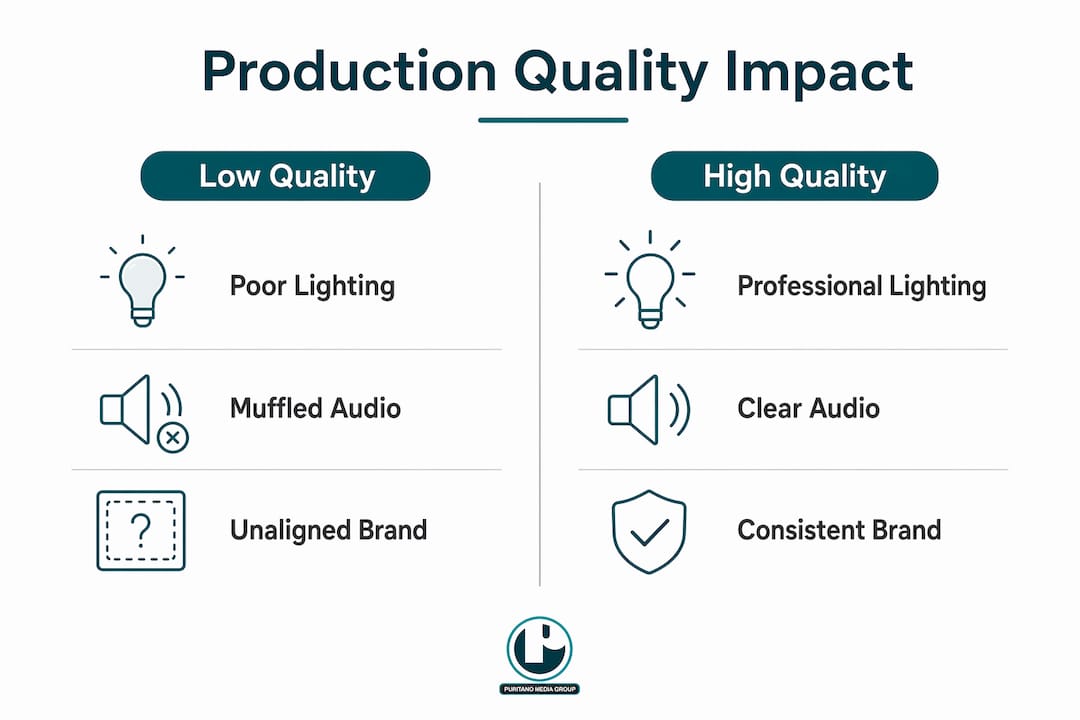
Without a clear, centralized brand brief, production teams create videos that may be technically sound yet lack brand identity. The result is strategically hollow content. It looks polished, but it does not feel like anyone in particular. That ambiguity is a red flag for prospects evaluating an agency’s capabilities.
Production quality cannot compensate for undefined brand identity. A well-produced video without a clear brand soul feels disconnected regardless of technical excellence. Subjective artistic decisions, while professional, may miss strategic brand alignment entirely and weaken the video’s impact.
The fix requires sequencing. Brand foundation must come before production begins. Here is the order that works:
Define brand voice and vocabulary. Identify the specific words and phrases the brand uses, and the ones it avoids. This is not a mood board. It is a written reference document.
Establish emotional goals. Decide what the viewer should feel at the end of the video. Confidence? Urgency? Warmth? Every production decision flows from this.
Document visual identity parameters. Specify color palettes, typography, logo usage, and motion graphic style before a single frame is shot.
Create a centralized brief. Consolidate voice, tone, visuals, and messaging into one document that every team member references throughout production.
Align the production partner on strategy, not just specs. A good production partner asks about brand positioning, not just camera format.
Pro Tip: Treat your brand brief as a living document. Update it after every major campaign so your production team always works from current brand standards, not assumptions from two years ago.
Understanding brand storytelling best practices before production starts is one of the most practical steps a brand manager can take to prevent misalignment.
How does video quality impact audience engagement, trust, and future marketing success?
The behavioral effects of video quality are measurable and significant. High-resolution, well-produced videos increase viewer engagement and trust, while poor quality reduces credibility and willingness to engage further. This is not a soft observation. It reflects how audiences process and respond to media.
Low-resolution and buffering in video content cause viewers to disengage, remember less emotional impact, and reduce future content interaction. Degraded video lessens support for the message itself and discourages return viewers. For an agency, that means a single poorly produced video can suppress the performance of every piece of content that follows it.
The long-term effects compound quickly. An audience that disengages from one video is less likely to watch the next one. An audience that associates an agency’s content with poor production begins to associate the agency itself with poor judgment. The impact of video quality on branding is cumulative, not isolated.
Key behavioral signals that poor quality triggers:
Viewers stop watching before the core message lands
Social sharing drops because people do not want to associate their name with low-quality content
Comment sections fill with technical complaints rather than engagement with the message
Prospects question whether the agency can deliver quality work for their own clients
What practical steps can agencies take to align production quality with brand strategy?
Aligning production quality with brand strategy requires deliberate process, not just good intentions. Here is what works in practice.
Develop a video style guide. A video style guide for brand consistency documents every visual and audio standard the brand expects across all video content. It covers aspect ratios, color grading presets, music tone, voiceover style, and graphic templates. Without it, every new video becomes a negotiation.
Integrate brand briefs into every production kickoff. The brief should cover brand voice, tone, vocabulary, emotional goals, and visual identity. Production teams need this information before they write a script, not after they deliver a rough cut.
Choose production partners based on strategic alignment, not just portfolio aesthetics. High-quality video production for agencies requires process, equipment, talent, and accountability. A production partner who asks about your brand positioning before discussing camera specs is a fundamentally different animal from one who only talks about deliverables.
Run quality checks at every stage, not just at delivery. Review scripts for brand voice alignment. Screen rough cuts for visual consistency. Check audio in the edit before color grading begins. Catching a brand misalignment at the script stage takes minutes. Catching it after the final cut takes days and budget.
Use a brand-first script system to reduce costly rewrites. Clear voice, vocabulary, and positioning inputs at the start avoid subjective revisions later and keep every video aligned with brand standards from the first draft.
How to evaluate and communicate the value of high-quality video production
Justifying a production budget internally requires more than enthusiasm. It requires evidence and a clear narrative about brand impact.
Lead with engagement data. Pull viewer retention rates, click-through rates, and social sharing metrics from past campaigns. Show the performance gap between high-quality and low-quality video content. Numbers make the case faster than any argument about aesthetics.
Frame quality as risk management. A single poorly produced video that goes live can damage brand credibility across an entire audience segment. The cost of prevention is always lower than the cost of reputation repair.
Connect production investment to client outcomes. When agencies produce branded video content that performs well for clients, those clients renew contracts and refer new business. Quality production is a revenue driver, not just a cost center.
Evaluate production partners against brand standards, not just price. Ask prospective partners how they handle brand briefs, what their revision process looks like, and how they measure success beyond technical delivery. A partner who cannot answer those questions clearly is not the right fit.
Understanding storytelling for brands also helps internal stakeholders see video as a strategic asset rather than a line item. When the conversation shifts from “how much does this cost” to “what does this build,” budget approvals become easier.
Key Takeaways
Video production quality directly reflects agency brand because every technical and creative decision communicates professionalism, strategic alignment, and trustworthiness to the viewer.
What I’ve learned from watching agencies get this wrong
After more than two decades in video production, the pattern I see most often is this: agencies invest in production quality before they invest in brand clarity. They hire talented crews, rent excellent equipment, and deliver technically impressive work. Then the client watches the final cut and says, “It doesn’t feel like us.” That moment is expensive for everyone.
The uncomfortable truth is that production quality and brand identity are not the same problem. They require different thinking, different timing, and different expertise. Production quality is a craft problem. Brand identity is a strategy problem. Trying to solve the strategy problem with craft solutions is where agencies consistently lose time and money.
What I’ve found actually works is treating the brand brief as the most important document in any production. Not the shot list. Not the edit timeline. The brief. When every person on the production team understands the brand’s voice, emotional goals, and visual standards before they pick up a camera, the final product almost always lands. When they don’t, even the most technically perfect footage feels hollow.
The other lesson is about collaboration. Marketers and producers need to be in the same room, or at least the same conversation, from day one. Producers who understand brand strategy make better creative decisions on set. Marketers who understand production constraints write better briefs. That overlap is where the best work comes from.
Treat video as a core brand asset. Not marketing collateral. Not a deliverable. A brand asset that compounds in value every time it performs well and depreciates every time it underperforms.
Puritano’s approach to brand-first video production
Puritano Media Group has spent over two decades building a production process that starts with brand strategy, not camera specs. Whether the project is a corporate video, a TV commercial, or music video production, the work begins with understanding the client’s voice, positioning, and audience before a single frame is planned. That sequencing is what separates content that performs from content that just exists. If you are a marketing professional or brand manager ready to produce video that genuinely reflects your brand’s standards, Puritano is the production partner built for that conversation. Reach out through puritano.com to start the discussion.
FAQ
Why does video production quality reflect agency brand?
Video production quality reflects agency brand because every technical and creative decision signals the agency’s professionalism and attention to detail. Poor audio, inconsistent visuals, or weak editing tell viewers the agency does not hold itself to high standards.
What is the biggest mistake agencies make with video production?
The biggest mistake is starting production before establishing a clear brand identity. Without a centralized brief covering voice, tone, and visual standards, even technically excellent videos feel disconnected from the brand they represent.
How does poor video quality affect audience engagement?
Degraded video quality causes viewers to disengage, retain less of the message, and reduce future interaction with the brand’s content. The impact compounds across campaigns over time.
What should a video style guide include?
A video style guide should cover color grading standards, aspect ratios, typography, music tone, voiceover style, logo usage, and graphic templates. It gives every production team member a shared reference point before work begins.
How can brand managers justify investment in high-quality video production?
Brand managers can justify the investment by presenting viewer retention data, click-through rates, and the long-term revenue impact of content that performs well. Framing quality as risk management, not just aesthetics, makes the budget case more persuasive internally.
Recommended
Viewers judge an agency's judgment by what is on the screen, and we hold our work to a standard our founder brought with him into this company. Charlie Puritano worked on Forrest Gump and on films by Oliver Stone and Milos Forman, and that feature background shapes what this shop considers acceptable lighting, sound, and pace. A prospect may never learn those credits, but they see the discipline in the first ten seconds, which is exactly where a brand is either confirmed or quietly discounted.


Comments