

Storytelling Impact Videos for Donors That Drive Giving

Storytelling impact videos for donors are short, narrative-driven productions that use authentic human stories and verifiable outcome data to make a donor’s contribution feel real, visible, and worth repeating. These videos do something no annual report or email newsletter can do: they make donors feel the impact rather than simply process it. Organizations like UNICEF Australia and Plan International Canada have proven this at scale, using personalized video workflows to generate measurable increases in donations and engagement. Frameworks like the GIVE Arc, developed by philanthropy strategists, provide the sequencing logic that turns a single video into a long-term relationship tool.
What are the essential elements of effective storytelling impact videos for donors?
The industry term for this practice is donor impact storytelling, and the most effective versions share four non-negotiable elements: authenticity, verifiable impact data, personalization, and a clear call to action.
Authenticity over production value. Short authentic testimonials outperform highly polished productions in driving donor engagement on limited nonprofit budgets. Donors respond to real faces, unscripted moments, and behind-the-scenes transparency because those signals communicate honesty. A beneficiary speaking directly to camera in a community center is more persuasive than a cinematic montage with a voiceover.
Verifiable, numeric impact data. Social impact storytelling requires verifiable, numeric outcomes and informed consent to maintain credibility. Scripts should embed checkable evidence, not vague claims. “Your gift helped provide clean water to 47 families in Nairobi” is credible. “Your gift changed lives” is not. The difference between those two sentences is the difference between a donor who gives again and one who quietly disengages.
Personalization at the story level. Donor engagement videos that reference a supporter’s specific giving history, named project, or geographic region perform significantly better than generic versions. This is not a minor optimization. It is the core mechanism behind the results organizations like Plan International Canada have achieved.
A clear donor bridge. Impact storytelling must pair emotion with a clear call to action, communicating what donors can do next. Leaving a viewer inspired but directionless is a production failure. Every video should end with one specific, low-friction action: renew your gift, share this story, or join our next event.
Lead with a real person, not a statistic
State the outcome in numbers within the first 30 seconds
Show the before and after, not just the after
Name the donor’s contribution explicitly in personalized versions
Close with one action, not three
Pro Tip: Film two or three short testimonial clips at every site visit or program event. These raw clips become the raw material for six months of donor engagement videos without additional production trips.
Which video formats and lengths work best for donor engagement?
Format and length are not aesthetic choices. They are strategic decisions that directly affect whether a donor watches, shares, or ignores your content.
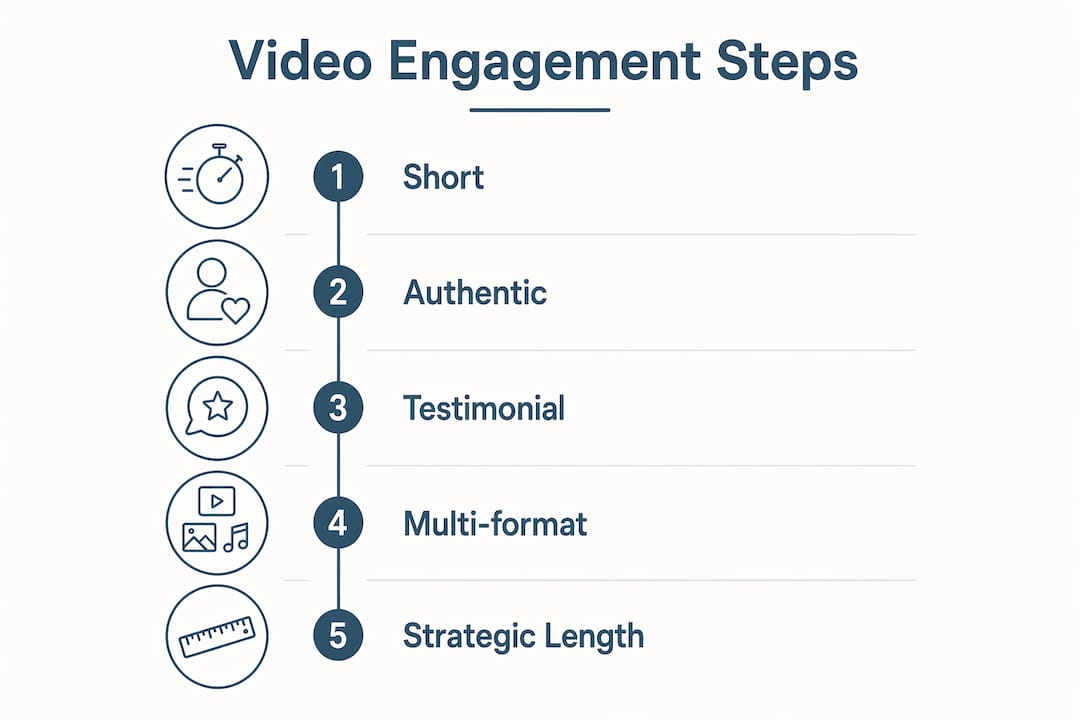
Short-form videos in the 10 to 90 second range generate around 2.5 times more engagement than longer videos. That number means a two-minute video you spent weeks producing may perform worse than a 45-second clip shot on a smartphone. The implication for nonprofits is clear: prioritize brevity and authenticity over length and production complexity.
Format | Ideal Length | Best Use Case | Platform Fit |
Beneficiary testimonial | 30–60 seconds | Emotional connection, new donor acquisition | Instagram Reels, YouTube Shorts |
Behind-the-scenes clip | 15–45 seconds | Transparency, trust building | TikTok, Instagram Stories |
Impact data snapshot | 10–30 seconds | Donor retention, stewardship emails | Email thumbnails, LinkedIn |
Educational mission snippet | 60–90 seconds | Advocacy, mid-level donor cultivation | YouTube, Facebook |
Personalized thank-you | 30–60 seconds | Stewardship, renewal campaigns | Email, direct message |
Testimonials from beneficiaries carry the most emotional weight. Testimonials from volunteers, board members, and long-term donors add social proof and credibility. Rotating these formats across a campaign prevents fatigue and keeps your content ecosystem feeling alive rather than repetitive.
Pro Tip: When producing video narratives for charities, shoot vertical and horizontal versions of every clip simultaneously. This doubles your distribution options without doubling your production time.
How to create and scale personalized storytelling videos efficiently
Scaling personalized donor videos sounds expensive. The actual workflow, once set up, is one of the most cost-efficient tools in a nonprofit communications budget.
The method that produced UNICEF Australia’s results follows a clear sequence:
Design a reusable video template. Create a master video with dynamic text fields for donor name, project name, impact metric, and location. The visual and narrative structure stays fixed. Only the data changes.
Prepare your donor data file. Export a CSV from your CRM (Salesforce, Bloomerang, or similar) with one row per donor and columns matching your template’s dynamic fields.
Render personalized videos automatically. Use a video personalization platform to merge the template with the data file, generating one unique video per donor at scale.
Export personalized links. Each rendered video gets a unique URL tied to that donor’s record.
Build personalized landing pages. Each link resolves to a page that greets the donor by name, shows their specific impact, and presents a single renewal or upgrade ask.
Deploy via email with personalized thumbnails. Embed a static thumbnail image in the email that shows the donor’s name or project. Link it to their unique landing page. This single tactic drives click-through rates far above standard email benchmarks.
UNICEF Australia delivered 20,000 personalized thank-you videos using exactly this workflow and generated an 8% increase in donations. That result came from a template-plus-data approach, not from producing 20,000 individual videos.
Campaign | Personalization Method | Key Result |
UNICEF Australia | Template + donor data CSV, personalized thumbnails | 8% donation increase across 20,000 donors |
Plan International Canada | Donor history references, personalized video content | 50%+ above predicted open and completion rates, 10% social share rate |
Let’s Save the Strays | 200+ personalized mobile videos over 6 months | Strengthened donor loyalty and repeat engagement |
The separating insight here is that reusable templates and dynamic data are the highest-leverage combination available to nonprofits working within real budget constraints. You are not producing a video for each donor. You are producing one video that speaks to each donor.
How to use donor engagement videos within a stewardship strategy
Producing compelling donor impact stories is only half the equation. Where and when you deploy them determines whether they build relationships or get ignored.
The GIVE Arc framework, developed by philanthropy strategists, sequences donor communications into four stages: Gratitude, Impact, Voice, and Engagement. Video content is most powerful in the Gratitude and Impact phases, where emotion and evidence do the work that words alone cannot.
Gratitude phase: Send a personalized thank-you video within 48 hours of a gift. This is not a receipt. It is a relationship signal. It tells the donor their contribution was noticed by a human being, not processed by software.
Impact phase: Follow up 30 to 60 days later with a short video showing exactly what their gift accomplished. Use numbers. Show faces. Name the project.
Voice phase: Invite donors to share their story or participate in a testimonial. This transforms a passive supporter into an active advocate, which is the most durable form of donor loyalty.
Engagement phase: Use live video sessions, Q&A events, or behind-the-scenes tours to create two-way connection. Live engagement consistently outperforms messaging volume or timing as a predictor of gift size and donor retention.
The critical discipline here is sequencing. Sending a donation ask before completing the Gratitude and Impact phases is the nonprofit equivalent of asking for a second date before the first one ends. Donors who feel seen and informed before they are asked give more and give longer.
Avoid urgency-based messaging in video content. “Give now before midnight” trains donors to wait for pressure rather than give from conviction. Video narratives for charities that focus on relationship and identity produce donors who give because it reflects who they are, not because a deadline scared them into it.
What common challenges arise in producing these videos and how to avoid them
Most nonprofits hit the same four walls when building a donor video program. Knowing them in advance saves significant time and budget.
Over-polishing kills authenticity. A professionally lit studio interview with a scripted beneficiary often performs worse than a candid conversation filmed in the field. Invest in good audio before you invest in cinematic lighting. Viewers forgive shaky footage. They do not forgive inaudible dialogue.
Vague impact claims destroy credibility. “We helped thousands of children” is not a story. It is a press release. Embed specific, checkable numbers in every script. If you cannot verify the claim, do not make it.
Ignoring consent and ethics. Informed consent is not optional. Every person who appears in your video must understand how the footage will be used, where it will be distributed, and for how long. This is both a legal requirement and a trust signal to donors who are paying attention.
Skipping the metrics. Tracking email open rates, video click-through rates, video completion rates, and social shares is the only way to know what is working. Personalized video metrics like completion rate and social share rate are the clearest indicators of whether your storytelling is landing.
“Scripts should embed checkable evidence, not vague claims. Audiences and donors are more sophisticated than most organizations give them credit for.” — Andi Cross, Social Impact Storytelling
The production bottleneck most organizations face is not budget. It is workflow. Nonprofits that leverage video strategically treat content creation as an ongoing system, not a one-time project. Build the template once. Collect footage continuously. Render and distribute on a schedule.
Key takeaways
Storytelling impact videos for donors work because they combine emotional authenticity, verifiable evidence, and personalized delivery to make donors feel their contribution is real and worth continuing.
Point | Details |
Authenticity beats polish | Short, real testimonials outperform cinematic productions for donor engagement on nonprofit budgets. |
Personalization multiplies results | Donor-specific video content drives completion rates and social shares well above generic video benchmarks. |
Sequence before you ask | The GIVE Arc framework places gratitude and impact videos before any direct ask to deepen commitment. |
Verify every claim | Numeric, checkable impact data builds credibility; vague claims erode donor trust over time. |
Template-plus-data scales efficiently | Reusable video templates merged with donor CRM data allow personalized video at scale without proportional cost increases. |
What I’ve learned producing donor videos that actually move people
I have spent over two decades in video production, and the most consistent lesson I take from nonprofit work is this: donors do not need more information. They need to feel something true.
The organizations that get this right are not necessarily the ones with the largest budgets. ReSurge International’s “Closing the Gap” campaign used authentic survivor storytelling to increase new donors by 227% and new donor revenue by 490%. That result came from reframing reconstructive surgery as vital care through real human stories, not from a production budget that outspent the competition.
What I have found actually works, versus what sounds good in theory, is the combination of a clear narrative structure and genuine restraint. Most organizations try to say too much in a single video. They want to cover the mission, the history, the impact, the ask, and the thank-you in three minutes. The videos that perform best do one thing well. They introduce one person, show one outcome, and make one ask.
The personalization piece is where I see the biggest gap between what nonprofits know they should do and what they actually execute. The workflow is not complicated once you have the template built. The barrier is usually internal: someone has to own the data, someone has to own the template, and someone has to own the distribution. When those three roles are clear, the results follow. When they are not, the program stalls after the first campaign.
My honest advice: start with five personalized thank-you videos for your top donors. Measure the response. Then build the system to scale what works.
How Puritano can help you tell stories that donors remember
Puritano Media Group has spent over two decades producing video content for nonprofits, associations, and mission-driven organizations across the Washington D.C. area and nationally. We understand the specific challenge of creating donor engagement videos that feel personal, credible, and worth watching. Our team builds production workflows designed around your storytelling goals and your budget, from single-story testimonial shoots to scalable personalized video campaigns. If you want to see what this looks like in practice, explore our video production services or review our virtual events work to understand how we approach audience engagement at every scale. We would be glad to talk through what your next donor video campaign could look like.
FAQ
What makes a donor impact video effective?
An effective donor impact video combines a real person’s story with specific, verifiable outcome data and ends with one clear action for the viewer. Authenticity and numeric evidence together build the trust that motivates giving.
How long should a storytelling video for donors be?
Videos in the 10 to 90 second range generate around 2.5 times more engagement than longer formats. For stewardship and thank-you videos, 30 to 60 seconds is the most reliable length for completion and response.
How do nonprofits personalize donor videos at scale?
The most efficient method uses a reusable video template with dynamic data fields merged with a donor CRM export. UNICEF Australia used this approach to deliver 20,000 personalized videos and achieve an 8% increase in donations.
When in the donor cycle should impact videos be sent?
The GIVE Arc framework places video in the Gratitude phase (within 48 hours of a gift) and the Impact phase (30 to 60 days later), before any direct ask. This sequencing builds commitment rather than transactional compliance.
What metrics should nonprofits track for donor videos?
Track email open rate, video click-through rate, video completion rate, and social share rate. Plan International Canada’s personalized video campaign achieved completion rates and open rates more than 50% above predicted benchmarks using these metrics to optimize delivery.
Recommended
Comments