

U.S. TV Commercial Length Strategy: Use One 30s Master for 6s–60s
Updated: 4 days ago

For most U.S. TV campaigns, a 30-second spot should be your baseline asset. It has the widest network acceptance, the cleanest cutdown math, and the deepest measurement history. Build 15-second versions for frequency and reminder flighting, keep 6-second bumpers for digital and streaming pods, and reserve 60 seconds for launches or brand stories that need room to breathe. Everything below explains why, with U.S. cost and technical specifics attached.
What Are the Standard TV Commercial Lengths?
Four durations cover nearly every buy a U.S. media planner will make: 6, 15, 30, and 60 seconds. Each one earns its place in a campaign for a different reason, and the TVB’s inventory data on commercial length activity confirms that 30-second units still dominate total ad time, with 15-second spots making up the fastest-growing share.
6 seconds. A bumper, not a story. Best for pre-roll on streaming, brand tags, or closing a campaign with a single logo-and-message hit.
15 seconds. The frequency workhorse. Ideal for reminders, promotions, and follow-on messaging after a longer spot has already introduced the brand.
30 seconds. The default unit across broadcast, cable, and ad-supported streaming. Enough time for a setup, a turn, and a call to action.
60 seconds. Reserved for launches, holiday campaigns, or emotionally driven brand manifestos where the story needs two full acts.
Availability matters here too. Linear networks sell 15s and 30s as their bread and butter, and most streaming platforms have converged on those same units rather than inventing new ones, according to a 2026 review of how TV ad formats are changing. Six-second units show up mostly in digital and CTV pods, not traditional broadcast avails.
Which Commercial Length Works Best for Your Objective?
Length should follow objective, not the other way around. A 2025 multi-method study on micro ads found that shorter spots generate more immediate web traffic than longer ones, while both lengths produce similar direct effects on online sales when the short version follows a longer campaign. That is a specific, narrow win: micro ads perform as reminders, not as replacements for narrative introductions.
The data point that should shape your media plan: Micro ads (6s to 15s) drive faster direct response and web traffic, but longer spots (30s to 60s) carry the narrative weight that produces lasting brand recall. Peer-reviewed research on commercial length backs this up, showing that short ads have real limits and that longer spots see diminishing recall gains past 30 seconds.
The practical takeaway: allocate your 30s or 60s inventory to the objectives that need story (awareness, consideration, brand differentiation), and let 15s and 6s handle the objectives that need repetition (recall reinforcement, promotional urgency, direct response), using proven conversion rate optimization tips to maximize TV-driven web traffic conversion. Mixing both into a single flight, rather than picking one length for the whole campaign, is how the strongest U.S. advertisers get both outcomes out of one budget.
How Much Does TV Commercial Length Affect Cost?
Cutting your spot in half does not cut your media bill in half. A WARC study on cost per second found that a 15-second ad typically costs between 60% and 80% of a 30-second spot’s media rate, not 50%. Networks price attention and reach, not seconds, and a 15s spot still competes for the same viewer eyeballs as its longer counterpart.
Budget ranges vary enormously by market and daypart:
Local 30-second spots can start in the low hundreds of dollars and climb into the low thousands depending on the station and time slot, per Simulmedia’s 2026 TV cost guide.
National prime-time inventory and special events (such as championship broadcasts) command rates that can be very high, sometimes reaching millions for marquee events.
Production costs scale with length and complexity. A straightforward 30-second spot with minimal locations costs far less than a 60-second spot with multiple scenes, talent, or visual effects, a distinction covered in more depth in Puritano’s breakdown of what a 30-second commercial really costs.
The rule of thumb for planners: budget for 15s inventory at roughly two thirds to three quarters the price of your 30s buy, not half, and route any real savings from shorter airtime toward frequency, not toward stretching the same dollars further than they will go.
How Do You Plan One Commercial Across Linear, Streaming, and Social?
A single 30-second master asset, shot and edited with clear markers at the 15-second and 6-second cut points, is the most efficient way to serve linear TV, connected TV, and social feeds without paying for three separate productions. Because ad-supported streaming has converged on the same length units as broadcast, one well-built master reduces both production cost and measurement complexity across platforms, an efficiency also noted in Puritano’s look at OTT ad formats.
Shoot for the cutdown, not just the master. Plan your strongest visual and audio beat to land inside the first six seconds, since that footage becomes your bumper.
Protect the brand cue in every version. Logo, tagline, or product shot should survive the edit down to 6 seconds, even if the story does not.
Match pod structure to platform. Linear ad pods still run longer sequences of 30s spots, while many streaming pods favor a mix of 15s and 6s units, so confirm avail structure with your buyer before finalizing cutdowns.
What Timing Structure Keeps Viewers Watching?
Attention inside a 30-second spot tends to hold for roughly the first ten seconds before recall starts declining, based on findings referenced in the sales-focused research on commercial length. That window is where your hook, your brand reveals, and your emotional turn need to land, not the closing seconds most scripts save them for.
First 5 to 10 seconds: Open with the visual hook or the problem, not a slow logo build. This is where most viewer attention lives.
Middle section: Use this space for the demonstration, the story turn, or the proof point, since it is the connective tissue between hook and payoff.
Final seconds (CTA window): Repeat the brand name and the single action you want the viewer to take, since this is what survives into a 15-second cutdown.
For 15-second spots, skip the slow build entirely and open on the payoff or the reminder message. Puritano’s breakdown of high-converting video ad structure applies the same logic to digital formats.
Pro Tip: Write your 6-second cutdown script before you shoot the 30-second master. If the core message survives in six seconds, everything longer than that is just extra room to build the story, not a separate message you have to cram in later.
How Do You Choose the Right Length for Your Campaign?
Start with a checklist, not a guess. Length decisions get made in isolation far too often, and that is how budgets end up split across formats that do not actually support each other.
Define the objective first. Awareness and story need 30s or 60s. Reminders and promotions run fine on 15s or 6s.
Set reach and frequency targets. Nielsen-informed planning benchmarks generally aim for reaching 60% to 75% of the target audience with an average frequency of three or more across the flight.
Match budget to the real cost curve. Remember that 15s runs 60% to 80% of a 30s buy, not half, when you build your media math.
Account for creative complexity. A demonstration or multi-scene story needs more than 15 seconds to land; a single-message reminder does not.
Confirm your measurement plan before production. Know whether you are tracking web traffic lift, sales lift, or brand recall, since that determines which lengths belong in the flight.
Bring these exact questions to your media buyer and traffic team before you lock a schedule:
What is the required Ad-ID format, and does each cutdown need its own code?
How much pad time does the network require on each end, especially for 15s and 6s versions?
What are the pod lengths and slot structures for this specific daypart or platform?
What delivery format and file specs does the network or streaming partner require?
NBCUniversal’s linear commercial guidelines spell out exactly how strict these submission requirements are, and minor revisions often require a full resubmission.
How Did TV Commercial Lengths Get Shorter Over Time?
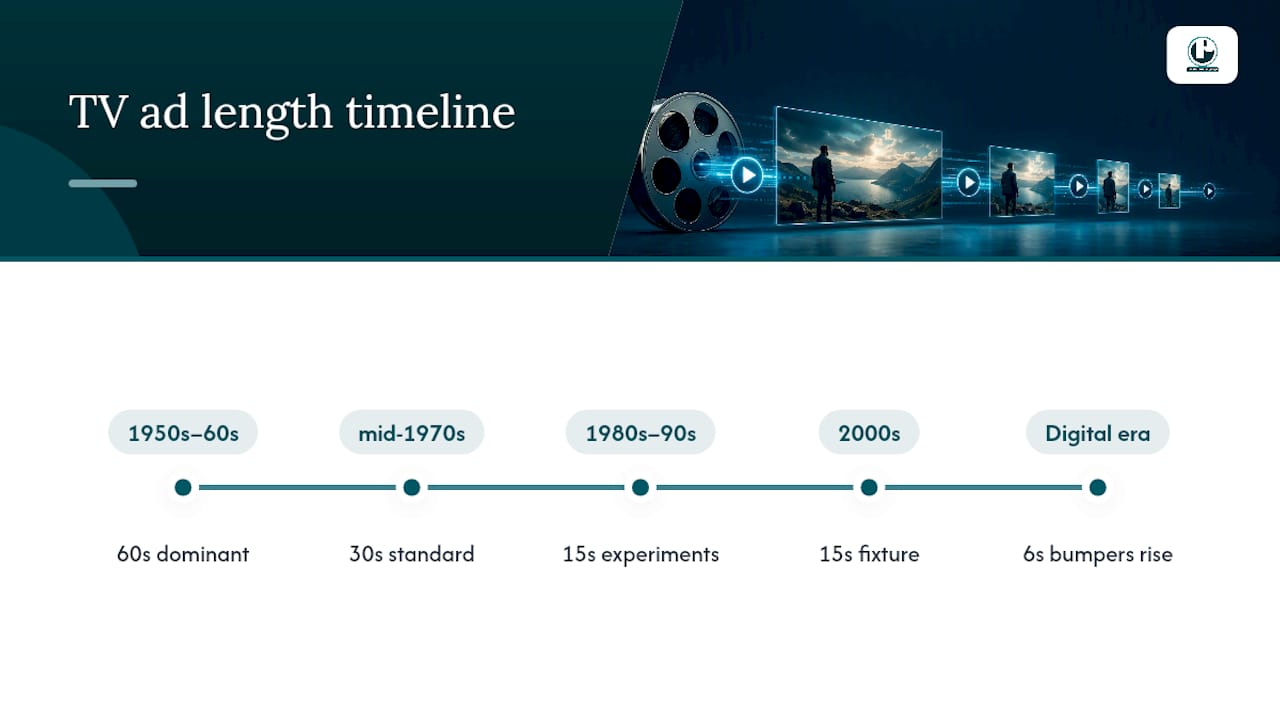
The 60-second spot ruled American television through the 1950s and into the 1960s, when airtime was cheaper and networks had fewer advertisers competing for the same hour. As demand for ad slots grew, networks split hours into more units to sell more inventory, and the 30-second spot became the standard by the mid-1970s, a shift that let broadcasters roughly double the number of advertisers per break without doubling airtime.
The 1980s and 1990s pushed the trend further. Cable expansion multiplied channel choices, remote controls made channel surfing effortless, and advertisers began experimenting with 15-second spots to stretch budgets across more networks and dayparts. By the 2000s, 15s had become a fixture of nearly every national campaign, typically running as a companion to a 30s or 60s anchor spot rather than a standalone unit.
The most recent shift, accelerated by mobile and social video, is the rise of the 6-second bumper. Digital platforms popularized ultra-short formats first, and connected TV inventory adopted them as ad-supported streaming matured. What has not changed is the industry’s reliance on 30 seconds as the anchor length, still the most commonly sold unit across both traditional and streaming inventory. Short formats expanded the toolkit. They did not replace the master asset.
How Does Viewer Attention Affect the Length You Should Choose?
Viewer behavior has changed more than the technology used to measure it. Streaming, DVR skipping, and second-screen habits mean fewer viewers sit through an ad passively from start to finish, which is part of why the ten-second attention window inside a 30-second spot matters so much for creative structure.
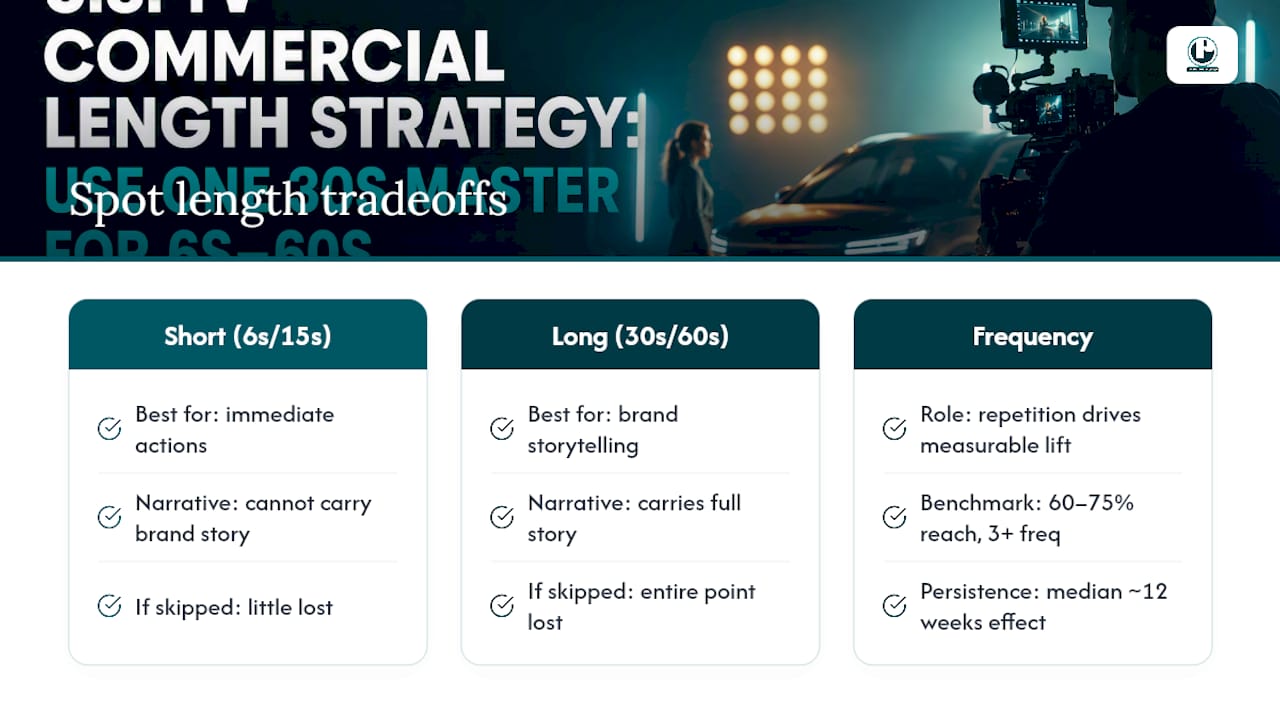
Shorter attention spans do not automatically mean shorter commercials win. The micro-ad research is specific: 6s and 15s spots outperform on immediate actions like web visits, but they cannot carry a brand story the way 30s and 60s formats can. A viewer who skips past a 6-second bumper has lost almost nothing of a narrative, because there was no narrative to lose. A viewer who tunes out ten seconds into a 60-second story misses the entire point.
This is why frequency planning matters as much as length. Nielsen-informed benchmarks that target 60% to 75% reach with three-plus average frequency exist precisely because repetition, not one long exposure, is what drives measurable lift in distracted viewing environments. A 30-second spot shown once does less work than a 30-second spot supported by 15-second reminders shown three or four times across the flight. Measurement reviews consistently find that most tracked TV campaigns report statistically significant lift, with effects that can persist for a median of roughly 12 weeks after the flight ends, according to effectiveness data compiled across Nielsen, IPA, and Kantar sources. Attention spans have shortened. Persistence of a well-built campaign’s effect has not.
What Do Real Campaigns Show About Commercial Length Performance?
The clearest comparative signal comes from the micro-ad research itself, which tested short and long formats side by side rather than relying on anecdote. Micro ads (6s to 15s) consistently drove more immediate web traffic than their longer counterparts in the same campaigns, while direct sales impact stayed roughly comparable between short and long formats when the short spot ran as a follow-on to an established campaign.
That pattern shows up in category-level behavior too. Retail and promotional advertisers, who need viewers to act now, lean heavily on 15s inventory paired with digital retargeting. Auto and insurance brands, who need viewers to remember a name months later, still commit disproportionately to 30s and 60s units for launches and then fill the rest of the flight with 15s reminders. The peer-reviewed research on commercial length backs this split, finding that short-format gains taper off once a message requires more than a single beat, while longer formats show diminishing recall improvement past the 30-second mark. Neither format wins outright. Each wins the job it is built for, and the campaigns that blend both lengths deliberately tend to outperform the ones that pick a single length for everything.
Are There Rules That Limit How Long a TV Commercial Can Be?
There is no federal length cap on individual TV commercials in the United States, but that does not mean anything goes. The Federal Communications Commission enforces the Children’s Television Act, which limits total commercial time during children’s programming to 10.5 minutes per hour on weekends and 12 minutes on weekdays, a per-hour ceiling rather than a per-spot one.
Beyond federal rules, individual networks set their own technical length and submission standards, and those standards function as the real gatekeeper for most advertisers. NBCUniversal’s guidelines, for example, specify exact accepted durations, required pad time, and mandatory Ad-ID codes, and reject spots that do not match the approved format specifications. Other major networks run comparable technical checklists, so a spot approved by one network’s traffic department is not automatically cleared for another without reformatting.
International markets differ sharply from the U.S. approach. Several countries cap total commercial minutes per broadcast hour far more tightly than the U.S. does, and some regulate content categories (alcohol, gambling, political ads) with length and placement restrictions that have no direct U.S. equivalent. For a campaign staying entirely within U.S. broadcast and streaming inventory, the practical constraints are network technical specs and children’s programming limits, not a general commercial length law.
Why a Full-Service Production Partner Makes Length Strategy Easier
Getting the length strategy right on paper is one thing. Producing a 30-second master that cuts cleanly into 15-second and 6-second versions, without losing the brand cue or the CTA, takes a production team that plans the cutdowns before the camera ever rolls. A seasoned production team with extensive experience producing TV commercials, corporate video, and branded content for organizations across regional and national markets helps ensure campaigns run smoothly from editing to network delivery.
Experienced production teams handle challenging tasks such as shooting with cutdowns in mind from day one, editing multiple length versions off a single master, and coordinating delivery specs to avoid network rejections due to technical issues. If you are planning a campaign that needs a 30-second anchor spot with 15-second and 6-second companions built to actually work together, Puritano’s music video production portfolio shows the kind of visual storytelling and technical polish behind that process. Reach out through Puritano’s site to talk through your flight plan and get a production timeline built around your air dates.
Sources
For deeper measurement and pricing detail, consult the WARC cost-per-second study, NBCUniversal’s commercial guidelines, and TVB’s inventory reports directly.
FAQ
How Long Are Most TV Commercials?
Most U.S. TV commercials run 30 seconds, which remains the industry-standard unit across linear broadcast, cable, and ad-supported streaming, with 15-second spots as the second most common length.
How Long Were TV Commercial Breaks in the 90s?
Commercial breaks in the 1990s typically ran shorter than today’s breaks, but the decade is when 15-second spots became widely adopted alongside 30-second spots as advertisers looked to stretch budgets across more networks.
What Is the Longest TV Commercial Ever Aired?
Extended-length commercials, often called infomercials, can run well beyond standard formats and are typically sold as dedicated programming blocks rather than standard commercial units, which is a separate buying category from the 6s to 60s spots covered in this guide.
Recommended
Broadcast discipline is in our roots. Charlie Puritano has directed commercials on 35mm film, a format now reserved mostly for big budget feature films, and shooting on film punished waste. Every length in a campaign had to be planned before the camera rolled, because there was no cheap coverage to hide behind. That habit still governs how we build a thirty second master today: one clear idea, shot deliberately, with the fifteen and the six already accounted for in the plan.


Comments