

What a 30-Second TV Commercial Really Costs in 2026
Updated: 4 days ago

Production and airtime are two separate bills, and confusing them is the fastest way to blow a budget. A do-it-yourself or AI-assisted spot can run $0 to $5,000, a small local production lands between $1,500 and $15,000, regional work hits a range commonly seen in the industry, and a national-caliber commercial typically costs within a broad typical range. Celebrity talent or premium campaigns push past $500,000.
Airtime is its own budget entirely. A single local spot might cost $200 to $50,000 depending on the market, national primetime placements run $200,000 to over $1 million per 30 seconds, and a Super Bowl spot cost roughly $8 million in 2026, before production. Connected TV (CTV) offers a cheaper entry point, with CPMs generally between $20 and $65.
DIY/AI production: $0–$5,000
Small/local production: $1,500–$15,000
National production: $50,000–$500,000
Local airtime: $200–$50,000 per spot
National primetime: $200,000–$1M+ per spot
For most small businesses, a realistic combined launch budget, production plus a modest media run, falls within a moderate budget range.
Key Takeaways
Production and airtime are billed separately, and most small business budgets fail because they underfund airtime frequency rather than production quality.
Point | Details |
Separate your budgets | Production ($1,500–$500,000+) and airtime ($200–$8M+ per spot) are billed independently and should be planned separately. |
Prioritize frequency over polish | A cheaper production with more airings usually outperforms a costly spot that airs only a few times. |
Confirm talent usage terms | SAG-AFTRA session and usage fees can double real talent costs if usage windows aren’t negotiated upfront. |
Use CTV for lower minimums | CTV CPMs of $20–$65 let small businesses reach targeted audiences without broadcast-level spend. |
Work with an experienced partner | Puritano Media Group scopes production tiers around actual client budgets, drawing on two decades of commercial production experience. |
How Much Does a TV Commercial Cost to Produce?
Production budgets scale with ambition, not just runtime. A 30-second spot shot on a phone with stock footage and template editing can cost next to nothing, while a national campaign with union talent, a full crew, and custom music can run into six figures. According to production cost breakdowns, most professional commercials for growing businesses fall between $5,000 and $50,000, a range wide enough to cover a one-location shoot with a small crew up through a two-day production with drone footage and a hired actor.
Here’s where that money actually goes on a typical mid-tier shoot:
Script and concept development: $500–$5,000
Pre-production (casting, location scouting, permits): $1,000–$5,000
Shoot day (crew, gear, locations): $3,000–$20,000 per day
On-camera talent: $500–$3,000 for non-union; union rates run higher
Editing and color grading: $1,500–$10,000
Sound design and mixing: $500–$3,000
Music licensing: $200–$5,000 depending on the track and usage term
Cutdowns (15s, 6s, vertical versions): $300–$1,500 each
Talent is where quotes often go sideways. If you cast a SAG-AFTRA member, you’re paying a session fee up front and then separate usage fees every time the spot renews on air, based on published SAG-AFTRA rate structures. A commercial that airs in one market for 13 weeks costs a fraction of what the same spot costs running nationally for a year, because usage compounds with reach and duration. We’ve broken down exact 2026 SAG rate tiers in our commercial rates guide, which is worth reading before you sign a talent contract, not after.
Pro Tip: Ask your production partner for the usage window in writing before the shoot, not after you’ve locked the edit. Renegotiating talent usage after the fact almost always costs more than negotiating it up front.
What Does TV Airtime Cost by Market and Channel?
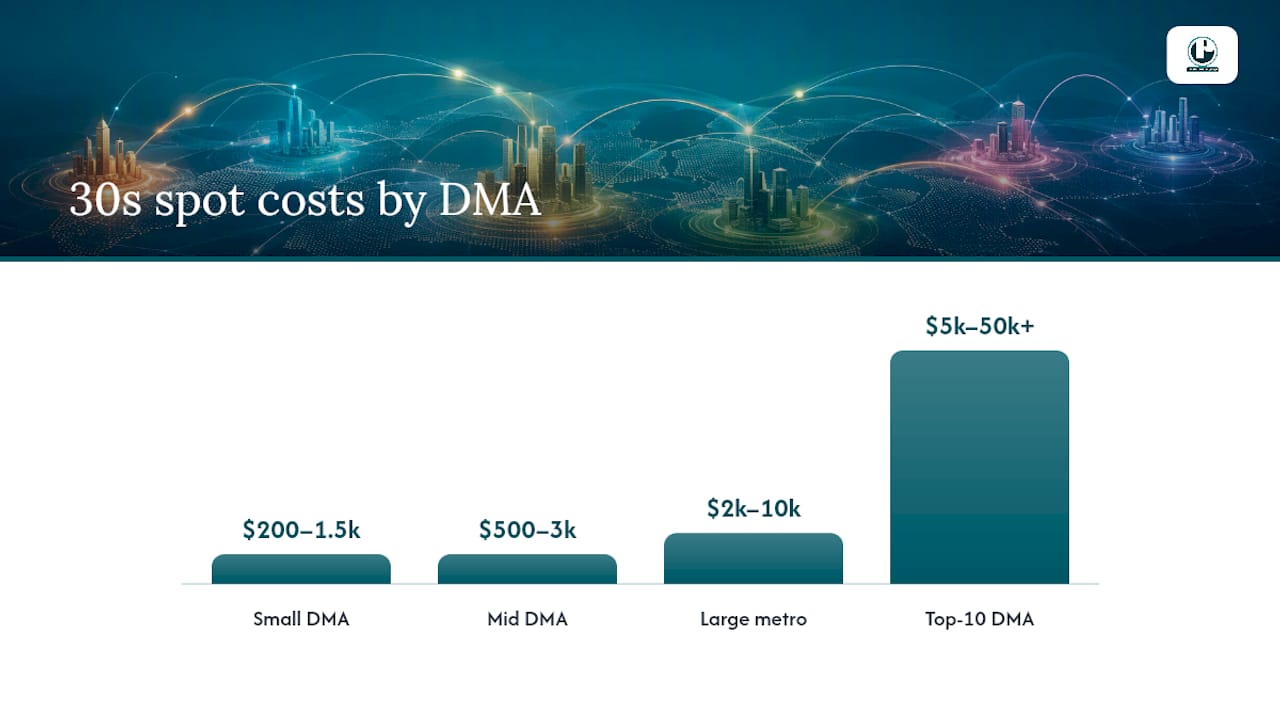
Airtime pricing depends almost entirely on two things: how many people are watching, and how badly the network needs to fill that slot. Local TV runs on a tiered system based on Designated Market Area (DMA) size. Small markets charge $200 to $1,500 per 30-second spot, mid-sized markets run $500 to $3,000, larger metros climb to $2,000 to $10,000, and top-10 markets like New York or Los Angeles can command $5,000 to $50,000 or more for a single airing.
National broadcast operates on a different scale entirely. Primetime spots on major networks typically cost $200,000 to $1 million, and live sports inflate that further, sometimes dramatically. Cable and niche channels sit well below broadcast rates and work well when your audience is narrow: a home-improvement brand advertising on a DIY-focused cable network often pays a fraction of broadcast CPM for a more targeted viewer.
CTV and streaming have become the entry point for smaller advertisers. CPMs run $20 to $65, and monthly campaigns can start as low as $1,000 to $5,000, a minimum no broadcast network can match. That accessibility is part of why CTV ad spending topped $26.6 billion in 2025. Programmatic CTV buys are cheaper and faster to launch, but direct buys from a network’s ad sales team usually get you better inventory and audience guarantees.
Small DMA: $200–$1,500 per spot
Top-10 DMA: $5,000–$50,000+ per spot
National primetime: $200,000–$1M+ per spot
CTV: $20–$65 CPM, $1,000–$5,000 monthly minimums
Three Real Budget Scenarios for TV Commercials
Total cost depends on how you split production and media, and that split should shift with company size and goals.
Small business ($5,000–$25,000 total). Most of this goes to production, since local airtime is comparatively cheap. A common split is $5,000 to $15,000 for a solid local production and $2,000 to $10,000 for a month or two of local spots plus a CTV run, based on common industry budget tiers.
Mid-market ($25,000–$100,000 total). Here the ratio flips. Production might run $15,000 to $40,000 for a polished spot with paid talent, while $25,000 to $60,000 goes toward a regional broadcast buy layered with CTV for frequency.
Enterprise ($100,000+ total). Production alone can reach $50,000 to $250,000 with union talent and multi-location shoots, while national media spend, agency fees, and negotiated broadcast packages absorb the rest, often several hundred thousand dollars or more.
The tradeoff worth understanding: spending more on production rarely improves results if your media budget can’t buy enough reach to matter. A $40,000 commercial airing three times a month in one DMA underperforms a $10,000 spot running consistently across a regional CTV and cable mix.
How to Turn a CPM Quote Into a Real Media Budget
CPM stands for cost per thousand impressions, but the number a media rep quotes rarely matches what you actually pay. Media CPM is the base rate for the airtime itself. Delivered CPM includes verified impressions after the campaign runs, which can differ from projections. Effective CPM factors in every added fee, platform costs, data targeting, and agency markups, divided by actual impressions delivered.
To build a working budget:
Set your impression goal (say, 500,000 impressions in a mid-size DMA).
Multiply by your quoted CPM ($30, for example) divided by 1,000, giving you $15,000 in base media cost.
Add 10% to 20% for frequency capping and audience overlap waste.
Confirm platform fees, data costs, and ad-serving charges, since quoted CPMs often exclude these.
Line Item | Example Cost |
Base media (500K impressions at $30 CPM) | $15,000 |
Waste/frequency buffer (15%) | $2,000 |
Platform/data fees | $1,000–$3,000 |
Estimated total spend | $18,000–$20,000 |
From Brief to Delivered Files: What’s the Timeline?
A standard live-action commercial takes four to six weeks from concept approval to final delivery: one week for scripting and casting, one to two weeks for pre-production, one shoot day, and two to three weeks for editing, color, and sound. Animation or heavy visual-effects work extends that timeline to six to twelve weeks.
Live-action: 4–6 weeks standard
Animation/VFX: 6–12 weeks standard
Rush post-production: adds 25%–50% to editing costs
Weekend/overnight shoots: crew overtime premiums apply
Practical Ways to Cut Cost Without Cutting Impact
Smart budgeting is about buying smarter, not buying less. Remnant and off-peak local TV inventory sells at a steep discount when networks need to fill unsold slots. CTV lets you target precisely at a lower minimum spend than broadcast, which matters if your audience is narrow. Shooting multiple cutdowns, a 30-second, 15-second, and vertical version, in the same session lets you stretch one production budget across several platforms instead of paying for separate shoots.
Buy remnant/off-peak local inventory for steep discounts
Use CTV for lower minimums and tighter targeting
Shoot cutdowns in one session to reuse footage across platforms
Negotiate talent usage windows instead of defaulting to a buyout
Skip custom music licensing unless brand recall depends on it
Pro Tip: Before signing a media contract, ask your rep three questions: What’s the delivered versus quoted CPM? Are there hidden data or platform fees? What remnant inventory is available this quarter? Those three answers alone can save thousands.
Why Puritano’s Two Decades of Commercial Work Matters Here
These ranges aren’t theoretical. Puritano Media Group has produced commercial and branded content for two decades, and the numbers above reflect what actually shows up in client budgets, not aspirational marketing copy.
Puritano’s guide to SAG-AFTRA commercial rates breaks down 2026 session and usage tiers in detail.
Our post on accurate video cost estimates covers the scoping questions that keep quotes honest.
For small and mid-market clients, Puritano typically scopes production in tiers that match the budget scenarios above, matching crew size and shoot days to what the media plan can actually support.
What Actually Drives Commercial Costs in 2026
The conventional advice treats production and airtime as one number, and that’s the single biggest reason small business budgets go sideways. Marketers ask “what does a commercial cost” as if it’s one line item, then get blindsided when a $10,000 production needs another $15,000 in airtime just to be seen by anyone.
Here’s what the numbers actually support: airtime, not production, is where most small businesses underinvest. A beautifully shot spot that airs four times in a month reaches almost nobody. The smarter allocation, based on how CTV pricing and local DMA tiers actually work, is to spend less on production polish and more on frequency. A clean $8,000 production paired with $15,000 in disciplined CTV and local cable buys will outperform a $20,000 production that airs twice.
The other overlooked factor is usage rights. Businesses fixate on the shoot day and forget that a talent contract with an open-ended usage window can quietly double the real cost of a commercial eighteen months later. Ask about usage before you ask about day rate.
— Charlie
Get a Realistic Production Quote Built Around Your Actual Budget
Puritano is the alternative to guessing at line items from a generic pricing guide. Instead of piecing together production estimates from national averages that don’t reflect your market or your goals, you get a scoped quote built around the budget tier that actually fits your business, whether that’s a lean local spot or a regional campaign with CTV layered in. Puritano has spent two decades producing commercial and branded content for businesses that needed real numbers, not inflated agency estimates or DIY guesswork that falls apart on set day.
If you want to see the caliber of work a properly scoped budget buys, browse the music video and commercial portfolio or check out Puritano’s virtual events case study for a sense of project scope and delivery. From there, reach out for a quote built around your market size, your talent needs, and your actual media plan, not a template.
Sources
Recommended
The gap between a local spot and a national one is not only money. It is the number of decisions that have to be right before the camera rolls. Charlie Puritano has directed commercials on 35mm film, a format now reserved for big budget features, and that background shapes how we scope commercial work today. Crew, locations, casting, and post are settled in writing first, so the production serves the media plan instead of competing with it. A commercial earns its airtime when nobody on set is improvising the plan. Specialty work is part of that range: one PMG holiday commercial was built around a slow-motion shot of a splash into Santa's glass of milk, filmed at 1,000 frames per second, the kind of image that only exists when the day is planned around a single perfect moment.


Comments