

Ten Corporate Video Types and When to Use Each One
Updated: 3 days ago

These are the ten corporate video types marketers use most: brand/profile films, product demos and explainers, testimonials and case studies, training and onboarding, recruitment and culture, event recaps, social clips, animated explainers, investor/stakeholder updates, and FAQ or support videos. Each one maps to a different business goal, and picking the wrong one wastes a production budget faster than almost any other marketing decision. Brand films build awareness, explainers move a prospect through consideration, testimonials and demos close deals, and training or FAQ content keeps existing customers and employees productive after the sale. This isn’t a small trend to chase, either: video marketing statistics consistently show video outperforming static content across engagement and conversion metrics. Over two decades of producing all ten formats for clients in the DMV area and nationally, Puritano has learned that the format matters more than the polish.
Awareness: brand/profile films, recruitment/culture videos
Consideration: product demos, explainers, animated explainers
Conversion: testimonials, case studies, event recaps
Retention/internal comms: training, onboarding, FAQ/support, investor updates
Key Takeaways
The right corporate video type matches the business goal, funnel stage, and distribution plan first, with polish and budget decided only after that.
Point | Details |
Match type to goal | Use brand films for awareness, explainers for consideration, testimonials for conversion. |
Plan repurposing early | Capture multiple framed variants and vertical B-roll during the original shoot, not after. |
Runtime follows purpose | Social clips run 15 to 60 seconds; explainers and demos run 1 to 5 minutes. |
Handle legal basics upfront | Secure release forms, confirm music licensing, and add captions before publishing. |
Puritano’s role | Puritano scopes and produces the full range of these formats, from testimonials to virtual event coverage, for DMV and national clients. |
What Are the Main Corporate Video Types and Their Uses?
Every video type below solves a specific business problem. Treat this as a reference you can hand to a producer or an internal stakeholder when you’re scoping a project.
Brand/profile videos. These tell your company’s story and establish identity. Run 90 seconds to 3 minutes, lean heavily on live-action cinematography with a documentary or narrative structure, and belong on your homepage, About page, and LinkedIn. They earn their cost when you’re entering a new market or repositioning after a rebrand, since nothing else builds trust with a cold audience as efficiently.
Product demos and explainers. These show how something works and why it matters. StudioBinder recommends keeping these to 1 to 5 minutes depending on complexity, using a mix of screen capture, live action, or simple motion graphics. Place them on product pages and in sales decks. They justify their cost whenever your product has a learning curve a headline can’t explain.
Testimonials and case studies. Real customers describing real results, shot simply with one or two cameras in a natural setting. Keep these to 1 to 3 minutes. Testimonial runtimes and effectiveness data show this format punches far above its production cost for closing deals, because a low-budget testimonial with an authentic voice usually outperforms a slick ad. Distribute on product pages, sales follow-ups, and case study pages.
Training and onboarding. These reduce support tickets and shorten ramp time for new hires. Length varies by module, typically 3 to 10 minutes each, and production style is usually simple: screen recordings, slides, or a presenter on camera. Host these in your LMS or an internal knowledge base. A modular shoot with simple edit templates lets you update individual segments without a full reshoot, which matters for content that needs refreshing every year or two.
Recruitment and culture videos. These sell your workplace to candidates, not customers. Run 1 to 3 minutes, favor a documentary style with real employees, and publish on careers pages, LinkedIn, and Indeed listings. They earn their keep in tight labor markets where candidates are comparing culture as much as compensation.
Event recaps. These capture energy from a conference, product launch, or internal town hall and extend its life for months. Keep the main recap to 2 to 4 minutes, with a live-action, fast-cut style, and publish on YouTube, LinkedIn, and internal channels. If you’re covering a hybrid or fully virtual event, the distribution planning matters as much as the shoot itself.
Social clips, ads, and shorts. Fifteen to 60 seconds, vertical or square, fast-paced, and built for sound-off viewing. These rarely justify a standalone shoot. Instead, they’re the payoff from repurposing longer content, which is why practical repurposing examples treat them as a byproduct of smarter planning, not a separate line item.
Animated explainers. When a concept is too abstract or technical for live action, animation clarifies it. Typical runtime is 60 to 120 seconds. These cost more per second than live action but less overall once you factor in locations, talent, and crew. Use them for financial products, software workflows, or anything involving data you can’t film.
Investor and stakeholder videos. Quarterly updates, annual reports, or capital raise pitches. Run 3 to 7 minutes, usually a hybrid of presenter footage, data visualization, and B-roll. These rarely go public, but they carry outsized weight with the audience that sees them.
FAQ and support videos. Short, specific answers to common customer questions, 1 to 2 minutes each, usually screen capture plus voiceover. Host on your help center and YouTube. They reduce support load and build trust with customers already past the sale.
Pro Tip: Plan your repurposing before the camera rolls, not after. A shoot designed for repurposing should capture two or three framed variants per interview, tight, medium, and wide, plus B-roll shot for both vertical and square crops. Retrofitting a widescreen brand film into a square Instagram post after the fact always looks like exactly what it is.
If you’re weighing which format drives which outcome, the pattern holds up across most industries: testimonials and case studies build trust, explainers handle education, and brand films or social content build reach. Trying to make one video do all three jobs is the single most common way budgets get wasted.
How Do You Choose the Right Corporate Video Type?
Start with four questions before you write a single line of script:
What is the primary objective? Awareness, education, conversion, retention, or hiring.
Who is the audience? Cold prospects need a different tone than existing customers or job candidates.
What is the distribution plan? A video built for a homepage hero doesn’t work as a LinkedIn ad.
What is the budget and timeline? A one-day shoot yields different options than a multi-day production.
From there, apply a simple matching framework: match production complexity to message complexity, match runtime to platform attention spans, match budget tier to expected reach, and match content lifecycle to how often you’ll need updates.
Before hiring a production partner, ask these five scoping questions:
What deliverables are included, and how many versions per platform?
Will you shoot for repurposing, and what additional assets does that add?
What’s the full timeline from kickoff to final delivery?
Who owns the raw footage and usage rights afterward?
How many rounds of revisions are built into the quote?
Watch for three red flags: a vendor recommending a format that doesn’t match your funnel stage, no repurposing plan discussed at the shoot planning stage, and a strong production budget with nothing allocated for distribution. A great video nobody sees isn’t a great investment.
Why Puritano’s Production Experience Matters Here
Puritano has produced brand films, virtual event packages, testimonials, and training modules for organizations across the DMV area and nationally for more than 20 years. That range across formats is what shapes the best practices below:
Start with a story-first brief, not a shot list, since human-centered narratives consistently outperform generic marketing tone.
Plan repurposing at the shoot, not in the edit bay.
Choose format based on funnel stage, never on whatever style is trending.
What Emerging Corporate Video Formats Should You Watch?
A few newer formats are worth understanding even if they’re not yet a default choice for most budgets. Virtual reality and 360 degree video let viewers explore a facility, campus, or product environment from inside the frame rather than watching it from a fixed camera angle. These work well for real estate, manufacturing tours, or complex physical spaces, but they demand specialized equipment and a viewer willing to engage more actively than with a passive video, so reach tends to stay narrow.
Interactive video, where viewers click choices that change the path of the content, shows real promise for training and onboarding. A new hire can branch into role-specific modules instead of sitting through generic content that doesn’t apply to their job. The production complexity is higher than a standard training video, since you’re essentially building several linked videos instead of one, but the maintenance benefit from modular structure carries over here too.
CEO or president messages deserve their own mention because they’re deceptively simple to produce and easy to get wrong. A leader speaking directly to camera, unscripted or lightly scripted, works best for moments that call for authenticity, like a crisis response, a major company milestone, or an annual address to stakeholders. The temptation is to over-produce these with heavy graphics and music. Resist it. The format’s entire value comes from the leader feeling human, not polished.
None of these formats should be your first video. They’re additions once your core catalog, brand films, explainers, testimonials, training, is already working.
What Legal and Compliance Issues Do Corporate Videos Raise?
Every corporate video carries legal exposure most teams don’t think about until something goes wrong. Get signed release forms from every employee, customer, or bystander who appears on camera, especially in testimonials and culture videos where real people are the entire point. Without a release, you may not have the right to use that footage commercially, even if the person verbally agreed on set.
Music and stock footage licensing trips up more projects than almost anything else. A track that sounds perfect for your brand film can trigger a copyright claim or takedown if the license doesn’t cover the platforms you’re using it on, so confirm usage rights cover web, social, and paid advertising specifically, not just “commercial use” in general.
Accessibility matters both legally and practically. Closed captions aren’t optional anymore for most corporate video, since a large share of social video gets watched with sound off, and captions also support compliance with accessibility standards like the ADA for public-facing content. Add audio descriptions for training content when visual details carry meaning that a caption alone can’t convey.
Finally, if your video touches financial results, health claims, or regulated industries, loop in legal review before publishing, not after. A recruitment video overstating benefits or an investor update implying guaranteed returns creates liability that’s expensive to unwind after the fact.
How Do You Measure Corporate Video Performance?
Match your metrics to the goal you set for each video type, because a single dashboard number rarely tells the full story. Brand films should be judged on reach, watch time, and brand recall, not clicks, since awareness content isn’t supposed to convert immediately. Product demos and explainers deserve a closer look at completion rate and click-through to the next page, since a viewer dropping off at the two-minute mark tells you exactly where the content lost them.
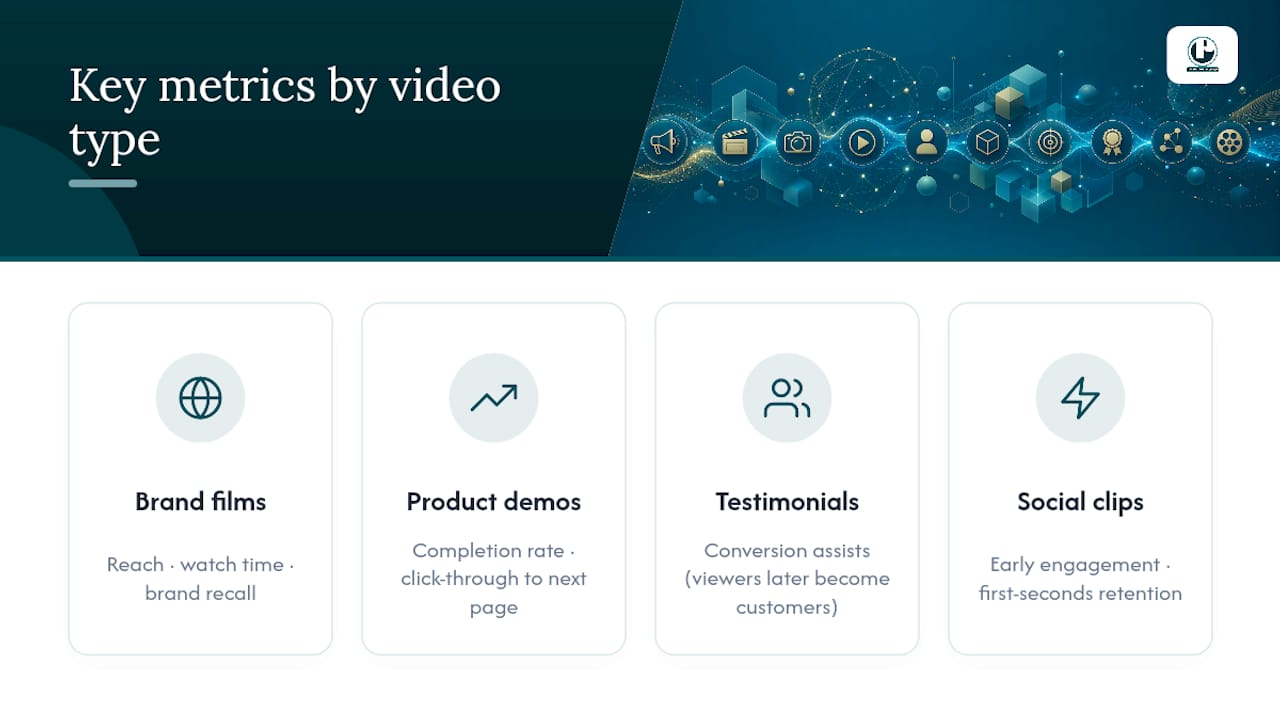
Testimonials and case studies are best measured against conversion assists, meaning how often someone who watched one later became a customer, even if the video wasn’t the last touchpoint. Training and onboarding content should be tracked through completion rates and, where possible, downstream performance metrics like faster ramp time or fewer support tickets. Social clips live and die by early engagement, the first few seconds of retention usually predict whether the algorithm keeps showing it.
Set a baseline before you launch a new format, then compare apples to apples. A common mistake is comparing a 3 minute brand film’s completion rate to a 15 second social clip’s completion rate; those numbers were never meant to be judged on the same scale. Review performance quarterly and feed what you learn back into your next production brief, rather than treating each video as a one-off.
A Note on Getting the Format Wrong
The most common mistake we see isn’t a bad script or a shaky camera. It’s a company commissioning a polished brand film when what they actually needed was three testimonials, or building a training series with no plan to update it a year later. Puritano spends more time on scoping conversations than most clients expect, precisely because catching a mismatched format before the shoot saves far more than fixing it in the edit.
Ready to Scope Your Next Corporate Video?
You’ve got other options for getting a corporate video made: an in-house team stitching something together, a freelancer for a single project, or a large agency with overhead built into every invoice. Puritano offers a different path: a dedicated production partner who scopes the right format for your actual goal, handles full production, and builds repurposing into the plan from day one instead of charging extra for it later. With more than 20 years producing brand films, testimonials, training modules, and live event coverage for clients across the DMV area and nationally, Puritano brings the range to match format to objective rather than defaulting to whatever’s trendy. If you’re planning coverage for an upcoming conference or town hall, the virtual events portfolio and case study shows how that work comes together. For a look at narrative-driven production quality, the music video portfolio is worth a look too. Ready to talk specifics? Reach out to request a scoped estimate for your project.
Frequently Asked Questions
What are the most common corporate video types businesses use?
The most common types are brand/profile films, product demos and explainers, testimonials and case studies, training and onboarding videos, recruitment and culture videos, event recaps, social clips, animated explainers, investor updates, and FAQ or support videos. Most organizations need a handful of these, not all ten, depending on their funnel stage and internal needs.
How long should a corporate video be?
It depends entirely on the type and platform. Social clips run 15 to 60 seconds, testimonials run 1 to 3 minutes, explainers and demos typically run 1 to 5 minutes, and training modules vary by topic but often land between 3 and 10 minutes each.
Should a corporate video be live action or animated?
Live action works best when you’re building trust through real people, like testimonials, culture videos, or CEO messages. Animation works better for abstract or technical concepts that are hard or impossible to film, like data flows or financial processes.
How much does a corporate video cost to produce?
Cost depends on production complexity, crew size, and length, with simpler testimonial-style videos costing far less than a fully animated explainer or a multi-day brand film shoot. Get a scoped estimate based on your specific deliverables rather than relying on industry averages.
What corporate video type converts best?
Testimonials and case studies tend to have strong conversion impact because they provide social proof at relatively low production cost, while brand films and social content are better suited to building awareness and reach rather than closing deals directly.
Sources
Recommended
Animated explainers earn their slot on this list when the subject cannot be filmed at all. For Amgen, we explained biologics and biosimilars, among the hardest subjects in modern medicine, in a five-minute animated film made for the public and for regulators. No camera could have shown that material directly, so original animation carried the explanation instead of talking around it. When you choose among the ten types, that is the test: pick the format that can actually show what your audience needs to understand.


Comments