

Corporate Video Distribution Channels Explained for Marketers
Updated: 3 days ago

Corporate video distribution channels are the owned, earned, and paid platforms businesses use to deliver video content to specific audiences with measurable reach and engagement. Most marketing teams invest heavily in production and treat distribution as an afterthought. That’s the wrong order. Where your video lives determines how it performs, who sees it, and whether it drives any business result at all. This article breaks down every major channel category, compares the top corporate video sharing platforms, and gives you a practical framework for building a distribution strategy that actually works.
What are the main types of corporate video distribution channels?
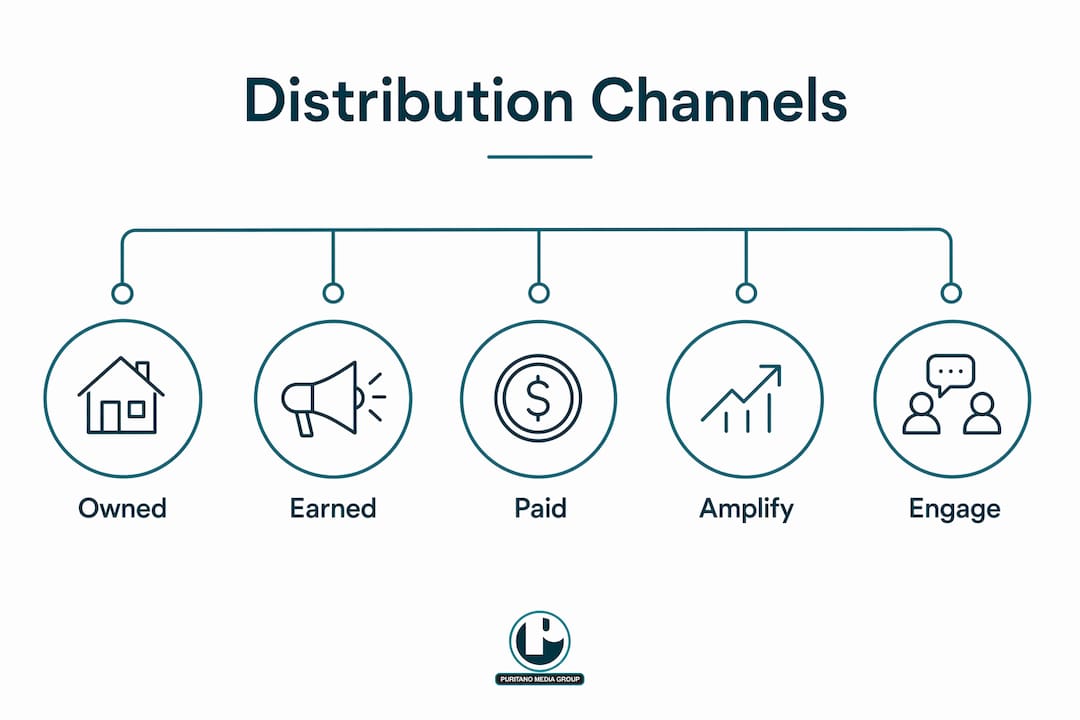
The standard industry framework for video distribution divides channels into three categories: Owned, Earned, and Paid. Each serves a different function, and the most effective video marketing strategies use all three in combination.
Owned channels are platforms you control directly. Your company website, branded video player, email list, and LinkedIn company page all qualify. These channels are the foundation of any distribution plan because algorithms can’t remove your control over them. You capture audience data, control the viewing experience, and maintain brand consistency without depending on a third-party platform’s rules.
Earned channels include organic social shares, press coverage, influencer amplification, and editorial syndication. You don’t pay for this reach directly. A well-produced corporate video shared by a respected industry voice on LinkedIn, or picked up by a trade publication, generates credibility that paid placements rarely match. The trade-off is that earned distribution is unpredictable and hard to scale on demand.
Paid channels cover video ads on YouTube, Facebook, LinkedIn, and connected TV (CTV) platforms, along with sponsored content and promoted posts. Paid distribution gives you precise audience targeting and predictable reach, but it requires ongoing budget and careful optimization to stay cost-effective.
The goal of a well-structured plan is to drive traffic toward owned assets while using paid and earned channels to amplify reach. Think of owned channels as your home base and paid or earned channels as the roads that bring people there.
Pro Tip: Build every campaign around a destination on your owned channel first. Whether that’s a landing page, a gated video, or an email sequence, paid and earned efforts should funnel viewers somewhere you control.
How to choose the best video distribution channels for your goals
Choosing the right channels is not about being everywhere. It’s about matching your content, your audience’s behavior, and your business objective to the platforms where those three things align.
Here’s a practical process for making that call:
Define your audience’s mindset on each platform. A LinkedIn user scrolling during a lunch break is in a professional, information-seeking mode. A Facebook user in the evening is in entertainment mode. The same corporate video will land differently in each context, and audience mindset shapes platform expectations before you even hit play.
Match video length to platform requirements. Facebook in-stream ads require videos of at least 3 minutes to qualify, and 5 to 10 minute videos consistently generate the highest RPMs on that platform. TikTok and Instagram Reels reward content under 60 seconds. Forcing a single cut to work everywhere is a reliable way to underperform on all of them.
Audit your existing audience data. Where does your web traffic originate? Which social platforms already drive engagement for your brand? Start with channels where you have existing traction before expanding to new ones.
Align channel selection with campaign objectives. Brand awareness campaigns favor YouTube pre-roll and CTV. Lead generation campaigns favor LinkedIn video ads with gated content. Internal communications favor your intranet or a branded video player with access controls.
Plan distribution before production begins. This is the step most teams skip. Distribution planning before filming prevents the common problem of finishing a video and realizing it doesn’t fit any channel well. Knowing your channels in advance shapes decisions about aspect ratio, pacing, intro timing, and caption placement.
Pro Tip: When you’re planning a corporate video shoot, add a distribution brief to your pre-production checklist. List the three primary channels, their format requirements, and the audience mindset for each. Your editor will thank you.
Comparing top corporate video sharing platforms
Not all platforms serve corporate video equally. Here’s how the major options stack up for marketing professionals.
A few points worth expanding on. LinkedIn is the workhorse of corporate video distribution for B2B brands. Native video uploads on LinkedIn consistently outperform links to external platforms because the algorithm rewards content that keeps users on-site. That means uploading your video file directly rather than sharing a YouTube link, even if the same video lives on YouTube.
YouTube remains the strongest channel for search-driven discovery. A well-optimized corporate explainer video on YouTube can generate organic views for years. That’s a different value proposition than LinkedIn or Facebook, where content has a short shelf life in the feed.
CTV and FAST (Free Ad-Supported Streaming TV) platforms represent a growing opportunity for enterprise brands. Corporate video channels now extend to connected TV, editorial syndication within news portals, and podcast directories, which means a single video asset can reach audiences across screens and formats that didn’t exist as distribution options five years ago.
For repurposing corporate video across platforms, the key is editing for each channel rather than cross-posting a single file. A 90-second LinkedIn cut, a 15-second Instagram Reel, and a 6-minute YouTube version can all come from the same shoot day.
How technology tools enhance corporate video distribution
At enterprise scale, manual distribution breaks down fast. Uploading individual files, writing custom metadata, and tracking performance across six platforms is not a sustainable workflow for a team managing dozens of video assets per quarter.
Enterprise Video Content Management (EVCM) systems solve this problem. These platforms automate distribution workflows, handle format conversion, and manage metadata across channels from a single interface. MRSS feeds within EVCM systems propagate content and metadata updates across platforms automatically, so a change made in one place reflects everywhere the video is published.
Beyond EVCM platforms, tools like Wistia and Brightcove provide branded video players for owned channel distribution, with built-in lead capture forms and viewer analytics. These are particularly valuable for gated content, product demos, and e-learning modules where you need to know exactly who watched what and for how long.
Scheduling is another underused lever. Publishing LinkedIn videos between 8 and 10 AM or 12 and 2 PM improves algorithmic reach because those windows align with peak professional activity. Instagram performs better in the evenings. Platform-specific scheduling is a detail most marketing teams overlook, but it compounds over time into meaningfully better organic performance.
Pro Tip: If your team manages more than 10 video assets per month across multiple platforms, an EVCM system pays for itself in time savings alone. Start by auditing how many hours per month go into manual uploads and metadata entry.
For teams thinking about aspect ratio and format decisions, those choices need to be made before the edit, not after. EVCM tools can convert formats, but they can’t fix a video that was framed for widescreen when the primary channel is vertical.
Key takeaways
Effective corporate video distribution requires matching owned, earned, and paid channels to specific audience behaviors, platform requirements, and campaign objectives before production begins.
Why distribution should be the first conversation, not the last
Here’s what I’ve learned after working on corporate video projects across industries: the teams that get the best results from their video investments are the ones who treat distribution as a creative constraint, not a logistics task.
When you know a video is going on LinkedIn before you shoot it, you frame your interviews differently. You write a hook that lands in the first three seconds because LinkedIn autoplay is silent. You keep the runtime under two minutes because that’s where attention holds on that platform. Platform fit affects framing, intro timing, and runtime in ways that can’t be fixed in post if the footage wasn’t captured with those constraints in mind.
The most common mistake I see is a team spending significant budget on a beautifully produced corporate video, then uploading it to YouTube and sharing the link on LinkedIn. That single decision costs them reach, engagement, and ROI. The video deserved better. So did the budget.
The other pattern worth calling out is over-reliance on paid distribution to compensate for weak owned channel infrastructure. Paid amplification works, but it rents you an audience. Building your email list, your website video library, and your LinkedIn following gives you an audience you own. The short-form video impact on social platforms is real, but it’s most powerful when it drives viewers back to content you control.
Distribution is not the last step in a video project. It’s the first question you should ask.
How Puritano can support your video distribution strategy
Puritano Media Group has spent over two decades producing corporate videos, branded content, and multi-platform campaigns for clients across the Washington D.C. area and nationally. We don’t just deliver a finished video file. We think through distribution from the first planning conversation, which means your assets are built for the channels where they’ll actually live.
Whether you need a LinkedIn-optimized thought leadership series, a long-form YouTube brand film, or a full suite of platform-adapted cuts from a single production day, our team handles the creative and technical decisions that make distribution work. Explore our corporate video production services to see how we approach projects from strategy through delivery. If you’re running virtual events or need case study content, our virtual events portfolio shows what’s possible when production and distribution are planned together.
FAQ
What are corporate video distribution channels?
Corporate video distribution channels are the platforms and methods businesses use to share video content with specific audiences, including owned channels like websites and email, earned channels like organic social shares, and paid channels like video ads on LinkedIn or YouTube.
Why does native video upload matter on social platforms?
Native video uploads on platforms like LinkedIn and Facebook are rewarded by their algorithms over external links, resulting in higher organic reach and engagement for the same content.
How long should a corporate video be for Facebook ads?
Facebook in-stream ads require videos of at least 3 minutes, and videos between 5 and 10 minutes consistently generate the highest ad revenue per thousand views on that platform.
What is an Enterprise Video Content Management system?
An EVCM system automates video distribution across multiple platforms using MRSS feeds, handles format conversion, and centralizes metadata management, making it practical for teams managing large volumes of video content.
Should distribution be planned before or after video production?
Distribution should be planned before production begins. Knowing your target channels in advance shapes creative decisions including aspect ratio, intro timing, caption placement, and video length, all of which directly affect performance.
Recommended
Distribution planning belongs at the front of a production, not after the edit locks. When we scope a project, the deliverables list is settled before filming: the full piece, the cutdowns, the clips, each shaped for the channel where it will live. A video cut only for a website and then squeezed into social feeds performs like an afterthought because it is one. Deciding the destinations first means every channel gets a version built for it, and the archive keeps feeding channels later.


Comments