

Event Videography vs Photography Explained for Planners
Updated: 5 days ago

Event videography records moving images, sound, and narrative over time, while event photography captures still moments frozen in a single frame. Understanding the event videography vs photography comparison is the first decision every event planner faces when building a media budget. Get it wrong and you end up with beautiful photos nobody uses, or a video that never gets posted. This guide breaks down the core differences between video and photo, the real cost and delivery gaps, and how to match each format to your post-event goals in 2026.
What are the core differences between event videography and photography?
Event videography and photography are fundamentally different animals, not just different tools. Videography captures motion, ambient sound, speaker audio, crowd energy, and a sequence of events that builds into a story. Photography captures a single decisive moment with no sound, no movement, and no before-or-after context.
The equipment gap is real. A professional videographer arrives with cameras, audio recorders, lavalier microphones, stabilizers, and lighting rigs. A photographer works with a camera body, lenses, and flash. That difference in gear is one reason videography costs more than photography on average.
The skill sets also diverge sharply. Photographers train to read light, anticipate moments, and compose frames in a fraction of a second. Videographers must manage all of that while also tracking audio levels, maintaining motion continuity, and thinking in sequences rather than single shots. Both disciplines require years of practice, but they reward very different instincts.
Here is a direct breakdown of the key differences:
Motion and sound: Videography captures both; photography captures neither.
Narrative structure: Video tells a story with a beginning, middle, and end. Photos document individual highlights.
Editing complexity: Video editing involves layered sound design, color grading, motion continuity, and sequence construction. Photo retouching is a faster, lighter process.
Delivery timeline: Photographers typically deliver initial highlight images within 24 hours. Videographers need 1–2 weeks for a polished final cut.
File size and storage: A one-hour event video can exceed 100 GB of raw footage. A full day of photography rarely tops 10 GB.
Audience experience: Viewers watch video passively and absorb emotion through sound and movement. Photo viewers actively scan and select what resonates.
Understanding these differences between video and photo is not academic. It directly shapes your budget, your vendor briefing, and how useful your assets will be after the event closes.
How do cost, delivery, and file handling compare?
Budget is where the event video vs photo decision gets concrete. Videography services cost 50–80% more than photography on average, driven by heavier equipment, longer shoot days, and a far more labor-intensive editing process. That premium is consistent across markets.
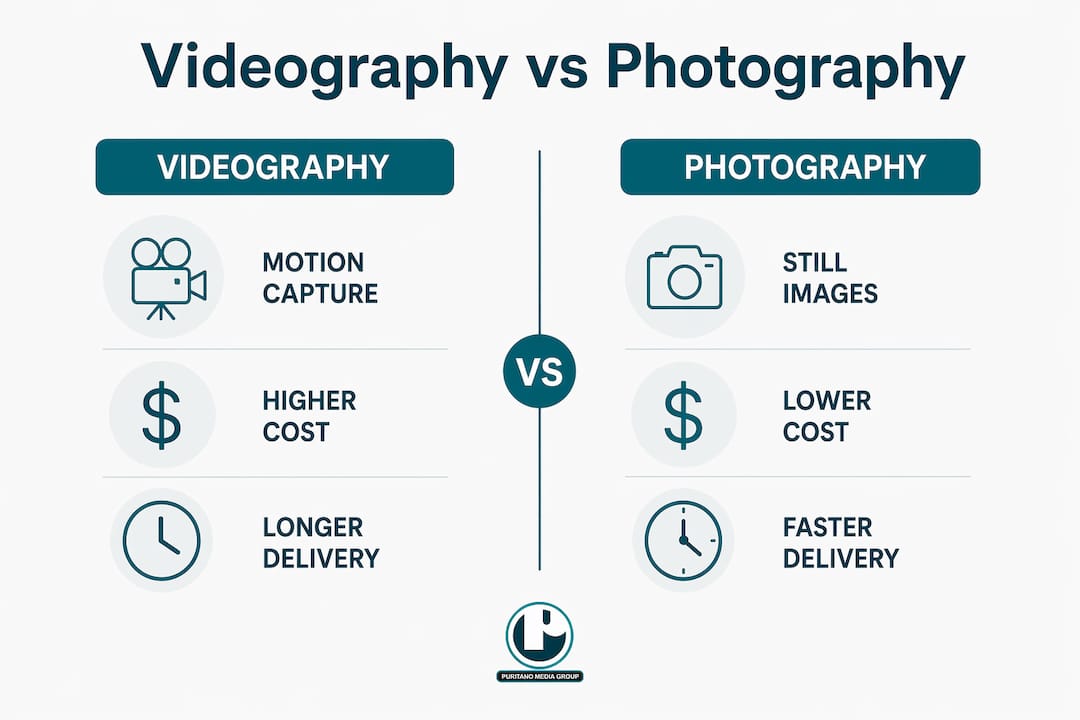
Delivery timelines matter more than most planners realize. If your event ends on a Friday and you need content live by Monday morning, photography is your only realistic option for that window. Videography simply cannot compress a full edit into 48 hours without cutting quality. Plan your content calendar around these realities before you sign any contracts.
File handling is a practical headache that rarely comes up in vendor conversations. Raw video files are enormous. Make sure your vendor specifies how long they retain footage, what format they deliver, and whether cloud storage is included. Photographers usually deliver web-optimized JPEGs and high-resolution TIFFs with no storage drama.
Pro Tip: Ask every vendor to define deliverables in writing before the event. Specify the number of edited photos, the length of the final video cut, and whether a short-form social clip is included. Vague contracts are the number one source of post-event disappointment.
What post-event uses favor video or photography?
The format you choose should follow the assets you plan to use, not the other way around. Event media decisions driven by planned asset use consistently outperform those made on instinct or habit.
Photography excels in these post-event contexts:
Website updates: Hero images, speaker galleries, and sponsor recognition pages all require high-resolution stills.
Sponsor and partner decks: A clean, well-lit photo of your keynote speaker on stage is worth more in a pitch deck than any video screenshot.
Press and PR submissions: News outlets and trade publications almost always request still images, not video files.
Internal reports and board presentations: Leadership teams reviewing event ROI want clean, professional stills they can drop into slides.
Print materials: Brochures, programs, and signage for future events all draw from your photo library.
Videography excels in these contexts:
Social media reels and short clips: Short-form video under 60 seconds is the highest ROI content format for events in 2026. A 30–60 second recap clip consistently outperforms static posts in reach and engagement.
Speaker and interview content: A recorded keynote or panel discussion becomes a reusable training asset, a podcast episode, or a thought leadership piece.
Performance and product demo coverage: Music, dance, product launches, and live demonstrations lose their impact entirely in a still image.
Email campaigns and landing pages: Autoplay video on a post-event landing page drives significantly higher time-on-page than a photo gallery.
Sales enablement: Professional event video acts as visual social proof that shortens sales cycles by reducing perceived risk for prospective partners and clients.
The importance of event videography becomes clearest when you map it to distribution channels. If your post-event plan includes Instagram Reels, LinkedIn video posts, or YouTube recaps, video is not optional. If your plan centers on a website refresh and a press release, photography may be all you need.
When does combining both formats make sense?
Combining videography and photography makes sense for events where you need to serve multiple audiences and distribution channels simultaneously. A corporate conference with a sponsor deck, a social media campaign, and a post-event email series genuinely needs both formats. A small internal team meeting probably does not.
Here is a practical framework for deciding when to combine:
Map your deliverables first. List every asset you plan to produce after the event. If the list includes both a highlight reel and a press photo gallery, you need both formats.
Consider B-roll as a cost-efficient add-on. B-roll footage captured by photographers gives you short motion clips for social media without the full cost of a videography package. This works well for ambient coverage like registration, networking, and room setup. It is not a substitute for a full video production, but it fills gaps effectively.
Avoid splitting your budget too thinly. Investing fully in one medium consistently outperforms diluting resources across both. A strong photography package beats mediocre coverage of both formats every time.
Name your deliverables explicitly in the brief. Tell your vendor: “We need 150 edited photos, a 90-second highlight reel, and three 30-second social clips.” Vague briefs produce vague results.
Match vendor specialization to your primary need. If video is your priority, hire a videographer and ask about B-roll photography as an add-on. If photos are primary, hire a photographer and discuss whether short motion clips are within their scope.
Pro Tip: For events where short-form video is a priority, brief your videographer on social formats before the shoot, not after. Knowing the final cut is 30 seconds changes how they capture footage on the day.
Key takeaways
The right format choice between event videography and photography depends entirely on how you plan to use your assets after the event. Here’s an example PMG project where we shot both a corporate marketing video and still headshots on one shoot: https://www.instagram.com/p/DXz0JG4CQBJ/?igsh=cnNnZml3eHdobDE=
What I’ve learned after two decades of event coverage
Here is something I see repeatedly: planners book a photographer or a videographer based on what they did last year, not based on what they actually need this year. The event changes, the marketing strategy changes, but the vendor brief stays the same. That is a real problem.
The most common misconception I encounter is that video is always the premium choice and photography is the fallback. That is not true. For a trade association publishing a quarterly magazine and updating a sponsor portal, professional photography is the higher-value asset. For a nonprofit running a fundraising campaign on Instagram and LinkedIn, a 45-second recap video will outperform a photo gallery by a wide margin. The format question is always a distribution question first.
I have also watched organizations waste significant budget trying to do both formats at half the quality. A rushed photographer and an underpaid videographer produce assets that nobody uses. One well-executed format, planned with clear deliverables and a real content calendar, produces assets that work for months. That lesson took a few painful client conversations to fully absorb, but it holds across every event type we cover.
The 2026 trend worth watching is the demand for event video storytelling that goes beyond a highlight reel. Clients increasingly want narrative-driven short films from their events, not just a montage with music. That shift raises the bar for videography and makes the format choice even more consequential. If you are going to invest in video, invest in a team that understands story structure, not just camera operation.
My honest recommendation: start with your post-event content calendar. Work backward from the assets you need. Then brief your vendor with specifics. That sequence produces better results than any other approach I have seen.
How Puritano approaches event media coverage
At Puritano, we have spent over two decades helping organizations in Washington D.C. and nationally get the most from their event media investments. Whether you need a full corporate video production package with photography, a short-form social campaign built from live event footage, or a virtual event covered end to end, we scope every project around your actual deliverables. We do not sell formats. We build coverage plans that match your marketing goals. If you are planning an event and want a clear-eyed conversation about what you actually need, reach out to the Puritano team. We will tell you exactly what will work and what will not.
FAQ
What is the main difference between event videography and photography?
Event videography captures motion, sound, and narrative over time, while event photography captures single still moments. The right choice depends on how you plan to use the assets after the event.
Should i hire a videographer or a photographer for my event?
Hire a videographer if your post-event plan includes social media reels, speaker interviews, or performance coverage. Hire a photographer if you primarily need website images, press materials, or sponsor decks.
How much more does event videography cost than photography?
Videography services cost 50–80% more than photography on average, reflecting heavier equipment requirements and a significantly longer editing process.
Can a photographer also capture video at my event?
A photographer can capture B-roll clips as a cost-effective add-on for social media use. This is not a replacement for full videography production, but it works well for ambient coverage.
What is the best event content format for social media in 2026?
Short-form video under 60 seconds delivers the highest engagement and ROI for event content on social media platforms in 2026.
Recommended
The choice between the formats usually settles once a client sees what motion gives them that stills cannot. Our longest running association relationship, the Washington Building Congress, covers events, member stories, and advocacy, including Hall of Fame films honoring master craftsmen in stone and the building trades. A photograph can honor a craftsman. Film lets him explain his trade in his own voice while his hands are working. For planners, that difference is the argument for building video into the event from the start.


Comments