

SAG Commercial Rates 2026: What Producers Need to Budget
Updated: Aug 21

Year 2 of the SAG-AFTRA Commercials Contract took effect on April 1, 2026, raising wages and use fees by a moderate fixed percentage for new commercials, unpermitted edits, and MPU renewals through March 31, 2027. That’s the number every production manager needs before touching a budget spreadsheet this quarter. The SAG-AFTRA Production Center rate sheet has the official line items, and the Commercial Payment Calculator turns those numbers into real payment outputs without you doing the math by hand.
Here’s what you need to know right now:
The increase: a moderate fixed percentage increase on wages and use fees for the Year 2 cycle, part of a scheduled multi-year increase.
The window: Applies to bookings, unpermitted edits, and MPU renewals dated between April 1, 2026 and March 31, 2027.
The exemptions: Class A per use, all Cable rates, Streaming Platforms, and Traditional Digital with Paid YouTube are explicitly exempt from the increase.
The P&H baseline: Pension & Health contributions sit at 23.5% of applicable compensation, with a discounted 19.95% rate available to certain JPC-authorized signatories.
If you produce commercials, book talent, or manage payroll for agency clients, that April 1 date is the line between Year 1 pricing and Year 2 pricing. Get it wrong and you’re either underbilling your client or shortchanging a performer, neither of which is a good Monday.
Key Takeaways
Point | Details |
Effective date | Year 2 rates apply to bookings, edits, and MPU renewals from April 1, 2026 through March 31, 2027. |
Increase amount | Non-exempt wages and use fees rise 4%, following a 5% Year 1 increase and a scheduled 3% Year 3 increase. |
Exempt categories | Class A per use, all Cable rates, Streaming Platforms, and Traditional Digital with Paid YouTube stay flat. |
P&H rates | Standard contribution is 23.5% of applicable compensation, with a discounted 19.95% rate for qualifying signatories. |
MPU renewal risk | Any MPU renewing inside the Year 2 window must be recalculated at Year 2 rates, regardless of the original booking date. |
What Changed Under Year 2 of the 2026 SAG Commercial Contract?
Year 2 dials that back slightly to 4%, but it’s still a real cost increase that hits every non-exempt session fee, use fee, and renewal that falls inside the April 1, 2026 to March 31, 2027 window. It’s a scheduled climb producers should be baking into multi-year campaign forecasts now.
The trigger isn’t the shoot date alone. Three types of transactions activate Year 2 rates:
New commercials produced on or after April 1, 2026.
Unpermitted edits made to existing spots after that date, which can reset the applicable rate.
MPU renewals (more on those in a moment) that fall due during the Year 2 window.
That last category catches more producers off guard than the other two combined. A commercial shot in 2025 under Year 1 rates can still owe Year 2 money the moment its MPU comes up for renewal in, say, June 2026.
The JPC bulletin issued ahead of the effective date spells this out plainly for signatories:
Year 2 rates are in effect as of April 1, 2026, and apply to new commercials, unpermitted edits, and MPU renewals occurring between April 1, 2026, and March 31, 2027. Signatory producers should update payroll systems and budget templates accordingly.
That’s not a suggestion. It’s a compliance notice, and the JPC exists specifically to keep signatories aligned on exactly this kind of contract mechanic. If your production has open questions about how a specific booking classifies, the SAG-AFTRA Production Center fields those calls directly rather than leaving you to guess from a PDF.
Which SAG Commercial Rates Increased and Which Are Exempt?
This is where budgeting errors happen most often, and honestly, it’s an easy mistake to make. Not every rate category moves with the Year 2 increase. Some are explicitly frozen, and treating a frozen rate as if it got the 4% bump means you’re either overcharging your client or padding a line item that shouldn’t exist.
Rate category | Year 2 status |
Standard session fees (on-camera and off-camera) | Increased 4% |
Wild spot and general use fees | Increased 4% |
Class A per use | Exempt, no increase |
Cable rates (all categories) | Exempt, no increase |
Streaming Platforms | Exempt, no increase |
Traditional Digital with Paid YouTube | Exempt, no increase |
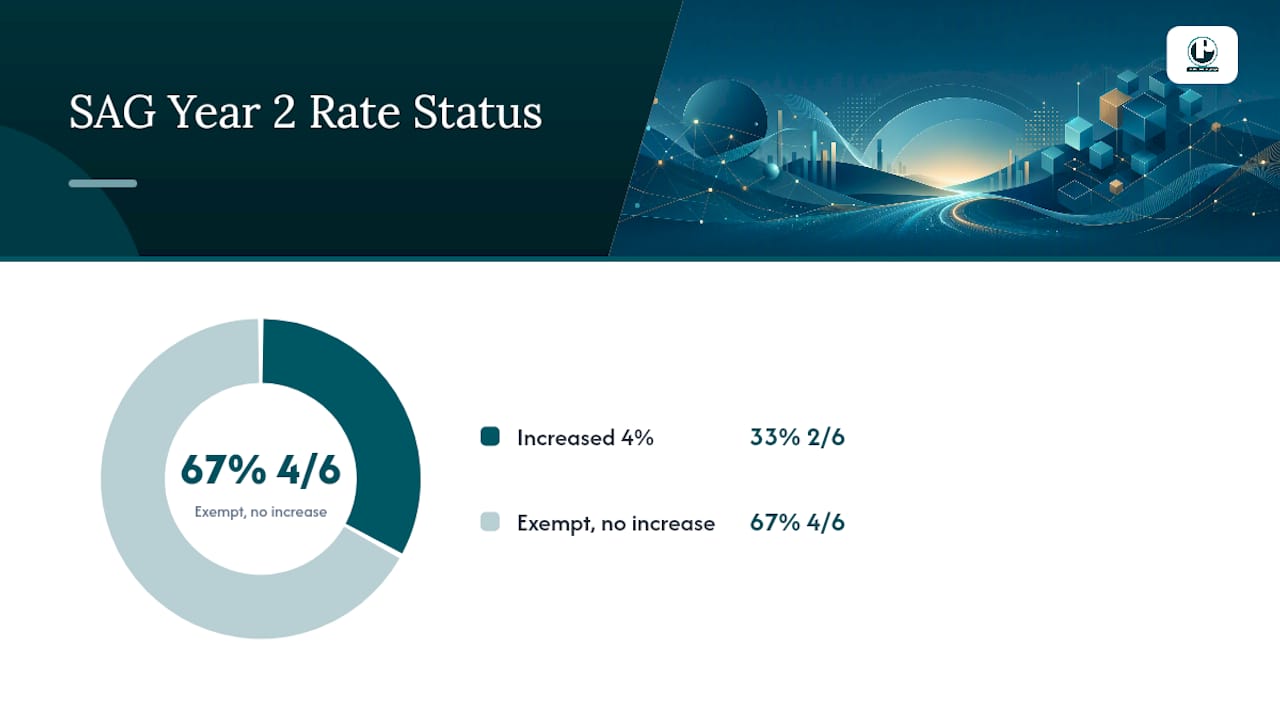
The exemption list matters more than the increase itself for a lot of digital-first campaigns. If your buy leans heavily on paid social and streaming placements rather than broadcast, you may see far less budget movement than a producer running a traditional broadcast or cable schedule.
P&H is calculated on top of whatever wage base applies, whether that base moved or not. Don’t skip that step just because the wage rate itself didn’t change.
Traditional Digital with Paid YouTube is specifically exempt. Check the use category against the official rate sheet before you apply any increase, not after.*
Where Can Producers Find the Official SAG-AFTRA Rate Sheets and Calculator?
Skip the secondhand summaries and go to the source. SAG-AFTRA maintains four resources every producer working under this contract should have bookmarked, not screenshotted from a colleague’s email three months ago.
The Commercials hub on the SAG-AFTRA Production Center is the canonical starting point. It bundles the full agreement text, rate digests, forms, and links to every calculator you’ll need.
The Year 2 Rate Sheet publishes the actual numbers: session fees, use fees, and P&H percentages broken out by category. This is what you cite when a client asks “where did this number come from?”
The Commercial Payment Calculator takes your inputs and returns the payment due, including current Year 2 figures, so you’re not manually cross-referencing five different tables.
The JPC Year 2 bulletin is your contract interpretation resource. When a booking doesn’t fit neatly into a category, this is the document that explains scope and timing in plain signatory language.
Think of the rate sheet as your source of truth, the calculator as your working tool, and the JPC bulletin as your tiebreaker when something’s ambiguous. If you’re still stuck after all three, the Production Center’s contact lines exist precisely for edge-case questions. Calling before you submit payroll is always cheaper than correcting it after.
How Do You Calculate Payments for Common Commercial Bookings?
Numbers are easier to trust when you see them worked. Here are five scenarios you’re likely to run into this year, each following the same order of operations: session or use fee first, then holding fees or credits, then P&H contributions, then payroll vendor fees and taxes.
Principal day rate plus P&H. Start with the Year 2 session fee for a principal performer from the rate sheet. Apply the 4% increase if the booking falls after April 1, 2026 and isn’t in an exempt category. Add P&H at 23.5% of that wage (or 19.95% if your production qualifies for the discounted rate). That combined figure, not the session fee alone, is what goes into your payroll submission.
Background performer, 8-hour session. Background rates follow a separate schedule from principal rates, and the increase still applies if the booking date is after April 1, 2026 and the use isn’t exempt. Calculate the base session rate, add any applicable overtime past 8 hours, then layer P&H on top of the full compensable amount, not just the base 8 hours.
13-week streaming buy. Because Streaming Platforms are exempt from the Year 2 increase, your use fee calculation here stays flat from Year 1. Don’t apply the 4% bump to the use portion. You still owe P&H on session compensation, and if any portion of the campaign crosses into a non-exempt category (say, a companion broadcast cutdown), that piece needs its own calculation.
MPU renewal calculation. This is the one that trips people up. If a spot’s Made-for-Purpose Use period expires and renews between April 1, 2026 and March 31, 2027, the renewal fee is calculated at Year 2 rates even if the original booking happened under Year 1. Pull the original session date, confirm the MPU expiration, and recalculate the renewal fee fresh, not as a percentage bump on the old number.
Unpermitted edit re-session. If you’re editing a spot in a way that goes beyond the original permitted use and that edit happens after April 1, 2026, the resulting fees are calculated under Year 2 rates regardless of when the original shoot occurred. Treat it as a new use trigger, not a continuation of the old contract terms.
Pro Tip: Run every calculation in this order: session or use fee, then holding fees or credits, then P&H contributions on the pensionable amount, then payroll vendor fees and taxes last. Doing P&H before you’ve locked the correct use fee is the single most common source of underbudgeting we see in commercial payroll.
If any of these scenarios feel unfamiliar, that’s a signal to loop in your payroll vendor early rather than after you’ve already quoted a client. A quick primer on corporate video budgeting covers similar line-item discipline if you’re building out a broader project budget alongside talent costs.

When Should Producers Use Regional Commercial Codes Instead?
Not every commercial needs the full National Commercials Contract. Regional Commercial Codes exist specifically for advertisers running localized or limited-market campaigns, and they often come with more flexible terms and lower costs than a national buy.
If your campaign is airing in a single metro area, running for a limited flight window, or working with a client whose budget doesn’t support national-scale union rates, Regional Codes are worth a serious look before you default to the standard contract.
Run through this checklist before deciding:
Is the campaign airing in one market or a small cluster of regional markets, rather than nationally?
Does the client’s budget realistically support national rate tiers, or would that price the project out entirely?
Is the flight window short-term, with limited or no plans for national expansion?
Would flexible use terms under a Regional Code better match how the client plans to repurpose the footage?
If you answered yes to two or more, it’s worth requesting a Regional Code quote alongside your standard contract estimate. Producers based in specific metro markets, including those coordinating regional or local shoots in areas like Northern Virginia and the D.C. region, often find the Regional Code framework fits mid-tier budgets better than a national agreement ever could.
Pro Tip: Don’t assume Regional Codes are automatically cheaper across every line item. Get a side-by-side quote. Some regional rates run close to national once you factor in P&H and use fees, and the real savings usually come from more flexible terms rather than a flat discount.
What Compliance Steps Should Producers Follow for Year 2?
Getting the math right is only half the job. The other half is process, and process is where audits and client disputes actually happen. Here’s the order to work through on every commercial booking touching the Year 2 window.
Confirm signatory status first. Before booking any SAG-AFTRA talent, verify your production company’s signatory status is current. A lapsed signatory agreement invalidates everything downstream.
Lock the session contract with the correct use category. Specify whether the use falls under an exempt category (Cable, Streaming, Traditional Digital with Paid YouTube, Class A per use) or a standard category subject to the 4% increase. Get this wrong at booking and you’re recalculating payroll later.
Track every MPU expiration date in one place. A shared spreadsheet or production management tool works fine, but the point is visibility. Any MPU expiring between April 1, 2026 and March 31, 2027 needs a Year 2 recalculation before renewal, not after.
Submit payroll with the correct rate tier flagged. Whether you run payroll in-house or through a vendor, flag which bookings fall under Year 1 versus Year 2 explicitly. Don’t rely on the payroll processor to catch the April 1 cutoff on their own.
Remit P&H contributions on the full pensionable amount. Whether it’s the 23.5% standard or the 19.95% discounted rate, confirm which applies to your signatory status before remitting, and keep documentation showing which rate you used and why.
Retain session contracts, use notices, and payment confirmations. Keep everything tied to a specific booking together. If a performer or their union rep questions a payment months later, you want that file assembled in minutes, not days.
The two biggest timing traps are the April 1 cycle itself and MPU expiry windows that sneak up mid-campaign. A commercial that felt fully wrapped in late 2025 can still generate a Year 2 payment obligation the moment its MPU comes due for renewal in the summer of 2026.
Pro Tip: If you outsource payroll, confirm your vendor’s system has the Year 2 rate tables loaded before your first Year 2 booking runs through it. An audit-proof record trail, session contract, use notice, and payment confirmation stored together per booking, is what saves you when a post-production billing question surfaces six months later. For broader compliance context around video production obligations, our video regulation guide covers adjacent recordkeeping standards worth pairing with your SAG paperwork.
How Do You Use the Commercial Payment Calculator Accurately?
The Commercial Payment Calculator does the heavy lifting, but only if you feed it the right inputs in the right order. Here’s how to walk through it without generating a number you can’t defend later.
Start with performer classification. Select principal or background first. This single choice determines which rate table the calculator pulls from, so get it right before entering anything else.
Enter the booking date. This is what determines whether Year 1 or Year 2 rates apply. If the date falls on or after April 1, 2026, the tool should default to Year 2 figures automatically.
Select the use category. Choose the specific use (Cable, Streaming, Traditional Digital with Paid YouTube, Class A per use, or standard use) carefully. This is where the exemption logic lives, and picking the wrong category is the fastest way to generate an incorrect output.
Add session length and any overtime. Input the actual hours worked, including any overtime past standard session length, since that affects the base compensation the calculator uses for P&H.
Confirm P&H rate eligibility. Indicate whether your production qualifies for the discounted 19.95% rate or defaults to the standard 23.5%, since this changes the total cost output significantly.
Export the summary. Once the calculator generates a result, export or save that summary. This is your audit trail. Payroll teams should keep the exported document alongside the session contract for that booking.
Advanced tip: if you’re running multiple bookings for the same campaign, save each scenario separately rather than overwriting inputs. That way, if a client asks for a breakdown by performer or by use category months later, you can pull the exact exported summary instead of recreating the math from memory.
Pro Tip: Screenshot or export the calculator’s summary page immediately after each calculation, before closing the browser tab. That exported record, matched against the session date and use category, is exactly what a payroll auditor or a performer’s representative will ask to see if a payment gets questioned.
Where Should Producers Look for Ongoing Guidance?
Puritano has spent two decades navigating union talent agreements alongside corporate, nonprofit, and commercial video production for clients across the D.C. metro area and nationally. Rate cycles like this one are exactly why we lean on official sources rather than secondhand summaries when we’re scoping a project involving union performers.
If your production needs a team that already understands how to build a realistic budget around commercial talent costs, union compliance, and multi-platform use fees, Puritano’s music video production portfolio shows how we handle performer-driven projects from concept through delivery. We also work with agencies and internal marketing teams who need a production partner comfortable navigating SAG-AFTRA paperwork without adding weeks to the timeline. If you’re weighing vendor options for casting or payroll support on a union shoot, this practical sourcing guide is a solid outside resource for thinking through that vendor selection process.
Reach out through our contact page if you’re budgeting a commercial project for 2026 and want a production partner who already speaks fluent SAG-AFTRA.
Why Producers Overthink the Wrong Part of Rate Changes
The conventional advice on rate updates like this tends to focus almost entirely on the percentage. What the industry chatter underplays is how much money gets lost or overcharged in the exemption logic, not the increase itself.
Producers who’ve been burned by this before know the real risk isn’t math, it’s classification. Calling a Traditional Digital with Paid YouTube placement a “standard use” because it feels digital and modern is an easy mistake with real financial consequences on either side of the transaction.
If you take one thing from this, make it the MPU renewal habit. Most production teams track shoot dates religiously and completely forget that a renewal months later can trigger a totally different rate. Build that audit into your quarterly production calendar now, not when a performer’s rep flags a discrepancy.
Frequently Asked Questions About SAG Commercial Rates 2026
When exactly did the SAG commercial rates 2026 increase take effect? Year 2 rates became effective April 1, 2026, and apply through March 31, 2027, covering new commercials, unpermitted edits, and MPU renewals within that window.
No. Class A per use, all Cable rates, Streaming Platforms, and Traditional Digital with Paid YouTube are explicitly exempt from the Year 2 increase and remain at prior rates.
Where can I find the official Year 2 rate numbers? The SAG-AFTRA Year 2 Rate Sheet publishes the full session and use fee tables, and the Commercial Payment Calculator generates payment outputs based on those numbers.
What is the Pension & Health contribution rate under the 2026 contract?
How do MPU renewals interact with the Year 2 rate change? Any Made-for-Purpose Use renewal falling between April 1, 2026 and March 31, 2027 gets recalculated at Year 2 rates, even if the original commercial was shot and booked under Year 1 pricing.
Should smaller regional campaigns use the national contract or Regional Commercial Codes? For localized or limited-market campaigns, Regional Commercial Codes often offer more flexible terms and better cost alignment than the National Commercials Contract, particularly for shorter flight windows and single-market buys.
Sources
2025 Commercials Contract Rate Sheet - Year 2 — SAG‑AFTRA
Recommended


Comments