

FCC Captioning Rules for U.S. Producers: What Compliance Requires
Updated: 3 days ago

If you distribute video programming that airs or has aired on U.S. television, the FCC’s captioning rules almost certainly apply to you. The baseline is straightforward: video programmers and video programming distributors (VPDs) must caption all new, nonexempt English and Spanish programming, and most pre-rule programming still in the pipeline. Every caption, live or prerecorded, has to meet four quality standards set out in 47 CFR § 79.1:
Accuracy — captions match the dialogue and relevant background sounds
Synchronicity — captions appear in time with the corresponding speech
Completeness — captions run from the start of the program to the end
Placement — captions never block other important on-screen visuals
The Federal Communications Commission enforces these standards through its VPD Registry complaint process, and the Twenty-First Century Communications and Video Accessibility Act (CVAA) extended captioning obligations into internet-delivered video. If you’re a producer, broadcaster, or compliance officer trying to figure out where your project stands, this is your working map.
Key Takeaways
Compliance with FCC captioning rules depends on classifying your content correctly, meeting the four quality standards, and documenting every exemption and corrective action in writing.
Point | Details |
Know your coverage tier | New nonexempt programming needs 100% captioning; pre-rule programming needs 75%. |
Master the four pillars | Accuracy, synchronicity, completeness, and placement each have distinct, checkable failure modes. |
Confirm exemption eligibility in writing | Document the specific exemption category and reasoning at the time of production, not after a complaint. |
Separate TV and digital-first rules | IP captioning rules only apply to content previously shown on U.S. television with captions. |
Keep a documentation trail | Retain caption files, vendor contracts, and corrective-action logs for at least a year to support any FCC review. |
Ready to make captioning a standard part of your production process instead of a last-minute scramble? Puritano Media Group builds accessibility and compliance checks directly into our production workflow, from live event coverage to music video production and beyond, so captioning is never an afterthought bolted on before delivery. If your organization runs live broadcasts, webcasts, or hybrid events where captioning stakes are highest, our virtual event production work shows how we coordinate ENT workflows and vendor handoffs to keep captions accurate under real-time pressure. Reach out and let’s talk about your next project.
Who Has to Caption Under FCC Rules, and How Much
Two parties share responsibility for closed captioning, and confusing them is one of the most common compliance mistakes we see. A video programmer is the entity that produces or is licensed to distribute the content. A video programming distributor, or VPD, is the entity that delivers it to viewers, whether that’s a broadcast station, cable operator, or satellite provider. The VPD carries the ultimate legal obligation to make sure captions actually appear on screen, even when a programmer supplied the content.
The coverage math matters more than most people realize. Under 47 CFR § 79.1, distributors must caption 100% of new, nonexempt English and Spanish-language video programming each calendar quarter. “New” means it was first published or exhibited on or after the applicable compliance deadline for its category. That gap exists because older program libraries were never produced with captioning workflows built in, and retrofitting an entire back catalog overnight was never realistic.
Coverage requirements also flex based on how the content is delivered:
Prerecorded programming gets the highest bar. There’s no excuse for accuracy or timing problems when there’s time to review captions before air.
Live programming (news, sports, unscripted events) is judged with more flexibility, since real-time captioning has inherent technical lag.
Near-live programming (recorded a few hours before broadcast, like some late-night formats) sits in between, and the FCC expects distributors to caption it as if it were prerecorded whenever the turnaround allows.
Complaints about missing or defective captions route through the FCC VPD Registry, which maintains contact information distributors are required to keep current. If you don’t know who at your organization is listed there, that’s worth checking today.
What Accuracy, Synchronicity, Completeness, and Placement Actually Look Like
The four caption-quality pillars sound abstract until you’re staring at a QC report. Here’s what each one means when you’re actually reviewing footage.
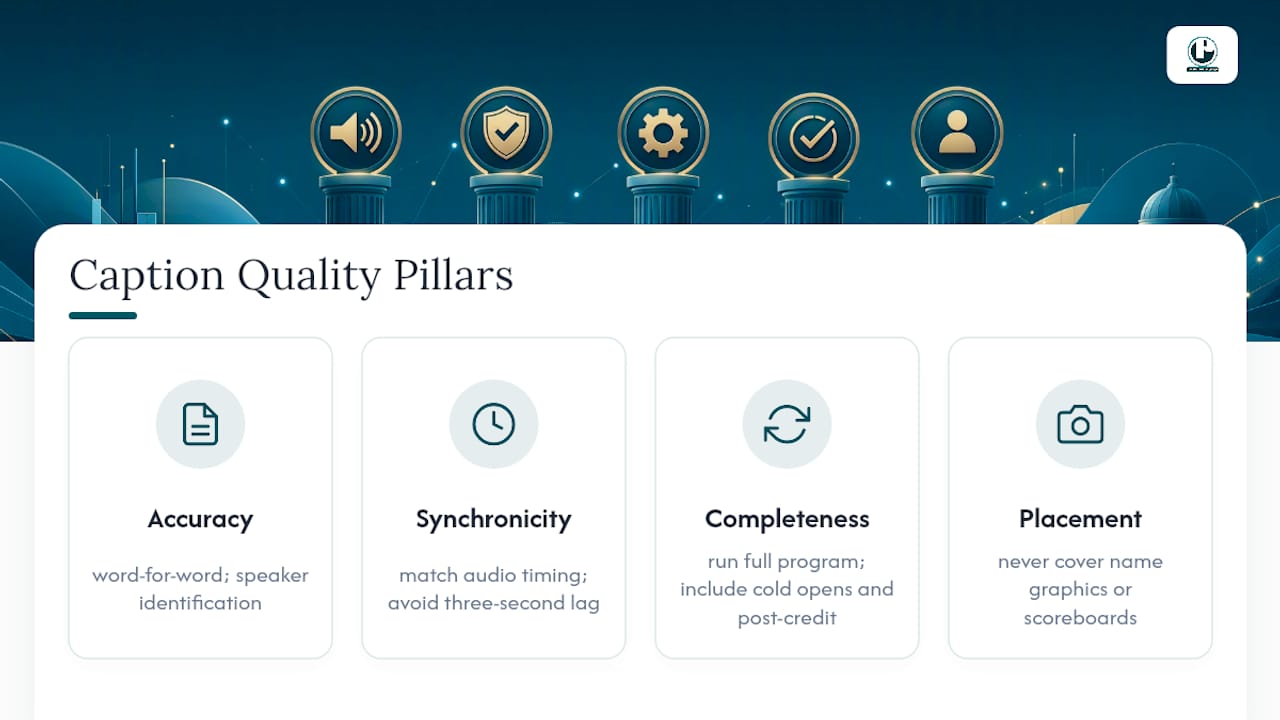
Accuracy means captions reflect what’s said, word for word where feasible, plus relevant non-speech information like [laughter] or [phone ringing]. A common failure: paraphrased captions that drop a speaker’s exact phrasing, or missing speaker identification when multiple people talk over each other in a panel discussion.
Synchronicity means captions appear at essentially the same time as the audio. The classic failure shows up during editing, when a jump cut or crossfade shifts audio timing but the caption file wasn’t re-synced to match. A three-second lag might not sound like much until a viewer is trying to follow a fast-paced interview.
Completeness means captions run the full length of the program, not just the parts someone remembered to caption. We’ve seen cold opens and post-credit scenes get skipped because they were added after the original caption file was locked.
Synchronicity and completeness both get evaluated differently depending on format. The FCC applies stricter scrutiny to prerecorded content, where there’s no technical excuse for gaps, while live and near-live programming gets judged against a “greatest extent possible” standard that accounts for the realities of real-time transcription.
Placement means captions never cover a name graphic, a scoreboard, or other on-screen text the viewer needs to see. This one gets missed constantly in sports and news graphics-heavy content.
Pro Tip: Keep a simple corrective-action log for every caption failure your QC team catches, even minor ones. If the FCC ever investigates a complaint, showing a pattern of caught-and-fixed issues carries real weight versus having no documentation at all.
Which Programming Is Exempt From Closed Captioning Requirements
Not everything needs captions, and knowing the exemptions saves you from over-engineering workflows for content that doesn’t require it. The FCC’s self-implementing exemptions, meaning you don’t need to file anything to claim them, cover a specific list:
Public service announcements under 10 minutes that aren’t paid for with federal dollars
Programming aired between 2 a.m. and 6 a.m. local time
Content that’s primarily textual (like a station’s local weather crawl)
Locally produced, non-news programming with no repeat broadcast value
Certain non-vocal musical programming
Beyond the categorical list, distributors can request an economic-burden exemption if captioning costs would be unreasonable relative to the entity’s resources. Section 79.1(f) sets a general benchmark around 2% of gross revenues from the relevant category of operations, though the FCC evaluates each petition on its specific facts rather than applying a strict cutoff.
A common real-world pitfall: assuming a small, locally produced segment is automatically exempt because it “seems local.” The no-repeat-value condition is narrow. If a nonprofit’s fundraising video airs once, then gets reposted to their website and shared at a gala six months later, that repeat use can knock it out of the exemption.
Pro Tip: If you’re claiming any exemption, document the reasoning in writing at the time of production, not after a complaint arrives. Note the exemption category, the air date, and why it qualifies. That file becomes your evidence if a viewer ever files a complaint you need to answer.
Registration, Certification, and Reporting Duties for Programmers and Distributors
Compliance isn’t just about the captions themselves. It’s about the paperwork trail behind them. Distributors are required to obtain a certification from every programmer confirming that programming meets FCC captioning obligations or qualifies for a specific exemption. If a programmer won’t certify, or is non-responsive, distributors can report that directly to the Commission at captioningcertification@fcc.gov rather than assuming liability themselves.
Recent amendments published in the 2024 Federal Register update clarified that programmers serving exclusively public, educational, or government (PEG) access channels, or certain nonbroadcast networks, may carry lighter administrative obligations when a channel administrator keeps current certifications on file for the whole channel.
A working certification file should include:
The programmer’s contact information matching what’s on file with the VPD Registry
A statement of which exemption (if any) applies to specific content
Confirmation of the captioning vendor or in-house process used
The date range the certification covers
A named internal contact responsible for responding to complaints
Set an internal review cadence, quarterly works well for most production teams, to confirm certifications are current before they lapse. Waiting until a complaint arrives to discover your certification expired eight months ago is a bad way to spend an afternoon.
Live Captioning and the ENT Standard You Need to Know
Live and near-live programming gets judged by a more forgiving standard than prerecorded content, and for good reason. Real-time captioning has inherent latency, and the FCC’s own guidance acknowledges significant technical hurdles that don’t exist when there’s time to review a caption file before air.
That’s where Enhanced Newsroom Technique (ENT) comes in. ENT lets local newsrooms caption certain scripted segments, like a teleprompter-read anchor lead-in, using text pulled directly from the newsroom computer system rather than real-time stenography. It’s acceptable specifically because the source text already exists and is accurate; ENT is not a substitute for captioning genuinely unscripted material like breaking interviews or ad-libbed banter.
For everything else live, a few practical steps consistently reduce errors:
Build in redundancy: a backup captioning feed or a second stenographer on standby for high-stakes broadcasts
Weigh remote captioning against on-site stenography based on connectivity reliability at the venue
Use a short delay buffer where your workflow allows it, even a few seconds helps synchronicity
Assign an ENT coordinator who confirms script accuracy before it hits the caption feed
Strong live audio capture directly improves caption accuracy, since most captioning errors trace back to poor audio feeds rather than the captioner’s skill.
Pro Tip: After any live-caption failure, preserve the original audio feed, the caption output file, and a timestamped incident note the same day. Reconstructing what happened three weeks later from memory rarely holds up if the FCC asks for it.
Do FCC Captioning Rules Apply to Streaming and Online Video?
Internet-delivered video plays by a different rule than broadcast, and it trips up a lot of digital-first teams. The FCC’s IP captioning rules apply only to programming that was already shown on U.S. television with captions. If your content was never broadcast, produced exclusively for YouTube, a client’s website, or a social feed, it generally falls outside the FCC’s IP captioning mandate entirely.
That distinction matters when you’re planning a project. A TV-first program repurposed for streaming carries the captioning obligation with it; a digital-first branded video typically does not, even though captioning it anyway is still smart practice for accessibility and watch-time.
The 2024 Closed Captioning Display Settings Report and Order updated expectations around how devices and video players present captions to viewers, including user-selectable font, color, and placement options tied to CVAA apparatus requirements. If you’re delivering content through a third-party player or streaming platform, confirm during ingest that caption metadata and user display preferences actually pass through intact. It’s a common breakdown point when content moves between systems.
Pro Tip: Ask your streaming vendor directly whether their player preserves caption styling metadata end to end. Some platforms strip it during transcoding, which technically satisfies “captions present” but fails the display-settings intent of the rule.
What Happens When Someone Files a Captioning Complaint
Viewers can file written complaints about non-emergency programming within 60 days of the alleged captioning problem. Once a complaint reaches a distributor through the VPD Registry, that distributor generally has 30 days to respond with an explanation or corrective action.
The Commission doesn’t treat every glitch the same way. When evaluating whether an error rises to an enforcement issue, it weighs whether the problem was a one-time technical failure or part of a recurring pattern, what caused it, and what the distributor did afterward. A single dropped caption during a power outage looks very different from the same station repeatedly failing to caption its evening newscast.
That’s why documentation discipline pays off. Keep a retention schedule covering:
Caption files and QC logs for each broadcast, ideally for at least a year
Vendor contracts and service-level agreements for captioning providers
Corrective-action records tied to any past complaint or internal QC catch
Current VPD Registry contact information, reviewed at least annually
If a programmer refuses to certify compliance, distributors should escalate to the Commission rather than let the gap sit unresolved.
A Practical Captioning Compliance Checklist for Production Teams
Building captioning into your workflow from the start, rather than bolting it on before delivery, is the single biggest predictor of clean compliance. Here’s a sequence that works across most production types:
Set specs at the planning stage. Decide caption format, vendor, and delivery timeline before shooting begins.
Choose a captioning vendor with FCC-specific QC experience, not just general transcription.
Run format-specific QC. Prerecorded content gets full accuracy and sync review; live content gets a post-broadcast error review; near-live content gets treated like prerecorded whenever turnaround allows.
Retain minimal metadata with every caption file: air date, exemption status if applicable, vendor name, and QC sign-off.
Assign clear ownership. Production confirms caption delivery, legal or compliance confirms certification status, and distribution confirms the caption actually displays correctly at the point of broadcast or stream.
Review post-broadcast for any viewer complaints and log the resolution.
Clear ownership across these steps is what separates a team that handles an FCC complaint calmly from one that scrambles.
One change worth making this quarter
We added a final captioning QC check to our deliverable sign-off process years ago, right alongside color and audio review, instead of treating it as a separate afterthought handled by a third party after final cut. Complaints dropped, and certifications got faster because nothing was a surprise. Pick one gap in your own workflow and close it before your next delivery.
Frequently Asked Questions
Does every video I produce need closed captions under FCC rules? Only if it airs, or has aired, on U.S. television as nonexempt programming, or if it’s internet video that previously ran on TV with captions. Digital-first content created solely for streaming or social platforms generally falls outside FCC captioning requirements, though captioning it still improves accessibility and reach.
What counts as a “de minimis” captioning error? The FCC evaluates errors case by case, weighing whether a problem was isolated or recurring, what caused it, and whether the distributor took corrective action. There’s no fixed error-rate threshold, which is exactly why maintaining incident logs and correction records matters so much during an investigation.
Who is responsible if a programmer refuses to certify captioning compliance? The video programming distributor should report the non-certifying programmer to the FCC at captioningcertification@fcc.gov rather than assume the compliance risk themselves. Distributors still bear the ultimate obligation to ensure captions display correctly.
How long do I have to respond to an FCC captioning complaint? Distributors generally have 30 days to respond once a written complaint reaches them through the VPD Registry process. Viewers themselves have 60 days from the alleged issue to file a complaint about non-emergency programming.
Are live sports and news broadcasts held to the same captioning standard as prerecorded shows? No. The FCC applies more flexibility to live and near-live programming because of the technical realities of real-time captioning, while prerecorded content is expected to meet the four quality standards without exception.
Sources
Recommended
Programs that air on television live under exactly this kind of documented obligation. In our federal production work, deliverables are defined against the client's review process from the start, and the finished pieces are built to remain in service for years. That discipline transfers directly to broadcast compliance: caption quality, exemption records, and corrective steps are paperwork a producer should be keeping all along, because a complaint is the wrong moment to start reconstructing how a program was captioned and checked.


Comments