

How to Write a Music Video Treatment That Gets Approved

A music video treatment is a written creative brief, typically 1–5 pages, that defines the visual concept, narrative, and production direction for a music video before a single frame is shot. Think of it as the document that sells the idea to stakeholders and then guides every department through execution. Without one, you are asking a director, DP, art director, and editor to read your mind.
Here is what every solid treatment must include:
Logline: 15–30 words that capture the concept, mood, and narrative hook
Concept summary: 2–3 paragraphs explaining why this idea fits this song
Visual language: palette, lighting approach, camera behavior, and texture
Scene progression: blocks organized by song structure (verse, hook, bridge, climax)
Reference images with intent notes: what to borrow, where to place it, what to leave alone
Feasibility notes: locations, casting assumptions, VFX complexity, budget range
Approval checklist: sign-off items before production begins
That list is your quality gate. If any item is missing when you hand off the document, expect revision cycles.
Key Takeaways
A music video treatment is a 1–5 page creative brief that must include a logline, visual language system, scene progression, feasibility notes, and a signed approval before production begins.
Point | Details |
Lead with the logline | A 15–30 word logline crystallizes the concept and gives every department a shared reference point. |
Visual language must be testable | Replace vague adjectives with department-ready specs: palette, lighting, camera behavior, and texture. |
Tie scenes to song structure | Organize scene blocks by verse, chorus, and bridge to prevent pacing mismatches in the edit. |
Sign-off prevents scope creep | Written approval on the treatment before production starts is the clearest protection against mid-shoot changes. |
Puritano’s approach | Puritano starts every music video project with a one-page treatment and expands to 2–3 pages for label-level pitches. |
What does a music video treatment actually do?
A treatment serves two audiences at once, and most writers only write for one of them. That is where things go sideways.
For an artist, manager, or label, the treatment is a pitch. It needs to make someone feel the video before it exists. The writing should be vivid, confident, and specific enough that the reader can picture the opening shot. Wrapbook’s guide to music video treatments describes this dual role clearly: the document both sells the creative idea and aligns the production team on how to execute it.
For a production team, the same document is a reference. The DP needs to know the lighting approach. The art director needs the color palette. The editor needs to understand the pacing logic. If your treatment only works as a pitch, it will fail as a production handoff.
The sign-off function is the one most people skip. Getting written approval on the treatment before production starts is what prevents scope creep. When an artist asks for a third location two days before the shoot, a signed treatment gives you a clear record of what was agreed. Without it, every creative decision is up for renegotiation.
RobinPiree’s treatment guide makes a useful point about audience calibration: the length and detail of your treatment should match who is reading it. A label A&R reviewing a pitch needs a polished, visual-forward document. An internal production team needs specific, department-ready language. Trying to write one document that does both equally well often produces one that does neither particularly well.
Label/artist pitch: Lead with the logline and concept, use evocative language, include one strong reference image per visual idea
Internal production handoff: Prioritize testable specs, scene tags, and feasibility notes over mood language
AI-augmented production: Add character consistency rules, aspect ratio specs, and lip-sync guidance so generated assets stay coherent
Pro Tip: Write the pitch version first, then create a production addendum. Two short documents beat one bloated hybrid that confuses both audiences.
A copyable step-by-step treatment template
The structure below draws from the VibeMV 7-step framework, which recommends a pre-write project brief to lock the concept before drafting begins. That brief alone prevents most rewrites.
Step 1: Pre-write project brief (10 minutes)
Answer these five questions before you write a single treatment sentence:
What is the song’s emotional core in one word?
What is the narrative or conceptual hook (performance, narrative, abstract, or hybrid)?
Who is the primary character or visual subject?
What is the single most important image in the video?
What is the budget range and location count?
If you cannot answer all five, the concept is not ready to write. Spending 10 minutes here saves hours of revision later.
Step 2: The logline
A logline is 15–30 words. It states the concept, the mood, and the narrative tension in one sentence. Here is the difference between a weak logline and a strong one:
Weak: “A moody, cinematic video that captures the feeling of the song.”
Strong: “A lone dancer moves through an abandoned warehouse at dusk, her reflection multiplying across broken mirrors as the chorus builds to a single, still moment of clarity.”
The strong version gives the director a shot, the art director a location, and the editor a structural cue. The weak version gives everyone nothing to work with.
Step 3: Concept summary (2–3 paragraphs)
This is where you explain why this concept fits this song, not just any song. A high-value treatment links wardrobe, color, and movement directly to the song’s emotional core. If someone could swap your concept into a different track without changing a word, the concept is not specific enough.
Paragraph one: state the concept and its emotional logic. Paragraph two: describe how the visual approach mirrors the song’s structure. Paragraph three: explain what the viewer feels at the end and why that feeling matches the artist’s intent.
Step 4: Visual language as a system
Avoid adjectives like “cinematic” or “moody.” They mean nothing to a gaffer or a colorist. Instead, define visual language as a testable system:
Color palette: cool-toned grade, desaturated midtones, warm practical sources (tungsten at 3200K)
Lighting: overcast exterior, motivated practicals indoors, no fill on shadow side
Camera behavior: handheld 50mm close-ups in verses, locked-off wide shots on the hook
Texture: 16mm grain overlay, slight halation on highlights
Every department can act on those notes. Nobody can act on “moody and cinematic.”
Step 5: Scene progression by song structure
Organize scene blocks by the song’s architecture, not by location or character. The VibeMV format guide recommends a song structure map that ties visual shifts to musical moments, which prevents pacing mismatches in the edit.
A basic structure looks like this:
Intro/verse 1: Establish character, location, and emotional state. Slow build.
Pre-chorus: Visual tension increases. Camera moves closer. Color shifts slightly.
Chorus: Peak energy. Widest shot or most kinetic movement. Palette saturates.
Verse 2: Return to intimacy, but with new information or perspective.
Bridge: Visual departure. Different location, texture, or treatment.
Final chorus/outro: Resolution. The opening image returns, transformed.
Step 6: References with intent notes
Every reference image needs three annotations: what you are borrowing, where it appears in the video, and what you are explicitly not copying. This prevents subjective debates in approval meetings. “Inspired by” is not a direction. “Borrow the color temperature and depth of field from this frame; do not copy the costume or set design” is.
Step 7: Feasibility notes
State your assumptions plainly: number of locations, estimated shoot days, casting requirements, VFX complexity (simple composite vs. full CG), and a budget range. For realistic budget planning, Puritano’s music video budget guide breaks down what different spend levels actually deliver. Feasibility notes are not a deal-breaker list. They are a transparency tool that builds trust with whoever is approving the concept.
Pro Tip: Use a scoring rubric before you submit. VibeMV recommends a quality gate, such as a 20-point checklist, that turns approval into a structured process and cuts revision cycles significantly.
How to translate a treatment into a shootable script
A treatment describes what the video feels like. A script describes what the camera captures. Converting one into the other is a mechanical process once you know the format.
Script format basics
Every scene in a music video script uses the same three elements:
Slugline: INT. WAREHOUSE / NIGHT or EXT. ROOFTOP / GOLDEN HOUR. Location, interior/exterior, time of day.
Action line: A present-tense description of what the camera sees. No dialogue tags. No camera directions in the action line unless they are essential to the concept.
Lyric cue (optional): The lyric playing during the scene, in brackets, so the editor knows the sync point.
Here is a short example derived from a treatment sentence:
Treatment prose: “The dancer moves through the warehouse, her reflection multiplying in broken mirrors as the chorus hits.”
Script format:
INT. ABANDONED WAREHOUSE / DUSK MAYA moves slowly through the space. Broken mirrors line the walls. As the chorus begins [“I see myself in every piece”], her reflection multiplies across the shards. She stops. Dozens of versions of her stare back.
Translating prose into production tags
Once the script exists, you break it down by tagging every element a department needs to prepare. StudioBinder’s breakdown guide shows how to identify “hidden elements” — things the treatment implies but does not explicitly call out, like in-frame monitors, screens within screens, or required composites. These hidden elements often trigger additional shoot days or VFX work if they are missed at the breakdown stage.
Script element | Department tag | Notes |
Broken mirrors (20+) | Art Dept / Props | Source, transport, safety protocol |
Reflection multiplication | VFX | Composite or practical mirror rig |
Dancer (MAYA) | Casting / Talent | Choreography rehearsal required |
Dusk lighting | Grip / Electric | Golden hour window: limited time |
Warehouse location | Locations | Permit, power access, floor condition |
A breakdown spreadsheet built from this table becomes the production’s scheduling and budgeting backbone. For a deeper look at how to hand this off cleanly, Puritano’s guide on briefing a video production team covers the handoff process in detail.
What technical specs and constraints belong in a treatment?
Leaving technical specs out of a treatment is one of the most common and costly omissions. Vendors, editors, and AI tools all need explicit parameters to deliver consistent assets.
At minimum, your treatment should state:
Aspect ratio: 16:9 for standard delivery, 9:16 for vertical/social cuts, or both if multi-platform
Frame rate: 24fps for a filmic look, 30fps for broadcast, 60fps for slow-motion sequences
Deliverable formats: master file specs (ProRes 4444, H.264 web export), color space (Rec.709 or DCI-P3)
Final file requirements: resolution, codec, audio mix specs
For AI-augmented productions, the spec list gets longer. If you are using generative tools for any portion of the video, your treatment needs to include character consistency rules (reference images, physical descriptors, wardrobe locked to specific frames), guidance on where lip-sync generation is acceptable versus where beat-synced movement is preferred, and notes on prompt ownership and asset rights. An AI video workflow guide covers how to structure these constraints so human teams and AI tools stay aligned throughout production.
Production constraints belong here too, not buried in a separate email chain:
Known locations and their limitations (no power, limited access hours, permit restrictions)
Stunt or VFX complexity that affects scheduling
Time-of-day dependencies (golden hour, night shoots)
Union or talent constraints that affect crew size or shoot length
Budget range, even if approximate
Pro Tip: Frame constraints as creative parameters, not apologies. “We are shooting in a single location with a 12-hour window” reads as a limitation. “The entire video unfolds in one continuous space, building tension through camera movement rather than location changes” reads as a concept.
Common mistakes that kill treatments and how to fix them
Most treatments that get rejected share the same handful of problems. Here is what to watch for.
Vague style language is the most common red flag. If your visual language section uses words like “cinematic,” “ethereal,” or “raw,” a producer cannot brief a single department from it. Replace every adjective with a testable specification. “Neon practicals backlight at 3200K” tells the gaffer exactly what to build.
Concepts that could fit any song signal that the writer did not engage with the music. If you can swap your treatment into three different tracks without changing a word, it is not a treatment for this song. Tie every visual choice to a specific lyric, structural moment, or emotional beat.
Missing feasibility notes make approvers nervous. When a treatment has no mention of locations, shoot days, or budget assumptions, the reader fills in the blanks with worst-case numbers. State your assumptions explicitly, even rough ones.
No logline forces the reader to reverse-engineer the concept from the body text. A missing logline is a red flag that the writer has not crystallized the idea yet.
For pitching specifically:
Tailor the first page to the stakeholder. A label executive wants to feel the video. A line producer wants to know it is shootable.
Show, do not tell. One strong reference image with intent notes beats three paragraphs of mood description.
Include your reel link and contact information on the cover page. Approvers often share treatments internally, and the document needs to travel with your credentials attached.
Request written sign-off before any production activity begins. A verbal “yes” is not a green light.
Pro Tip: Keep a master template with your visual language system, scene block structure, and feasibility checklist pre-filled with placeholder text. Starting from a blank page every time is the slowest way to write a treatment.
Puritano’s one-page treatment template and how it maps to production
At Puritano, we favor a one-page treatment for early-stage pitches. It forces clarity. If you cannot explain the concept, the visual system, and the production logic in one page, the idea is not ready to pitch. For label-level stakeholders or complex multi-location productions, we expand to 2–3 pages, but the one-page version is always the starting point.
Here is the scaffold we use:
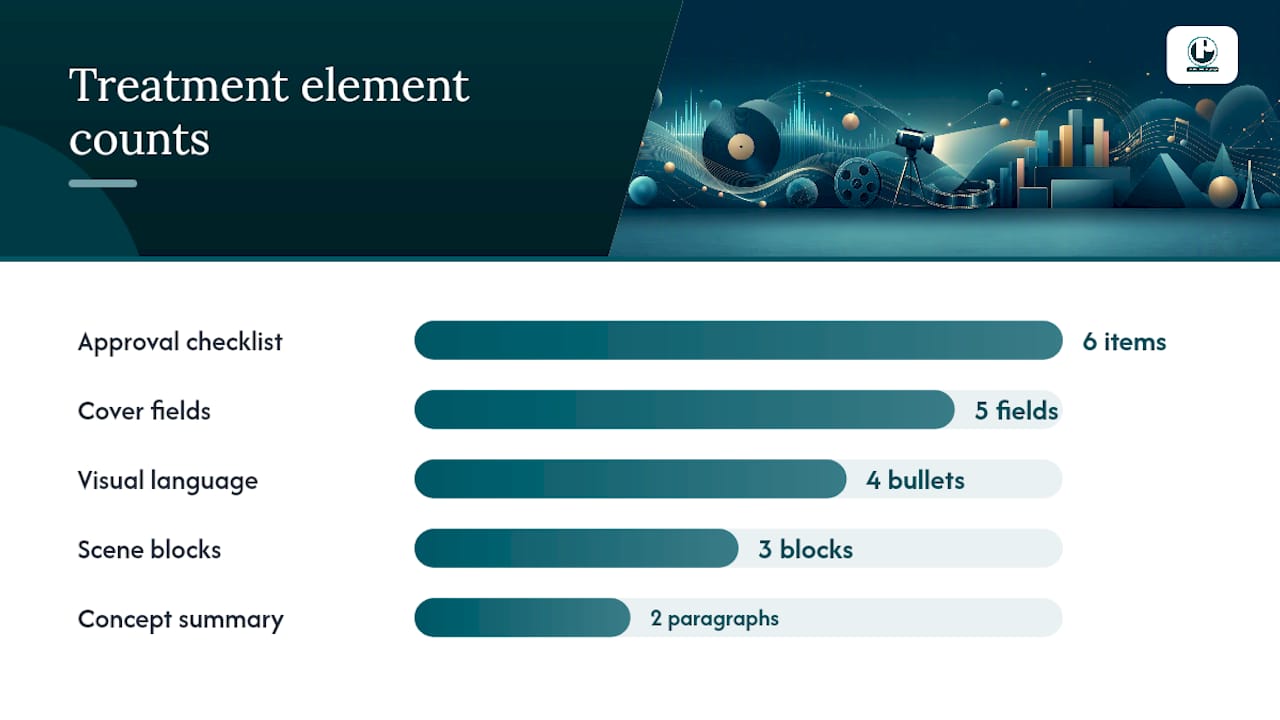
Cover: Artist name, song title, director name, version date, contact
Logline: One sentence, 15–30 words
Concept summary: Two paragraphs. Paragraph one: the idea and its emotional logic. Paragraph two: how the visual approach mirrors the song structure.
Visual language: Four bullet points. Palette. Lighting. Camera behavior. Texture.
Scene blocks: Three blocks tied to song structure (opening, chorus, resolution)
Feasibility notes: Locations, shoot days, VFX complexity, budget range
Approval checklist: Six items for sign-off
Here is a short excerpt from a Puritano-style treatment to show the tone and specificity we aim for:
Logline: A grieving musician plays through the night in an empty concert hall, the audience he imagined slowly materializing in the seats as the final chorus arrives. Visual language: Desaturated base grade with warm amber practicals. Handheld 35mm close-ups in verses; locked-off wide shots from the balcony on the chorus. Dust particles caught in a single follow spot. No color correction on the imagined audience — they appear in full saturation against the muted hall.
Every line in that excerpt tells a department what to do. The colorist knows the grade. The DP knows the lens and movement. The art director knows the lighting rig. The VFX team knows the composite approach.
You can see how these concepts translate into finished work in Puritano’s music videos portfolio.
Pro Tip: Map each treatment sentence to a department tag before you submit. If a sentence does not tell at least one department what to do, cut it or rewrite it.
Pre-production checklist, sign-off language, and handling changes
A treatment becomes a binding creative agreement the moment both parties sign it. Here is the checklist we use before any production begins.
Pre-production sign-off checklist:
Logline approved and on file
Visual language system reviewed by DP and art director
Scene progression confirmed against song structure
Technical specs locked (aspect ratio, frame rate, deliverables)
Feasibility notes reviewed by line producer
Budget range acknowledged in writing
Location and casting assumptions confirmed
Sign-off language (short form):
That language does not need to be in a formal contract. An email reply with “approved as written” attached to the treatment PDF is sufficient in most cases.
Handling requested changes:
Receive the change request in writing (email is fine)
Assess whether the change affects scope, budget, or schedule
If it does, issue a one-paragraph change-order brief: what is changing, what it adds to the budget or timeline, and what requires re-approval
Get written acknowledgment before implementing
Changes that do not affect scope, budget, or schedule can be absorbed without a formal change order, but document them anyway. A quick email confirmation takes 30 seconds and prevents disputes later.
For timeline planning around these approvals, Puritano’s video production timeline guide maps out each phase from treatment sign-off through final delivery.
What producing music videos has taught us about treatments
Here is something most treatment guides will not tell you: the best treatments are written by people who have been on set when a concept falls apart. You learn fast what language actually prevents problems and what language just sounds good on paper.
The most common trade-off we see is ambition versus budget. A treatment that calls for five locations, a 50-person crowd scene, and a VFX composite in the bridge is not a bad idea. It is just a bad idea for the budget on the table. The skill is finding the one-location solution that feels cinematic through camera movement, lighting design, and performance rather than production scale. Some of the most striking music videos ever made were shot in a single room. The treatment is where you make that case convincingly.
We have also learned to read a brief fast. When an artist sends a reference playlist and three mood images, we can usually tell within five minutes whether we have a strong concept or whether we need to ask more questions. The question we always ask first: “What do you want the viewer to feel at the end?” That answer tells us more about the right visual approach than any reference image.
Working with artists on brand alignment is its own discipline. The goal is never to copy an existing video the artist loves. The goal is to understand why they love it and find a different path to the same emotional destination. A treatment that borrows too heavily from a reference becomes a knockoff. A treatment that understands the reference and builds something original becomes a signature.
When a full-service production team is the right call
Writing a strong treatment is one thing. Executing it is another. When the concept involves complex VFX, multiple locations, a tight label deadline, or a budget that requires professional crew management, a full-service production partner is the practical choice, not a luxury.
Puritano handles music video projects from concept development and treatment writing through full production and post. That means one point of contact from the first logline to the final deliverable, with a team that has spent over two decades producing visual content across every format and budget level. We work with independent artists, labels, and marketing agencies, and we bring the same production rigor to a single-location performance video as we do to a multi-day narrative shoot.
If you are ready to move from treatment to production, or if you want a team to write and pitch the treatment alongside you, take a look at our music video work and reach out to start a conversation about your project.
Sources
These are the sources we drew from and recommend for deeper study:
Recommended
Comments