

Video Production Timeline: A Phase-by-Phase Planning Guide
Updated: 3 days ago

A video production timeline is the project schedule that maps every phase of a video from initial concept through final delivery. The industry term for this document is a production schedule, and it covers five distinct stages: creative planning, pre-production, production, post-production, and distribution. Most comprehensive projects span 8–10 weeks from kickoff to launch. Producers, marketers, and project managers who build this schedule before a single camera rolls avoid the budget overruns and missed deadlines that derail otherwise solid projects.
What is a video production timeline and why does it matter?
A video production timeline is a structured schedule that assigns specific tasks, owners, and deadlines to each phase of a project. Without one, teams make decisions reactively instead of proactively. That reactive mode is where costs spike and quality drops.
The timeline creates predictability. When every stakeholder knows when the script is due, when the shoot happens, and when the first cut lands in their inbox, approvals move faster and surprises shrink. Pre-production is where most projects succeed or fail; strong planning at that stage directly improves shoot efficiency and post-production smoothness.
The schedule also serves as a communication tool. A producer can share it with a client on day one and set clear expectations about what happens when. That single document prevents more arguments than any contract clause.
What are the key phases in a video production timeline?
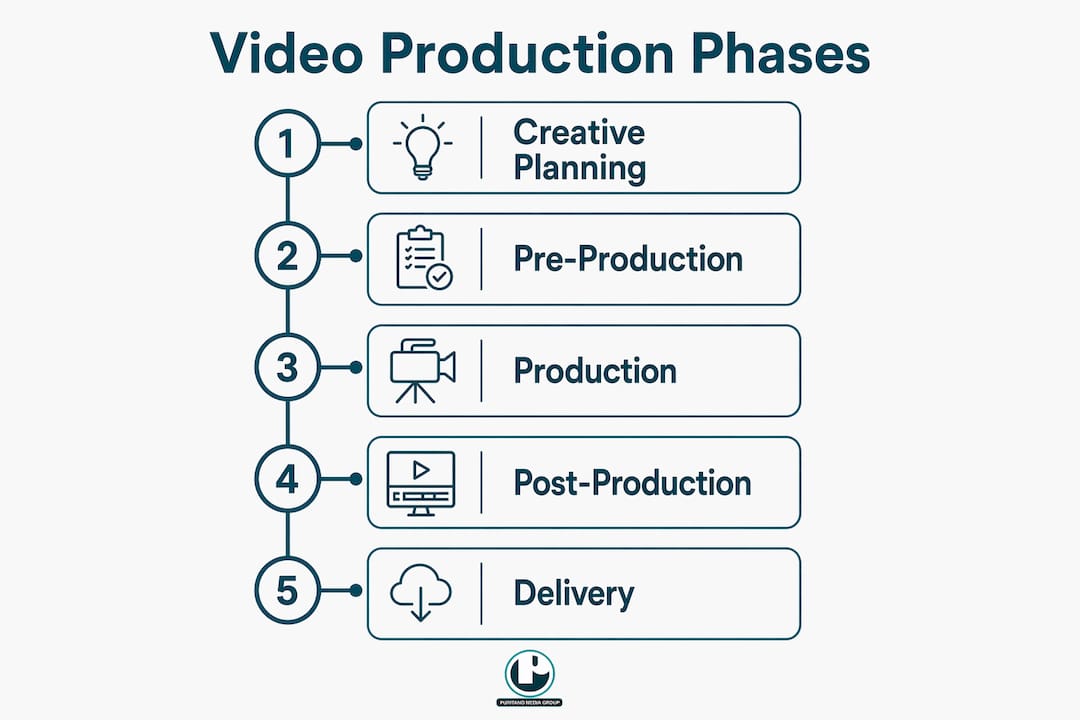
The five phases below represent the standard framework used across corporate video, branded content, and commercial production. Timing estimates reflect typical projects; complex shoots or large stakeholder groups will push these numbers higher.
Creative planning (1–2 weeks). This phase covers goal setting, audience definition, concept development, and initial budget alignment. The output is a creative brief that every subsequent decision references. Skipping this phase is the single fastest way to waste money on production day.
Pre-production (approximately 3 weeks). Scripting, storyboarding, location scouting, talent casting, permit acquisition, and shot list creation all happen here. Sequential planning documents like the brief, storyboard, and shot list streamline production day efficiency. This is the most labor-intensive phase on paper, and the most valuable investment you can make.
Production (1–3 days). The actual shoot. Duration depends on location count, talent complexity, and the number of scenes. A single-location corporate interview runs one day. A multi-location TV commercial can run three days or more.
Post-production (approximately 2 weeks). Editing, color grading, sound design, motion graphics, and client revision rounds all live here. This phase is where most timeline overruns actually occur, not because editing is slow, but because feedback loops are.
Distribution planning (1 week). Encoding for different platforms, caption creation, thumbnail design, and upload scheduling. Teams that treat this as an afterthought often scramble at the end and miss launch windows.
Pro Tip: Plan your deliverable variants during pre-production, not after the edit. A 60-second hero video can generate 12–24 variants in different aspect ratios, durations, and caption formats. Discovering that in post-production adds days you do not have.
How do you create and manage an effective video production schedule?
Building a production schedule that actually holds requires working backward from your delivery date and building in realistic buffers at every stage. Here is the process that works consistently.
Lock the delivery date first. Every other date derives from this one. If the video must launch on a specific date, count backward through each phase to find your true start date. Most teams start too late because they underestimate how long pre-production takes.
Build your planning documents in sequence. The brief informs the script. The script informs the storyboard. The storyboard informs the shot list. The shot list informs the call sheet. Skipping steps in this chain creates confusion on set and in the edit bay.
Schedule production by logistics, not script order. Organizing shooting schedules by location or talent availability rather than script order minimizes costly company moves and overtime. Shooting all scenes at Location A before moving to Location B saves hours, regardless of where those scenes fall in the narrative.
Define revision rounds in writing before production begins. The standard professional structure is a rough cut at approximately 70% completion, followed by two formal revision rounds. Client feedback delays account for approximately 40% of total timeline overruns. Putting revision limits in the contract protects both sides.
Add buffer time to every phase. Timelines should include 15–20% extra time for key phases. Failure to build in buffer is the most common reason deadlines slip. A two-week post-production window should carry at least two to three days of buffer.
Centralize feedback and version tracking. Cloud storage with date-stamped folders and version tracking speeds post-production and keeps stakeholder comments from scattering across email threads. Uploading footage daily with clear folder naming keeps the entire team oriented.
Pro Tip: When you brief a video production team, include the delivery date and the revision limit in the same document. Read more about how to brief a production team to set your project up correctly from day one.
What are common challenges in keeping video timelines on track?
Most timeline failures trace back to a small set of recurring problems. Recognizing them early is the first step to preventing them.
Late client approvals. This is the single biggest variable in project duration. When clients miss feedback deadlines, every downstream phase shifts. The fix is contractual: define turnaround windows for each review round and make them binding.
Unclear or fragmented planning documents. When the brief lives in one email, the script in another, and the shot list in a shared drive nobody updates, production day becomes guesswork. Centralizing all documents in one location and updating them in real time removes this problem entirely.
Scope creep. A client who adds a second location, a third interview subject, or a new deliverable format after production begins is not being difficult. They simply were not given clear boundaries. Treat deliverables and revision limits contractually, and quote fees for out-of-scope changes immediately. Scope creep kills schedules and erodes profit margins simultaneously.
Underestimated pre-production tasks. Location securing, talent confirmation, and script finalization consistently take longer than planned. Build extra days into pre-production rather than assuming everything will resolve quickly.
Technical and logistical surprises. Equipment failures, weather delays, and location access issues happen on real productions. A contingency plan and buffer time convert these from crises into minor inconveniences.
For a deeper look at managing the client side of these challenges, the guide on managing client video projects covers revision structures and approval workflows in practical detail.
How does project size affect the video production timeline?
Project complexity changes every phase of the schedule, not just the shoot day. A social media clip and a corporate brand film share the same five phases but live in completely different time scales.
The number of stakeholders also drives timeline length. A project with one decision-maker moves through approvals in hours. A project with a five-person committee can stretch a single revision round from two days to two weeks. Factor stakeholder count into your schedule the same way you factor location count.
Deliverable variants add post-production time that most clients do not anticipate. A hero video that needs versions for Instagram, LinkedIn, broadcast, and internal use is effectively four separate finishing jobs. Planning these variants in pre-production prevents schedule surprises at the worst possible moment. For a practical breakdown of how post-production timing works, the 2026 editing guide is worth reviewing before you finalize your schedule.
Key Takeaways
A well-structured video production timeline is the single most effective tool for delivering quality video on time and within budget.
What I’ve learned about timelines after two decades in production
The phase that gets underestimated most consistently is pre-production. Clients see it as paperwork. Producers sometimes rush it to get to the “real work” of filming. That is a mistake I have watched cost teams thousands of dollars and weeks of rework.
Here is what I have found to be true: every hour spent in pre-production saves three hours in post-production. A tight shot list means the editor is not hunting through hours of unusable footage. A confirmed location means the crew is not problem-solving on the morning of the shoot. A finalized script means the client cannot rewrite dialogue after the actor has gone home.
The other thing I will say plainly is that communication shapes timeline success more than any tool or template. A client who understands why revision rounds have limits is a client who respects those limits. That conversation happens at the brief stage, not after the first cut lands. Video production timelines are flexible strategic roadmaps, not rigid rules, but flexibility only works when both sides understand the boundaries. The teams that hit their deadlines consistently are not the ones with the best software. They are the ones who had the hard conversations early.
How Puritano approaches video production planning
Puritano Media Group has spent over two decades building production schedules that hold. Whether the project is a corporate brand film, a government video, or a music video production, the planning process follows the same disciplined framework: clear phases, defined deliverables, and revision limits set before a single frame is shot. Puritano’s team works with producers, marketers, and project managers across the DMV area and nationally to build schedules that match creative ambition with real-world logistics. If your next project needs a production partner who treats the timeline as seriously as the creative, reach out to Puritano to discuss your goals. You can also explore virtual event production as an example of how complex, multi-phase projects get managed from brief to broadcast.
FAQ
What is a video production timeline?
A video production timeline is a structured project schedule that maps all phases of a video from concept to final delivery, typically covering creative planning, pre-production, production, post-production, and distribution. Most projects span 8–10 weeks from start to launch.
How long does a typical video production schedule take?
A full corporate or brand video typically takes 8–10 weeks from kickoff to delivery. Simpler social media clips can complete in 2–3 weeks, while TV commercials or multi-location productions can run 10–14 weeks.
What causes the most video production timeline delays?
Client feedback and revision rounds cause approximately 40% of total timeline overruns. Late approvals, unclear feedback, and underestimated pre-production tasks are the most frequent culprits.
How many revision rounds should a video production schedule include?
The standard professional structure includes a rough cut followed by two formal revision rounds. Additional rounds typically incur extra fees, which should be defined in the contract before production begins.
How do I create a video production timeline for a small project?
Start from your delivery date and work backward through each phase. Assign realistic durations to pre-production, the shoot, and editing, then add 15–20% buffer time to each phase to absorb unexpected delays.
Recommended
Timelines stop being wishful thinking when the project is genuinely large. For Montgomery County Public Schools, we produced a 13-video safety and crisis series: staff training, student versions for two age groups, and a community film covering lockdown, evacuation, and shelter procedures. Every video then had to be translated, with custom graphics and narration, into six languages. A schedule that honest has to be built phase by phase, with review owners named at each step, because a series like that cannot be rescued by working faster at the end.


Comments