

The Role of Music in Promotional Video: 2026 Guide

Music is the single most underestimated production element in promotional video. The role of music in promotional video goes far beyond background noise. It shapes emotional response before a single word of dialogue lands, anchors brand identity, and directly increases how much viewers remember. Research confirms that viewers retain up to 40% more core information when music aligns emotionally with the video content. That number alone should change how you budget and plan your next production.
How does music influence viewer emotions and memory in promotional videos?
Music triggers emotional response faster than visuals or copy. Modern audiences encounter 4,000 to 10,000 ads daily, which means your video has roughly three seconds to register before a viewer moves on. The right music makes those three seconds count. It creates an immediate emotional signal that tells the viewer whether to lean in or scroll past.
The psychological mechanism behind this is well documented. Music triggers dopamine release, which creates a sense of reward and anticipation. That neurological response is what makes certain ads feel good to watch, even when you cannot immediately explain why. Producers who understand this use music as a deliberate emotional primer, not a finishing touch.
“Music conveys the brand’s emotional tone before any script dialogue, making it a vital piece of message architecture.”
Memory retention follows emotional engagement. When the music matches the emotional intent of the visuals, the brain processes the content as a unified experience rather than separate inputs. That coherence is what drives the 40% retention improvement. Mismatched or generic music breaks that coherence and forces the viewer to work harder, which reduces both enjoyment and recall.
The impact of music in videos also extends to decision-making. Emotional engagement accelerates the viewer’s willingness to trust the brand and act on the message. A well-scored promotional video does not just entertain. It moves people through the consideration process faster.
Emotional priming: Music sets the emotional context within the first three seconds, before visuals fully register.
Dopamine response: Familiar or pleasantly surprising music triggers reward pathways that increase ad enjoyment.
Memory consolidation: Emotionally congruent audio strengthens how the brain stores and recalls the brand message.
Decision acceleration: Positive emotional states reduce skepticism and shorten the path from awareness to intent.
What criteria should marketers and producers use to select music for promotional videos?
Music selection for ads is a brand positioning exercise, not a taste preference. Aligning music with brand goals such as premium, urgent, or restrained enhances coherence and credibility. A luxury real estate brand and a direct-response e-commerce ad require fundamentally different sonic identities, even if both videos share a similar visual style.
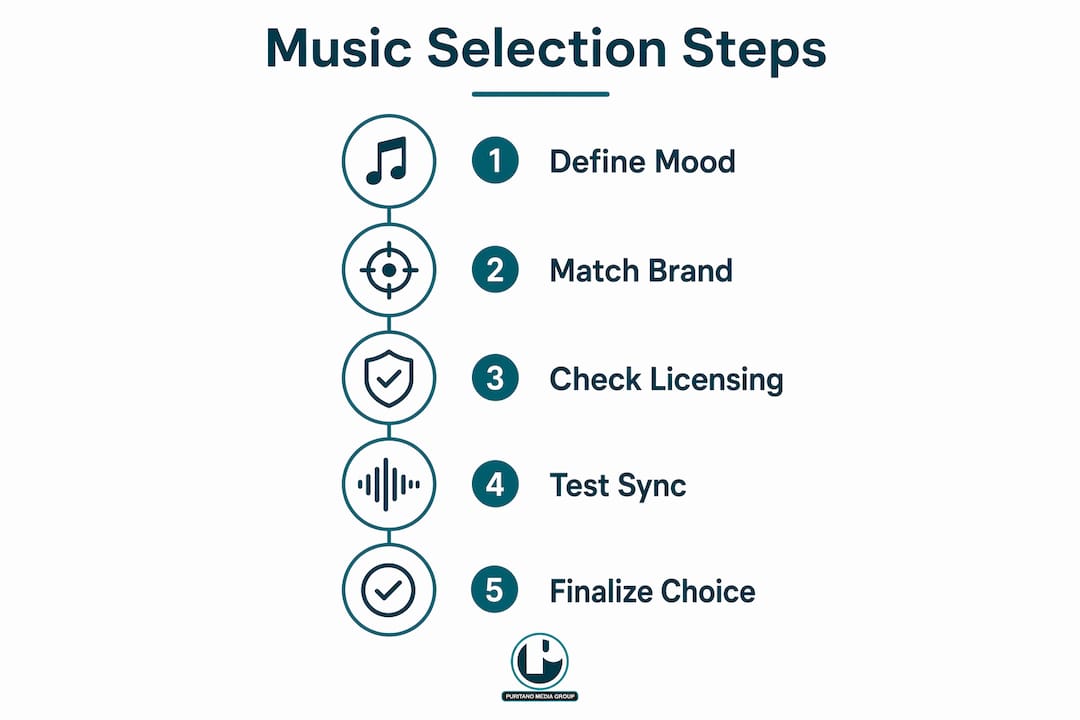
Here is a practical framework for making that selection:
Define the emotional target first. Before you open a music library, write down the single emotion you want the viewer to feel at the end of the video. Excitement, trust, nostalgia, urgency. Every music decision flows from that anchor.
Match tempo to narrative pace. A fast-cut product demo needs a track with a driving rhythm. A testimonial-based brand film needs space and breathing room. Tempo mismatch creates cognitive friction that viewers feel even if they cannot name it.
Choose modular tracks. Tracks with stings and loops allow editors to maintain musical flow across multiple video versions, from a 60-second broadcast cut to a 15-second social edit. This is not a minor convenience. It saves significant post-production time and keeps the campaign sonically consistent.
Audit licensing scope before you commit. Generic royalty-free music often carries geographic or platform restrictions that surface only when you try to scale the campaign. Securing worldwide, lifetime synchronization rights upfront avoids costly renegotiations later.
Test against your brand’s visual identity. Play the track over a rough cut with no dialogue. If the music tells a different story than the visuals, it is the wrong track regardless of how good it sounds in isolation.
Pro Tip: Build a short internal brief for music direction the same way you write a creative brief for visuals. Include tempo range, instrumentation preferences, emotional target, and any sonic references from past campaigns. This brief prevents subjective debates in the edit suite and keeps the music choice tied to strategy.
The importance of music in promotion also means avoiding the most common pitfall: defaulting to generic stock music because it is cheap and available. Generic royalty-free music consistently underperforms congruent, purposefully selected soundscapes on both emotional engagement and audio-visual fit. The cost difference between a generic track and a well-licensed, strategically chosen one is almost always smaller than the difference in campaign performance.
How does music interact with narrative and visual elements to enhance storytelling?
Music functions as a secondary voiceover in brand video storytelling. It carries emotional subtext that dialogue and visuals alone cannot deliver. When a narrator describes a company’s mission, the music underneath tells the viewer how to feel about that mission. These two channels work in parallel, and when they align, the storytelling effect multiplies.
The synchronization of musical beats with editing cuts is one of the most technically underrated skills in video production. Cutting on the beat creates a sense of momentum and intention. Cutting against it creates unease or tension, which can be used deliberately for dramatic effect. Editors who treat music as a structural guide rather than a layer added at the end produce noticeably more cohesive work.
Congruent soundscapes score significantly higher on audio-visual fit, with a mean score of 4.29 out of 5, compared to generic background music. Emotional engagement scores follow the same pattern at 3.94 out of 5. These numbers reflect what experienced editors already know intuitively: the right sound makes the picture feel more real and more credible.
Beyond music, the broader soundscape matters. Ambient sound, sound effects, and silence all contribute to the viewer’s sense of presence. A corporate video shot in a busy office feels flat without the ambient hum of that environment underneath the music. That layered audio approach, sometimes called transportation in media psychology, pulls viewers into the world of the video rather than leaving them as passive observers.
Beat synchronization: Align editorial cuts with musical phrases to create visual rhythm and forward momentum.
Emotional subtext: Use music to carry the emotional layer that dialogue cannot state directly without sounding forced.
Soundscape layering: Combine music with ambient audio and sound design for a fuller sense of presence.
Silence as a tool: Strategic silence before a musical swell creates anticipation and amplifies impact at key moments.
How music enhances video is ultimately about coherence. Every sonic element should point in the same emotional direction as the visuals and the script. When those three channels disagree, the viewer senses the conflict and disengages.
What are emerging best practices for music in promotional videos?
Short-form content has changed the rules for musical elements in promotional content. On platforms like TikTok and Instagram Reels, trending audio increases immediate engagement and improves algorithmic reach, particularly for awareness-stage content. Producers working on social campaigns need to treat audio selection as a distribution strategy, not just a creative one.
The concept of optimal incongruity offers one of the most useful frameworks for music selection in advertising. Combining a familiar song with a novel or unexpected visual context boosts engagement through dopamine-triggered interest. The familiarity lowers the viewer’s guard. The novelty creates curiosity. Together, they hold attention longer than either element would alone. This approach requires audience testing, because the line between pleasantly surprising and simply confusing is narrow.
Music’s impact on persuasion is highly context-dependent. Misaligned music distracts rather than enhances, which means there is no universal track that works across all audiences or campaign types. A dual-track approach works well for campaigns running across multiple stages. Use a more energetic, attention-grabbing track for awareness content and a warmer, more intimate track for consideration-stage videos where trust matters more than attention.
Trending audio for social: Match platform-native audio trends for short-form content to improve algorithmic performance.
Optimal incongruity: Pair familiar music with unexpected visuals to hold attention and trigger curiosity.
Audience pressure-testing: Test music choices with a sample of your target audience before the campaign launches, especially for unconventional genre selections.
Stage-specific selection: Calibrate music energy and tone to the viewer’s position in the consideration funnel.
Pro Tip: When producing a campaign with multiple video lengths and formats, commission or license a single master track and have it arranged in multiple versions: full, 30-second, 15-second, and loop. This keeps the campaign sonically unified across every touchpoint without requiring separate music searches for each format.
Key Takeaways
Music is the most direct path to emotional engagement in promotional video, and treating it as a strategic production element rather than a finishing touch is what separates forgettable campaigns from memorable ones.
Point | Details |
Music drives retention | Emotionally aligned music increases viewer retention of core information by up to 40%. |
Select music strategically | Treat music choice as a brand positioning decision tied to emotional targets and campaign goals. |
Use modular tracks | Choose tracks with stings and loops to maintain consistency across multiple video formats and lengths. |
Secure licensing early | Lock in worldwide synchronization rights before production scales to avoid costly renegotiations. |
Test before launch | Pressure-test music with your audience, especially when using unfamiliar genres or optimal incongruity approaches. |
Why music deserves the same craft as your script
Here is what two decades of production work has taught me: music is almost always the last thing clients think about and the first thing audiences feel. I have watched well-written, beautifully shot videos fall flat because the music was chosen in the final hour from a generic library. And I have seen modest productions punch well above their weight because someone took the time to find a track that genuinely matched the emotional intent.
The mistake most producers and marketers make is treating music as decoration. It is not. It is structural to brand storytelling in the same way that pacing and color grading are structural. You would not choose your color palette at the last minute. You should not choose your music that way either.
What I have found actually works is building the music brief before the shoot, not after. When the editor knows the sonic direction from day one, every creative decision in production and post aligns with it. The result is a video that feels intentional from the first frame to the last note. That intentionality is what viewers respond to, even when they cannot articulate why.
The licensing piece is the one that bites teams most often. I have seen campaigns get pulled from platforms because the sync rights did not cover streaming. Securing worldwide, lifetime rights upfront costs more initially, but it protects the entire investment. Treat it as production insurance, not an optional line item.
How Puritano can help you get the music right
Puritano Media Group has spent over two decades producing promotional and music videos where audio and visual storytelling work as one. We approach music selection as part of the creative brief, not an afterthought in post-production. Whether you are producing a TV commercial, a branded content series, or a social media campaign, our team integrates music strategy from the earliest planning stages. We also handle licensing guidance to make sure your content is protected across every platform and geography. If you want to see how purposeful audio transforms corporate video results, we would be glad to walk you through our process.
FAQ
What is the role of music in a promotional video?
Music shapes the viewer’s emotional response before dialogue or visuals fully register, making it a core narrative and brand identity tool. It also increases information retention by up to 40% when aligned with the video’s emotional content.
How does music selection affect ad performance?
Music aligned with the brand’s emotional target and visual tone scores significantly higher on both audio-visual fit and emotional engagement than generic background tracks. Misaligned music actively distracts viewers and reduces persuasion.
What is optimal incongruity in video marketing?
Optimal incongruity is the practice of pairing a familiar song with an unexpected visual context to trigger dopamine-driven curiosity and hold viewer attention longer. It requires audience testing to confirm the combination reads as surprising rather than confusing.
How do I choose music for different video formats?
Commission or license a single master track arranged in multiple lengths, including full, 30-second, and 15-second versions, to maintain sonic consistency across broadcast, digital, and social formats. Match tempo and energy to the viewer’s stage in the consideration funnel.
Why does music licensing matter for promotional campaigns?
Licensing fragility limits where and how long a campaign can run. Securing worldwide, lifetime synchronization rights from the start prevents platform restrictions, geographic limitations, and expensive renegotiations as the campaign scales.
Recommended
Comments