

Why Businesses Need Promotional Videos to Grow

Promotional videos are short, targeted assets designed to drive specific actions, such as sales, sign-ups, or event registrations, through clear and emotional storytelling. The case for why businesses need promotional videos has never been stronger: 91% of businesses now use video as a marketing tool, and 92% of marketers report a positive ROI from it. That level of adoption signals a fundamental shift in how brands communicate value. If your business is not using video, you are competing with one hand tied behind your back.
Why businesses need promotional videos to stay competitive
Promotional video is the industry term for short-form branded content built around a single marketing objective. It differs from general brand video in one key way: every element, the script, the visuals, the call to action, points toward a measurable outcome. Video content boosts brand awareness for 96% of marketers and drives increased lead generation for 90% of video marketers. Those numbers reflect a medium that works across industries, company sizes, and budget levels.
The importance of video marketing comes down to one simple fact: people process visual information faster than text. A well-crafted promotional video communicates your value proposition in 60 to 90 seconds. That same message in written form takes most readers three to five minutes to absorb, and retention drops sharply after the first paragraph.
How do promotional videos build audience engagement?
Video grabs attention in a way that static content cannot. Motion, sound, and human faces trigger instinctive responses in viewers. That is not a marketing opinion. It is how the brain processes sensory input. Businesses that use video tap into those responses and hold attention long enough to make a real impression.
The benefits of promotional videos extend well beyond views and watch time. Authentic video storytelling humanizes brands by answering the consumer’s implicit question: “Will this work for me?” Customer testimonials, behind-the-scenes footage, and product demonstrations each answer that question in a different way. Together, they build the kind of trust that a product description page rarely achieves on its own.
Adobe’s research confirms this: 87% of people who watched a brand’s video reported it convinced them to buy a product or service. That is a direct line between content and revenue. The persuasion happens because video combines proof, emotion, and clarity in a single format.
Here is what drives engagement in promotional video specifically:
Authentic testimonials show real customers getting real results, which reduces buyer skepticism faster than any written review.
Behind-the-scenes content gives viewers a look at the people and process behind a brand, which builds personal connection.
Product demonstrations answer “how does this work?” in real time, removing the friction that kills conversions.
Story-driven narratives create emotional investment before the pitch ever lands.
Pro Tip: Keep your strongest hook in the first three seconds. Viewers decide whether to keep watching almost immediately, so lead with the most compelling visual or claim you have.
What is the impact of promotional videos on SEO and conversions?
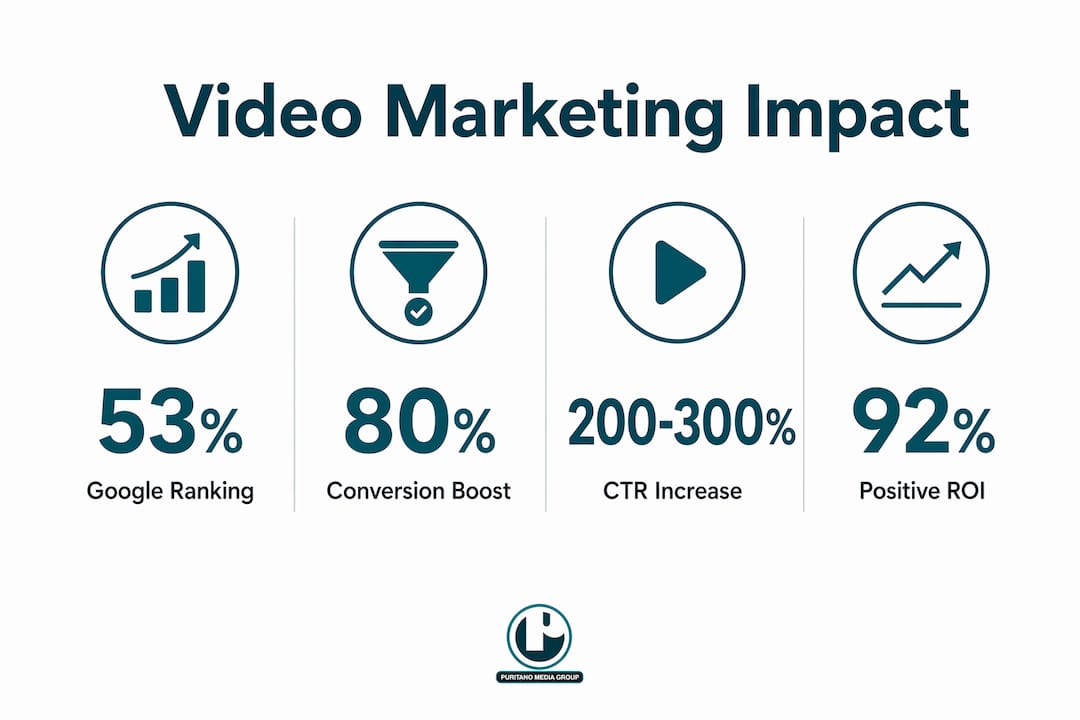
The SEO benefits of promotional videos are concrete and measurable. Google prioritizes pages with video because video increases dwell time, which is the amount of time a visitor spends on a page before returning to search results. Higher dwell time signals to Google that the page is relevant and useful. That signal feeds directly into organic rankings.
Pages with video are 53% more likely to rank on Google’s first page than pages without it. First-page placement is not a vanity metric. It determines whether your business gets found at all by people actively searching for what you sell.
The conversion data is equally direct. Landing pages with video see up to 80% higher conversion rates than those without. That improvement comes from the same trust-building mechanism that drives engagement. A visitor who watches a two-minute product video arrives at the “buy” button with far less hesitation than one who only read a bullet list of features.
Video on landing pages functions like a 24/7 sales team. It engages and qualifies visitors continuously, without requiring a human on the other end. For businesses with limited sales staff or high web traffic, that scalability is a genuine competitive advantage.
What types of promotional videos work best for different goals?
Not every promotional video serves the same purpose. Matching the format to the marketing goal is what separates a video that performs from one that just exists on a website. Well-crafted promotional videos can be adapted for different platforms and customer journey stages, which makes format selection a strategic decision, not just a creative one.
Explainer videos work best at the top of the funnel. They answer “what is this and why should I care?” in under two minutes. Software companies, nonprofits, and service businesses use them to simplify complex offerings for new audiences.
Customer testimonial videos belong in the middle and bottom of the funnel. They address doubt and build social proof right before a purchase decision. A 60-second testimonial from a real client carries more weight than a five-star rating.
Product demonstration videos show the product in action. They reduce return rates, increase purchase confidence, and work especially well for e-commerce and B2B sales.
Event teasers and recaps build anticipation and document credibility. Associations, nonprofits, and conference organizers use these to drive registrations and showcase community.
Social media clips are short, platform-specific, and built for sharing. They serve brand awareness goals and feed algorithm-driven discovery on platforms like Instagram, LinkedIn, and YouTube.
Videos in email campaigns increase click-through rates by 200–300%. That figure alone makes video a natural fit for nurture sequences, product launches, and event invitations. The format does not need to be elaborate. A 30-second clip embedded in an email can outperform a fully designed HTML newsletter.
Pro Tip: Match video length to platform expectations. LinkedIn audiences tolerate 90-second videos. Instagram Reels perform best under 30 seconds. YouTube supports longer formats when the content earns the watch time.
What are the best practices for promotional video in 2026?
The biggest shift in promotional video production right now is the move away from production polish toward content quality. In 2026, strong hooks and value-first messaging outperform high-budget productions that lead with brand logos and slow intros. Platform algorithms reward engagement signals, not production budgets. A founder talking directly to camera about a real customer problem can outperform a cinematic brand film if the message lands harder.
That does not mean production quality is irrelevant. Poor audio, shaky footage, and bad lighting still damage credibility. The standard has shifted from “looks expensive” to “looks intentional.” Viewers forgive imperfection. They do not forgive wasted time.
Here is what the most effective promotional video strategies share in 2026:
Platform-specific production. A video built for YouTube is not the same as one built for TikTok or LinkedIn. Aspect ratio, pacing, and caption style all vary by platform.
Value-first structure. The most useful or compelling content comes first. The brand mention comes after the viewer has already received something worth watching.
Clear single call to action. Every promotional video ends with one specific next step. Not three options. One.
Consistent publishing cadence. Algorithms and audiences both reward regularity. One video per month beats a burst of ten videos followed by six months of silence.
For businesses working with a video marketing strategy for the first time, the temptation is to produce one perfect video. The better approach is to produce a series of focused, shorter videos that each serve a specific goal in the customer journey.
Key takeaways
Promotional videos are the single most effective format for combining brand awareness, audience trust, and measurable conversion improvement in one asset.
Point | Details |
Video drives measurable ROI | 92% of marketers report positive ROI, making video the most validated content investment. |
SEO rankings improve with video | Pages with video are 53% more likely to reach Google’s first page due to higher dwell time. |
Conversions rise on video landing pages | Landing pages with video see up to 80% higher conversion rates than text-only pages. |
Format must match the goal | Explainers, testimonials, demos, and social clips each serve different funnel stages. |
Content quality beats production budget | In 2026, strong hooks and useful messaging outperform expensive but slow-starting productions. |
What I’ve learned from two decades of producing promotional videos
After more than 20 years producing video for businesses across the DMV area and nationally, one pattern stands out above everything else: the businesses that treat video as a one-time project consistently underperform compared to those that treat it as an ongoing channel.
The most common mistake I see is producing a single brand video, posting it to a website homepage, and calling it a video strategy. That video might be excellent. But without a distribution plan, a follow-up series, and a clear connection to a specific business goal, it sits there and collects dust. Video is not a trophy. It is a workhorse.
The second mistake is chasing production value before nailing the message. I have worked with clients who spent significant budgets on cinematic visuals, only to realize the script did not answer the viewer’s core question. The reverse, a clear, honest message delivered with modest production, almost always performs better. Get the story right first. Then invest in making it look great.
The businesses I have seen get the most from brand video storytelling are the ones who come in knowing what action they want the viewer to take. Not “we want people to know who we are.” That is too vague. “We want viewers to book a consultation” or “we want to increase demo requests by 30%.” Specific goals produce specific videos that produce specific results.
Puritano’s video production services for growing businesses
Puritano Media Group has spent over two decades helping businesses across Washington D.C., Virginia, Maryland, and nationally produce promotional video content that connects with real audiences and drives real results. The team works across corporate video, TV commercials, social media content, e-learning, nonprofit video, and live event coverage. Every project starts with a clear understanding of your business goal, not just your creative preferences. If you are ready to build a video presence that actually performs, Puritano is the production partner worth talking to. Reach out through the website to discuss your next project.
FAQ
What are promotional videos used for in business?
Promotional videos are used to drive specific actions such as purchases, sign-ups, or event registrations. They work across the full customer journey, from brand awareness at the top of the funnel to conversion at the bottom.
How do promotional videos improve SEO?
Video increases dwell time on web pages, which signals relevance to Google and improves organic rankings. Pages with video are 53% more likely to appear on Google’s first page than pages without it.
What types of businesses benefit most from promotional videos?
Every business category benefits, but the impact is especially clear for service businesses, B2B companies, nonprofits, and e-commerce brands. These sectors rely on trust and explanation, and video delivers both faster than text.
How long should a promotional video be?
Length depends on platform and goal. Social media clips perform best under 30–60 seconds. Explainer videos and testimonials typically run 60–120 seconds. Longer formats work on YouTube when the content earns the watch time from the first frame.
Do promotional videos actually increase sales?
Yes. 87% of people report that watching a brand’s video convinced them to make a purchase. Landing pages with video also see up to 80% higher conversion rates, making video one of the most direct drivers of revenue available to marketers.
Recommended
Comments