

What Is a Corporate Testimonial Video? A 2026 Guide

A corporate testimonial video is a professionally produced recording where real, satisfied customers describe their genuine experience with your product or service on camera. Unlike a written review, this format captures facial expressions, tone of voice, and body language — the human signals that text simply cannot replicate. Landing pages with video testimonials convert 34–38% higher, and 85% of viewers report being convinced to make a purchase after watching one. For businesses and organizations looking to build credibility fast, few marketing assets deliver results this direct.
The industry term for this format is the client testimonial video, though “corporate testimonial video” and “corporate video testimonial” are used interchangeably in production and marketing contexts. Both refer to the same asset: a curated, edited video piece featuring a real customer speaking authentically about measurable outcomes they experienced with your brand.
What is a corporate testimonial video and why does it matter?
A corporate testimonial video is defined as a short, professionally edited video in which a verified customer speaks directly about the results, experience, or transformation your business delivered. The word “corporate” signals that the video is produced with intentional quality — proper lighting, clean audio, and purposeful editing — rather than a casual phone recording. This distinction matters because production quality directly affects perceived credibility.
The importance of testimonial videos in modern marketing comes down to one word: trust. Only 42% of consumers fully trust written reviews, a number that has declined steadily as fake review scandals have eroded confidence in text-based social proof. Video is significantly harder to fabricate. A real person, speaking in their own words, with natural hesitations and genuine emotion, carries a weight that no copywriter can manufacture.
Platforms like YouTube, LinkedIn, and Vimeo have made distribution frictionless. A single well-produced testimonial video can live on your homepage, run as a paid social ad, appear in a sales email sequence, and anchor a trade show presentation. That multi-channel utility is what separates testimonial videos from almost every other content format in your marketing mix.
What measurable benefits do corporate testimonial videos deliver?
The ROI case for testimonial videos is not theoretical. Conversion lifts of 20–80%, cost-per-acquisition reductions of 20–40%, and sales cycle compression of 20–35% are documented outcomes across industries. These numbers mean a single well-placed testimonial video can pay for its production cost within a single campaign cycle.
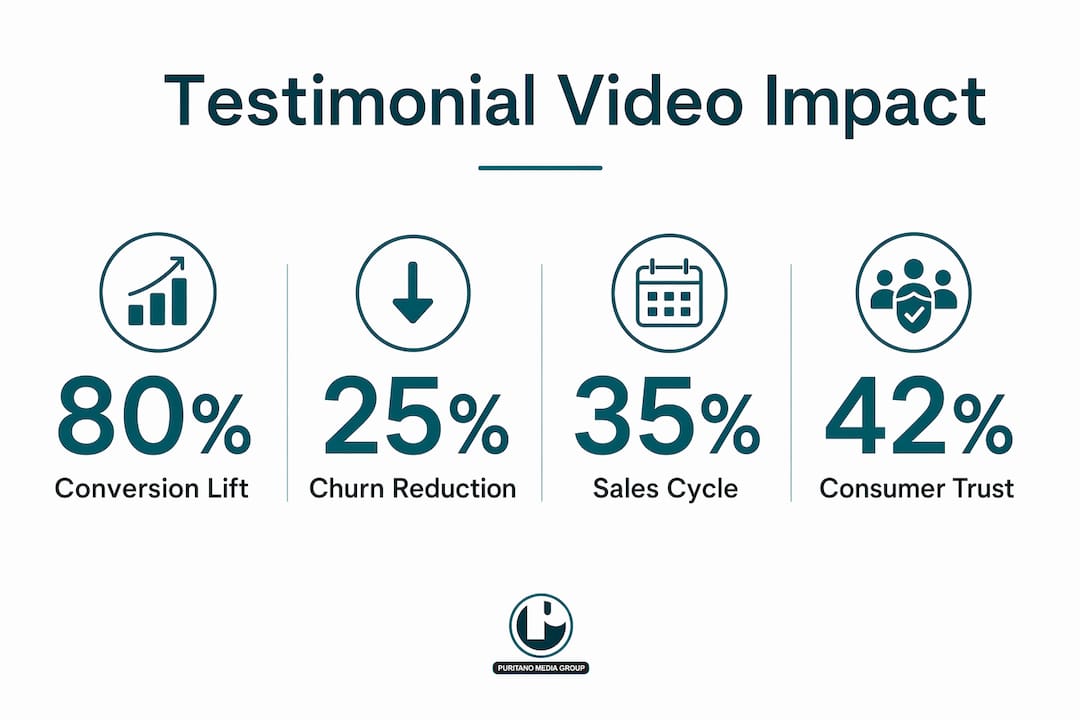
Consider the sales cycle impact specifically. When a prospect watches a customer describe a problem they recognize and a solution that worked, the internal objection-handling process accelerates. Sales reps at B2B companies that deploy video testimonials in their outreach report 15–20% more closed deals per rep. That is not a marginal improvement. It is a structural shift in how quickly trust is established.
The benefits of testimonial videos also extend past the initial sale. First-year churn rates drop 15–25% when customers have been exposed to peer success stories before and during onboarding. A new client who has watched three customers describe positive outcomes enters the relationship with higher confidence and clearer expectations. Lower churn means higher lifetime value, which compounds the ROI of every video you produce.
Here is a snapshot of the core performance data:
The multi-channel compounding effect is worth emphasizing. A testimonial video produced once can generate returns across paid media, organic search, email, and direct sales simultaneously. Most content formats are channel-specific. Testimonial videos are a different animal entirely — they function as scalable, high-ROI assets that appreciate in value the more channels you deploy them across.
How do video testimonials compare to text testimonials?
Video and text testimonials are not competitors. They are complementary tools that serve different functions at different stages of the buyer journey. Understanding when to use each is what separates a good testimonial strategy from a great one.
Text testimonials win on volume and SEO. You can collect dozens of written reviews through platforms like Google Business Profile or G2 with minimal friction. Those reviews feed search engine indexing, populate star ratings, and provide breadth of social proof across many customer types. They are the workhorse of everyday credibility maintenance.
Video testimonials win on depth and emotional impact. Top-converting brands use a blended strategy: video for emotional connection at high-stakes decision points, and text testimonials for breadth and SEO coverage. A homepage that features one strong video testimonial alongside six to eight written quotes gives visitors both the emotional anchor and the volume signal they need to feel confident.
The authenticity gap between the two formats is significant. Only 42% of consumers consider written reviews as credible as personal recommendations. Video closes that gap because it is nearly impossible to fake convincingly. A real customer’s micro-expressions, natural speech patterns, and specific details about their experience create a credibility signal that no text block can match.
Here is a practical breakdown of when each format performs best:
Video testimonials work best on high-traffic landing pages, in sales outreach emails, at trade shows, and in paid social campaigns where emotional resonance drives action.
Text testimonials work best for SEO-rich review pages, product detail pages, and situations where you need volume across many customer segments quickly.
Combined placement works best on pricing pages and case study sections, where a video testimonial serves as the trust anchor and surrounding text quotes reinforce the message with specificity.
The strategic insight from video versus text testimonial research is that video should be treated as a trust anchor, not a replacement for written social proof. Place your strongest video testimonial at the moment of highest buyer hesitation, and let text testimonials do the volume work everywhere else.
How to create effective corporate testimonial videos
Creating a strong corporate testimonial video follows a clear process. The quality of the output depends far more on preparation and customer selection than on camera equipment.
1. Select the right customers. Choose customers who achieved a specific, measurable result with your product or service. Vague enthusiasm (“They were great to work with!”) does not convert. Specific outcomes (“We reduced our onboarding time by 40% in the first quarter”) do. Prioritize customers who are articulate, comfortable on camera, and represent the audience you are trying to reach.
2. Make participation easy. Promise a low time commitment, specify the format clearly, and offer final content approval before publication. These three commitments remove the most common reasons customers decline. Most people are willing to participate when they understand the ask is 30 minutes, not a half-day production.
3. Use conversational prompts, not scripts. Conversational prompts produce more authentic responses than scripted answers. Ask questions like “What was the situation before you worked with us?” and “What specific result surprised you most?” Let the customer speak naturally, and plan for multiple takes to capture the best version of each answer.
4. Prioritize audio, then lighting, then video. Audio quality comes first in any testimonial production. A viewer will tolerate slightly imperfect visuals, but poor audio kills credibility instantly. Use a lapel microphone or a directional mic close to the subject. Natural window light or a simple two-light setup handles most interview situations without a Hollywood budget.
5. Keep the final edit under 60 seconds. 64% of viewers prefer video ads no longer than one minute. Edit out pauses, filler words, and tangents. Use B-roll footage of your product, office, or team to cover cuts and add visual variety. A tight, well-paced 45-second testimonial outperforms a rambling three-minute one every time.
6. Distribute across every relevant channel. Publish the video on your website’s landing pages, share it on LinkedIn and YouTube, embed it in sales email sequences, and repurpose short clips for Instagram Reels or TikTok. Remote recording options using tools like Zoom or Riverside.fm make geographic distance a non-issue while keeping production costs manageable.
Pro Tip: Record three to five times more footage than you think you need. The best testimonial moments often come after the subject relaxes, which typically happens in the second or third take. Give yourself editing options.
Where and how do businesses use corporate testimonial videos strategically?
The most effective uses of corporate video testimonials go well beyond the homepage. Businesses that treat testimonial videos as a single-placement asset leave significant value on the table.
On landing pages, a video testimonial placed above the fold functions as what research calls a “trust anchor.” It signals immediately that real people have used this product and found it worth talking about. Pair it with a clear call to action and supporting text quotes, and you have the highest-converting page structure available to most businesses.
In sales enablement, testimonial videos sent during the proposal stage address objections before a prospect raises them. A sales rep who shares a video of a customer in the same industry describing a successful outcome shortens the trust-building process by days or weeks. This is where the brand storytelling dimension of testimonials becomes most visible: the customer’s story becomes your story, told by someone the prospect trusts more than you.
Testimonial videos also serve recruiting and investor relations functions that many organizations overlook. A prospective employee watching a client describe the quality of your team’s work gets a credibility signal that no job posting can provide. An investor watching three customers describe measurable ROI gains a confidence level that a slide deck alone cannot generate. For associations and nonprofits, member testimonial videos build the case for joining or donating more effectively than any brochure.
“The most powerful testimonial videos are not about your company. They are about your customer’s transformation. Your brand is the supporting character in their story.”
Social media distribution amplifies reach without additional production cost. A 60-second testimonial cut into three 20-second clips gives you a week of LinkedIn content from a single interview. YouTube hosts the full version for long-term organic discovery. The company culture video and testimonial video formats also complement each other naturally, with testimonials handling external credibility and culture videos handling internal brand perception.
Key takeaways
Corporate testimonial videos are the highest-trust, highest-ROI content format available to businesses because they combine emotional authenticity, measurable conversion impact, and multi-channel scalability in a single asset.
What I’ve learned after two decades of producing these videos
Here is something most articles on this topic will not tell you: the biggest obstacle to a great testimonial video is not budget or equipment. It is the client’s reluctance to ask their customers. We see it constantly at Puritano. A business has ten genuinely thrilled customers who would happily speak on camera, but no one has ever asked them directly.
The fix is simpler than most people expect. When you approach a satisfied customer with a clear, low-friction ask — “We’d love 30 minutes of your time, you’ll see the edit before it goes live” — the acceptance rate is high. The customers who say yes are usually the ones who feel a genuine sense of partnership with your brand, and that genuine feeling is exactly what the camera captures.
I have also seen businesses over-produce their testimonials to the point where they feel like commercials. Scripted answers, heavy-handed graphics, and overly polished editing strip out the authenticity that makes these videos work. The high-converting video structure is not the most visually elaborate one. It is the one where the customer sounds like a real person talking to a friend.
The future of testimonial marketing is moving toward shorter, more frequent, and more casually produced clips distributed on social platforms. But the foundational principle does not change: a real person, describing a real result, in their own words, is the most persuasive marketing asset your business can own.
How Puritano can help you produce testimonial videos that convert
At Puritano, we have spent over two decades producing corporate video content for businesses, associations, and organizations across the Washington D.C. area and nationally. Testimonial video production is one of the most requested services we handle, and we have developed a process that keeps the experience low-friction for your customers while delivering polished, credible results. We handle everything from pre-interview coaching and on-location filming to remote recording coordination and final editing. If you are ready to put real customer voices to work for your brand, explore our full video production services to see how we approach each project.
FAQ
What is the ideal length for a corporate testimonial video?
The ideal length is under 60 seconds. Research shows 64% of viewers prefer video content no longer than one minute, and tightly edited testimonials consistently outperform longer versions in both completion rate and conversion impact.
How many testimonial videos does a business need?
Start with three to five videos representing different customer types, industries, or use cases. Variety signals broad credibility and allows you to match the right testimonial to the right audience segment throughout the buyer journey.
Can testimonial videos be recorded remotely?
Yes. Remote recording using platforms like Riverside.fm or Zoom is a practical and cost-effective option that removes geographic barriers. The key is maintaining audio quality with a dedicated microphone and ensuring the subject has adequate lighting before recording begins.
How do corporate testimonial videos affect SEO?
Video testimonials increase time-on-page and reduce bounce rates, both of which are positive signals for search rankings. Hosting on YouTube also creates an additional indexed asset that can appear in Google search results independently of your website.
What makes a great testimonial video versus an average one?
A great testimonial video features a specific, measurable outcome described in the customer’s own words, recorded with clean audio and natural delivery. Average testimonials rely on vague praise and feel scripted. Specificity and authenticity are the two variables that separate high-converting testimonials from forgettable ones.
Recommended
Comments