

YouTube Shorts Length in 2026: What Creators Need to Know
Updated: 4 days ago

YouTube Shorts can run anywhere from 15 seconds to 3 minutes. That 3-minute ceiling has been in place since October 15, 2024, when YouTube expanded the format from its original 60-second cap. The practical rule of thumb: use the shortest runtime that communicates one complete idea and matches your goal. Longer is not better by default.
Here’s how to think about length at a glance:
Under 30 seconds: Trend-driven content, quick hooks, high-shareability clips, and anything built around a single visual gag or reaction. These tend to loop well and rack up replays.
30–60 seconds: The sweet spot for most branded content and social media campaigns. Enough room to set context, deliver a payoff, and include a call to action without losing the viewer.
60–180 seconds (1–3 minutes): Step-by-step tutorials, serialized storytelling, product walkthroughs, and mini-documentaries. Use this range only when the idea genuinely needs the time.
Key Takeaways
YouTube Shorts max out at 3 minutes as of October 15, 2024, and the right length is always the shortest runtime that cleanly communicates one idea for your specific goal.
Point | Details |
Current length limits | Shorts run 15 seconds minimum to 3 minutes maximum; the 3-minute cap took effect October 15, 2024. |
Classification signal | Vertical (9:16) or square (1:1) uploads at or under 3 minutes are treated as Shorts; 16:9 routes to long-form. |
Algorithm priority | Watch-through rate, replays, and retention outweigh raw runtime in the Shorts feed ranking. |
YPP Shorts threshold | Monetizing through the Shorts feed requires 1,000 subscribers and 10 million valid public Shorts views in a rolling 90-day period. |
Puritano’s approach | Puritano aligns on goal first, picks a length band in discovery, and tests length variations while holding the hook constant. |
What is the official YouTube Shorts length limit?
The official minimum for a YouTube Short is 15 seconds. The maximum is 3 minutes (180 seconds). Both limits apply to vertical and square uploads that meet the aspect-ratio classification rules.
The timeline matters for creators and marketers managing catalogs. Vertical or square videos uploaded on or after October 15, 2024 that meet the aspect-ratio requirements are classified as Shorts and become eligible for Shorts revenue-sharing. Videos uploaded before that date follow earlier classification logic. YouTube also notes additional classification considerations for videos uploaded around December 8, 2025, so creators managing back-catalog uploads should review the current guidance directly.
YouTube detects Shorts primarily through aspect ratio, not a title tag or hashtag. A vertical (9:16) or square (1:1) upload at or under 3 minutes will generally be treated as a Short. Upload a 16:9 widescreen file and it routes to the standard long-form feed regardless of runtime. That distinction has real consequences for discovery and monetization, which we cover below.
Two edge cases worth knowing. First, Content ID interactions can affect Shorts that use third-party music, particularly those over 1 minute. Second, tracks in the Shorts Audio Library carry their own duration limits: some are capped at 30, 60, or 90 seconds of use inside a single Short. If you’re building a 2-minute Short around a licensed track, check the audio duration indicator at selection before you commit to that music.
How does Shorts length affect distribution and monetization?
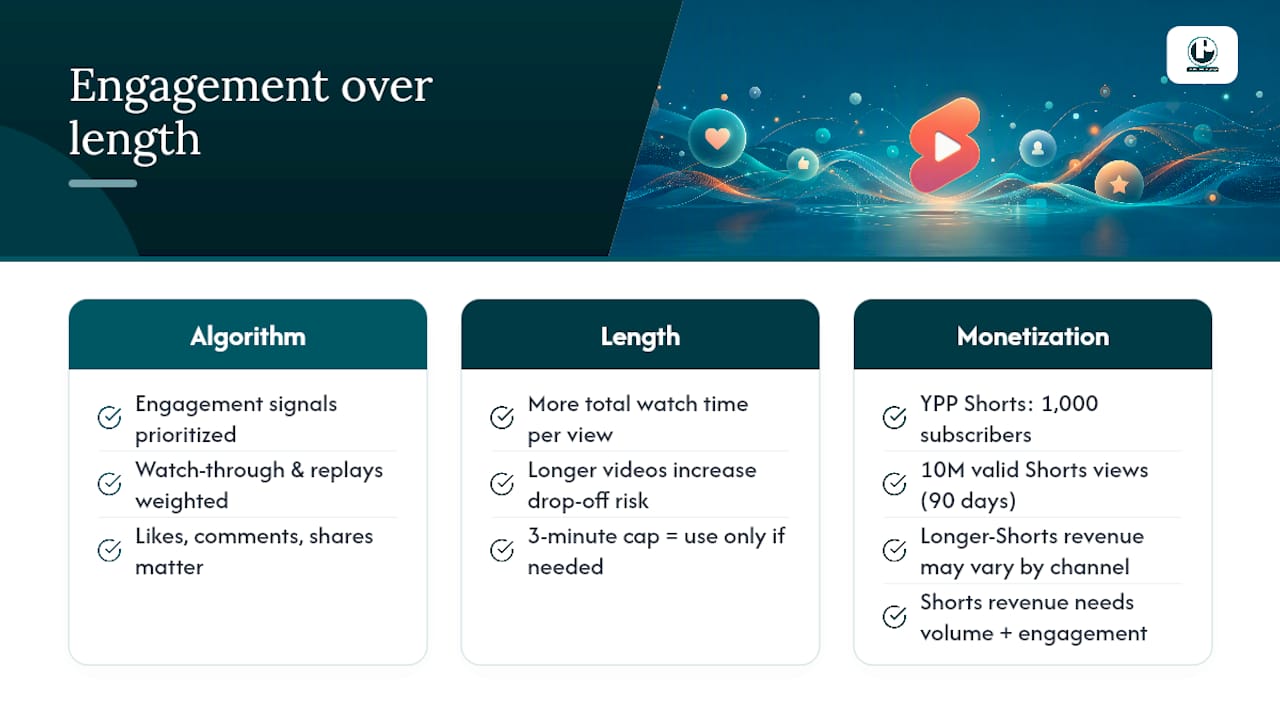
Length is a lever, not a guarantee. According to reporting on YouTube’s own algorithm explanations, the Shorts feed prioritizes engagement signals over raw runtime. Watch-through rate, replays, likes, comments, and shares carry more weight than whether a Short is 20 seconds or 2 minutes.
That said, length and retention are connected. Longer Shorts give you more total watch time per view, which can help channel-level metrics, but they also give viewers more opportunities to drop off. The YouTube Blog’s creator guidance frames the 3-minute expansion as extra storytelling flexibility, not a directive to make longer content. The platform’s own advice: treat the 3-minute cap as a ceiling you use only when the story needs it.
The Shorts algorithm rewards viewer behavior, not video length. A Short that gets replayed consistently will outperform a longer Short that loses viewers at the halfway point.
Monetization thresholds are specific. To earn through the Shorts feed via the YouTube Partner Program, creators must reach 1,000 subscribers and 10 million valid public Shorts views within a rolling 90-day period. That threshold is separate from the standard YPP long-form requirement (1,000 subscribers and 4,000 watch hours). Creators who rely on Shorts views for revenue should know that monetization for longer Shorts (1–3 minutes) may also interact with channel-specific monetization agreements, so the revenue mechanics can differ from standard Shorts payouts. Check your channel’s monetization settings for the specifics.
For marketers, the practical implication is this: if your goal is Shorts-feed revenue, you need volume and engagement, not just long runtimes. If your goal is brand awareness or conversion, length decisions should be driven by creative clarity, not a platform revenue formula.
What is the ideal YouTube Shorts length for your goal?
There’s no single ideal length. The right runtime depends on what you’re trying to accomplish. Here’s how the three practical ranges break down.
15–30 seconds: reach and virality
Short clips under 30 seconds loop naturally, which inflates replay counts and signals strong engagement to the algorithm. They work best for trend participation, quick product reveals, single-punchline humor, and anything where the hook is the content. Production is lean, iteration is fast, and you can test multiple concepts in the time it takes to produce one longer Short.
The trade-off: there’s almost no room for context. If your brand, product, or message needs even a sentence of setup, 30 seconds will feel rushed.
30–60 seconds: engagement and brand storytelling
This range gives you a setup, a payoff, and a moment to direct the viewer somewhere (a link, a follow, a next video). Most branded social content and campaign-driven Shorts live here. Viewer behavior in this range tends to be more intentional: people who watch past 15 seconds are usually genuinely interested, which means your average view duration numbers will look healthier.
For video storytelling that needs to establish a brand voice, 45–60 seconds is often the minimum viable runtime.
60–180 seconds: tutorials, conversion, and serialized content
The 1–3 minute range is a different animal. Viewers who watch a 2-minute Short are self-selecting as high-intent. That makes this range valuable for product tutorials, how-to content, behind-the-scenes brand stories, and anything designed to move someone toward a purchase or sign-up. The challenge is that you need a strong hook and strong pacing throughout, because the Shorts feed is still a scroll environment.
Creators get the most from the 3-minute allowance when they use it for single-topic narratives rather than padding a quick idea to fill time. A 90-second Short that covers one step of a process will outperform a 3-minute Short that meanders through three loosely related ideas.
Pro Tip: If you’ve produced a 3-minute Short, cut it into two or three standalone clips and publish them as a series. Each clip functions as a reach driver for the others, and you get multiple data points on which length and hook combination your audience responds to best.
Tactics that improve retention at any length
The first 1–3 seconds of a Short decide everything. Open with a direct value statement (“Here’s how to fix your lighting in 60 seconds”), a visual hook that creates immediate curiosity, or a question that the viewer needs answered. Avoid slow pans, logo animations, or any intro that delays the point. The YouTube Blog’s guidance is explicit: capture attention in the first few seconds or lose the viewer to the next scroll.
Pacing works differently across length ranges. For sub-30-second Shorts, cut cadence should be fast, with scene changes every 2–4 seconds. For 60–180-second Shorts, use micro-cliffhangers at the 15-second and 30-second marks to keep viewers from swiping. Think of those moments as internal hooks: a quick “and here’s the part most people get wrong” or a visual reveal that rewards continued watching.
On audio: music tracks from the Shorts Audio Library often have duration caps (30, 60, or 90 seconds). If you’re building a Short longer than 60 seconds with licensed music, check the audio duration indicator when you select the track. A Content ID block on a 90-second Short because the music license only covered 60 seconds is an avoidable production mistake. For longer Shorts, original audio or voiceover is often the safer choice.
Captions are non-negotiable for mobile-first viewers. A significant share of Shorts are watched without sound, and on-screen text keeps those viewers in the video.
Pro Tip: Storyboard your first 5–10 seconds as a separate creative brief before you script the rest of the Short. Treating the hook as its own deliverable forces you to make it genuinely compelling rather than a warm-up for the “real” content.
How do you choose the right length for each Short?
Use this decision matrix as a starting point, then test.
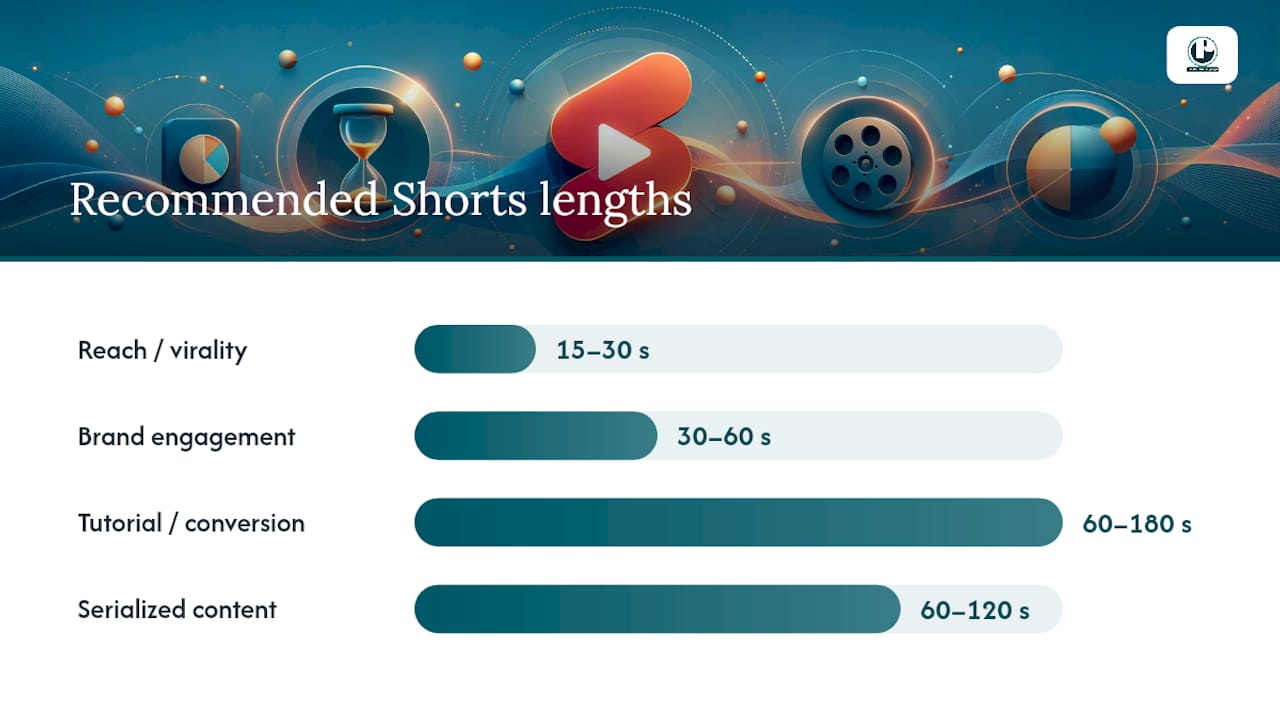
Goal | Recommended length | Strengths | Watch for |
Reach / virality | 15–30 seconds | High replay rate, fast iteration | No room for context or CTA |
Brand engagement | 30–60 seconds | Balanced retention, brand voice | Needs strong hook to hold past 15s |
Tutorial / conversion | 60–180 seconds | High-intent viewers, deeper storytelling | Pacing must stay tight throughout |
Serialized content | 60–120 seconds per episode | Builds return audience, strong watch time | Requires consistent publishing cadence |
Once you’ve picked a length band, run a structured test before committing to a format for a full campaign.
Hold the hook and thumbnail constant. The only variable you’re testing is length. If you change the hook at the same time, you can’t attribute performance differences to runtime.
Publish at least 3–5 Shorts per length band before drawing conclusions. Single-video performance is too noisy to be reliable.
Wait 14–21 days per test batch. Shorts can get delayed distribution pushes, and early view counts often don’t reflect final performance.
Measure retention curves, not just view counts. A Short with 50,000 views and a 40% average view duration is underperforming relative to one with 20,000 views and 80% retention. The algorithm reads both signals.
The metric that matters most in a Shorts length test is not total views. It’s the point in the video where your audience drops off — that’s where your creative is losing them, and that’s what you fix next.
For a deeper look at how engagement metrics translate to platform performance, social video performance context is worth reviewing alongside your analytics.
Technical specs and upload tips for YouTube Shorts
Getting the technical side right prevents misclassification and avoids re-encoding artifacts that reduce perceived quality.
Aspect ratio is the primary classification signal. Upload vertical 9:16 to get Shorts treatment. Square 1:1 is also accepted. Upload 16:9 widescreen and YouTube routes the video to the standard long-form feed, regardless of runtime. If you’re deliberately trying to keep a sub-3-minute video out of the Shorts feed (to preserve standard monetization mechanics, for example), a 16:9 file is the practical way to do it.
For resolution, ShortSync’s upload requirements guide recommends 1080×1920 (1080p vertical) as the target. YouTube can aggressively re-encode very high-resolution uploads for the Shorts format, which sometimes reduces perceived sharpness. Shooting and delivering at 1080p vertical keeps file sizes manageable and avoids that re-encoding penalty.
A quick pre-upload checklist:
Aspect ratio: 9:16 vertical or 1:1 square
Resolution: 1080×1920 preferred for vertical
Runtime: 15 seconds minimum, 180 seconds maximum
Audio: Check duration limits on any Shorts Audio Library track before finalizing the edit
Metadata: Titles, descriptions, and hashtags are indexed, but viewer behavior signals drive feed ranking. Optimize metadata for click-through, not keyword density.
Content ID: Shorts over 1 minute using third-party music carry higher Content ID risk. Confirm licensing before publishing.
For a full cross-platform spec comparison, including how Shorts requirements compare to Instagram Reels length in 2026 and other short-form formats, Puritano’s 2026 platform spec guide covers the differences in one place. Aspect ratio decisions also have implications beyond Shorts, which the corporate video aspect ratio guide covers in more depth.
How Puritano approaches Shorts length for client work
We’ve worked on enough social video campaigns to know that the length question rarely has a clean answer before you look at the data. Our approach starts in discovery: we align on the goal first (reach, conversion, brand awareness, or a specific campaign KPI), then pick a target length band based on that goal and the client’s existing content performance.
From there, we storyboard the first 5–10 seconds as a standalone creative brief before scripting the rest. That discipline forces the hook to earn its place rather than serving as a warm-up. For brands running Shorts as part of a larger content strategy, we often recommend starting with a 30–60-second format to establish baseline retention data, then testing a shorter cut and a longer cut against that baseline.
Two patterns we see consistently: quick-hit brand awareness clips in the 20–30-second range perform well for product launches and event teasers, where the visual is the message. Longer 90–120-second Shorts work for tutorial-style content where a viewer needs enough context to take a next step, like visiting a product page or booking a consultation. The brand storytelling best practices we’ve developed reflect both patterns. Visual storytelling principles, including how to structure a narrative arc inside a short runtime, are also covered well in this visual storytelling resource.
Puritano produces Shorts built to perform, not just comply
Knowing the rules is the starting point. Getting the length, hook, pacing, and format right for your specific audience and goal is where production expertise pays off. Puritano’s team handles the full production chain for social video: strategy and goal alignment, vertical shooting, mobile-first editing, audio selection, and post-publish performance review to inform the next iteration.
For brands that want to repurpose existing long-form content into Shorts, we build a repurposing workflow that extracts the highest-retention moments and reformats them for the Shorts feed, often producing three to five Shorts from a single long-form asset. That’s a faster production cadence than starting from scratch, and it extends the life of content you’ve already invested in.
See how Puritano approaches social and music video production in the music video portfolio, or reach out directly to discuss a Shorts strategy for your brand.
Sources
Recommended
Runtime decisions get easier when versions are planned before the shoot instead of carved out afterward. We direct Chats with Change Makers, the interview series for DiscoverE, the national engineering outreach organization, and each filming session is designed so one conversation yields a full episode plus cutdowns and clips in shorter lengths. Because the short versions were part of the plan from the start, each length has a complete idea to work with rather than whatever happened to survive the edit.


Comments