

Video Regulation for U.S. Organizations: Compliance Guide
Updated: Aug 12

Every professional video project in the U.S. requires you to address four non-negotiable compliance areas before distribution: copyright clearance and registration with the U.S. Copyright Office, music and third-party asset licensing, signed talent and location releases, and accessibility (captions and audio description for covered entities under the ADA and Section 508). The Department of Justice enforces Title II digital accessibility obligations, and the FTC governs advertising disclosures. Puritano Media Group builds each of these checkpoints into its production workflow as standard practice, not an afterthought.
Assign these tasks before cameras roll:
Legal lead: Verify copyright ownership, confirm registration strategy, and review any third-party asset licenses.
Producer: Collect signed talent, location, and property releases; confirm music sync and master-use licenses are in writing.
Accessibility lead: Order professional captioning and audio description; specify deliverable formats in the contract.
Budget owner: Allocate funds for music licensing, caption production, copyright registration, and legal review.
What does “video regulation” actually cover in the U.S.?
The phrase “video regulation” is informal shorthand for a cluster of distinct legal frameworks, each with its own enforcement authority. Understanding which law applies to your project determines who can sue you, which agency can investigate, and what remedies are on the table.
Copyright (Title 17 U.S.C.) protects original audiovisual works automatically at fixation. The U.S. Copyright Office handles registration and deposit. Right of publicity is state law, varying by jurisdiction, and governs commercial use of a person’s name, image, or likeness. Privacy law covers intrusion and disclosure of private facts. ADA Title II (enforced by the DOJ) and Section 508 (for federal agencies and contractors) mandate accessible media. WCAG 2.1 AA is the technical standard those laws point to. The FTC regulates endorsements and advertising disclosures in video content. COPPA applies when content targets children under 13. State privacy laws, including California’s CCPA, add data-handling obligations when video production involves collecting viewer or participant data.
Enforcement comes from multiple directions: private lawsuits, DOJ or state attorney general investigations, platform takedowns via Content ID or DMCA notices, and contract-based rejection by distributors who require chain-of-title documentation before licensing your content.
“The nondiscrimination requirements of Title II of the ADA apply to all services, programs, and activities of public entities, including those provided via the web and mobile apps.” — U.S. Department of Justice, 2024 Final Rule
Copyright basics: what protection you have and when to register
Copyright attaches the moment an original work is fixed in a tangible medium, which means your video is protected from the instant it is recorded. That protection is real, but it has limits without registration.
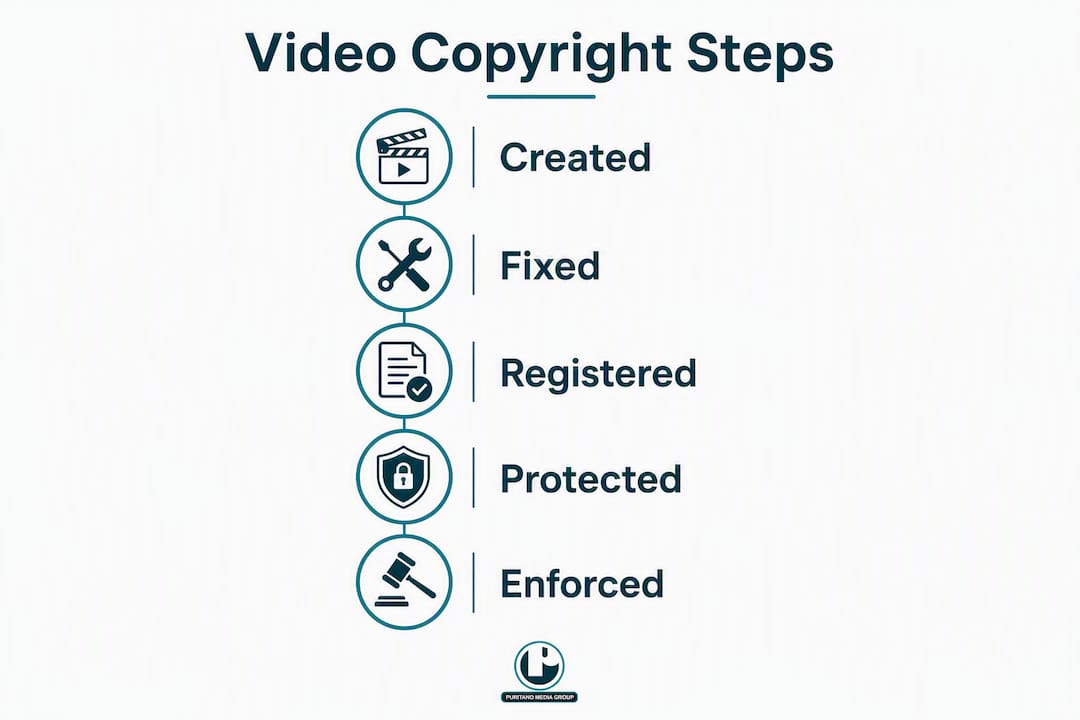
Registration with the U.S. Copyright Office unlocks two critical litigation tools: the right to seek statutory damages (up to $150,000 per willful infringement) and the right to recover attorneys’ fees. Without a timely registration, you can still sue, but you are limited to actual damages, which are often difficult to prove and rarely worth the cost of litigation. The Copyright Office can also demand deposit of one complete copy of the best edition of a published work within three months of publication; failure to comply after a formal demand can result in fines and other penalties.
Fair use (17 U.S.C. § 107) is a defense, not a clearance strategy. Courts weigh four factors:
Nature — of the copyrighted work
Relying on fair use for commercial video production is legally risky because courts decide it case by case, and the outcome is never guaranteed. Get legal review before using any third-party footage, music, or imagery without a license.
Pro Tip: Register your video with the U.S. Copyright Office before public release, especially if distribution partners or broadcasters require proof of ownership or if you may need to enforce against infringement.
What should you clear before production begins?
Pre-production is where most compliance problems are either prevented or created. Securing releases and licenses before filming avoids the far more expensive alternative: re-shoots, injunctions, or platform takedowns after the project is complete.
Releases and permissions to collect before the shoot:
Signed talent releases from every on-camera person, including background performers who are identifiable
Guardian consent forms for any minor appearing on screen
Location and property releases from owners of private spaces, recognizable artwork, and visible trademarks
Permits required by local jurisdictions for public filming
Music licensing is where teams most often get caught. Every piece of music carries two separate copyrights: the composition (melody and lyrics) and the master recording (the specific recorded version). You need a sync license for the composition and a master-use license for the recording. Performance rights organizations (ASCAP, BMI, and SESAC) collect royalties for public performance, but they do not grant sync rights. Document every license in writing, and confirm it covers your intended distribution platforms and territories. Stock music libraries that offer “royalty-free” tracks typically bundle sync and master rights in one license, which simplifies clearance considerably.
Chain-of-title documentation confirms that every element in your video, including graphics, archival footage, and music, has a written license covering commercial use, your distribution platforms, and the full duration of your intended use. When in doubt, commission original elements.
Pro Tip: Obtain all releases before the first day of filming. A talent or location dispute discovered in post-production can halt delivery and cost far more than the original shoot.
How do ADA, Section 508, and WCAG apply to your video?
Accessibility is no longer optional for most organizations producing video. WCAG success criteria and the Revised Section 508 Standards require captions for prerecorded and live synchronized media, and audio description (or an equivalent alternative) wherever visual information is essential to understanding the content.
The DOJ’s 2024 final rule on web and mobile accessibility extends Title II obligations explicitly to digital multimedia for state and local governments, with compliance dates staggered by population size. Federal agencies and their contractors remain subject to Section 508. Private organizations serving the public face ADA Title III exposure for inaccessible video content on their websites.
Minimum accessibility deliverables for prerecorded video:
Accurate closed captions with speaker identification and non-speech sound descriptions
Audio description track (or a described version of the video) for content where visuals convey information not in the audio
Accessible media player with caption and audio description toggle controls (per Section 508 requirement 503.4)
Transcript for audio-only content
Auto-captions alone do not meet the standard. Human review is required to correct errors, add speaker IDs, and describe relevant non-speech audio. Build caption QA and audio description review into your post-production schedule, not as a last-minute add-on.
Pro Tip: Specify caption accuracy standards, speaker identification, and audio description in your production contract. Require a signed accessibility QA sign-off before final delivery.
Privacy, right of publicity, and defamation: where the landmines are
Privacy and publicity claims are separate legal theories, and conflating them creates gaps in your release strategy. Right of publicity protects against commercial exploitation of a person’s name, image, or likeness without consent. Privacy covers intrusion into private spaces and disclosure of private facts. Both require releases when you are using someone’s appearance for commercial purposes.
Filming on public property generally does not require location releases, but identifiable individuals in your footage still need talent releases if they appear in a commercial context. Private property always requires a property release. Minors require written guardian consent, full stop.
Defamation risk arises when video content makes false statements of fact about an identifiable person or organization. The defenses are truth, opinion framing, and documented editorial verification — but none of them substitute for legal review before publishing claims about real people.
Testimonials and endorsements carry their own risk layer: the FTC requires that any material connection between an endorser and a brand be clearly disclosed. Undisclosed paid testimonials in video content are an FTC enforcement target.
For sensitive subject matter, including investigative content, whistleblower interviews, or content involving minors, involve counsel before production begins. Document every interview consent, keep approval records, and archive signed release forms as evidence.
Platform rules, COPPA, influencer content, and advertising disclosures
Distribution platforms enforce their own compliance requirements on top of federal law, and they act fast.
YouTube and major social platforms use Content ID and DMCA systems to flag unlicensed music and footage. Keep written proof of every license; platform enforcement makes documentation non-negotiable for resolving disputes.
FTC endorsement rules require clear disclosure whenever there is a material connection between a brand and an on-screen endorser or influencer. “Ad,” “#sponsored,” or equivalent language must appear prominently, not buried in a caption.
COPPA applies when your content is directed to children under 13 or when you knowingly collect data from that audience. Platforms require content creators to self-identify child-directed content, which restricts behavioral advertising and data collection. Misclassification is an enforcement risk.
Influencer and user-generated content: require contributor release forms, IP ownership warranties, and clear content moderation rules in every collaboration agreement. An influencer’s upload of your branded content without proper disclosure creates FTC liability for your organization, not just theirs.
Deepfakes and AI-generated video: using AI to generate realistic likenesses of real people without consent creates right-of-publicity exposure and, in some states, specific statutory liability. Disclose AI-generated content clearly and obtain releases when real likenesses are involved.
Pro Tip: Add a platform-scope clause to every music and footage license that explicitly names the distribution channels (YouTube, LinkedIn, broadcast, paid social) and confirms the license covers paid advertising use, which often requires a separate license tier.
What contract clauses actually protect you?
A production contract without the right IP and indemnity language is a liability waiting to surface.
Core provisions every production agreement needs:
Ownership: — work-for-hire language (for employees and qualifying contractors) or a written copyright assignment; specify what the client owns versus what the producer retains
A contract clause worth discussing with counsel: “Producer assigns to Client all right, title, and interest in the Deliverables, including all copyright, upon receipt of full payment, and warrants that the Deliverables do not infringe any third-party rights. Producer shall indemnify Client against any third-party claims arising from Producer’s breach of this warranty.”
Approval and documentation practices matter as much as the contract language itself. Use versioned sign-off, name the approval authority in writing, and archive every signed release and license file. Distributors and broadcasters routinely request chain-of-title documentation before licensing your content. See how to manage client video production projects for a practical approval workflow.
Typical timelines and cost ranges for compliance tasks
Build these into your project plan before pre-production begins, not after picture lock.
Compliance Task | Typical Turnaround | Ballpark Cost Range |
Live captioning (CART) | Same day | — |
Copyright registration (standard) | — | $45 filing fee |
Schedule clearance milestones at pre-production kickoff, caption and audio description tasks immediately after picture lock, and legal review at contract execution and before distribution.
Key Takeaways
Compliant video production in the U.S. requires copyright registration, pre-production releases, licensed music, accessible captions, and contract clauses that assign IP and allocate risk before distribution.
Point | Details |
Register before release | Copyright registration with the U.S. Copyright Office preserves statutory damages and attorneys’ fees if you need to enforce. |
Clear music with two licenses | Every track needs both a sync license (composition) and a master-use license (recording) before post-production. |
Captions require human QC | Auto-captions do not meet ADA, Section 508, or WCAG 2.1 AA standards; human review and speaker IDs are required. |
Releases before filming | Talent, location, and guardian consent forms must be signed before the shoot to avoid re-shoots or injunctions. |
Puritano embeds these checkpoints | Puritano Media Group integrates clearance, accessibility QA, and contract sign-off into its standard production workflow for government, nonprofit, and corporate clients. |
What we’ve learned building compliance into production from day one
The organizations that handle video compliance well share one habit: they treat it as a production workflow, not a legal checklist to hand off at the end. The teams that struggle are the ones who finish a video and then ask, “Do we have releases for everyone in this?” That question, asked after picture lock, has a way of becoming very expensive very quickly.
What most compliance guides understate is the contract layer. A well-drafted work-for-hire clause and a clear indemnity provision do more practical work than any amount of after-the-fact legal review. The same is true for accessibility: organizations that specify caption accuracy and audio description in the production contract get better deliverables than those who request it as a revision after delivery.
The deepfake and AI-generated content area is where we see the most uncertainty right now. The legal framework is still catching up to the technology, but right-of-publicity exposure is real and immediate in states with strong statutes. The practical answer is simple: disclose AI use, get releases when real likenesses are involved, and do not assume that “it’s AI-generated” is a defense.
Compliance is not the enemy of creative ambition. A production team that knows the rules can work faster and more confidently within them than one that discovers the rules after the fact.
How Puritano Media Group supports compliance-first video production
Compliance-first production is what Puritano delivers as standard, not as an upgrade. For government agencies navigating Title II accessibility obligations, nonprofits managing release documentation, and corporate communications teams that need licensed music and accessible deliverables, Puritano’s workflow covers the full checklist: pre-production legal sign-off, licensed music sourcing, in-house captioning coordination with human QC, and contract and release management built into every project plan.
Puritano works with government, nonprofit, and corporate clients nationally and across the DMV region. Whether you need a single compliant video or an ongoing content program, the process starts with a scoping conversation that maps your compliance requirements to a realistic budget and timeline. Explore music-licensed production examples or reach out directly at puritano.com to request a quote for your next compliance-focused project.
Authoritative resources and references
These primary sources are the foundation for the legal and accessibility guidance in this article. Legal and compliance leads should review the originals; accessibility teams will find Section508.gov especially operational.
U.S. Copyright Office: Copyright Law of the United States (Title 17) — the full statutory text governing copyright protection, registration, and licensing; essential for legal review of IP ownership and enforcement options.
Circular 45: Copyright Registration and Deposit Requirements — explains deposit obligations, registration procedures, and penalties for noncompliance; useful for legal teams managing registration strategy.
ADA.gov: Fact Sheet on the 2024 Web Accessibility Final Rule — DOJ’s summary of Title II requirements for state and local government digital content, including compliance deadlines.
ADA.gov: Guidance on Web Accessibility and the ADA — explains ADA obligations for web and multimedia content, including the inadequacy of auto-captions.
Section508.gov: Video and Other Synchronized Media — operational guidance on captioning, audio description, and player controls for federal content; the go-to reference for accessibility teams.
U.S. Copyright Office: Licensing Overview — covers statutory licenses for secondary transmissions and music; useful for understanding performance rights and cable/satellite licensing.
Recommended
Comments