

PSA Production Cost Guide for Nonprofits and Agencies
Updated: 5 days ago

A professionally produced U.S. PSA typically runs $20,000–$75,000 from concept through final delivery. National broadcast campaigns that include distribution, promotion, and 12 months of reporting commonly land between $46,000 and $66,000 all-in. Production alone is a smaller slice of that total, and the number shifts fast depending on four things: creative complexity, on-screen talent, location, and what deliverables you need at the end.
Here is a quick reference to bring to your first budget conversation:
Small/local PSA (single cut, social or local broadcast): $5,000–$20,000
Mid-tier PSA (30s + 60s, regional or national broadcast): $20,000–$50,000
Large multi-cut campaign (broadcast + social + Spanish-language): $50,000–$75,000+ production only
Distribution, reporting, and media valuation: add $19,000–$26,000 for a 12-month TV or radio campaign
Key Takeaways
A professionally produced U.S. PSA costs $20,000–$75,000 from production through delivery, with national broadcast campaigns including distribution and reporting running $46,000–$66,000 all-in.
Point | Details |
Core cost range | Small PSAs run $5,000–$20,000; mid-tier $20,000–$50,000; large multi-cut campaigns $50,000–$75,000+ production only. |
Biggest cost drivers | Creative complexity, shoot days, on-screen talent rights, and deliverable count move the number more than any other factor. |
Distribution is separate | TV distribution and 12-month reporting adds $19,000–$26,000 on top of production costs for a national campaign. |
Lock deliverables early | Every format added after contract signing costs more than including it upfront; define your distribution plan before briefing a vendor. |
Puritano for PSA projects | Puritano Media Group provides line-item estimates tied to a defined deliverables list and revision policy for U.S. nonprofits and agencies. |
What does PSA production cost, line by line?
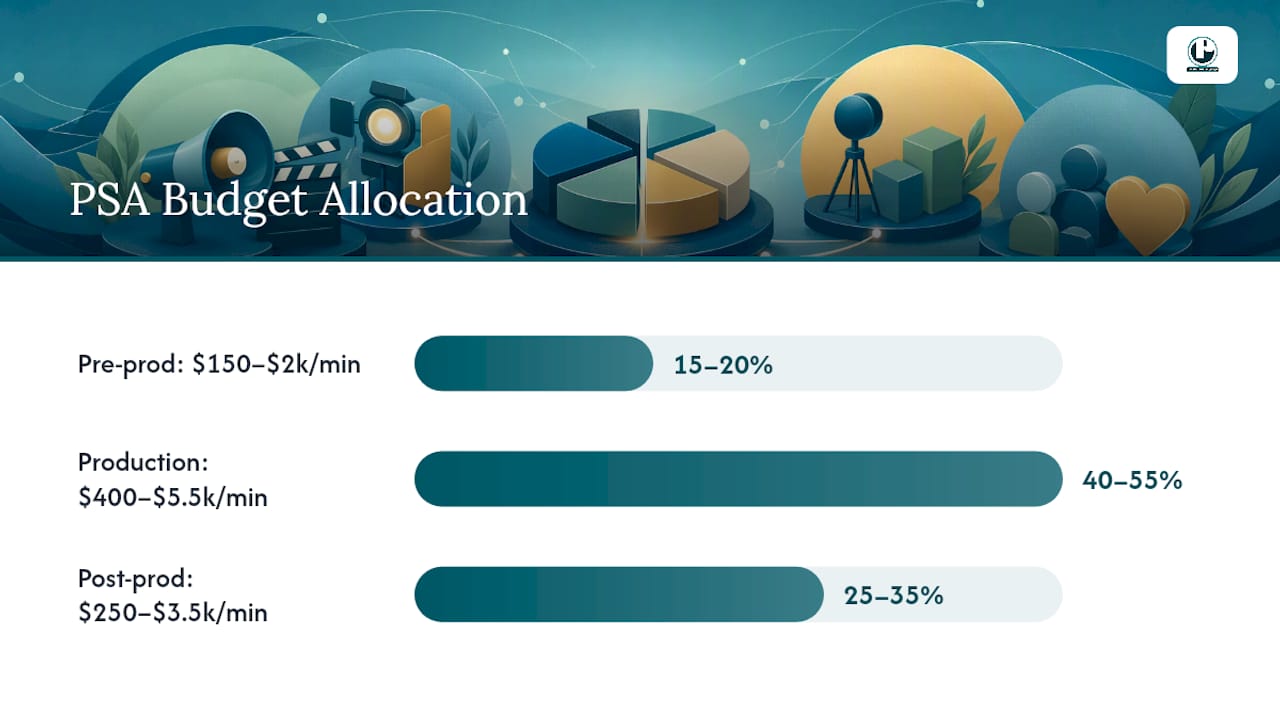
Professional video production runs $1,000–$10,000 per finished minute, with pre-production typically consuming 15–20% of the total budget, production 40–55%, and post-production 25–35%. For a PSA, those percentages translate to real line items your finance team will want to see.
Line Item | Typical Range | Notes |
Concept & scripting | $1,500–$5,000 | More revisions = higher cost |
Producing / project management | $2,000–$6,000 | Scales with shoot days |
Director + crew (3–5 person team) | $2,500–$8,000/day | Day rate varies by market |
On-screen talent | $500–$1,500/day | Union talent adds residuals |
Equipment rental | $1,000–$4,000/day | Camera, lighting, audio |
Location / studio rental | $500–$3,000/day | Permits often separate |
Permits & production insurance | $500–$2,500 | Required for public locations |
Editing | $75–$150/hour | 30s spot = 8–20 edit hours |
Color grading | $500–$2,000 | Broadcast spec adds cost |
Sound design & mix | $500–$2,000 | Broadcast delivery requires full mix |
Music licensing | $500–$5,000+ | Stock vs. custom score |
Captions & closed captions | $200–$600 | Required for broadcast |
Deliverable packaging & mastering | $300–$1,000 | Per format/platform |
Also cap revision rounds in writing before you sign — two rounds of revisions is the industry standard, and every additional round adds real hours.*
Copyable sample budgets for small, mid, and large PSAs
These three templates reflect realistic U.S. market rates. Pull the one closest to your scope and adjust line items to match your actual brief.
Assumptions for all three: single-language English, no celebrity talent, standard union-free crew, one shoot day per template unless noted.
Small PSA (local/social, one 30s cut)
Line Item | Budget |
Concept & script | $1,500 |
Producer / PM | $2,000 |
Director + 3-person crew (1 day) | $3,500 |
On-screen talent (1 person) | $600 |
Equipment rental | $1,200 |
Location rental | $500 |
Editing + color + sound | $2,000 |
Music (stock license) | $500 |
Captions + delivery | $300 |
Contingency (10%) | $1,210 |
Total | ~$13,310 |
Mid-tier PSA (regional/national, 60s + 30s cuts)
Line Item | Budget |
Concept, script & storyboard | $3,500 |
Producer / PM | $4,500 |
Director + 4-person crew (2 days) | $12,000 |
On-screen talent (2 people, 2 days) | $2,400 |
Equipment rental (2 days) | $5,000 |
Location / studio (2 days) | $3,000 |
Permits & insurance | $1,200 |
Editing + color + sound design | $5,000 |
Music licensing | $1,500 |
Captions, closed captions, transcript | $600 |
Deliverable packaging (broadcast + social) | $800 |
Contingency (10%) | $3,950 |
Total | ~$43,450 |
Large multi-cut campaign (broadcast + social + Spanish-language)
Line Item | Budget |
Concept, script (English + Spanish) | $7,000 |
Producer / PM | $8,000 |
Director + 5-person crew (3 days) | $22,500 |
On-screen talent (3 people, 3 days) | $6,000 |
Equipment rental (3 days) | $10,000 |
Location / studio (3 days) | $6,000 |
Permits & insurance | $2,000 |
Editing + color + sound (multiple cuts) | $10,000 |
Music (custom license) | $4,000 |
Captions, closed captions, transcripts | $1,200 |
Deliverable packaging (all formats) | $2,500 |
Contingency (12%) | $9,504 |
Total | ~$88,704 |
Common extras that sit outside these production budgets: distribution and media valuation reporting ($19,000–$26,000 for a 12-month TV or radio campaign), translation/dubbing beyond Spanish, and paid social amplification.
What does a realistic PSA production timeline look like?
Timeline is where most campaigns get into trouble. Stakeholders approve a PSA in week one and expect it on air in week three. That rarely works.
Low-complexity PSA (single location, no casting, stock music): 2–4 weeks from brief to delivery
Mid-complexity PSA (casting, 1–2 locations, original music): 6–10 weeks
High-complexity campaign (multi-cut, multi-location, broadcast spec): 10–16 weeks
Key milestones to build into your project plan: script sign-off (week 1–2), casting and location scouting (week 2–3), shoot day(s), offline edit review (week 5–7), color/sound/caption pass, and final broadcast master delivery.
The single biggest timeline killer is a script that isn’t locked before the shoot. Every change after cameras roll costs money and days. Get all stakeholders to sign off on the script in writing before pre-production begins — not during it.
Pro Tip: A single-location shoot with a locked script can compress a mid-complexity PSA from 8 weeks to 5. That’s the fastest legitimate shortcut in the business.
How to lower PSA production costs without wrecking impact
Cost reduction is possible without gutting your message. The key is knowing which tradeoffs cost you credibility and which ones don’t.
Animation instead of live action: An animated PSA can run around $20,000 versus roughly $40,000 for a comparable live-action spot. You lose the human face, which matters for emotional resonance, but gain flexibility on revisions and no talent residuals.
Stock music over a custom score: Saves $2,000–$8,000. The tradeoff is a less distinctive sound, which matters more for broadcast than for social.
Single-day shoot, single location: The most reliable cost lever. Every additional shoot day adds $5,000–$12,000 in crew, equipment, and talent costs.
Reuse existing b-roll: If your organization has archival footage that meets broadcast spec, it can fill gaps without additional shoot days.
Student or volunteer production: Donated personnel, student-produced work, and in-kind studio time are legitimate strategies for organizations with very tight budgets, though quality control requires active oversight.
Local station production packages: Some stations offer production support for $150–$300 while donating airtime. Policies vary widely, so confirm specs before committing.
One cost-reduction path to avoid: cutting post-production. Production quality directly affects placement likelihood — stations and networks are more likely to run a PSA that meets broadcast technical standards. A poorly mixed or incorrectly formatted file gets rejected, and re-delivery costs more than doing it right the first time.
Pro Tip: Before you test your social cuts on paid media, run a pre-launch creative test to identify which version resonates. It’s far cheaper to swap a cut before you spend on distribution than after.
How do deliverables and usage rights change your quote?
The deliverables list is where quotes diverge most between vendors. Two bids at the same total price can include very different things.
Deliverable | What to request | Why it matters |
Broadcast master | ProRes or MXF, broadcast spec | Required for TV placement |
60s, 30s, 15s cuts | All three, same grade/mix | Stations air different lengths |
Social cuts (9:16, 1:1) | Separate exports with captions burned | Platform-specific requirements |
Closed captions | .SRT or .SCC file | Legal requirement for broadcast |
Transcript | Plain text | Accessibility and SEO |
Raw footage / project file | Confirm ownership in contract | Needed for future edits |
Usage and licensing add cost in two ways. First, on-screen talent contracts specify where and how long the footage can air — broadcast rights cost more than digital-only, and national rights cost more than local. Second, music licenses are scoped by territory, medium, and term. A license cleared for social media does not automatically cover broadcast.
Request this language in every production contract: “Deliverables include [list every item], with [X] rounds of revisions. Client receives full ownership of final deliverables and all raw footage upon final payment. Talent usage rights cover [specific media, territory, and term].”
Some vendors use a 50/50 split. Confirm the schedule before signing, and tie the final payment to delivery of the agreed deliverables list, not to a calendar date.
How to evaluate and brief a production company
A low bid is not a good bid if the vendor can’t deliver broadcast-quality work. Here is a numbered checklist for evaluating any production company you’re considering.
Portfolio relevance: Have they produced PSAs or public-sector videos? Government and nonprofit video has different storytelling requirements than a commercial spot.
PSA-specific experience: Ask directly how many PSAs they’ve produced and for which organizations.
References: Request two client references from comparable projects.
Crew and day rates: Ask for a crew list with roles and day rates. Vague “production costs” line items are a red flag.
Written deliverables list: Every deliverable should be named in the estimate, not described as “final video files.”
Rights and ownership policy: Confirm you receive full ownership of final files and raw footage.
Insurance and permits: Ask for a certificate of insurance and confirm they handle location permits.
Sample RFP questions to include in your brief:
What is your estimated timeline from brief approval to final delivery?
Who is the director on this project, and can we see their reel?
How many revision rounds are included, and what is your rate for additional rounds?
Can you provide a line-item estimate rather than a single project total?
How do you handle broadcast technical delivery and QC?
Red flags: a single-line estimate with no breakdown; a bid significantly below market rate with no explanation; no written deliverables list; pressure to start without a signed contract; vague answers about who owns the footage after delivery.
A mid-range PSA case study from Puritano Media Group
Here is an anonymized budget from a mid-range PSA Puritano produced for a national nonprofit health awareness campaign. The scope: a 60-second broadcast spot plus a 30-second cut and two social formats, shot over two days in the Washington, D.C. area.
Line Item | Actual Spend |
Concept, script & storyboard | $4,000 |
Producer / PM | $5,000 |
Director + 4-person crew (2 days) | $13,000 |
On-screen talent (3 people, 2 days) | $3,200 |
Equipment rental (2 days) | $5,500 |
Location (permitted indoor venue, 2 days) | $2,800 |
Permits & production insurance | $1,400 |
Editing + color grading + sound design | $6,000 |
Music licensing (broadcast + digital) | $2,000 |
Captions, closed captions, transcript | $700 |
Deliverable packaging (4 formats) | $900 |
Contingency (used: 8%) | $3,560 |
Total | $48,060 |
The client used the broadcast master for donated TV airtime and the social cuts for a paid digital campaign. The deliverables list was locked in the contract before pre-production began, which kept the project on schedule and on budget.
The lesson from this project: the deliverables conversation is the budget conversation. Every format you add after the contract is signed costs more than it would have cost to include it upfront. Define your distribution plan before you brief a vendor.
How Puritano Media Group scopes PSA projects
Puritano’s process moves in six clear steps, and knowing them helps you prepare a brief that gets you an accurate estimate fast.
Brief: You share your audience, message, distribution plan, desired deliverables, ideal timeline, and budget target.
Estimate: Puritano returns a line-item estimate within a few business days.
Pre-production: Script, casting, location scouting, and shoot planning.
Production: Shoot day(s) with a professional crew.
Post-production: Editing, color, sound, captions, and deliverable packaging.
Delivery: Final files in all agreed formats, with a QC pass for broadcast spec.
Payment terms follow a standard 50/25/25 structure.
What to include when you request a quote:
Your target audience and the core message
Intended distribution (broadcast, digital, social, or all three)
Every deliverable you need (lengths, formats, captions)
Your ideal launch date and any hard deadlines
Your budget target or range
Pro Tip: Sharing your budget range upfront does not put you at a disadvantage. It lets a good production company scope the project to fit your resources rather than overbuild and then cut corners when the number comes in too high.
What a senior producer actually thinks about PSA budgets
Most communications directors come to a PSA brief with a commercial mindset. A PSA is a different animal. The goal is not to sell a product — it’s to change behavior or shift awareness, often with a donated media buy and a skeptical audience. That changes how you should allocate your budget.
Here are three rules of thumb we use at Puritano when scoping PSA projects:
The message has to land in 30 or 60 seconds with no second chance. That’s worth an extra $1,500–$2,000 in scripting and storyboarding.
Set a minimum timeline of six weeks for anything going to broadcast. Rushing post-production to hit a placement window is the most common way a PSA gets rejected by a station. Build the timeline backward from your air date, not forward from your approval date.
Negotiate revision rounds before you sign, not after. Two rounds is standard. If a vendor offers unlimited revisions, that’s not generosity — it usually means the scope is undefined, and undefined scope always costs more in the end. Lock the number in writing.
One more thing worth saying plainly: investing in short-form video for nonprofits is not just a production decision. It’s a media strategy decision. The production budget and the distribution plan need to be built together, not sequentially.
Puritano Media Group: scoped PSA estimates for U.S. organizations
Puritano Media Group brings over two decades of full-service video production experience to PSA projects for nonprofits, government agencies, and mission-driven brands across the United States. Where a generic production company hands you a single-line quote, Puritano delivers a line-item estimate tied to a defined deliverables list, a clear revision policy, and a production timeline built around your placement window.
For organizations that need broadcast-quality work at a mid-range budget, that specificity is what keeps projects on track. You can review Puritano’s production portfolio to see the quality standard, then reach out directly to request a scoped estimate for your PSA. Bring your distribution plan, your target audience, and your budget range — Puritano will build the rest.
Sources
These are the primary sources used to build the cost figures and guidance in this guide. Each is worth consulting directly for the specific detail noted.
PSA 101: How Much Does a Public Service Announcement Cost? - Connect360 Multimedia
Video Production Costs in 2026: Full Breakdown and Pricing Guide | Colossyan
Guide to Launching a PSA Campaign – PSN – Public Service Network
Chapter 6., Section 7. Preparing Public Service Announcements - Main Section | Community Tool Box
Recommended
Resourcefulness is the line item no budget template captures. On one PSA shoot, Charlie Puritano turned an entire floor of the PMG offices into a Puerto Rican grandma's living room, building the exact world the script needed out of the space we already had. That instinct matters on nonprofit work, where the message cannot wait for a perfect budget. A producer who can solve the location problem in-house spends the money on the things the audience actually sees, the performances, the sound, and the finish.


Comments