

Avoid 3 Day Delays: D.C. Filming Locations 7 Step Permit Checklist
Updated: 3 days ago

Every non-personal commercial shoot in Washington, D.C. needs a film permit from the Office of Cable Television, Film, Music and Entertainment (OCTFME). Your first move isn’t scouting; it’s confirming whether your site falls under city or federal jurisdiction. Once you know that, email your completed application to film@dc.gov and build in at least three business days before you need an answer.
TL;DR:
Applying for a D.C. film permit requires a minimum of three business days for processing, and separate permits are needed for city and federal lands.
The permit process is simplified for city sites, but federal locations such as the National Mall and Capitol require separate applications and longer timelines.
Street closures, vehicle rigs, generators, and tents trigger additional safety documentation, fees, and longer lead times.
A thorough on-site location scout with precise measurements, photos, and details prevents application delays and last-minute clarifications.
Building good relationships with local residents and businesses through advance notice and cooperation helps avoid conflicts and delays during filming.
Where You Can Actually Shoot: Washington, D.C. Filming Location Types
Before you fall in love with a backdrop, know what category it falls into. Each type carries different rules, and mixing them up costs you time you don’t have.
City streets and sidewalks. These are the workhorse of Washington DC filming locations. A permit covers public-space occupancy and, in many cases, dedicated parking for your production vehicles.
City-owned plazas and municipal buildings. Booking rules differ from street permits; you’re often coordinating directly with the facility manager as well as OCTFME.
Private indoor venues and studios. Interior shoots feel low-risk, but don’t skip the permit conversation if crew vehicles need street access or extended parking outside.
Rooftops, lots, and staged sets. These almost always require additional safety documentation, especially if you’re rigging cameras or building temporary structures.
Federal monuments, the National Mall, and Capitol grounds. These sit outside OCTFME’s authority entirely. Treat them as a separate application process from day one.
The city side of that list is flexible and well-documented. The federal side is a different animal, and conflating the two is the single most common scheduling mistake producers make in this market.
How to Apply for a D.C. Film Permit: A Practical Checklist
Applications go through the District of Columbia Film Permit Application portal, with correspondence routed through film@dc.gov. The process is straightforward once you know what OCTFME actually wants to see.
Name the production clearly. Include the project title, production company name, and a point of contact who can answer technical questions fast.
Nail down exact locations. Use street-and-side notation with cross streets, not neighborhood names. “1400 block of K Street NW, north side, between 14th and 15th” works. “Downtown near the office building” does not.
List dates, times, and headcounts. Cast and crew numbers affect everything from fee tier to whether police coordination gets triggered.
Map your vehicle footprint. Calculate parking needs realistically. A single grip truck can eat two or three standard spaces.
Attach supporting documents. A certificate of insurance, a written safety plan, rigging diagrams, and photos of the location and proposed equipment all speed approval. Incomplete applications simply don’t get processed.
Submit early. OCTFME needs a minimum of three business days for a simple request. Anything touching parking, street closures, or specialized city services takes longer, sometimes considerably.
Expect an invoice, not an upfront charge. Fees are billed after approval and vary with crew size and the number of shoot days.
Pro Tip: Put someone on your team who actually understands the technical ask, generators, rigging, temporary structures, in charge of writing that part of the application. OCTFME specifically recommends this, because vague technical descriptions are what trigger follow-up questions and blown timelines.
City Streets or Federal Land? Checking Jurisdiction Before You Book
This is where productions lose days they didn’t budget for. OCTFME controls city streets, sidewalks, and municipal property. It does not control federal land, and it will not permit federal land no matter how complete your application is.
The National Park Service manages monuments, memorials, and most of the National Mall.
The U.S. Capitol Police control Capitol grounds and the surrounding federal security perimeter.
OCTFME handles everything else within city jurisdiction.
Roughly 3 to 5 business days is the standard window OCTFME quotes for processing a straightforward permit, a figure that assumes you’re applying to the correct agency the first time. If your shoot crosses from a city sidewalk onto federal turf, plan for two separate applications, two separate timelines, and no unified permit covering both. OCTFME will flag out-of-jurisdiction requests during review, so confirm territory against the official jurisdiction map before you lock a location with a client or talent.
Street Closures, Rigs, and Fees: What Changes Your Permit Requirements
The moment your shoot needs more than a sidewalk and a tripod, your permit gets more complicated. Know these triggers before you scout, not after.
Street closures or traffic control. These pull in DDOT and often require MPD Special Operations staffing on location, which adds cost and lead time.
Camera rigs and vehicle-mounted setups. Anything beyond a handheld or standard tripod rig tends to need extra documentation, sometimes a police escort if the rig moves through traffic.
Generators and tents. These count as temporary structures in the city’s eyes and usually require their own line item in the safety plan.
Fee structure. Expect an application processing fee plus separate charges for the first shoot day and each additional day. Payment is due before the permit is actually issued.
Timeline reality. Budget at least three business days for a simple request, and longer when reserved parking or public safety services are requested.
Pro Tip: Check OCTFME’s posted notices before you commit to a block. The agency sometimes flags temporary restrictions on specific corridors, Pennsylvania Avenue NW has carried posted limitations in recent cycles, and finding out after you’ve booked talent is a bad afternoon.
What to Bring Back From Your Location Scout
A clean scout turns into a clean application. A messy one turns into a week of email clarifications with OCTFME. Here’s what to collect on-site, every time:
Exact block notation and cross streets. Write it the way you’d want to read it on a permit, not the way you’d describe it to a friend.
Parking meter numbers or loading zone details, if your footprint touches them.
Photos from every camera position, including sightlines toward hydrants, bus stops, and pedestrian flow patterns.
Truck lengths and staging math. A 26 foot production truck can occupy the equivalent of two or three metered spaces; count it that way on paper.
Rigging images or generator specs, especially anything that looks unusual to someone reviewing dozens of applications a week.
Missing pieces here, an imprecise block range, no meter numbers, no vehicle footprint, are the single most common reason applications stall. A thorough scout is cheaper than a delayed shoot date every time.
Keeping Local Businesses and Residents on Your Side
A valid permit gets you legal access to a location. It doesn’t get you goodwill from the shop owner whose entrance you’ve blocked or the resident whose parking spot disappeared for two days. That goodwill matters more than most producers admit, because D.C. neighborhoods talk, and a production that leaves a bad impression makes the next shoot on that block harder for everyone.
Start with direct notice, not a flyer taped to a pole. A short conversation or letter to adjacent businesses and residents, delivered a few days ahead, buys you patience you’ll need later. Tell them your actual footprint: which doors stay accessible, how long the closure runs, and who to call if something goes sideways mid-shoot.
Offer something concrete when you can. Covering a business’s lost parking revenue for the day, or simply giving staff a heads-up so they can reroute deliveries, costs little and prevents the kind of on-camera confrontation no marketing director wants in the background of a b-roll clip.
Timing matters too. Scheduling generator noise or repeated takes during a restaurant’s lunch rush is asking for a complaint call to the city. Shift high-impact work to slower hours where you can, and keep one crew member designated to field questions from curious or annoyed neighbors so your director doesn’t have to stop rolling to do it himself or herself.
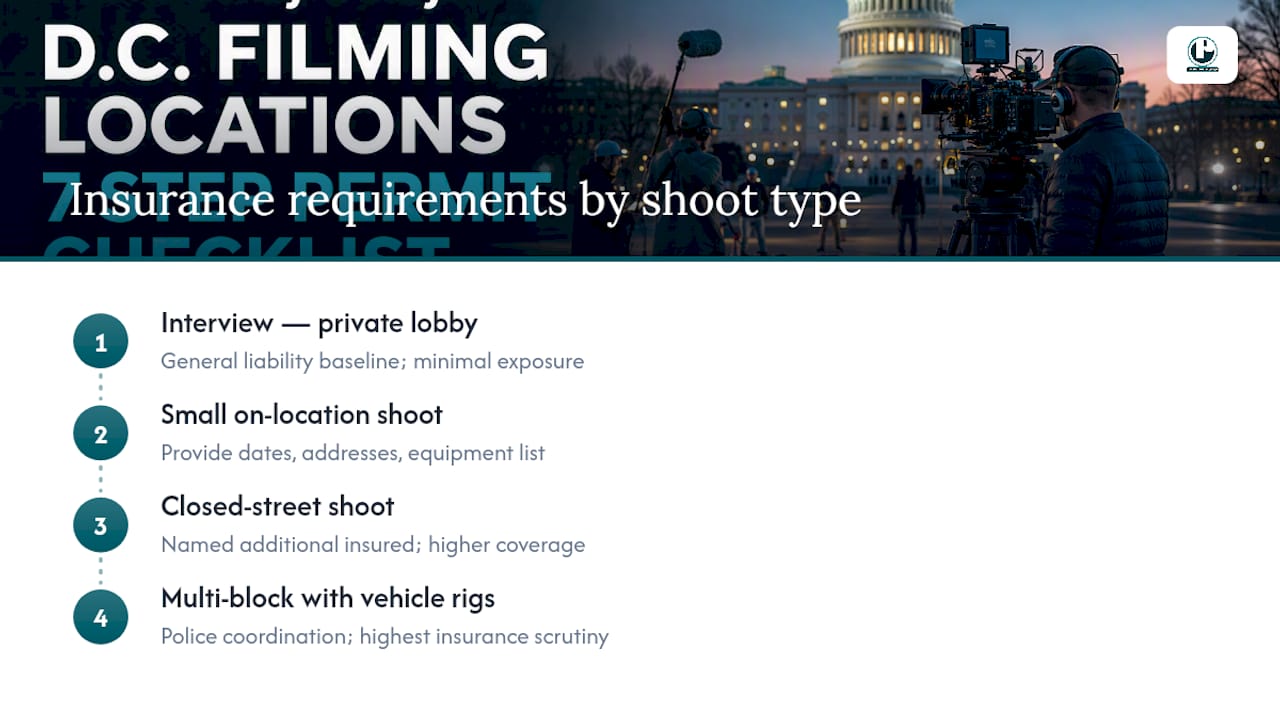
Insurance Requirements: What Coverage You Actually Need
OCTFME requires a certificate of insurance as part of a complete application package, and skipping it is one of the fastest ways to get your paperwork sent back.
General liability coverage is the baseline expectation for any commercial shoot on city property. Most productions carry policies naming the District of Columbia as an additional insured for the shoot dates, since that’s the structure OCTFME’s review process is built around. If your shoot involves closed streets, police coordination, or public-safety services, expect the insurance bar to sit higher, reviewers scrutinize these applications more closely because the city’s own liability exposure goes up when it’s staffing officers on your behalf.
Talk to your production insurer early, not the week before your shoot date. Coverage amounts should scale with your actual risk profile: a single-camera interview in a private lobby carries a different exposure than a multi-block chase sequence with vehicle rigs and a police escort. Whoever underwrites your policy needs the same location specifics OCTFME wants, street addresses, dates, equipment list, so pull that information together once and reuse it for both the permit application and the insurance certificate. Doing it twice, from scratch, is how productions blow their own timeline before the city even weighs in.
Puritano Media Group’s Perspective: What Two Decades of D.C. Shoots Taught Us
The permit process rewards preparation more than persistence. Assign one coordinator who owns the application, the attachments, and the follow-up emails, not a rotating cast of assistants. Pull rigging photos and draft the safety plan during the scout, not the night before submission; reviewers respond to specificity faster than to speed. Build a buffer into your schedule for anything crossing city and federal jurisdiction, and if you have flexibility, push high-risk requests, closures, generators, large rigs, toward off-peak weeks rather than stacking them against a tight air date.
— Charlie
How Puritano Can Help You Shoot on Location in D.C.
A local production company can be a helpful alternative to hiring an out-of-town crew and hoping they figure out D.C.'s permit maze on the fly. With extensive experience producing corporate, government, and branded video across the DMV, an experienced team can know which blocks draw scrutiny, which agencies to call first, and what an OCTFME reviewer wants to see attached to an application before they ask for it twice.
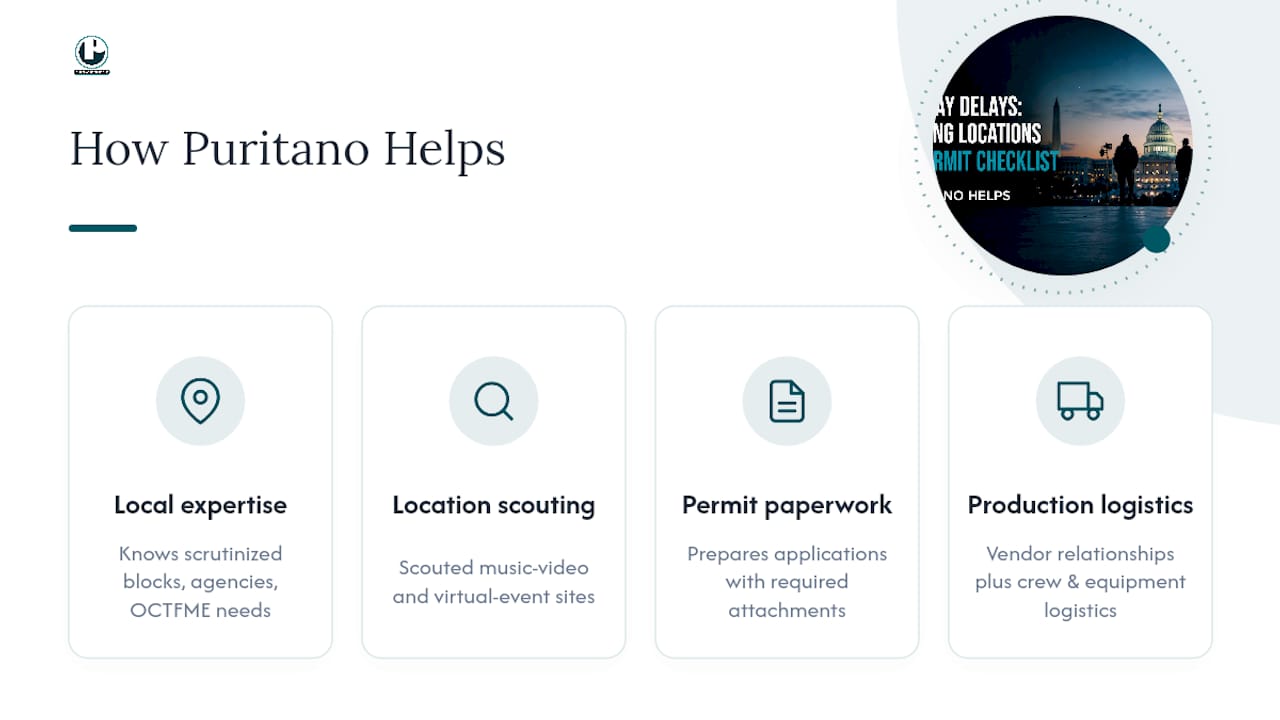
Such a track record covers location scouting, permit paperwork, vendor relationships, and full crew and equipment logistics, so your marketing or communications team isn’t learning jurisdiction maps under deadline pressure. Browse Puritano’s music video work or its virtual event production to see the range of location-based projects the team has handled, then reach out through Puritano’s corporate video services page to request a scouting consult or a production estimate for your next D.C. shoot.
Sources
Recommended
A location earns its place on the schedule only after someone has worked out how people, gear, and vehicles actually move through it. When we filmed the build of the Stonewall Energy Center in Loudoun County for Bechtel, we followed the project's largest components both on site and in transit, and let interviews with the project team carry the two-minute film. Shoots like that reward the unglamorous work in this checklist. Measurements, access points, and timing, settled in advance, are what let a crew spend the day filming instead of solving logistics.


Comments