

Why Video Outperforms Static Ads: 2026 Data Guide

Video ads often outperform static ads in many campaign scenarios. When optimized for platform and audience, video tends to generate higher click-through rates than static images, and Landing pages featuring video convert 86% better than those relying on static creative alone. The reason is straightforward: video combines motion, sound, and narrative into a single experience that static simply cannot replicate. Viewers retain much more of a message delivered via video compared to text or static content.
That said, the comparison is not absolute. Static ads hold real advantages in specific situations, particularly direct-response campaigns, retargeting, and rapid creative testing. The smartest advertising strategies in 2026 do not choose one format over the other. They assign each format to the funnel stage where it performs best.
Here is the short version of what the data shows:
Video wins on: brand recall, awareness, engagement, purchase intent, and cost-per-lead
Static wins on: CPM efficiency, production speed, direct-response conversion, and A/B testability
Interactive video ads can boost conversion rates over standard video
Combined campaigns using both formats often see higher ROI than single-format approaches
Static product image ads generally achieve higher CTRs for e-commerce direct response
Stat to know: Video ads deliver a 12.5-point ad recall lift versus 7.8 points for static ads, making video the default format for any brand-building objective.
Why video outperforms static ads: the 2026 performance data
The performance gap between video and static ads is real, but it is not uniform across every metric. Understanding where video wins decisively, and where static holds its own, is what separates a well-allocated media budget from a wasted one.
The CPM gap deserves honest attention. Video CPM runs 5–15 times higher than static for comparable placements. For brands optimizing purely for reach on a tight budget, static delivers more impressions per dollar. But the cost-per-lead picture flips that math. Video-driven clicks arrive with higher purchase intent because the viewer has already been educated and emotionally engaged before they click. The landing page does not have to do all the convincing.
Platform context shapes the gap significantly. Video dominates on Instagram Reels, TikTok, and YouTube because those platforms are built around motion and sound. TikTok shows the largest performance gap of any platform, since it is a video-only environment where static ads feel out of place. Instagram Feed video ads show a CTR around 0.88% versus 0.61% for static, a 44% lead in raw engagement. Facebook and Google Display show more balanced results between formats.
Stat to know: A football brand campaign using video ads showed 9.5x better message retention than its static counterparts, illustrating why recall is video’s most decisive advantage.
Creative lifespan also affects the true cost comparison. Static ads typically fatigue within 7 days, while video sustains performance for 2–4 weeks before significant decline sets in. A static campaign may need three or four creative refreshes per month to maintain CTR, while a video campaign often needs only one. Over a 90-day campaign period, that difference partially offsets video’s higher production cost.
Emerging interactive video formats push the advantage further. Interactive elements such as polls, swipe features, and embedded CTAs can boost conversion rates by an additional 26% over standard video. For brands willing to invest in that layer of production, the performance ceiling rises considerably.
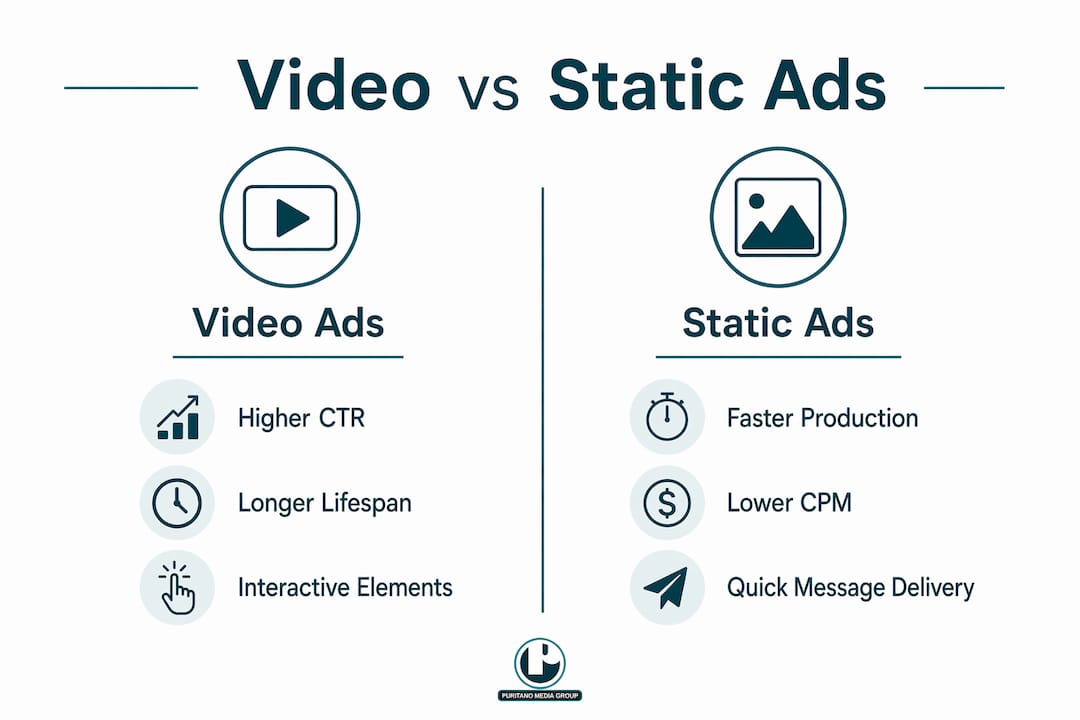
Strengths and weaknesses of each format
No format wins everywhere. Here is an honest breakdown of what each does well and where it falls short.
Video ad strengths
Multi-sensory engagement: Motion, sound, and narrative work simultaneously to create memory traces that static cannot match.
Brand recall: Video delivers a 12.5-point ad recall lift versus 7.8 for static, making it the clear choice for brand-building campaigns.
Purchase intent: Video increases purchase intent by 20% compared to static, a meaningful lift for consideration-stage campaigns.
Funnel education: Video gives a brand the narrative arc to take a cold audience from unaware to interested in 15–30 seconds.
Platform-native performance: On TikTok, Instagram Reels, and YouTube, video is the expected format. Static ads in those placements announce themselves as ads immediately.
Video ad weaknesses
Higher production cost: Scripting, filming, and editing require more time and budget than designing a static image.
Slower iteration: Testing 15 headline variants in video is not feasible for most budgets. Static creative can be produced, tested, and replaced in hours.
Stricter frequency management: Video needs tighter frequency caps. Once a viewer has reached 75% engagement with a video, continued exposure tends to waste spend rather than drive action.
Sound-off risk: A large share of video plays happen with sound off by default. Creative that depends entirely on audio loses that audience.
Static ad strengths
Speed and cost efficiency: A designer, or a capable AI image workflow, can produce ten static variations in the time it takes to script one video.
Direct-response conversion: Product image ads achieve 20% higher CTRs for e-commerce direct response compared to video in the same scenario.
Retargeting performance: Warm audiences already know the product. They need a clear offer and a visible CTA, not a brand story they have already seen.
A/B testability: Static creative enables rapid testing of headlines, visuals, and CTAs at a volume that video budgets cannot match.
Algorithm rewards: Meta’s Andromeda algorithm rewards semantic diversity, not video specifically. Twenty genuinely different static hooks can function as twenty distinct audience signals.
Static ad weaknesses
Lower sensory impact: A single frame cannot convey emotion, demonstrate a product in motion, or build narrative tension.
Faster fatigue: Static ads fatigue in roughly 7 days, requiring more frequent creative replacement.
Limited storytelling: Complex products, high-consideration purchases, and new brand introductions are difficult to communicate in a single image.
Banner blindness: Static ads, particularly display banners, are processed and dismissed quickly by audiences who have seen similar formats repeatedly.
When and where to use video vs. static ads in your funnel
The format debate becomes much cleaner when you map it to funnel stage. The question is not “which format is better?” It is “what does this specific slot in the funnel need?”
Top of funnel (awareness and discovery): Video. Cold audiences have no reason to care about your brand yet. Video buys you the narrative space to introduce a problem, present a solution, and build emotional connection. Short-form video on Instagram Reels, TikTok, and YouTube is the strongest starting point for prospecting unfamiliar audiences.
Mid-funnel (consideration and education): Video with static support. Use video to deepen engagement and demonstrate the product. Layer in static carousel ads to reinforce key proof points and keep the brand visible between video exposures.
Bottom of funnel (conversion and retargeting): Static. Warm audiences who have already visited your product page or watched most of your video do not need another brand story. They need a clear offer, a visible product image, and a low-friction call to action. Static image ads and carousels consistently outperform video for this purpose.
Post-purchase (retention and loyalty): Short video plus static offers. A brief testimonial or brand-pride video reinforces the purchase decision. Static ads carry specific repeat-purchase offers efficiently.
One message that does not need a video: “50% off, today only.” That message needs to be seen, read, and acted on immediately. Static ads with bold offer typography and a single clear CTA consistently outperform video for time-limited promotions and flash sales where the audience already knows the brand.
Pro Tip: Manage frequency by funnel stage. Video needs stricter frequency caps at the top of funnel. Once a viewer has engaged deeply with your video, shift them into a static retargeting sequence. This preserves video’s impact while letting static do the conversion work more efficiently.
How to integrate video and static ads for better campaign results
The brands consistently outperforming single-format competitors are running both video and static in deliberate sequence, not choosing between them. Campaigns combining video and static see up to 42% higher ROI than those betting on one format alone.
Here is how to structure that integration effectively:
Lead with video for awareness. Use video at the top of funnel to build a warm audience. Run it for 30 days, accumulate video viewers, and then activate static retargeting for the second phase.
Test angles in static first. Static creative is cheap and fast to produce. Find your winning hook, headline, and visual concept in static before committing budget to a full video production. This is the most cost-efficient way to validate a message.
Refresh static weekly, video every 2–4 weeks. Static fatigues around 7 days; video holds for 2–4 weeks. Build a production cadence that matches those timelines, not one that treats both formats identically.
Use cross-format sequencing. Show a brand video to a cold audience, then retarget video viewers with static product ads. This sequence consistently outperforms running either format in isolation.
Allocate budget by funnel weight. Many brands dedicate 30–40% of budget to top-of-funnel brand storytelling and 60–70% to retargeting engaged audiences with product-focused ads. That ratio helps explain why static often carries the majority of total conversions even when video wins more top-of-funnel attention.
Build for sound-off. Whether video or static, design creative that communicates the core message visually. On-screen text, captions, and strong visual hierarchy matter more than audio for most placements.
Judge on CPA, not CTR. Video routinely wins clicks and sometimes loses on cost per purchase. The metric that determines budget allocation should be cost per acquisition, not click volume.
For a deeper look at how video ad structure drives conversion, high-converting video ad anatomy is worth reviewing before your next production brief. And if you are working on effective CTAs for either format, the call-to-action strategy matters as much as the creative itself.
What marketing research reveals that most guides miss
The standard video-versus-static comparison stops at CTR and CPM. Here is where the more nuanced findings change how you should think about creative strategy.
Attention span and frequency capping
Video and static ads are not processed the same way by the brain. Static ads are absorbed almost instantly, which is both their strength and their weakness. That speed means they fatigue faster. After a viewer reaches 75% engagement with a video, continued exposure tends to waste budget rather than drive incremental action. The practical implication: set frequency caps on video tighter than you think you need to, and shift engaged video viewers into static sequences quickly.
Pro Tip: Track the 75% video view threshold in your ad platform. Once a meaningful portion of your retargeting pool has crossed that mark, pause the video and activate static retargeting. You will spend less and convert more.
AI-generated static and the semantic diversity advantage
One of the most underreported shifts in 2026 advertising is what AI-generated static creative has done to the format’s competitive position. AI-generated static ad variations have achieved ROAS lifts of up to 45%, exceeding the 20% conversion lift typically cited for catalog video formats. FULLBEAUTY Brands replaced standard catalog images with AI-generated lifestyle variations and saw 45% higher ROAS, 22% higher CVR, and 36% higher CTR. Those were static ads.
The reason this works connects to how Meta’s Andromeda algorithm functions. The algorithm now uses creative as the primary targeting signal, rewarding semantic diversity rather than video specifically. Twenty genuinely different static hooks reach twenty distinct audience segments. That kind of variation is faster and cheaper to produce in static than in video, which changes the ROI conversation for brands that previously assumed video was always the higher-performing investment.
Static removes friction for ready buyers
There is a concept worth naming directly: static ads remove what practitioners call the “friction of time” for buyers who are already ready to purchase. A warm audience member who has seen your brand, visited your product page, and is close to buying does not want to sit through a 30-second video. They want to see the product, read the offer, and click. Creative diversity and rapid iteration in static ads are more rewarded by modern algorithms than video for retargeting, precisely because the algorithm recognizes that these audiences need a trigger, not a story.
Creative velocity as a competitive advantage
Roughly 5% of ads become real winners while 50% get minimal spend, and this ratio holds nearly identically across formats. Video ads are not more likely to become winners than static ads. They are simply harder to produce at the volume required to surface those winners. The format that can be produced in hours often beats the format that takes days, purely on pipeline math. For brands with limited production budgets, this means static creative is not a compromise. It is a structural advantage in the current market.
Examples of video ad campaigns with measurable outcomes
Real campaign data grounds the format debate in outcomes that matter.
FULLBEAUTY Brands and AI-generated static creative: This case illustrates the intersection of video strategy and static execution. FULLBEAUTY replaced white-background catalog images with AI-generated lifestyle variations and recorded 45% higher ROAS, 22% higher CVR, and 36% higher CTR. The lesson is not that video lost. It is that creative quality and variation, regardless of format, drive performance.
The Derma Co. carousel retargeting: This DTC skincare brand achieved a 6–7% CVR on bottom-of-funnel carousel ads, roughly four times the median Meta CVR of 1.57%. Those carousels were static. The campaign worked because the format matched the funnel stage: warm audiences who already knew the brand needed a product-focused, low-friction offer, not a brand narrative.
Football brand video recall study: A campaign using video ads showed 9.5x better message retention than static counterparts in the same market. This is the clearest illustration of video’s recall advantage. For a brand entering a new market or launching a new product, that retention gap is the reason video earns its higher production cost.
Combined format sequencing: The broader pattern across published 2026 campaign data is consistent. Brands running video for awareness and static for retargeting outperform single-format campaigns by up to 42% on ROI. The sequence matters as much as the format. Video builds the warm audience; static converts it.
For marketers looking to see what production-grade video creative looks like across different brand contexts, Puritano’s video production portfolio covers a range of formats and industries. And if you are evaluating which promotional video styles fit your campaign goals, format selection at the production stage shapes performance long before the ad goes live.
If your organization is ready to move from format theory to actual production, Puritano works with brands nationally to develop video creative built for performance, not just aesthetics. Explore Puritano’s video work to see how storytelling and production quality translate into measurable results.
Key Takeaways
Video ads outperform static ads on awareness, recall, and cost-per-lead, but static wins on production speed, CPM efficiency, and direct-response conversion, making a combined funnel strategy the highest-ROI approach in 2026.
Recommended
Comments