

Why Video Increases Nonprofit Visibility and Giving
- Charlie Puritano
- 2 days ago
- 8 min read

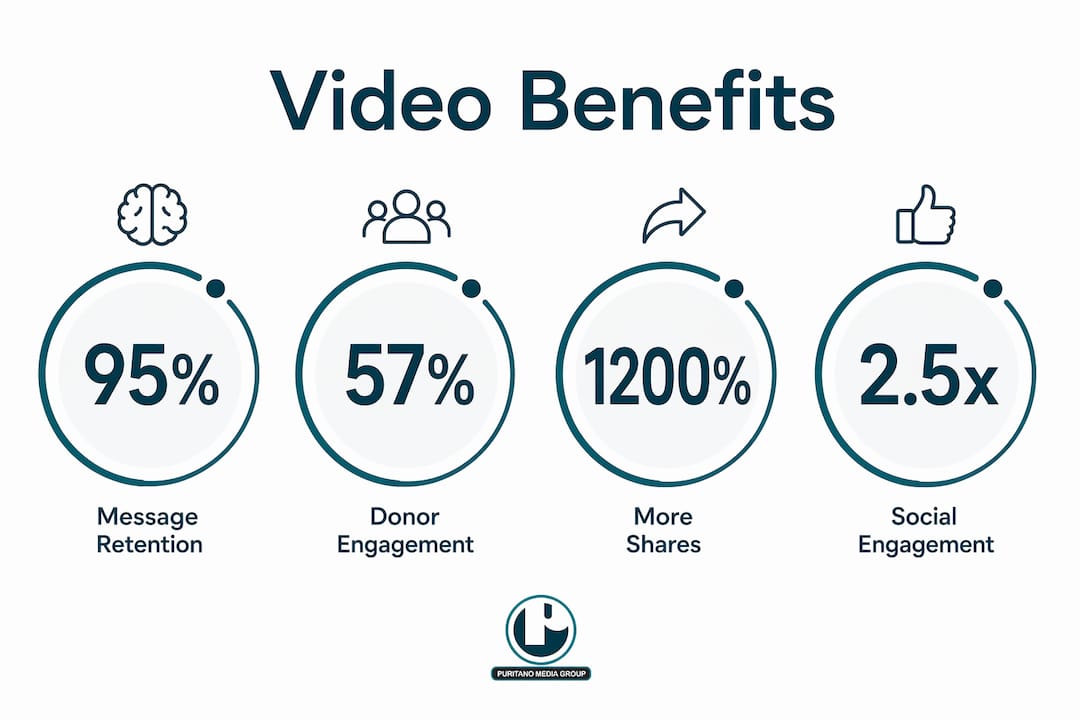
Video is the most effective tool for increasing nonprofit visibility because audiences retain 95% of a message delivered through video compared to just 10% through text. That gap is not a minor advantage. It is the difference between a donor who remembers your cause tomorrow and one who forgets it before dinner. Nonprofit professionals who understand why video increases nonprofit visibility gain a real edge in crowded fundraising environments. Video combines emotional resonance, search engine performance, and social sharing power into a single format that no other medium matches.
Why video increases nonprofit visibility more than any other format
Video works because the human brain processes moving images and sound simultaneously, creating a richer memory trace than text alone. That neurological reality translates directly into donor behavior. Fundraising campaigns with video raise 114% more than campaigns without it. That number reflects something real: when people feel something, they give. Video triggers feeling faster and more reliably than a written appeal ever will.
The benefits of video for nonprofits extend beyond donations. Video drives 57% donor engagement and produces measurably higher social proof and lead generation compared to static content. Search engines also reward video. Pages with embedded video hold visitors longer, and that increased time-on-page signals relevance to Google’s ranking algorithm. The result is better organic search placement, which means more people find your organization without you spending a dollar on ads.

Video also travels. Videos on social media generate 1,200% more shares than text and images combined. Every share is an unpaid endorsement that puts your mission in front of a new audience. For nonprofits operating on tight budgets, that kind of organic reach is not a bonus. It is a core part of the strategy.
How human-centered storytelling boosts nonprofit reach
The brain prioritizes stories about individuals over abstract statistics. This is the identifiable individual effect, a well-documented psychological phenomenon where people respond more strongly to one named person’s struggle than to data representing thousands. Personal stories increase donor confidence by 2.3 times compared to abstract data presentations. That is a significant multiplier, and video is the only format that delivers it with full emotional force.
Faces matter. When a viewer sees a real person speaking directly to the camera, the brain’s mirror neurons activate. The viewer begins to feel what the subject feels. That empathic response is the foundation of donor trust. A written testimonial can describe suffering. A video of someone describing their own experience makes the viewer feel it.
Effective donor storytelling in video follows a clear structure: establish the person, show the problem, demonstrate the transformation, and connect it to the donor’s role. This arc works because it mirrors how humans naturally process cause and effect. When the story lands, the call to action feels like the obvious next step rather than an interruption.
The most effective nonprofit videos use a modular storytelling approach:
Beneficiary perspective: Let the person your organization serves speak in their own words.
Staff or volunteer voice: Add credibility and organizational context through someone inside the mission.
Donor testimonial: Social proof from a peer is more persuasive than any organizational claim.
Impact data, briefly: One or two numbers, stated by a real person, anchor the emotional story in fact.
Pro Tip: Build your video library modularly. Shoot each story element as a standalone clip. That way, you can recombine them for different campaigns, platforms, and donor segments without reshooting.
What role authenticity plays in driving nonprofit engagement
Modern donors distrust polish. A highly produced video with perfect lighting and a scripted spokesperson can feel like a corporate ad, and that feeling creates distance. Authenticity in short-form nonprofit videos builds trust with donors more effectively than high-production content. This does not mean low quality. It means real people, real moments, and honest storytelling.
Short-form videos generate 2.5 times more engagement than long-form videos across social platforms. Attention is finite, and donors scrolling through a feed make split-second decisions. A 60-second video that opens with a compelling human moment will outperform a five-minute documentary every time in that context. The science of authentic brand storytelling confirms that transparency and genuine connection consistently outperform scripted perfection.
The video formats that consistently perform well for nonprofits include:
Behind-the-scenes footage: Show your team in the field, at an event, or preparing a program. This builds transparency.
Beneficiary testimonials: Unscripted, direct-to-camera accounts carry more weight than polished narratives.
Cause education clips: Short explainers that answer one specific question about your issue area position your organization as a trusted authority.
Day-in-the-life videos: Follow a staff member or volunteer through their work. This humanizes the organization without requiring a large production budget.
One caveat: audio quality matters more than visual quality. Shaky footage reads as authentic. Poor audio reads as unprofessional. A viewer will watch a slightly blurry video if the sound is clear. They will abandon a beautifully shot video if the audio is hard to follow.
Pro Tip: Invest in a $50 clip-on microphone before you invest in a new camera. Clean audio is the single biggest production upgrade most nonprofits can make immediately.
How platform optimization maximizes video reach and visibility
Every platform has its own rules, and ignoring them costs you reach. Video is the most effective content type for improving SEO by increasing time-on-page and engagement metrics. YouTube is the clearest example: it functions as the world’s second-largest search engine, and a well-optimized nonprofit video there can surface in Google results for years.
Platform-specific video strategy for nonprofits:
YouTube: Upload full-length impact stories and cause explainers. Optimize titles and descriptions with specific keywords. Add chapters to improve watch time. YouTube’s algorithm rewards consistent uploads and high completion rates.
Instagram Reels and TikTok: Keep videos under 60 seconds. Open with a visual hook in the first two seconds. Use captions, because most viewers watch without sound. These platforms reward novelty and emotional immediacy.
Facebook: Mid-length videos (90 seconds to three minutes) perform well here, especially with older donor demographics. Facebook’s algorithm favors content that generates comments, so end with a direct question.
LinkedIn: Use video to reach corporate donors, grant-makers, and potential board members. Professional tone, clear mission framing, and impact data work best on this platform.
Platform | Ideal length | Primary audience | Best content type |
YouTube | 3–8 minutes | Broad, search-driven | Impact stories, explainers |
Instagram Reels | Under 60 seconds | Younger donors | Testimonials, BTS clips |
90 seconds–3 minutes | Mid-age donors | Campaign updates, events | |
1–2 minutes | Corporate, professional | Mission statements, data |
Cross-posting saves time, but raw repurposing wastes opportunity. Trim your YouTube video into a Reel. Pull a quote from a testimonial for a LinkedIn clip. Each platform version should feel native, not like a copy-paste job. For a deeper look at social media video ideas built specifically for nonprofits, the platform-by-platform breakdown is worth reviewing before your next campaign.
How to convert video visibility into donations and real support
Visibility without conversion is just awareness. The goal is to turn viewers into donors, volunteers, and advocates. Embedding a call to action naturally within the storytelling arc significantly improves conversion rates. The ask should feel like the earned conclusion of the story, not a commercial break.
Specific asks outperform vague ones every time. “Donate $25 to provide one child with school supplies for a year” converts better than “support our mission.” The donor needs to see the direct line between their action and a tangible outcome. Video makes that line visible in a way text rarely can.
Key metrics to track for nonprofit video campaigns:
Watch time and completion rate: These tell you whether your story is holding attention. A high drop-off in the first 15 seconds means your opening is not working.
Click-through rate (CTR): Measures how many viewers take the next step after watching.
Shares and saves: High share counts indicate the content resonates emotionally. Saves suggest the viewer intends to return.
Donation conversion rate: Track donations attributed to specific video campaigns using UTM parameters in your links.
Pro Tip: Place your donation link or landing page URL within the first comment on social posts and in the video description. Reduce every click between the emotional peak of your video and the donation form. Friction kills conversions.
Timing matters as much as content. Reducing friction between emotional engagement and donation significantly improves campaign results. Deploy your strongest video at the emotional peak of a campaign, not as a warm-up. Pair it with a landing page that mirrors the video’s tone and imagery so the donor’s emotional state carries through to the giving moment.
Video type | Best campaign moment | Primary conversion goal |
Impact story | Campaign launch | First-time donation |
Beneficiary update | Mid-campaign | Recurring gift upgrade |
Thank-you video | Post-donation | Donor retention |
Urgency appeal | Final 48 hours | Last-push giving |
Key Takeaways
Video increases nonprofit visibility because it combines message retention, emotional connection, and social sharing into a format no other medium can replicate.
Point | Details |
Video retention advantage | Viewers retain 95% of video messages versus 10% from text, making video the clearest communication tool. |
Storytelling drives giving | Personal stories increase donor confidence by 2.3 times compared to abstract data or statistics. |
Authenticity beats polish | Short, authentic videos generate 2.5x more engagement than long-form, highly produced content. |
Platform optimization matters | Tailoring video length and format to each platform maximizes organic reach and algorithm performance. |
CTAs must feel earned | Embedding calls to action naturally within the story arc converts more viewers into donors. |
What I’ve learned after years of nonprofit video production
The most common mistake I see nonprofits make is waiting until they have a “real” budget to start using video. They treat it as a luxury rather than a core communication tool. That thinking costs them visibility, donor trust, and ultimately, revenue. The nonprofits that grow their audiences consistently are the ones that commit to video early and iterate fast, not the ones that wait for perfect conditions.
The second mistake is confusing production value with impact. I have seen six-figure productions fall flat and smartphone videos go viral. What separates them is not equipment. It is story clarity and emotional honesty. The science of video storytelling consistently points to authentic connection as the driver of engagement, not technical perfection.
What I tell every nonprofit client is this: measure everything, but start with watch time. If people are not finishing your video, no other metric matters. Fix the story first. Then optimize for the platform. Then scale what works. That sequence, repeated consistently, is how nonprofits build lasting visibility through video.
How Puritano helps nonprofits build visibility through video
Puritano has spent over two decades producing video content for nonprofits, associations, and mission-driven organizations across the Washington D.C. area and nationally. The work ranges from nonprofit impact stories and cause education videos to full virtual event productions that extend a nonprofit’s reach far beyond a single room. Puritano’s approach centers on story clarity and authentic connection, the same principles this article identifies as the drivers of real donor engagement. If your organization is ready to put video to work, Puritano’s team is built for exactly this kind of mission. Reach out through Puritano’s virtual events page to see how the production process works and what a campaign could look like for your cause.
FAQ
Why does video increase nonprofit visibility so effectively?
Video combines emotional storytelling, high message retention, and social sharing into one format. Viewers retain 95% of a video message compared to 10% from text, and videos generate 1,200% more social shares than text and images combined.
How does video humanize nonprofit causes?
Video puts real faces and voices at the center of a story, activating empathy through direct human connection. Personal stories delivered on camera increase donor confidence by 2.3 times compared to abstract data presentations.
Why do nonprofits use video for grant applications?
Video demonstrates program impact in a concrete, credible way that written reports cannot match. Grant-makers respond to evidence of real outcomes, and a short impact video provides that evidence in under two minutes.
What video length works best for nonprofit social media?
Short-form videos under 60 seconds generate 2.5 times more engagement on social platforms than long-form content. Save longer impact stories for YouTube and your website, where viewers are already in a research mindset.
How can nonprofits measure the impact of video on donations?
Track watch time, click-through rate, and donation conversion rate using UTM parameters tied to each video campaign. Watch time reveals whether your story holds attention; conversion rate tells you whether it drives action.
Recommended