

Publish 20 B2B YouTube Shorts This Month Without Burnout
Updated: 4 days ago

Yes, YouTube Shorts belongs in a B2B video program, but only when it educates instead of entertains and pulls double duty as repurposed content. With YouTube’s 2 billion-plus monthly users and HubSpot data showing most teams already repurpose long-form video into short clips, the opportunity is real. Prioritize a strong 2-second hook, one clear value point per clip, and captions built for muted autoplay before you worry about anything else.
TL;DR:
Use Shorts to target top-of-funnel awareness by delivering quick, clear explanations of industry terms or common misconceptions within 15 to 30 seconds.
In mid-funnel content, focus on feature highlights, client outcomes, or behind-the-scenes clips that build trust and can influence consideration without needing full-length videos.
When creating Shorts, keep videos under three minutes, with 15 to 60 seconds being optimal for reach, and ensure captions and branding are included for silent autoplay.
Implement a structured workflow by repurposing existing long-form content, timestamping highlights, editing vertically, and batching production to maintain consistency without burnout.
Measure success through engagement metrics like view duration and click-throughs, linking Shorts performance directly to pipeline impact with UTM tracking and targeted landing pages.
Why YouTube Shorts Matter for B2B Marketing
The scale argument alone is worth taking seriously. YouTube reports more than 2 billion monthly active users, and unlike most social feeds, it doubles as a search engine. Someone typing “how does invoice matching work” into YouTube’s search bar is closer to a buying decision than someone scrolling a feed for entertainment, which makes Shorts a discovery tool as much as a branding one.
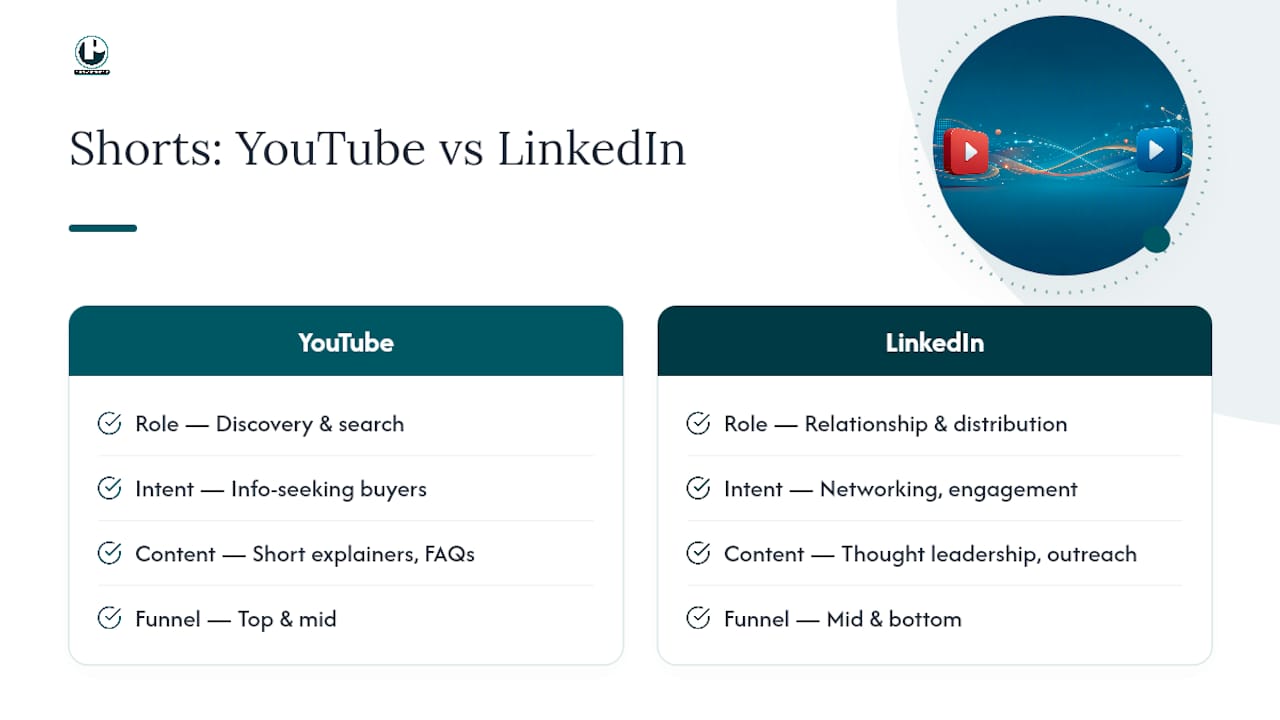
That said, YouTube isn’t where most B2B teams currently choose to publish first. HubSpot’s research found that 8 in 10 marketing teams name LinkedIn their primary video platform, compared to 76% who post to YouTube. The gap is small, and it tells you something useful: treat YouTube as your discovery and search engine, and LinkedIn as your relationship and distribution engine. Shorts work well on both, but the job each platform does for you is different.
Mapped against a funnel, Shorts earn their keep differently at each stage. At the top, they work as ungated educational snacks. A 45-second explainer answering “what is a DAM system” pulls in cold traffic that a full webinar never would. In the middle, Shorts function as trust builders, quick product walkthroughs, feature highlights, and myth-busting clips that nudge a prospect who already knows your name toward booking a demo. At the bottom, Shorts rarely close deals on their own, but a tight 30-second client outcome clip embedded in a sales email or LinkedIn message can shorten the trust-building step that usually eats weeks of a sales cycle.
Choose longer-form YouTube video or a full webinar when the topic needs nuance, like a technical deep dive for engineers evaluating your API. Choose Shorts when the goal is reach, repetition, or a fast answer to a narrow question. Most SaaS and service brands find the two formats complement each other. A social video strategy that treats Shorts as the front door to longer content, rather than a replacement for it, tends to perform best.
20 YouTube Shorts Ideas B2B and SaaS Teams Can Publish This Month
Most B2B teams stall on Shorts not because the format is complicated, but because nobody hands them a list of ideas that fit a business audience. These twenty are grouped by funnel stage, each with a length band and a note on where to pull the raw footage from so you’re not starting from a blank camera roll.
Top-of-funnel (awareness and education):
Jargon-buster explainer (20 to 30 seconds): Define one industry term your prospects Google constantly. Pull the script straight from your glossary or FAQ page.
“Wrong way vs. right way” split screen (30 seconds): Show a common mistake next to the correct approach. Works well shot fresh with two quick takes.
Industry stat reaction (15 to 25 seconds): React on camera to a data point from a report like Statista or HubSpot’s video research and explain what it means for your buyer.
One-question interview clip (20 to 40 seconds): Pull a single sharp answer from a longer executive interview or podcast recording.
“Here’s what nobody tells you about X” hook (25 to 35 seconds): Contrarian framing on a common industry assumption.
Middle-of-funnel (consideration and trust):
Feature highlight (30 to 45 seconds): Screen-record one feature solving one problem, no full product tour.
Before/after client outcome (30 seconds): Numbers-driven result clip, pulled from a case study you already have written up.
Day-in-the-life at your company (30 to 60 seconds): Humanizes the brand; repurpose from onboarding or recruiting footage.
Behind-the-scenes of a shoot or event (20 to 30 seconds): Low production lift, high authenticity payoff.
Common objection, answered (30 seconds): Sales team supplies the objection; you supply the concise rebuttal on camera.
Tool comparison snippet (30 to 45 seconds): Frame your category thinking, not a head-to-head pitch.
Customer quote overlay (15 to 20 seconds): Text-and-audio clip pulled directly from a testimonial video or recorded call (with permission).
Bottom-of-funnel and demand capture:
60-second product demo (up to 60 seconds): The single clearest workflow moment from your full demo video.
“What our onboarding actually looks like” (30 to 45 seconds): Reduces perceived risk for a prospect close to signing.
Pricing myth clarified (20 to 30 seconds): Address the most common pricing misconception directly.
ROI calculation walkthrough (45 seconds to 1 minute): Show the math behind a client’s return, pulled from a sales deck.
Repurposing-heavy, low-lift formats:
Webinar highlight reel (30 to 60 seconds): Clip the single best insight from a recorded webinar.
Event teaser (15 to 25 seconds): Vertical crop of b-roll from an upcoming conference or trade show booth.
Panel soundbite (20 to 30 seconds): One strong quote from a multi-speaker panel recording, captioned for silent viewing.
Quarterly recap in numbers (30 seconds): Fast, text-heavy summary of what your team shipped or achieved.
Batching wins here. Record four or five webinar sessions or interviews in a quarter, and you can mine dozens of Shorts from that single production window instead of scheduling new shoots every week.
YouTube Shorts Length Rules and Specs for 2026
YouTube classifies any vertical or square video up to three minutes as a Short, a rule that widened significantly from the original 60-second cap. Per YouTube’s own Help documentation, Shorts uploaded after October 15, 2024 fall under this three-minute ceiling, and guidance through December 2025 confirms these longer Shorts remain eligible for Shorts monetization under YouTube’s revenue-sharing model.
The technical checklist to follow before you export anything:
Aspect ratio: vertical or square, with 9:16 as the standard for mobile viewing.
Resolution: 1080×1920, recommended by platform guidance for Shorts specs.
Format and codec: H.264 MP4 for the cleanest upload and playback compatibility.
Maximum length: three minutes, though most B2B content performs better well under that ceiling.
Statistic Callout: Practitioner guidance suggests 15 to 60 seconds tends to work best for reach and discovery, with 30 to 60 seconds serving as a common sweet spot for tutorials and explainers, while the full three-minute window suits storytelling once a viewer is already engaged, according to industry length guidance.
For a jargon-buster or a myth-bust clip, stay in the 15 to 30 second band. For a demo or ROI walkthrough, 30 to 60 seconds gives you room without losing viewers. Reserve the full three minutes for genuine storytelling, a client journey or a founder narrative, where the audience has opted in for more.
Length alone doesn’t drive payout. Shorts monetization pools ad revenue monthly and allocates a Creator Pool share by country and by engaged views, not simply by runtime, so a tightly edited 20-second clip can outperform a padded two-minute one financially and in reach. Music usage on Shorts is also governed by YouTube’s licensing library. Stick to tracks cleared for commercial use inside YouTube’s audio library rather than pulling from a personal streaming playlist, since third-party music can trigger claims or limit monetization entirely.
Building a Repurposing Workflow That Doesn’t Burn Out Your Team
A one-off viral Short is luck. A steady pipeline of Shorts that consistently feeds your funnel is a workflow, and it starts with treating your existing long-form content as the raw material rather than always filming new footage. HubSpot’s research backs this up directly: over half of companies now repurpose longer video into short clips, with LinkedIn and YouTube as the two primary destinations.
Here’s the five-step process that keeps this sustainable instead of chaotic:
Identify your pillar content. Webinars, customer interviews, conference talks, and product demos are your source material. Pick one to two pillar pieces per month rather than trying to mine everything.
Timestamp the highlights. Watch the full recording once and mark every moment where someone says something quotable, surprising, or genuinely useful in under 60 seconds.
Edit vertically. Reframe the footage for 9:16, add motion or zoom to keep it visually active, and trim dead air aggressively. Completion rate matters more than polish here.
Caption everything. The majority of Shorts get watched with sound off initially, so burned-in captions aren’t optional.
Schedule in batches. Queue a month’s worth of Shorts in a single sitting rather than publishing reactively.
Set a cadence that your team can actually sustain. A monthly production window where you film or source two to three pillar assets, then spend a separate week editing and scheduling everything that comes out of them, tends to work better than trying to produce Shorts daily from scratch. This structural approach to repurposing video content is what separates teams with a real pipeline from teams posting sporadically when someone remembers to.
Assign roles clearly: one person owns sourcing and timestamping, one owns editing, and one owns publishing and captions review. For quality control, run every clip through a short checklist before it goes live, confirming captions are accurate, the hook lands in the first two seconds, and the video meets YouTube’s spec requirements for resolution and length.

Pro Tip: Keep a running “highlight log” spreadsheet during every recorded webinar or interview. Have someone note timestamps live, in real time, while the session happens. It cuts your editing search time by more than half.
Optimizing Shorts for Views, Watch Time, and Real Engagement
The first two seconds decide whether someone keeps watching or swipes away, so your hook has to work without sound and without context. Open with a question on screen (“Why does invoice matching fail 40% of the time?”), a bold stat, or a visual pattern interrupt, not your logo or a slow zoom into your office.
A few tactical rules make a measurable difference:
Put your hook as burned-in text within the first frame, since most viewers scroll with sound off.
Keep critical text and faces inside the center safe zone; YouTube’s UI elements crowd the edges on mobile.
Brand subtly, a small logo watermark or consistent color treatment, rather than a full intro slate that eats your first three seconds.
Add a single, clear call to action at the end: “Watch the full breakdown” with a link in the description, or “Follow for weekly tips.”
Use two to four relevant hashtags rather than stuffing ten; YouTube’s algorithm weighs relevance more than volume.
Cross-posting deserves a strategy of its own rather than a blind copy-paste. Since LinkedIn is where 8 in 10 B2B teams share video primarily, re-export your Shorts without YouTube’s watermark or Shorts-specific UI cues before posting natively there. LinkedIn’s algorithm favors native uploads over shared YouTube links, so treat each platform as its own upload rather than a simple cross-post. For paid promotion, prioritize boosting the two or three Shorts that already show strong organic completion rates rather than spreading a small budget across everything you publish.
Pro Tip: Test two different hook openings for the same clip as separate uploads when you have the bandwidth. The difference in retention within the first five seconds often reveals which framing actually earns attention, and that insight carries into your next batch of Shorts. A closer look at video SEO fundamentals can also help your titles and descriptions surface in YouTube search, not just the Shorts feed.
Which Metrics Actually Prove Shorts Are Working
Views are the vanity number everyone checks first, but they tell you almost nothing about pipeline impact on their own. The metrics that actually matter, in order of what to review weekly versus monthly, look like this:
Views and unique reach: Track weekly to spot which topics and hooks resonate; a spike tells you what to make more of.
Average view duration and completion rate: The real quality signal. A 20-second Short with 90% completion beats a 60-second one people abandon at ten seconds.
Engaged-view rate: How many viewers took an action, clicked, commented, or visited your channel, versus just watching passively.
Click-throughs to landing pages: Requires a link in your description or pinned comment, tagged with UTM parameters so it shows up cleanly in your analytics.
Downstream conversions: Demo requests or content downloads attributed back to a Shorts-driven session, tracked through event-based conversion tagging in your analytics or CRM.
Set up a distinct UTM structure for every Shorts campaign so it doesn’t get lumped in with your general YouTube traffic. Point viewers toward a dedicated landing page rather than your generic homepage, since a page built for the specific offer mentioned in the clip converts at a meaningfully higher rate than a broad destination. Review performance weekly for creative and hook learnings, but judge business impact monthly or quarterly, since attribution for consideration-stage content takes longer to surface than a single week of data can show. If you’re building this measurement layer for the first time, a structured video content strategy for B2B sales framework gives you a starting benchmark instead of guessing at targets cold.
Shorts in Action: Three Short-Form Case Sketches
Real outcomes from Shorts tend to look modest and specific, not viral. Three patterns show up consistently in production work:
A webinar highlight clip, a single 40-second answer to “how long does implementation take,” pulled from a recorded session and posted as a Short, generated a measurable lift in demo request form completions the following week, because it answered the exact objection prospects raised in sales calls.
A client outcome mini-case, structured as before-and-after numbers with a single quote overlay, shortened the average sales cycle for a services firm by giving prospects proof upfront that they’d normally only see midway through a sales conversation.
An event teaser built from b-roll shot the day before a conference booth opened drove a visible bump in booth visits and pre-scheduled meetings, simply by showing real energy instead of a static graphic.
What made each clip work wasn’t production value. It was one specific creative decision: answering a real objection, leading with a real number, or showing real footage instead of stock energy. Small teams can adapt these ideas with a phone camera and a free captioning tool. Enterprise teams running multiple product lines should batch this work quarterly across business units to keep the pipeline consistent without asking one person to produce everything alone.
Compliance and Brand Safety for B2B Shorts
B2B industries carry compliance stakes that consumer brands don’t always face, and a rushed Short can create real exposure. Financial services, healthcare, legal, and government-adjacent brands need every claim in a Short to match what compliance has already approved for other channels, since a 20-second clip is just as reviewable as a full webinar in the eyes of a regulator.
Build a lightweight approval step into your workflow rather than skipping it for speed. Route scripts, even short ones, through the same compliance reviewer who checks your blog posts or ad copy, particularly when a clip mentions pricing, guarantees, client results, or regulated terminology. Avoid making specific performance claims on camera unless you can back them with the same documentation you’d need for a case study.
Brand safety extends to the content you appear next to. YouTube’s autoplay and recommendation system can place your Short adjacent to unrelated or sensitive content, so monitor comments regularly, since B2B Shorts sometimes attract off-topic or spam engagement that reflects poorly on a professional brand if left unmoderated. Keep a consistent visual identity, logo placement, color treatment, and tone, so that even a stripped-down 20-second clip is instantly recognizable as coming from your organization. For teams in regulated sectors, treat every public-facing Short the way you’d treat a press release: reviewed, documented, and approved before it goes live.
Copyright and Music Rules for Shorts
Music is the single most common reason B2B Shorts get flagged or muted after publishing. YouTube’s copyright system, Content ID, scans every upload against a database of registered music and video, and a mismatch can result in your Short being muted, having ads redirected to the rights holder, or in repeated cases, a strike against your channel.
The safest approach is pulling tracks directly from YouTube’s built-in audio library, which is cleared for commercial use inside the platform. Avoid using commercial streaming music, even a few seconds of a popular song playing in the background of an event clip, since Content ID catches this reliably regardless of clip length.
Footage ownership matters just as much as music. If a Short includes clips from a conference, panel, or webinar with an outside speaker, confirm you have rights to publish their likeness and words before cutting it into a promotional clip. A signed release from any external speaker or panelist, standard practice for produced event coverage, protects you here. The same logic applies to customer testimonials: get explicit written permission before repurposing a client’s recorded quote into a public Short, even if they gave you the original interview for internal use.
Segmenting and Targeting a B2B Shorts Audience
B2B Shorts don’t reach a single audience the way a broad consumer video might, and treating every clip as a mass-market post wastes its potential. Segment your content plan around the roles actually involved in a purchase decision: end users who’ll use the product daily, economic buyers who approve budget, and technical evaluators who vet the fine print. Each group responds to a different angle in the same three-minute window.
A feature highlight aimed at a technical evaluator should show a screen recording with real interface detail. The same feature, aimed at an economic buyer, works better framed around time saved or cost avoided, with far less interface on screen. Running both versions from the same source footage costs little extra editing time but reaches two distinct decision-makers with the message each one actually needs.
Industry vertical matters too. A Short built for healthcare IT buyers should reference compliance language and terminology specific to that world, not generic SaaS phrasing that a manufacturing buyer would recognize instead. Where budget allows, use YouTube’s targeting options for paid Shorts promotion to narrow by industry or job function, and layer LinkedIn’s more precise B2B targeting on top when boosting the same clip natively there. Track which segment-specific versions of a clip get better completion rates, and let that data guide which audience angle you invest in producing more of.
Fitting Shorts Into Your Broader B2B Martech Stack
Shorts shouldn’t live as an isolated project sitting outside your existing marketing and sales systems. The strongest B2B programs treat a Short the way they’d treat any other content asset: tagged, tracked, and connected to the tools your revenue team already relies on daily.
Start by feeding Shorts performance data into whatever marketing analytics platform you already use, so view and engagement metrics sit alongside email and paid campaign data rather than in a separate silo only your video team checks. Connect click-throughs from Shorts descriptions to your CRM through UTM parameters, so a demo request that originated from a specific clip shows up as an attributed lead rather than a mystery conversion.
Give sales teams direct access to a library of published Shorts they can drop into outreach emails or LinkedIn messages. A 30-second product clip embedded in a follow-up email tends to get watched far more often than a generic case study PDF attachment. If your team uses a content management or asset library tool, tag every Short by funnel stage and topic so sales and marketing pull the right clip without hunting through a shared drive. As the insight from one recent B2B video marketing analysis points out, a sustainable Shorts program depends on a solid editorial backbone of pillar content that gets atomized consistently, not sporadic one-off clips disconnected from the rest of your content system.
The Publisher’s View on Shorts in a B2B Program
Most B2B teams treat Shorts as an afterthought bolted onto a real video budget, and that’s backward. Every piece of long-form video you commission, an interview, a webinar, an event recording, should be scoped from day one with Shorts extraction in mind. That single planning shift is what separates a scattered clip or two from an actual pipeline.
Puritano builds this into corporate and event video projects directly, structuring shoots and editing timelines so a client walks away with both the full asset and a batch of ready-to-post Shorts, not a second invoice later. DIY works fine for quick, low-stakes clips shot on a phone. Bringing in a production partner earns its cost when the footage needs to hold up across a compliance review, a sales deck, and a paid campaign simultaneously.
— Charlie
Turn Your Next Video Project Into a Shorts Pipeline
Puritano is the partner marketing teams call when they need Shorts that hold up next to their full campaign, not a rushed phone clip filmed between meetings. As a full-service video production company working with businesses, nonprofits, and government agencies across the DMV area and nationally, Puritano scopes every corporate shoot, live event, or webinar recording with repurposing built into the plan from the start, so you leave with a finished long-form asset and a batch of vertical Shorts ready to schedule.
If your next event needs both polished coverage and a stream of short clips for the weeks after, the virtual events production and case study page shows how that pairing works in practice. Browse the music video and short-form portfolio for a sense of the creative range, then reach out through Puritano’s site to scope your next shoot with Shorts included from the first conversation.
Sources
Recommended
Short-form output multiplies when the source material was shot for it. For the Society of American Florists, we filmed the Petal It Forward campaign in a single day in New York, and its two-minute story video became the center of a campaign that went viral. The campaign, written and directed by Charlie Puritano, won the ASAE Gold Circle Award, the highest association honor in PR. We also produced the association's four-video Stress Less series with versions cut for Instagram and television, because one planned shoot should feed every format a program needs.


Comments