

Top Video Styles for Public Safety Campaigns
Updated: Aug 12

The most effective public safety campaigns use one of these seven video styles, matched to the right objective: short-form social PSAs (urgent behavioral nudges for broad audiences), animated explainers (procedural or multilingual topics), hero live-action (trust-building and awareness at scale), testimonial and documentary (community credibility), scenario-based reenactments (training and recognition skills), motion-graphic data explainers (policy context and statistics), and interactive or choose-your-path video (staff training and compliance). The FBI’s “Prevent Mass Violence: Know the Signs. Speak Up.” PSA and DHS’s “If You See Something, Say Something” campaign are the clearest federal models of short-form PSA done right. NHTSA’s “Drive Sober or Get Pulled Over,” “Heatstroke Prevention,” and “Teen Driver Safety Week” campaigns demonstrate how hero live-action and motion graphics work at mass-media scale. At the municipal level, the City of Carlsbad’s e-bike safety social series and Palm Beach Gardens’ “Stroke Wars” campaign show what short-form creativity looks like when city communicators get it right.
Quick-scan shortlist:
Short-form social PSA — prompt one immediate action (report, call, share)
Animated explainer — simplify procedures, reduce localization cost, avoid re-shooting
Hero live-action — build authority and emotional resonance for TV and YouTube
Testimonial and documentary — earn community trust through real voices
Scenario-based reenactment — teach recognition and response skills
Motion-graphic data explainer — contextualize risk data and policy for general audiences
Interactive/choose-your-path — drive active learning in staff training environments
What each video style actually looks like for public safety work
Understanding the creative and production implications of each style is what separates a well-matched campaign from a costly mismatch. Here is how each one works in practice, along with the tradeoffs that matter most for government and public-safety communicators.
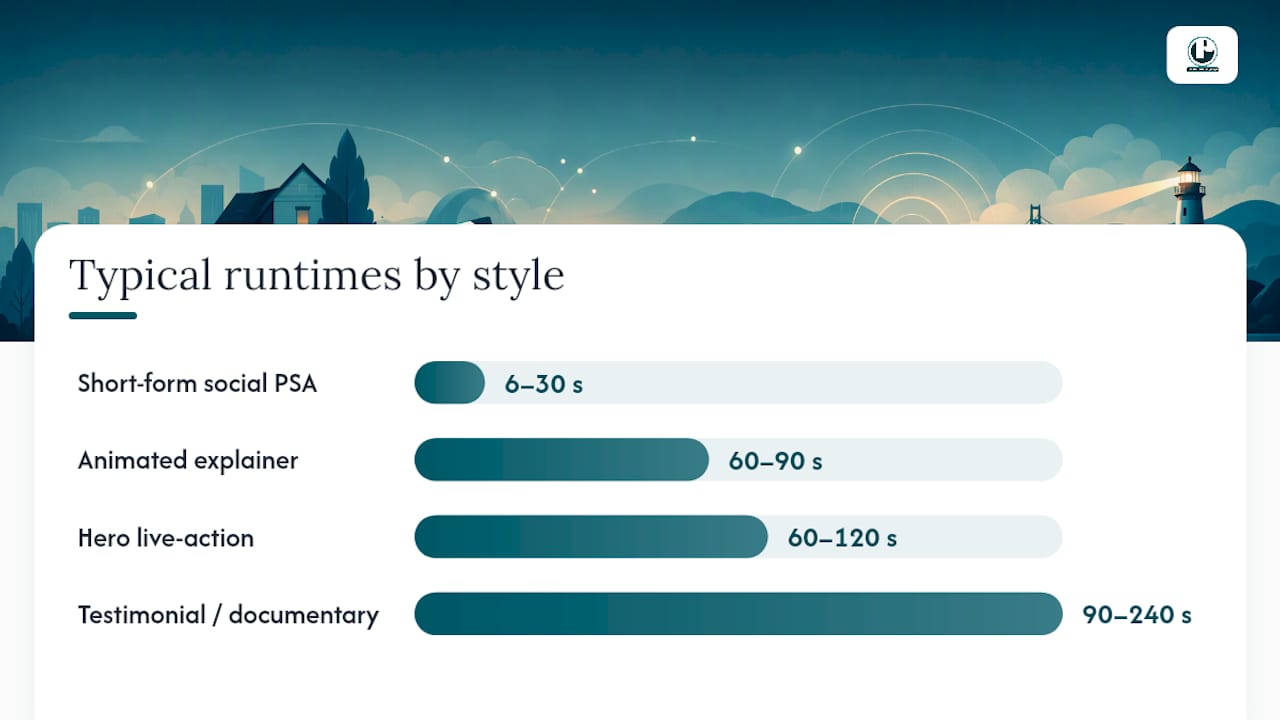
Short-form social PSA runs 6–30 seconds, front-loads the action in the first three seconds, and delivers one clear directive. The narrative is almost always problem-then-action: show the risk, name the step, end with a visual cue or branded tag. DHS’s “One Tip Could Make the Difference” asset is a textbook example of this structure. The style wins on shareability and recall but fails when the behavior is complex or requires explanation.
Animated explainer typically runs 60–90 seconds for public-facing messages and up to three minutes for professional training. It uses character-driven or icon-driven visuals to walk audiences through a process step by step. Animation is the right call for abstract, procedural, or sensitive topics because it ensures consistent representation across demographic groups and dramatically lowers localization cost. You swap a voiceover track and on-screen text rather than re-shooting an entire live-action scene. The Vidyard style guide frames this tradeoff clearly: animated content is harder to produce quickly but far easier to adapt.
Hero live-action is the workhorse of large-scale awareness campaigns. Shot on location with professional crew, it runs 60 seconds to two minutes for broadcast and is cut into 15–30 second social edits afterward. NHTSA’s “Drive Sober or Get Pulled Over” campaign has used this model for years, pairing broadcast hero spots with shorter social assets. The production cost is higher, but the authority and emotional weight it carries on TV and connected TV (CTV) are difficult to replicate with any other format.
Pro Tip: When you produce a hero live-action spot, plan your short-form social edits before you shoot. Build the shot list around 6–15 second self-contained moments that can stand alone without narration. You will cut your post-production cost and get platform-native assets from a single shoot day.
Testimonial and documentary builds credibility through real people. A survivor, a first responder, or a community member speaking directly to camera carries a kind of persuasive weight that scripted content cannot manufacture. The format runs 90 seconds to four minutes and works best on YouTube, Facebook, and earned media placements. The production challenge is consent management and editorial control. You need signed releases, and you need to protect subjects who may be discussing trauma.
Scenario-based reenactment puts actors in realistic situations to teach recognition and response. The DHS FPS Active Threat Awareness Overview uses a structured four-component model (prepare, respond, recover, threat types) delivered through this format. It is the right choice for workplace safety, active-threat preparedness, and any training where audiences need to recognize a situation before they can respond to it. Production complexity is moderate to high, and legal review of the scenario script is non-negotiable.
Motion-graphic data explainer uses animated charts, maps, and typographic sequences to contextualize risk. It is ideal when you need to explain why a behavior matters, not just what to do. NHTSA’s “Heatstroke Prevention” campaign has used this approach to visualize temperature data inside vehicles. Run time is typically 45–90 seconds. Production cost is moderate, and the assets are easy to update when data changes.
Interactive/choose-your-path video is a different animal from the formats above. It requires a hosting platform that supports branching (YouTube cards, Kaltura, or a dedicated LMS), and it works almost exclusively in staff training and compliance contexts. The payoff is measurable engagement: you can track which decision points users reach and where they drop off.
Style | Production complexity | Estimated cost tier |
Short-form social PSA | Low–moderate | $ |
Animated explainer | Moderate–high | $$–$$$ |
Hero live-action | High | $$$–$$$$ |
Testimonial/documentary | Moderate | $$–$$$ |
Scenario-based reenactment | Moderate–high | $$$ |
Motion-graphic data explainer | Moderate | $$–$$$ |
Interactive/choose-your-path | High (platform + production) | $$$–$$$$ |
How to match your campaign style to the right objective and channel
The most common mistake in public safety video planning is choosing a style based on what looks impressive rather than what the objective demands. Start with the behavior you want to change, then work backward to the format.
Here are five scenario-based recommendations that cover the most common briefs:
Urgent public alert, broad audience, short timeline. Objective: prompt one immediate action (call 911, report a tip, pull over). Recommended style: short-form social PSA or motion-graphic data explainer. Distribution: Instagram Reels, TikTok, Facebook, paid social, and TV bumpers. The DHS “If You See Something” model is the reference here.
Mass-media awareness campaign with TV and digital reach. Objective: shift attitudes and build recall over a sustained period. Recommended style: hero live-action as the anchor, with 15–30 second social edits cut from the same footage. Distribution: broadcast TV, YouTube pre-roll, CTV, and paid social. NHTSA’s “Drive Sober or Get Pulled Over” follows this pattern.
Complex procedural training for staff or first responders. Objective: teach recognition and response skills. Recommended style: scenario-based reenactment or animated explainer (or both, in a blended module). Distribution: internal LMS, staff training portals, or a dedicated intranet page. Towson University’s 1-minute safety videos demonstrate how compact, well-produced training assets can scale across an institution.
Community trust-building for a sensitive or contested topic. Objective: build credibility and reduce resistance. Recommended style: testimonial and documentary, featuring community voices rather than authority figures. Distribution: YouTube, local news partnerships, and community organization channels.
Multilingual or diverse-demographic audience. Objective: reach audiences who may distrust or disengage from authority-figure messaging. Recommended style: animated explainer (easiest to localize) or short-form social PSA with on-screen text in multiple languages. Distribution: platform-native social plus community partner channels.
For channel pairing, the general rule is: TV and CTV for reach and authority, YouTube for depth and search discovery, Instagram and TikTok for behavioral nudges and shareability, and LMS or intranet portals for staff-facing compliance content. Mixing two or three of these channels with a consistent visual identity is more effective than saturating a single platform.
Production checklist: tone, accessibility, consent, and legal considerations
Follow this checklist to reduce legal and accessibility risk while preserving the persuasive effect of your campaign.
Tone calibration. Public safety videos need to balance authority with approachability. A tone that is too clinical loses the general public; a tone that is too casual undermines credibility with policymakers and media partners. The FBI’s “Prevent Mass Violence” PSA threads this needle by using plain language and a direct ask without sounding alarmist. Test your script with a small audience sample before committing to production.
Consent for testimonials and reenactments. Every person who appears on camera, including actors in reenactments, needs a signed release that specifies how the footage will be used, on which platforms, and for how long. For testimonials involving trauma survivors or minors, have legal counsel review the release language before filming. Informed consent is not just a legal requirement; it protects your agency’s reputation.
Filming in public spaces. Most U.S. jurisdictions allow filming in public spaces without individual consent, but specific rules vary by state and municipality. If your shoot involves law enforcement vehicles, government facilities, or identifiable private property, confirm permits in advance. Puritano’s guide to safe shooting practices covers the practical steps for production teams working in public or high-risk contexts.
Accessibility must-haves. Closed captions are required for any video distributed on federal or federally funded platforms under Section 508 of the Rehabilitation Act. Beyond compliance, captions also improve performance on social platforms where most users watch without sound. Audio description tracks are needed for visually complex content. On-screen text should meet WCAG 2.1 contrast ratios (4.5:1 for normal text). For multilingual audiences, provide translated subtitle tracks rather than relying on auto-generated captions, which routinely fail on technical or safety-specific vocabulary.
Pro Tip: For videos covering sensitive subjects such as mental health crises, mass violence, or substance abuse, use anonymized animation or stylized reenactment rather than realistic live-action depictions. This approach preserves the dignity of those affected, reduces retraumatization risk for viewers with lived experience, and gives your legal team far less to worry about.
Sensitive imagery and reenactments. If your campaign depicts violence, medical emergencies, or crisis scenarios, establish clear editorial guidelines before scripting begins. Define what will and will not be shown, and document those decisions. This protects your team during review and gives community stakeholders a concrete basis for feedback.
Distribution and format specs: what to deliver for each platform
Deliver platform-specific masters. A single export optimized for broadcast will perform poorly on TikTok, and a vertical social cut will look wrong on a connected TV screen. Build your delivery schedule around native masters for each channel.
Platform | Recommended runtime | Aspect ratio | Key specs and tips |
Broadcast TV | 15s, 30s, 60s | — | High-resolution master; authority visuals early; no captions required but recommended |
YouTube | 15s–3 min | — | Captions on; hook in first 5s before skip; custom thumbnail with clear text; UTM tags on all links |
Instagram Reels / TikTok | 6s–60s | — | Captions burned in; action in first seconds; no lower-third text in lower screen area; trending audio optional |
30s–90s | — or 1:1 | Professional tone; captions on; target agency staff and policy audiences with paid promotion | |
Connected TV (CTV) | 15s, 30s | — | Non-skippable format; wider establishing shots; authority branding prominent; no clickable CTAs |
LMS / intranet | 1–4 min | — | Chapters/timestamps for navigation; downloadable transcript; SCORM packaging if required |
For paid deployment, attach UTM parameters to every link in video descriptions and paid ad sets. Set up event pixels on your landing pages so you can track post-click behavior, not just views. For organic social, the first three seconds of the video function as your thumbnail in autoplay environments, so treat them as a visual headline.
On TV and CTV, front-load authority signals: agency logo, official seal, or a recognizable spokesperson in the opening frames. On social, front-load the action or the question. These are opposite instincts, and getting them confused is one of the most common distribution mistakes in government video campaigns.
Measuring impact: KPIs that actually reflect behavior change
Choose KPIs that align to the objective, not to what is easy to pull from a dashboard. Impressions tell you how many people saw the video; they tell you nothing about whether anyone changed their behavior.
Awareness and reach campaigns:
Impressions and unique reach
View-through rate (VTR) at 25%, 50%, 75%, and 100% completion
Aided and unaided recall (measured via post-campaign survey)
Share of voice in earned media coverage
Engagement and intent campaigns:
Average watch time and drop-off points
Shares, saves, and comment sentiment
Click-through rate to campaign landing page
Survey-reported intent to act (pre/post comparison)
Behavior-change campaigns:
Reported incidents or tip volume (311 calls, hotline volume, online submissions)
Observed behavior metrics (traffic stop data, compliance rates, program enrollment)
Lift studies comparing exposed vs. unexposed audience groups
Academic or program evaluation partner assessments
For measurement infrastructure, instrument every asset with UTM parameters and platform-native analytics. Run baseline surveys before launch and follow-up surveys 4–6 weeks post-campaign. A/B test creative variants on paid social before committing to a full media buy. When reporting to executives, lead with behavior metrics and survey-reported recall. Technical appendices can carry the full analytics breakdown for program evaluation teams.
U.S. campaign case studies: style, objective, and what made it work
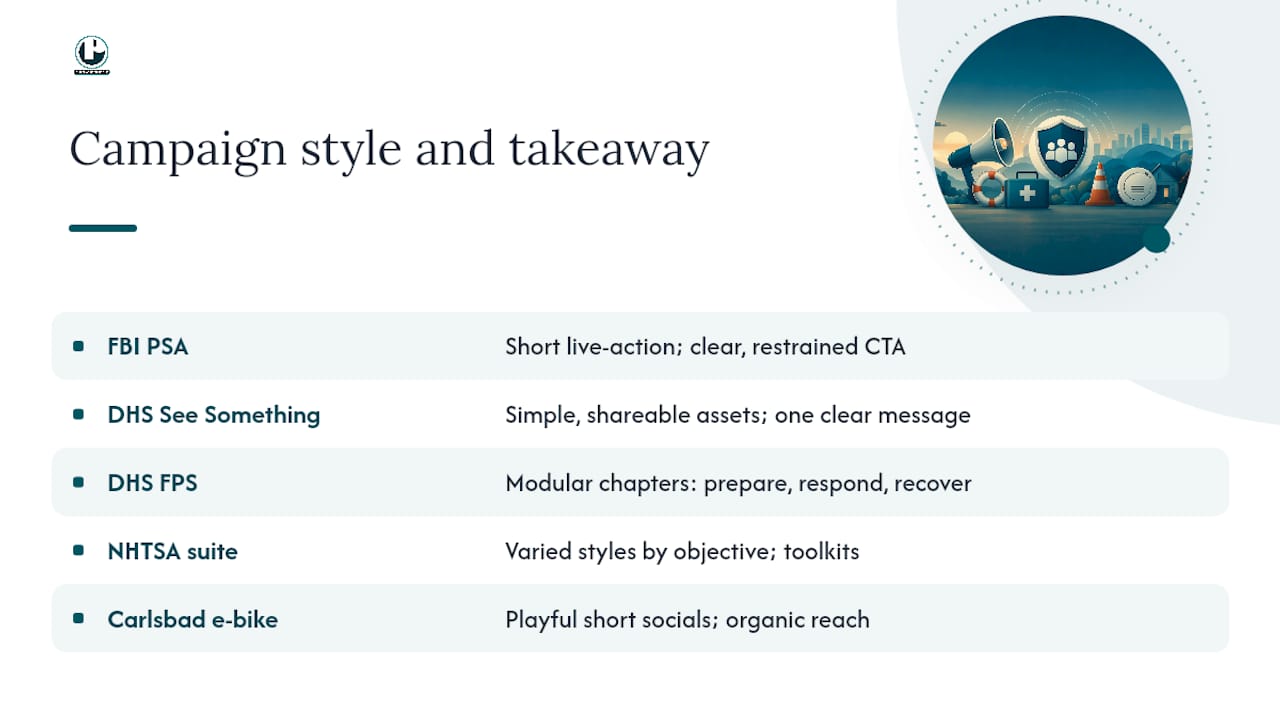
FBI “Prevent Mass Violence: Know the Signs. Speak Up.” This PSA uses a short-form live-action format to translate complex threat-recognition guidance into a single, memorable public action: report what you see. The style works because it humanizes the scenario without dramatizing violence, and the call to action is specific enough to be actionable. Takeaway: when the subject is high-stakes and emotionally charged, clarity and restraint outperform dramatic production.
DHS “If You See Something, Say Something.” The campaign’s social assets, including the One Tip Could Make the Difference video, are built for quick recall and shareability. Each asset delivers one message, one action, and one visual anchor. The format is deliberately simple so it can be co-branded and redistributed by transit agencies, sports venues, and local governments without re-production. Takeaway: design for redistribution from the start, and your reach multiplies without additional budget.
DHS FPS “Active Threat Awareness Overview.” The FPS training video uses a structured scenario-based format organized around four components: prepare, respond, recover, and threat types. The modular structure means individual segments can be extracted for shorter briefings without losing coherence. Takeaway: build training videos in chapters, not as a single unbroken narrative, so they can be repurposed across different audience contexts.
NHTSA traffic safety campaigns. “Drive Sober or Get Pulled Over,” “Heatstroke Prevention,” and “Teen Driver Safety Week” each use a different style matched to a different objective. “Drive Sober” relies on hero live-action with law enforcement authority figures to build deterrence. “Heatstroke Prevention” uses motion-graphic data visualization to make temperature risk visceral and immediate. “Teen Driver Safety Week” leans on testimonial and peer-voice formats to reach an audience that is resistant to authority messaging. The suite demonstrates that a single agency can and should use multiple styles across a portfolio of campaigns. NHTSA provides downloadable campaign assets and state-partner toolkits, making these among the most widely reused public safety video resources in the country.
City of Carlsbad e-bike safety social series. Recognized in the 3CMA Savvy PSA Video Library, this municipal series used short-form social video to address a specific, emerging safety issue with a tone that matched the platform. The creative approach was lighter and more visually playful than a traditional PSA, which helped it perform organically on social without paid amplification. Takeaway: municipal campaigns can afford to be more personality-driven than federal campaigns, and that flexibility is an asset.
Palm Beach Gardens “Stroke Wars.” Also featured in the 3CMA library, this campaign used a competitive, gamified framing to educate the public on stroke recognition. The style borrowed visual language from popular entertainment to make a medical topic feel urgent and engaging rather than clinical. Takeaway: borrowing from familiar cultural formats, whether sports, game shows, or cinematic genres, can dramatically increase engagement when the subject matter would otherwise feel distant or abstract.
Towson University 1-minute safety videos. Towson’s public safety video library includes compact training assets, including an Emmy-nominated active shooter training video, that demonstrate how well-produced short-form content can scale across an institution and be reused across multiple audience groups. The one-minute format forces editorial discipline and makes the content easy to embed in orientation programs, staff briefings, and digital signage.
How Puritano approaches public safety video production
Puritano pairs strategic storytelling with production discipline to deliver behavior-change video campaigns for government and public-safety clients. The process is designed to reduce the guesswork that typically slows government video projects and to give communications teams a clear, auditable production trail.
Here is the workflow Puritano uses for public safety engagements:
Scripting and storyboarding. Develop a script and visual storyboard for client and legal review before production begins. For government video projects, this review stage often involves multiple stakeholders; building it into the schedule prevents delays.
Puritano’s service offerings for public safety teams include animated explainers, hero live-action spots, short-form social edits, scenario-based training modules, and multilingual localization. For teams that need short-form social content at volume, Puritano also offers social media retainer packages that deliver a consistent cadence of platform-native assets.
Key Takeaways
The single most important decision in public safety video production is matching the style to the primary behavior objective before any creative work begins.
Point | Details |
Match style to objective first | Choose your video format based on the behavior you want to change, not on production trends or budget alone. |
Use short-form for immediate action | PSA formats of 6–30 seconds work best when you need the public to take one specific step quickly. |
Plan social edits before you shoot | Build your hero live-action shot list around self-contained 6–15 second moments to cut post-production cost. |
Accessibility is non-negotiable | Captions, translated subtitles, and WCAG-compliant contrast are required for federal platforms and improve performance everywhere. |
Puritano delivers end-to-end | Puritano handles discovery through delivery for government and public safety clients, including multilingual localization and KPI setup. |
What actually makes public safety videos work
Most public safety videos fail not because of poor production but because the message asks too much of the viewer. The campaigns that consistently drive behavior change, from the FBI’s mass violence PSA to Palm Beach Gardens’ “Stroke Wars,” share one quality: they reduce the ask to a single, concrete step the viewer can take right now.
The instinct in government communications is often to be comprehensive; following visual storytelling tips to boost your brand’s impact can help refine your message. Cover every scenario, address every objection, include every disclaimer. That instinct produces videos that are legally defensible and creatively inert. The viewer walks away informed but unmoved.
What works instead is radical specificity. Pick one behavior. Show one consequence. Give one instruction. The DHS “If You See Something” campaign has sustained public recall for years on exactly that formula. The FBI’s “Know the Signs. Speak Up.” PSA does the same thing for a far more emotionally complex topic.
The other thing that consistently gets underestimated is community co-creation. When you bring community members into the scripting and review process, not just as subjects but as co-authors of the message, the resulting video carries a credibility that no amount of production value can manufacture. It also catches tone problems early, before they become a public relations issue. The practical recommendation: before you finalize any script for a campaign targeting a specific demographic or community, run it by three to five members of that community and listen to what makes them uncomfortable. Their discomfort is the most useful feedback you will get.
Puritano is the production partner built for this work
Government and public safety communications teams face a specific set of constraints: multi-stakeholder review cycles, accessibility compliance requirements, multilingual delivery, and the pressure to show measurable behavior change on a public budget. Puritano has spent over two decades building production workflows that account for all of it.
Whether you need a full-scale hero live-action campaign or a series of short-form social PSAs, Puritano’s team handles the creative strategy, production, localization, and delivery in one coordinated engagement. You get a single production partner who understands both the creative demands and the compliance requirements of public safety video work, without the overhead of managing multiple vendors.
The simplest next step: submit a project brief or schedule an exploratory call at puritano.com to discuss your campaign objectives, timeline, and budget.
Recommended
Comments