

Revenue First B2B Video Strategy: LinkedIn, AI, Flagship Rhythm
Updated: 6 days ago

A B2B video strategy is a mapped system that assigns a measurable job and distribution plan to every asset you produce. It only works when each video answers three questions before a camera turns on: who is it for, what buyer stage does it serve, and what number moves when it succeeds. Start there. Document one flagship asset this quarter with a named persona, a funnel stage, and a KPI attached, and the rest of the strategy follows.
TL;DR:
A tiered video strategy allocates budgets based on funnel stage, with flagship videos for brand trust and short clips for awareness and social proof.
Effective videos must be planned around specific personas, stages, and KPIs, with a clear brief guiding production rather than relying on instinct.
Different buyer journey stages require distinct formats: short explainers for awareness, longer demos for consideration, and personalized videos for decision-making.
Distribution should prioritize LinkedIn and website embedding, with UTM tags and aspect ratios tailored to each platform for measurable results.
Measurement should focus on engagement, pipeline contribution, and deal attribution, using staged metrics to justify ongoing investment.
Why Invest in B2B Video Marketing: Measurable Benefits and Business Outcomes
Video shortens the distance between “I don’t understand this product” and “I want a demo.” Complex offerings, the kind most B2B companies sell, lose buyers in dense text. A ninety-second explainer that shows the product solving a real problem compresses comprehension time in a way a data sheet never will.
That comprehension speed translates into pipeline movement. Video influences deal velocity by giving prospects a faster, more memorable way to internalize your value proposition, which matters most at the exact moments buyers stall: right after a first call, right before a proposal, right when a champion needs to sell your solution internally to a committee that never spoke with you directly.
Not every asset needs a five-figure budget. A tiered video marketing strategy treats production spend as a variable tied to funnel position:
High-investment flagship films for brand positioning and top-of-funnel trust building
Mid-tier product demos and customer story videos for consideration-stage nurture
Low-cost, high-frequency short-form clips for social proof and awareness at scale
A useful benchmark: HubSpot’s research finds product videos, webinars, and educational content rank among the highest-impact formats B2B marketers produce, which is exactly why the format-to-stage mapping in the next section matters more than production polish alone.
The rule of thumb: reserve heavier budgets for assets that get reused across a long sales cycle or multiple campaigns. Everything disposable, timely, or reactive belongs in the short-form lane.
How to Build a B2B Video Marketing Strategy Step by Step
Most teams start with a shot list. Start with the business outcome instead. Before anyone talks about cameras, lighting, or editing software, answer what pipeline behavior this video needs to change and who exactly needs to see it.
Define the business outcome and ideal customer profile first. Name the revenue goal (more demo requests, faster close rate, higher deal size) and the specific buyer persona the asset targets. A video built for “everyone interested in our product” will move nobody.
Write a one-page brief before any production conversation. Every brief needs five fields: audience, funnel stage, single core message, call to action, and distribution plan. Atlassian’s Loom team recommends this exact discipline: match video type to buyer stage deliberately rather than defaulting to “let’s make a company overview video.”
Apply the flagship-plus-derivatives cadence. One high-investment flagship asset per quarter, paired with weekly short-form derivatives pulled from it, is a common rhythm among B2B teams balancing quality against volume. Stretch that cadence for long enterprise sales cycles; tighten it for shorter, higher-velocity sales motions that need constant fresh content.
Set a budget rubric tied to expected KPI lift, not gut feeling. If a video targets a decision-stage buyer with a small, high-value buying committee, a larger spend is justified because each view represents real deal weight. If it targets top-of-funnel awareness at scale, spend less per asset and produce more of them.
Lock the brief before you touch a camera. KEO Marketing’s approach treats video as a pipeline asset from day one, meaning the buying committee, distribution channel, and conversion mechanism all get documented in planning, not discovered in editing.
Pro Tip: Write the call-to-action link and the UTM parameters into the brief before production starts, not after the edit is locked. Teams that add tracking as an afterthought lose the ability to prove the video moved pipeline at all.
The brief is the strategy. Everything downstream, casting, shot list, editing style, distribution schedule, should trace back to the persona, stage, and KPI written on that one page.
Video Formats Mapped to Buyer Journey Stages
Different buyer stages need fundamentally different video jobs, and matching format to stage is where most B2B teams either win or waste budget. Loom’s guidance is direct on this point: an explainer built for cold awareness traffic and a personalized outreach video for a stalled deal are not interchangeable, even if they’re both “just video.”
Awareness stage relies on short explainers and social thought-leadership clips, typically 30 to 90 seconds, formatted vertically or square for LinkedIn and social feeds. The KPI here is watch depth and reach, not conversions.
Consideration stage calls for longer-form assets: product demos, recorded webinars, and case-study videos running three to eight minutes, usually landscape and embedded on website pages. Webinars repurpose especially well into landing-page assets and clips, which makes them one of the most efficient formats to invest in. The KPI shifts to engagement rate and demo requests generated.
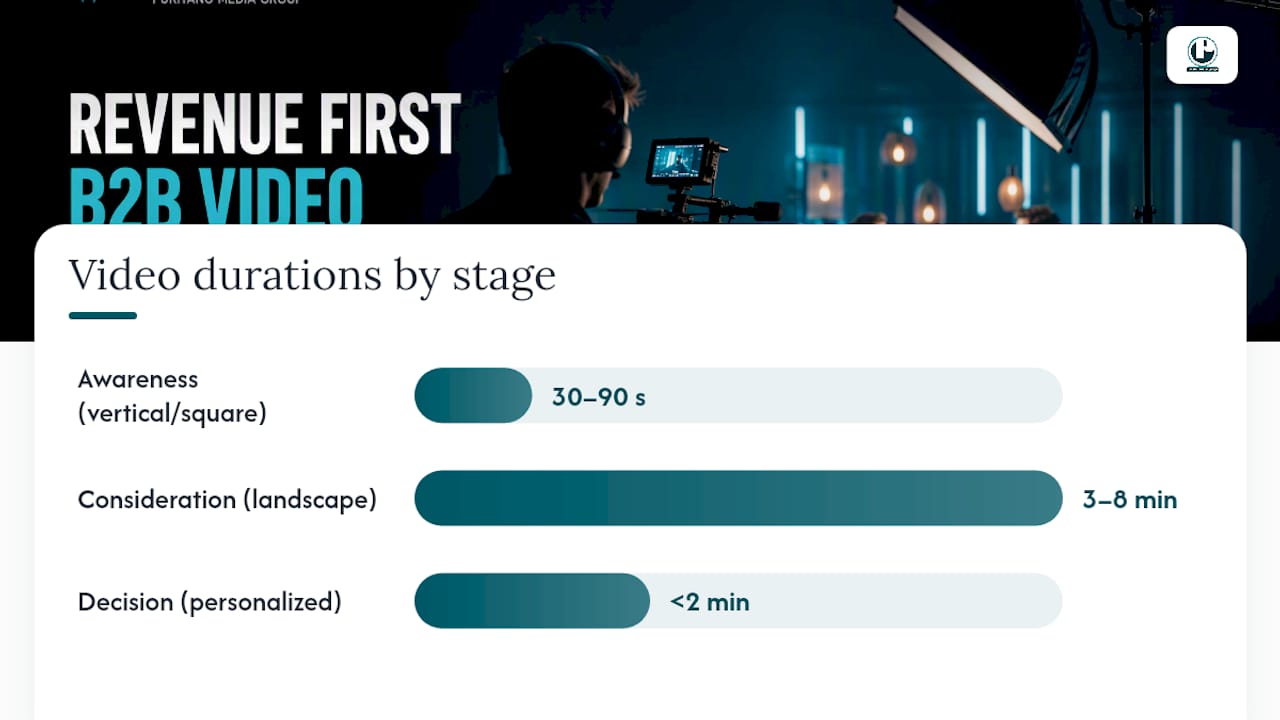
Decision stage narrows to testimonials and personalized, named-prospect outreach videos, often under two minutes and sent directly through sales sequences rather than posted publicly. The KPI here is meetings booked and close rate, and completion rate on these assets is a stronger signal of buyer intent than raw view counts.
Format checklist by stage:
Awareness: vertical or square, under 90 seconds, captioned, hook in the first three seconds
Consideration: landscape, 3 to 8 minutes, chaptered if hosted on your site, clear next-step CTA
Decision: under 2 minutes, personalized opening line, sent through sales tools rather than broad distribution
Distribution Channels and Amplification Priorities
Producing the video is half the job. Where it lands determines whether anyone outside your own team ever sees it. HubSpot’s data shows LinkedIn has edged out YouTube as the top channel B2B teams use to share video, which should shape where you spend the first dollar of amplification budget.
LinkedIn works because your buyers are already there in a professional mindset, scrolling with intent rather than escaping into entertainment. Native, captioned, square or vertical clips outperform anything that requires clicking away from the feed.
YouTube plays a different, longer game: search discoverability. A well-tagged demo or educational video keeps generating views months after publish date because people search “how does X work” long after your campaign budget is spent.
Website and landing pages function as the conversion anchor. This is where a prospect who’s already interested goes to confirm the decision, so embed video near your strongest CTA, not buried on an about page nobody visits.
Sales outreach accelerates deals already in motion. A short personalized video attached to a follow-up email routinely outperforms a plain-text nudge because it signals effort a template can’t fake.
Split paid amplification budget in priority order: LinkedIn first, then YouTube for compounding search value, then retargeting and paid social clips for prospects who’ve already engaged once. Before anything goes live, run this checklist:
Correct aspect ratio for each platform (76% of teams now resize per platform rather than uploading one file everywhere)
Burned-in or platform-native captions
A custom thumbnail, never an auto-generated frame
A visible CTA overlay or clickable link, not just a mention in the description
UTM tagging on every distribution link so performance rolls up cleanly in analytics
Choosing Production Models That Scale Without Burning Out Your Team
The in-house-versus-agency decision comes down to cadence and complexity, not just cost. If your flagship asset volume is one polished film per quarter with weekly derivatives, an internal generalist can often keep pace using templates and a lightweight editing tool. If you’re producing across multiple product lines, running live event coverage, or need broadcast-grade brand films, a production partner with dedicated crew and post-production capacity closes the gap internal teams usually can’t.
A blended model is common for mid-market teams: one internal marketer owns strategy, briefs, and distribution, while an outside partner or freelance pool handles filming and editing on a project or retained basis. This keeps strategic control in-house while borrowing production capacity only when volume demands it.
Whatever model you choose, build asset management discipline early:
Tag every raw file and finished cut by persona, funnel stage, and campaign
Store flagship footage separately from short-form exports so repurposing doesn’t require re-digging through raw files
Maintain one shared brief template so every stakeholder, internal or external, works from the same five fields
AI tools now sit inside most of this workflow, assisting with rough-cut editing, caption generation, and repurposing raw footage into short clips faster than manual editing allows. Treat AI as a production accelerant, not a replacement for a human review pass. Fully automated video content still carries credibility risk with B2B buyers who can sense when a human never touched the final cut.
Pro Tip: Budget for one internal or contracted “repurposing hour” for every hour of flagship footage shot. Raw footage that never gets recut into short-form derivatives is a sunk cost, not an asset.
The Three-Tier Measurement Framework That Ties Video to Pipeline
Vanity metrics get B2B video budgets cut. A tiered measurement model tied to revenue is what keeps them funded. KEO Marketing’s framework warns explicitly against judging a bottom-funnel asset by top-funnel numbers, and the reverse mistake is just as common.
Tier 1: Engagement metrics. Watch time, completion rate, and click-through rate. These tell you whether the video holds attention and whether the message lands, but they don’t prove revenue impact on their own.
Tier 2: Pipeline metrics. Leads attributed to a specific video, demo requests generated, and time-to-close for deals where video played a role. This is where the strategy starts proving its worth to a CFO.
Tier 3: Attribution. Closed deals with tracked video touchpoints, built through UTM tagging integrated into your CRM. Completion rate segmented by funnel stage is a better predictor of pipeline influence than raw view counts, which makes stage-specific tracking worth the setup effort.
Report on a monthly cadence for engagement metrics and quarterly for pipeline and attribution, since deal cycles rarely move fast enough to show meaningful movement week to week. An executive summary dashboard should carry no more than five numbers: total views by stage, completion rate on decision-stage assets, leads attributed to video, video-influenced pipeline value, and average time-to-close for video-touched deals. For a deeper look at translating these numbers into a board-ready report, Puritano’s ROI guide walks through sample dashboard structures.
Repurposing Workflows That Multiply Every Production Dollar
One well-produced flagship asset should generate weeks of derivative content, not a single publish-and-forget moment. The repurposing rule of thumb: within 72 hours of a flagship shoot wrapping, cut at least five short-form derivatives. Pull a 30-second hook clip for LinkedIn, a 15-second vertical teaser for other social feeds, a quote card animation, a sales-team snippet for outreach emails, and a landing-page embed trimmed to the strongest two minutes.
Webinars deserve their own repurposing checklist since they’re consistently among the most engaging long-form assets teams produce:
Cut the Q&A segment into standalone clips answering common objections
Pull the strongest audience question into a dedicated social post
Rebuild the slide-and-voice sections into a gated landing-page asset
Extract one bold claim or statistic into a quote graphic
Tag every derivative by source flagship, funnel stage, and publish date in a shared editorial calendar so nobody re-cuts the same clip twice. A useful 90-day cadence for a mid-market team: one flagship film in month one, four to six short-form derivatives published weekly through month two, and a fresh flagship or major case-study asset launching month three as the cycle repeats. Puritano’s repurposing best-practices guide and YouTube Shorts playbook both cover the tagging and scheduling mechanics in more depth.
How Puritano Media Group Applies This Strategy for Clients
Two decades of producing corporate videos, brand films, and virtual event coverage has taught Puritano one consistent lesson: the strategy work has to happen before the crew shows up, not after the footage is shot. Our teams brief every project against a named persona, funnel stage, and KPI, the same discipline covered above, whether the deliverable is a nonprofit campaign film or a full virtual event production package.
For readers building out their own service pages, our post on video content for B2B sales and our piece on B2B brand films and storytelling both expand on production tactics referenced in this article.
Legal and Compliance Considerations for B2B Video Content
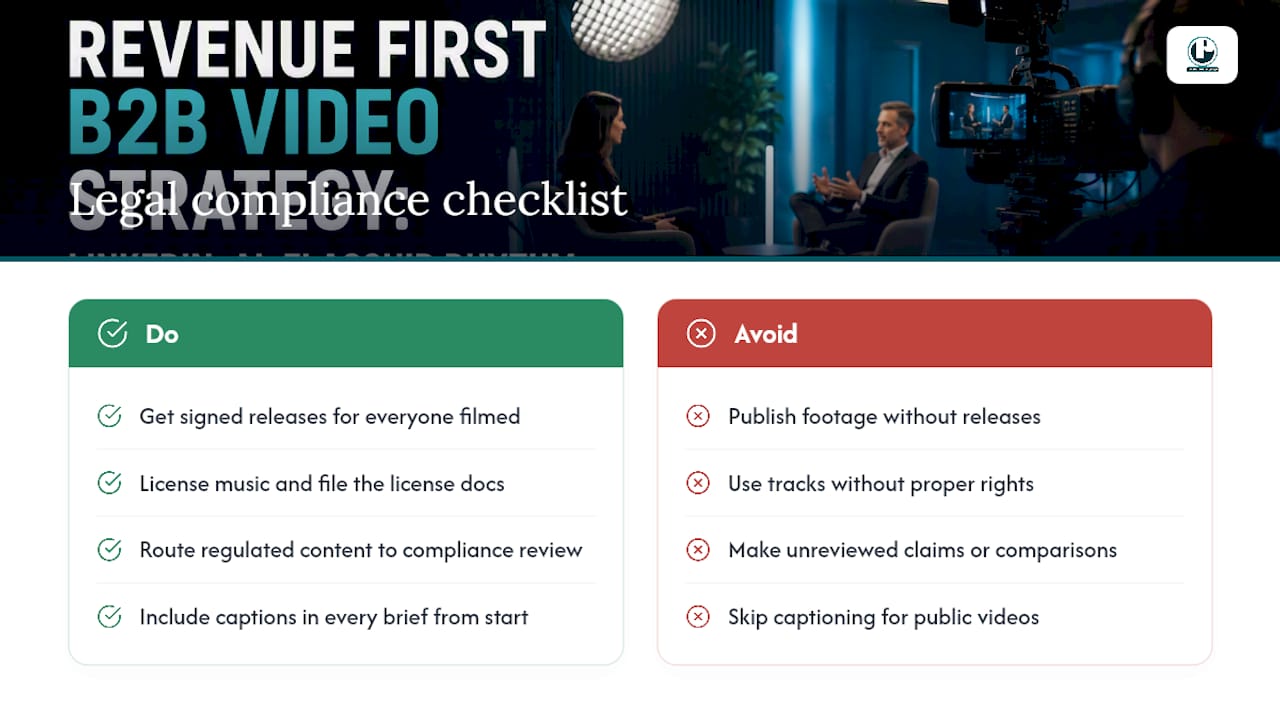
Video content carries legal exposure that a lot of B2B teams overlook until a client, partner, or employee objects after the fact. Every person who appears on camera, whether an employee testimonial, a client case study, or an event attendee caught in a wide shot needs a signed release before the footage goes public. This applies even to internal training videos that later get repurposed for external marketing.
Music licensing is a frequent trap. A track pulled from a free online source without checking usage rights can trigger a copyright claim months after publish, sometimes after the video has already driven real pipeline. License music properly or use a cleared library, and keep the license documentation filed alongside the project brief.
If your video makes performance claims, comparisons to competitors, or specific numeric promises about outcomes, treat that language with the same scrutiny your legal team applies to written advertising. Government contractors and healthcare-adjacent B2B brands face additional review layers: government agency videos often require public-record disclosure language, and any video touching regulated industries should route through compliance review before distribution, not after.
Accessibility compliance matters too, both legally and practically. Captioning isn’t just a nice-to-have for LinkedIn autoplay. Under the Americans with Disabilities Act, public-facing digital content, including video, increasingly falls under accessibility expectations that captioned, screen-reader-friendly assets satisfy more completely than uncaptioned ones. Build captioning into every brief rather than treating it as a post-production afterthought.
Emerging Technologies and Trends Shaping B2B Video
Interactive video is moving from novelty to standard practice for consideration-stage assets. Clickable branching paths inside a single video let a prospect choose which product feature to explore next, effectively turning a passive demo into a self-guided tour that adapts to what the viewer actually cares about.
Personalization at scale is the other major shift. Tools that insert a prospect’s name, company logo, or industry-specific footage into an otherwise templated video are closing the gap between mass-produced content and the one-to-one feel of a truly custom asset. This matters most at the decision stage, where a personalized touch signals effort that a generic testimonial reel can’t match.
AI-assisted production continues expanding across planning, rough-cut editing, and accessibility features like auto-captioning and multilingual dubbing. The caveat that matters more than the capability: B2B buyers evaluating six-figure and seven-figure purchases can often sense when a video feels entirely machine-generated, and that perception carries real credibility risk. The winning approach treats AI as a workflow accelerant that speeds up editing and repurposing, while keeping a human hand on final creative decisions, casting, and messaging accuracy. Teams exploring AI-assisted editing at scale can look at examples like AI-driven productivity gains for agencies to see where automation currently adds real efficiency without sacrificing the human judgment buyers still expect.
What Actually Separates a Working Strategy From a Wish List
Most B2B video failures trace back to skipping the brief and jumping straight to production. A team gets excited about a concept, books a crew, and only asks “who is this for and what should they do next” after the footage is already shot. That order of operations is backwards, and no amount of editing polish fixes a video built without a persona or a KPI attached to it.
The corrective is boring and that’s exactly why it works: write the five-field brief first, every time, no exceptions for “quick” internal requests either. When you’re vetting a production partner, ask how they handle briefing, not just how their reel looks. A proposal that jumps straight into shot lists and day rates without asking about your buyer stage and funnel goals is a sign the strategy thinking isn’t happening at all. For more on how briefs translate into finished sales assets, Puritano’s resources on B2B video for sales are a solid next stop, and our contact page is open if you want to talk through a specific project.
Work With a Production Partner That Plans Before It Films
Puritano gives you what a lot of production shops skip entirely: a strategy conversation before a single shot list gets written. Instead of handing you a generic package built around runtime and crew size, Puritano briefs every project against your actual buyer persona, funnel stage, and KPI, the same discipline this article just walked through, so the finished video has a job to do the moment it’s published.
That approach fits especially well for organizations planning webinars, conferences, or hybrid gatherings, where Puritano’s virtual event production work turns a single event into a flagship asset with weeks of repurposed derivatives built in. Nonprofits, associations, government agencies, and marketing agencies serving DMV-area and national clients all fall inside Puritano’s service range, from brand films to sales enablement video to full event coverage.
If you’re ready to stop guessing which videos your team should make next, reach out through Puritano’s contact page and describe your business goal, your audience, and your timeline. That’s the same brief every project starts with internally, and it’s the fastest way to get a proposal that actually matches your funnel, not a one-size-fits-all package.
Sources
Recommended
That discipline is how Charlie Puritano runs every production at PMG. Before a camera is booked, the audience, the job of the piece, and the full deliverables list are settled on paper, so the shoot day executes a plan instead of improvising one. It is the same thinking this strategy asks for, a named viewer, a defined stage, a result the piece is accountable for. More than 25 years of producing and directing sit behind that habit, and it is why our flagship pieces are built to be cut down, repurposed, and measured rather than admired once and shelved.


Comments