

Video in the Content Marketing Funnel: A Full Guide

Video is the most effective format for moving prospects through a content marketing funnel because it delivers tailored messages at each buyer stage with a retention rate that text simply cannot match. The role of video in content marketing funnel strategy goes far beyond brand awareness clips. It covers every stage from first impression to closed deal. 91% of businesses now use video as a marketing tool, and 89% report positive ROI. Those numbers reflect a structural shift in how buyers consume information and how marketers must respond. Formats like explainer videos, case study videos, and product demos each serve a distinct function in the buyer journey, and understanding which format belongs where is the difference between a funnel that converts and one that leaks.
What types of videos work best at each stage of the content marketing funnel?
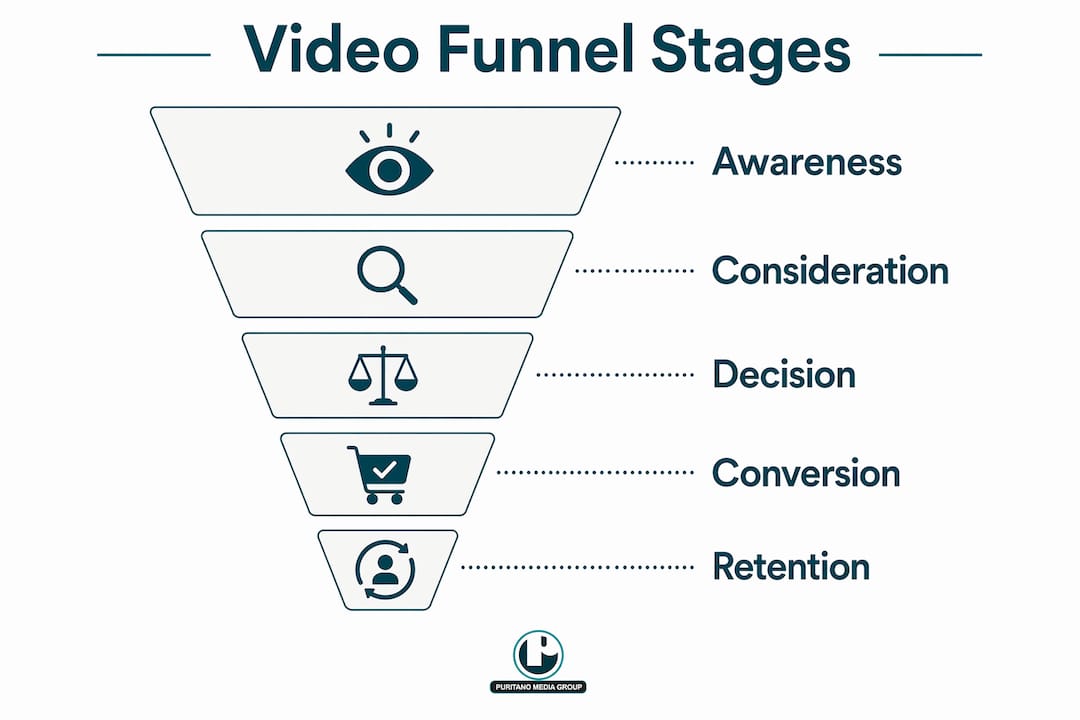
The video marketing funnel maps specific video formats to the awareness, consideration, and decision stages of the buyer journey. Each stage demands a different emotional register, length, and call to action. Using the wrong format at the wrong stage is one of the most common and costly mistakes in video content strategies.
Top of funnel: awareness
Short-form videos (15–90 seconds) are the workhorse of awareness-stage content. Their job is to stop the scroll, introduce the brand, and spark curiosity. Educational clips, brand story videos, and social media reels all fit here. The goal is reach, not conversion. KPIs at this stage are views, impressions, and brand recall.
Middle of funnel: consideration
Explainer videos, product demos, and tutorials belong in the consideration stage. These formats answer the buyer’s core question: “Does this solve my problem?” They run longer, typically 2–5 minutes, and they build trust by demonstrating value in action. Engagement rate and watch time are the metrics that matter here.
Bottom of funnel: decision
Case study videos and customer testimonials close deals. A prospect at the decision stage needs social proof and specifics, not inspiration. These videos should be direct, concrete, and focused on outcomes. The primary KPI is conversion rate.
Funnel stage | Video type | Ideal length | Primary KPI |
Awareness | Short-form, brand story | 15–90 seconds | Views, reach |
Consideration | Explainer, demo, tutorial | 2–5 minutes | Watch time, engagement |
Decision | Case study, testimonial | 2–4 minutes | Conversion rate |
Pro Tip: Write your CTA before you write your script. If you cannot state what action you want the viewer to take in one sentence, the video does not have a clear funnel objective yet.
How does video impact engagement and conversions across the funnel?
The performance data behind video in the customer journey is not subtle. Brands using stage-specific video content see 34% higher conversion rates than those running generic video strategies. That gap exists because generic video does not address the buyer’s specific concern at their specific stage.
The retention advantage is equally significant. Viewers retain 95% of a message delivered via video compared to 10% via text. That means a well-placed explainer video does more persuasive work in two minutes than a five-page white paper. For B2B marketers managing long sales cycles, that efficiency compounds quickly.
Distribution channel choices amplify these gains further:
Embedding video thumbnails in email nurture campaigns increases click-through rates by 200–300%
Landing pages featuring video convert 80–86% better than those without
Video used effectively in the consideration stage shortens B2B sales cycles by 23%
Companies integrating video across all funnel stages achieve approximately 4.8% conversion rates versus 2.9% without a structured video funnel
Each of these figures points to the same conclusion: video is not a nice-to-have channel. It is a conversion mechanism when placed correctly. The anatomy of a high-converting video ad confirms that format, placement, and stage alignment drive results far more than production budget alone.
Pro Tip: Track pipeline contribution, not just views. A video with 500 views that influenced three closed deals outperforms a viral clip with 50,000 views and zero attributed revenue. Connect your video data to your CRM from day one.
What are the key strategic pitfalls when integrating video into a funnel?
The biggest strategic error in video marketing is producing content without clear funnel objectives and pipeline tracking in place. Marketers often treat video as a creative exercise rather than a business tool. The result is a library of polished content that generates views but does not move buyers forward.
Avoiding that trap requires a structured approach. Here are the four most common pitfalls and how to address each:
No funnel mapping before production. Every video needs a defined stage, a defined audience segment, and a defined next step. Produce without that map and you will create content that fits nowhere.
Ignoring format and length ratios. Short-form video (15–90 seconds) drives awareness; long-form content (10–20 minutes) builds the trust needed for complex B2B purchases. The recommended production ratio is roughly 70% short-form to 30% long-form. Most teams invert this ratio and then wonder why their awareness metrics are weak.
Optimizing for views instead of retention. The YouTube algorithm prioritizes watch time and viewer retention over raw view counts. A video with strong retention signals gets distributed more widely. Front-load your value in the first 30 seconds to earn that retention.
Skipping metadata and chapter markers. Pre-scripting metadata, titles, descriptions, and chapter markers before production aligns your video with search intent from the start. Retrofitting this after the fact is harder and less effective. SEO-led video development that targets bottom-of-funnel search queries significantly improves qualified lead generation.
The strategic discipline here is the same as any content channel. You need a clear brief, a defined audience, and a measurable outcome before the camera rolls.
How to build a full-funnel video content strategy
A full-funnel video strategy starts with a content map, not a camera. Before producing a single asset, align your video topics to the search queries and buyer pain points at each funnel stage. This is where video in the sales funnel becomes a genuine revenue driver rather than a marketing expense.
The distribution layer matters as much as the content itself. Match your channels to your funnel stages: YouTube and social media for awareness, email sequences and blog embeds for consideration, and direct outreach or sales decks for decision-stage videos. Each channel has a different audience intent, and your video format should reflect that.
For measuring success, assign stage-specific KPIs from the start:
Awareness: Views, impressions, branded search lift
Consideration: Watch time percentage, engagement rate, email click-through rate
Decision: Conversion rate, pipeline influenced, cost per acquisition
Overall funnel: CRM attribution, revenue influenced by video touchpoints
CRM integration is the step most teams skip. Without it, you cannot connect a prospect’s video engagement history to their purchase decision. Tools like HubSpot and Salesforce both support video engagement tracking through native integrations or third-party connectors. That data tells you which videos actually move deals forward.
Pro Tip: Brand video storytelling at the awareness stage performs best when it answers an unspoken buyer question rather than promoting a product. Lead with the problem your audience recognizes, not the solution you want to sell.
Content mix is a practical constraint most teams underestimate. A 70/30 split between short-form and long-form content keeps your awareness pipeline full while still building the depth needed for consideration and decision stages. Producing only long-form content is a common trap for B2B teams. It creates depth without reach, and your funnel starves at the top.
Key Takeaways
Video drives measurable funnel performance when each format is matched to the right buyer stage, distribution channel, and KPI.
Point | Details |
Stage-specific formats win | Use short-form for awareness, explainers for consideration, and case studies for decision. |
Retention beats reach | Viewers retain 95% of video messages versus 10% from text, making video the most efficient persuasion tool. |
Conversion data is clear | Stage-specific video strategies produce 34% higher conversion rates than generic approaches. |
Pipeline tracking is non-negotiable | Connect video engagement data to your CRM to measure revenue impact, not just views. |
Production ratio matters | A 70% short-form to 30% long-form mix keeps the full funnel covered without starving awareness. |
What I’ve learned about video funnels after two decades in production
Here is the honest truth about video marketing that most strategy articles skip: the funnel framework is only as good as the content inside it. I have seen brands build technically perfect funnel maps with the right video types at every stage, and still produce content so generic that buyers tune out within 10 seconds. The framework does not save weak content.
What actually works is specificity. The best performing videos we have seen address one buyer concern, for one audience segment, at one funnel stage. That constraint feels limiting until you realize it is the reason the video gets watched to completion.
The rise of hybrid human-AI video production pipelines is changing the volume equation. Brands can now publish 4.3x more video content while keeping production costs manageable. That is a real advantage for funnel coverage. But it creates a new risk: quantity without a clear content brief produces noise, not pipeline. The teams winning with AI-assisted production are the ones who use it to execute a well-defined strategy faster, not to replace the strategy itself.
Platform algorithms are also shifting the rules. YouTube rewards topical consistency and watch time, not upload frequency alone. Channels with focused content niches grow faster because the algorithm recommends them within a defined topic cluster. That means your video content strategy needs a topical architecture, not just a production calendar.
My advice: run a quarterly content audit against your funnel map. Identify which stages are over-served and which are thin. Then produce to fill the gaps, not to hit an arbitrary volume target. Authenticity and specificity will always outperform volume in a buyer’s decision process.
Work with Puritano on your video funnel
Puritano Media Group has spent over two decades producing video content that does real work inside marketing funnels. From corporate video and branded content to virtual event coverage and social media assets, Puritano builds video that is mapped to your audience and your goals. The team serves clients across the Washington D.C. metro area and nationally, with production experience across B2B, nonprofit, government, and association sectors. If you are ready to build a video strategy that connects to measurable outcomes, explore Puritano’s full production services or review the virtual events and case study work to see how the approach translates into results.
FAQ
What is the video marketing funnel?
The video marketing funnel is a framework that maps specific video formats to the awareness, consideration, and decision stages of the buyer journey. Each stage uses different video types, lengths, and KPIs to move prospects toward conversion.
Which video type converts best at the bottom of the funnel?
Case study videos and customer testimonials are the most effective formats at the decision stage. They provide social proof and specific outcomes that address a buyer’s final objections before purchase.
How does video affect B2B sales cycles?
Video used effectively in the consideration stage shortens B2B sales cycles by 23% on average. Higher message retention and faster trust-building are the primary drivers of that reduction.
What KPIs should I track for funnel-stage video?
Track reach and views for awareness, watch time and engagement rate for consideration, and conversion rate and CRM-attributed pipeline for decision-stage videos. Vanity metrics alone do not reflect funnel contribution.
How much of my video content should be short-form?
A production ratio of roughly 70% short-form to 30% long-form content keeps the full funnel covered. Short-form drives awareness volume; long-form builds the trust needed for complex purchase decisions.
Recommended
Comments