

Plan $1–$3/Min: U.S. Closed Captioning Budget & Procurement Checklist
For most U.S. businesses, budget somewhere between $1 and $3 per minute for human-quality closed captions, or a few cents per minute if you go pure AI. The right move for scale is a hybrid workflow: AI for the first pass, human review where accuracy actually matters. If your content is regulated, live, or headed for broadcast, skip the shortcuts and pay for full human captioning. Live events get quoted separately, always by the hour.
How Much Does Closed Captioning Cost Per Minute?
Let’s get the real numbers on the table, because “it depends” isn’t a budget you can take to your finance team.
AI-driven captioning tools price by the minute, and it’s genuinely cheap. Depending on the platform and your monthly volume, AI transcription runs roughly $0.006 to $0.25 per audio minute. That’s not a typo. A one-hour training video can get a rough caption pass for less than the cost of your coffee.
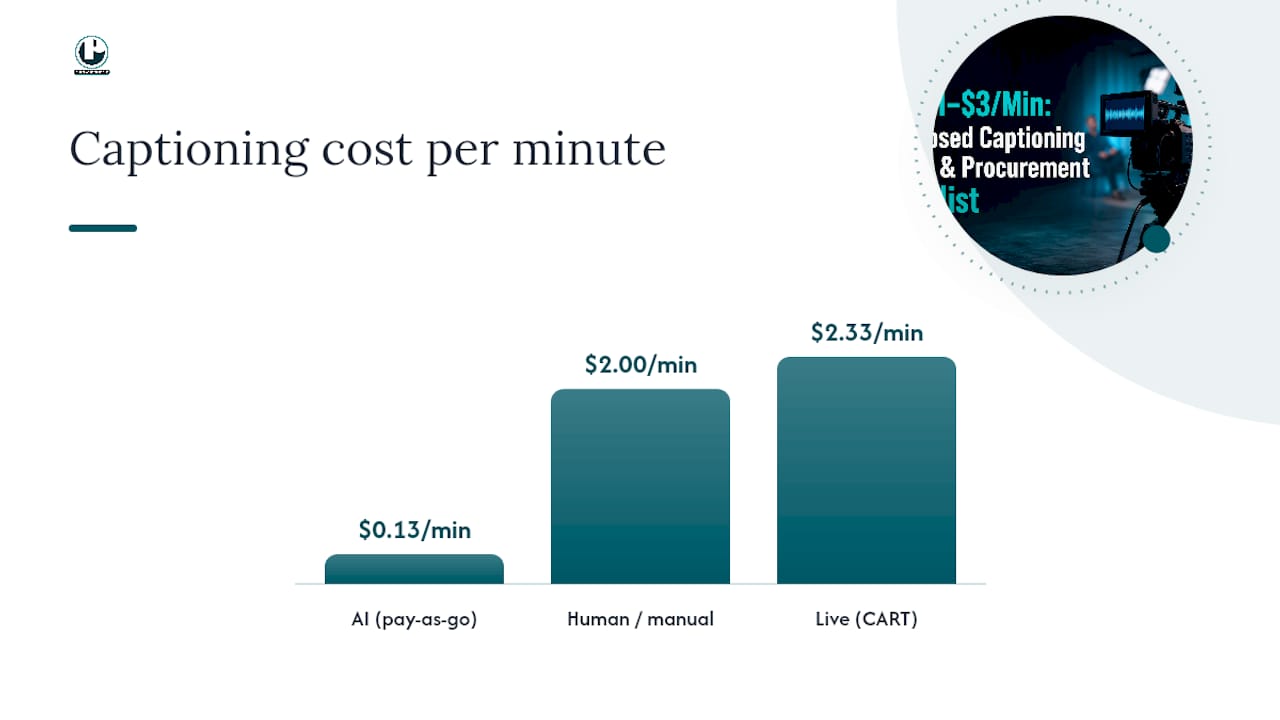
Human-generated captions live in an entirely different price tier. Manual captioning typically runs $1.00 to $3.00 per minute, and that gap between the AI and human tiers is where most buyers get confused when comparing quotes. A vendor charging near the top of that range isn’t necessarily overcharging. They’re usually including a human transcriber, a QC editor, and format exports you won’t get from a $0.02-per-minute tool.
Here’s how the bands generally break down:
Method | Typical price band | Best fit |
AI pay-as-you-go | $0.006–$0.25/minute | High volume, low-stakes, social clips |
AI subscription | Lower effective rate at volume | Regular monthly output, internal video |
Human/manual | $1.00–$3.00/minute | Client-facing, training, compliance content |
Premium/broadcast | Above standard human rates | Network delivery, SDH, strict style guides |
Live/CART | Quoted hourly, often $110–$170/hour on some government contracts | Conferences, webinars, live broadcast |
A few things vendors rarely spell out up front:
Subscription plans lower your effective per-minute price as monthly volume climbs, but only if you’re actually using the hours you’re paying for.
Most human-captioning vendors enforce a minimum charge per file, often 15 to 30 minutes, even if your clip is 90 seconds.
Rounding policies matter. Some vendors round up to the nearest minute; others round to the nearest five. On short clips, that rounding can add 20% to your bill without anyone doing anything wrong.
Live captioning pricing follows its own logic entirely, built around staffing minimums and backup coverage, not per-minute audio math.
If a quote comes in dramatically below these bands, ask what’s missing. It’s usually accuracy, formatting, or both.
What Drives the Price Up on a Caption Quote?
Two videos of identical length can generate wildly different quotes, and it’s rarely the vendor being arbitrary. Here’s what actually moves the number.
Audio quality is the single biggest lever. Clean studio audio with one speaker is fast, cheap work. A panel discussion recorded on a conference room mic, with three people talking over each other and a Southern drawl mixed with a Boston accent, takes a human editor two or three times longer to caption accurately. Vendors price for that time.
Speaker count and jargon compound the problem. Add a fourth speaker, throw in pharmaceutical terminology or legal citations, and you’ve just extended review time again. This is where industry-specific terminology creates real cost surcharges that generic pricing tables never show.
Turnaround speed has its own price tag. Standard turnaround (24 to 48 hours) is baked into the base rate. Same-day or rush delivery commonly adds a rush surcharge, sometimes doubling the per-minute cost for tight deadlines.
Deliverable count adds up fast. Each additional format, SRT, VTT, a burned-in version, a full transcript, SDH files for the deaf and hard-of-hearing, or a second-language subtitle track, is usually a separate line item.
Before you sign anything, ask specifically about these:
Speaker diarization (labeling who said what)
Compliance review for regulated content
Number of included revision rounds
Whether rush fees apply to your stated deadline
Pro Tip: *Ask every vendor for their base rate AND their rush-rate multiplier before you need it.
What Does a Real Captioning Budget Look Like?
Numbers on a pricing page only mean something once you run them against your actual content. Here’s the math on three common scenarios.
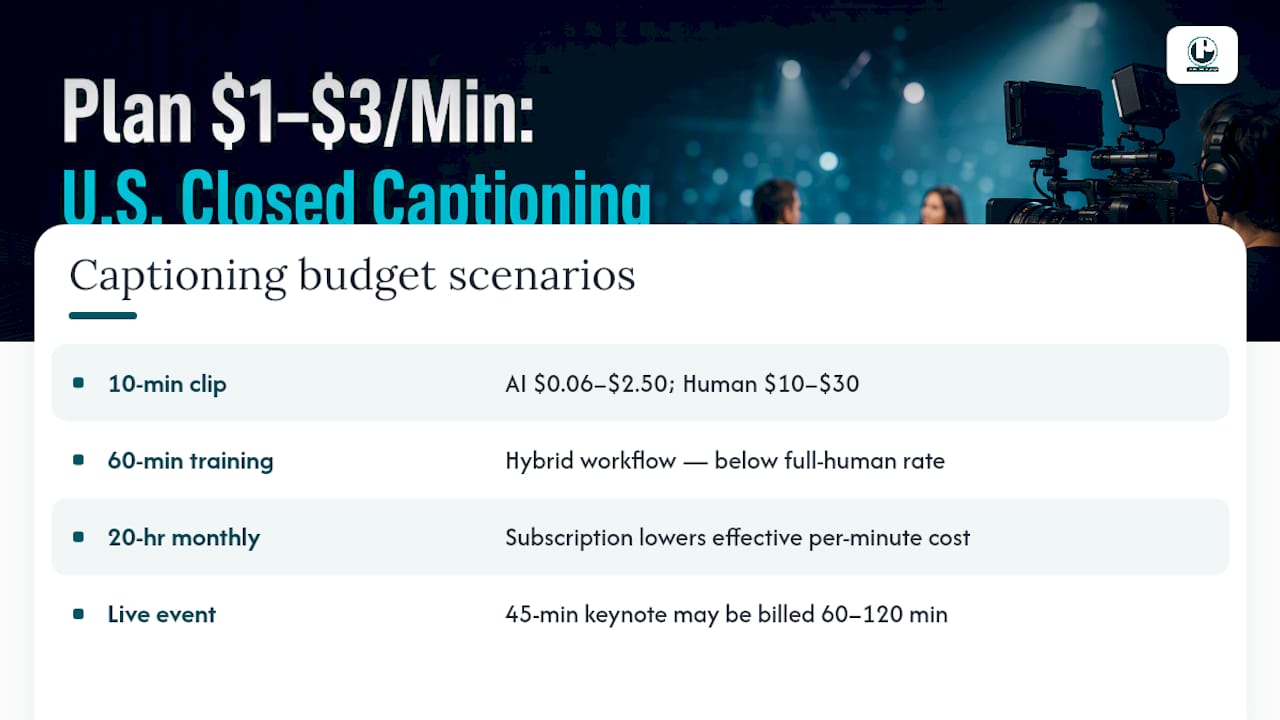
A 10-minute social clip costs roughly $0.06 to $2.50 with pure AI tools, versus $10 to $30 for full human captioning. For a quick Instagram Reel with no dialogue-heavy audio, AI alone is fine. For a client testimonial you’re running as a paid ad, spend the extra $20 and get it clean.
A 60-minute training video run through a hybrid workflow (AI draft, human QC pass) typically lands well below a full-human rate, while still catching the errors AI alone would miss on technical vocabulary.
A 20-hour monthly volume is where subscription plans start beating pay-as-you-go pricing. At that scale, locking in a monthly plan generally lowers your effective per-minute cost compared to paying per file every time.
Live events break this math entirely. Hourly minimums and backup staffing mean a 45-minute keynote might get billed as a full hour, sometimes two, depending on setup time.
How Do I Choose a Captioning Vendor?
Getting comparable quotes from three vendors is nearly impossible unless you ask for the exact same things every time. Here’s the request list I give clients before they shop around:
Ask for itemized deliverables. SRT and VTT files, a plain-text transcript, speaker labels, and timestamps should all be named individually in the quote, not bundled under “captioning.”
Confirm the turnaround window in writing. “Standard delivery” means nothing without a number attached, and it should specify what counts as a rush request.
Request a sample deliverable. Any legitimate vendor, including documented platforms like 3Play Media, can show you a real caption file so you can judge formatting and accuracy before you commit.
Ask what “accuracy rate” actually measures. A 99% claim on clean single-speaker audio means something very different than 99% on a noisy multi-speaker panel.
Clarify revision policy, data retention, and transcript ownership. These get skipped in verbal quotes and argued about later.
Beyond the request list, confirm the contract covers rush-fee terms, liability for errors, and data security practices, especially if you’re handling sensitive internal training content.
Here’s my rule of thumb: pay for full human review and QC on anything customer-facing, regulated, or going out under your organization’s name. Let AI carry the load on internal drafts, quick social cuts, and anything you’d caption yourself if you had the time.
How Can You Lower Your Captioning Costs?
You don’t have to choose between a real budget and quality captions. A few practical moves shrink the bill without cutting corners where it counts.
Batch your video and caption monthly, not per project. Vendors and subscription tools reward volume, and batching content lowers the effective per-minute rate compared to one-off requests.
Run AI first, human review second. This hybrid model, now standard for organizations balancing scale and accuracy, catches the obvious errors for free and saves human hours for the parts that actually need a trained ear.
Send clean source material. A speaker name list and a short glossary of technical terms cut review time meaningfully, since editors aren’t guessing at names or acronyms.
Negotiate volume tiers. If you’re producing 10+ hours of video a month, ask about retainer pricing before you accept a standard rate card.
Pro Tip: Send your caption vendor a one-page glossary of brand names, acronyms, and technical terms before the first project starts. It’s a five-minute task that prevents an entire round of revisions later.
What Should You Watch for When Comparing Caption Quotes?
After two decades producing video for government agencies, associations, and corporate clients across the DMV area, we’ve seen most of the ways a caption line item goes wrong. The most common one: a quote that looks cheap because it’s missing something you’ll need later, like SDH formatting or a compliance-ready transcript.
We build our approach around Section 508 and FCC captioning requirements, which matters directly if you’re producing for a federal agency or a broadcast client. Those standards set a hard floor on accuracy and formatting that a bargain AI-only vendor often can’t clear.
Watch for these red flags in any quote:
No mention of speaker diarization on multi-speaker content
Turnaround times listed without a rush-fee schedule attached
Deliverables described vaguely (“captions included”) instead of itemized by format
No stated revision policy
A quote you can actually compare should name every file format, state the turnaround in hours or business days, and specify whether compliance review is included or billed separately.
Get a Video Production Quote With Caption Deliverables Built In
Comparing per-minute rates across five different vendors takes real time, and you still end up managing two separate relationships, one for the video and one for the captions. Accessible, caption-ready deliverables can be integrated directly into the production process, so video, caption files, and compliance documentation come from one team that understands FCC and Section 508 requirements.
That matters most for government-related videos, association content, and training modules, where compliance isn’t optional and a mismatched caption file can send a project back for rework. Puritano’s video production services cover corporate video, training and e-learning modules, and branded content with accessibility built into the workflow from the first shoot day, not bolted on afterward.
If you’re scoping a project and want real numbers instead of a generic rate card, reach out through Puritano’s services page and ask for a quote scoped to your specific deliverables, formats, and timeline.
Sources
FAQ
What’s the difference between closed captioning and subtitles?
Closed captions include non-speech audio cues like sound effects and speaker identification, built for viewers who are deaf or hard of hearing. Subtitles assume the viewer can hear the audio and simply need dialogue translated or transcribed.
Does Amazon Prime offer closed captioning?
Yes, Amazon Prime Video includes closed captioning across the large majority of its streaming content, adjustable through each device’s accessibility or subtitle settings.
How much does CaptionCall cost?
CaptionCall is a phone-captioning service for people with hearing loss, not a video captioning vendor, and it’s typically provided at no direct cost to qualifying users through a certification process rather than a per-minute rate.
Do I have to pay for the captions app?
Many AI captioning apps offer free or low-cost tiers for short clips, but professional accuracy, multiple export formats, and higher monthly volume almost always move you into a paid tier or a human-reviewed service. For project-specific pricing on video with built-in caption deliverables, quotes are provided based on the actual scope rather than a flat published rate.
Recommended
Comments