

Submit 3 Business Days Ahead: Washington, D.C. Film Permit for Producers
Yes, if your shoot is commercial or otherwise organized, you need a Washington, D.C. film permit before you roll camera on public property. The Office of Cable Television, Film, Music and Entertainment, known as OCTFME, issues the District’s permit for public space. Shoots on the National Mall, monuments, or memorial grounds usually need a separate National Park Service permit, and anything near the Capitol adds another layer entirely.
Who Issues Your Washington DC Film Permit?
Three different agencies control Washington’s filming landscape, and picking the wrong one costs you days you probably don’t have.
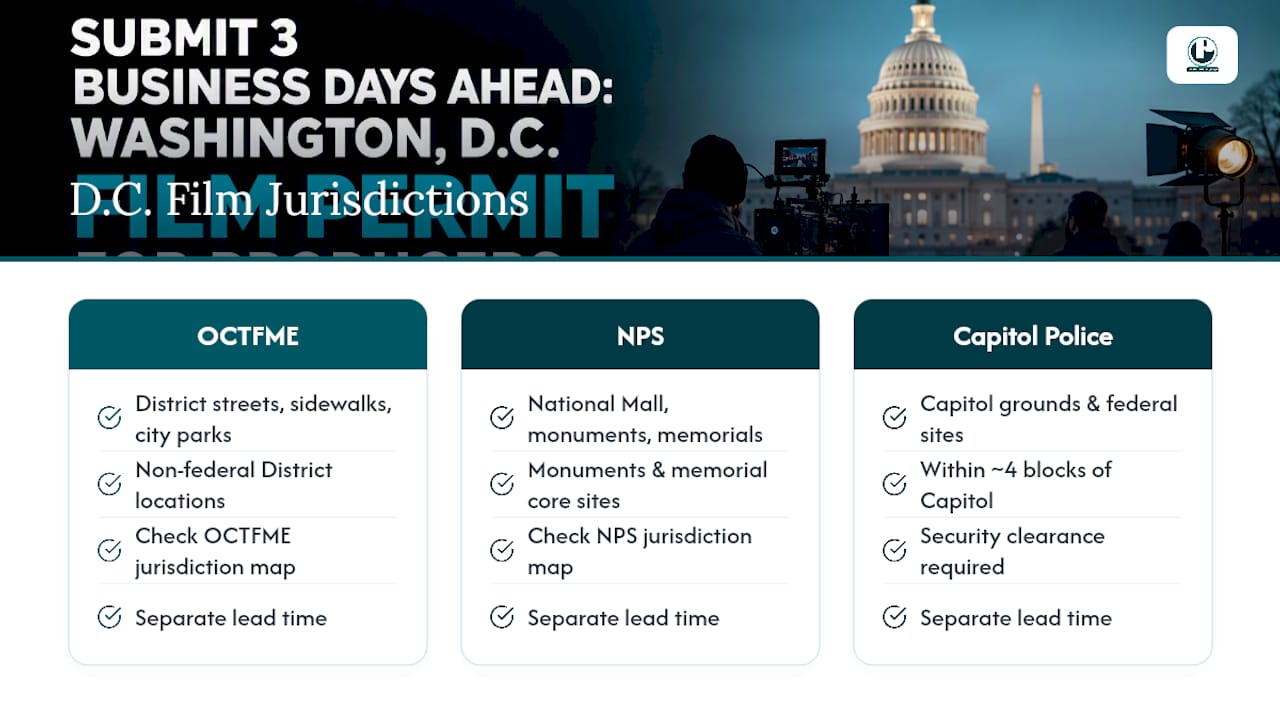
OCTFME handles the District’s public space, meaning sidewalks, streets, and city parks that fall outside federal control. Its permit is broad by design. One approval can cover multiple District locations across your shoot days, which saves you from filing a fresh application every time your unit moves three blocks.
National Park Service governs the National Mall and Memorial Parks, along with monuments and memorials scattered throughout the city. NPS draws a hard line between casual visitor photography, which needs no permit, and professional or commercial filming, which does. Many memorials also restrict tripods and other supporting gear even for small crews.
Capitol Police and other federal building managers control the grounds and buildings immediately surrounding the Capitol complex. Their approval process runs independently of both OCTFME and NPS, with its own security review.
Get the agency wrong, and you’re not just delayed. You’re unpermitted on someone else’s land.
How Do You Know Which Agency to Apply To?
A few rules of thumb save you a lot of guesswork. If your location is a monument, memorial, or sits inside the boundaries of National Mall and Memorial Parks, apply to NPS. If you’re within roughly four blocks of the Capitol building, expect Capitol Police jurisdiction and their own security clearance process. Everything else on District streets, sidewalks, or city-run parks falls under OCTFME.
Jurisdiction maps published by NPS and OCTFME make the boundaries visible, and it’s worth pulling both up before you lock your shot list. The line between federal and District land isn’t always obvious on the ground. A location that looks like a city park can sit on federal turf, and vice versa.
Mixed-jurisdiction shoots are common in D.C., especially for anything touching the monuments core. If your day covers a Capitol-adjacent exterior in the morning and a District sidewalk scene in the afternoon, you apply to each authority that controls the specific ground you’ll use. There’s no single master permit that spans all three. Budget separate lead times for each application, since they don’t process on the same clock.
How to Apply for a DC Film Permit, Step by Step
The application itself is straightforward, but the details inside it are where most producers lose time. Here’s the order that works:
Fill out the OCTFME application with precise block ranges for every location, not neighborhood names or general cross streets.
List exact prep and strike times, not just the shooting window. OCTFME wants the full occupancy footprint.
Provide complete contact information for the production, including an on-set point of contact reachable by phone during the permitted window.
Attach a written safety plan and name a designated safety compliance officer responsible for on-set conditions.
Attach an original Certificate of Insurance naming the Government of the District of Columbia as additional insured, or a signed student project letter if you qualify for that exemption.
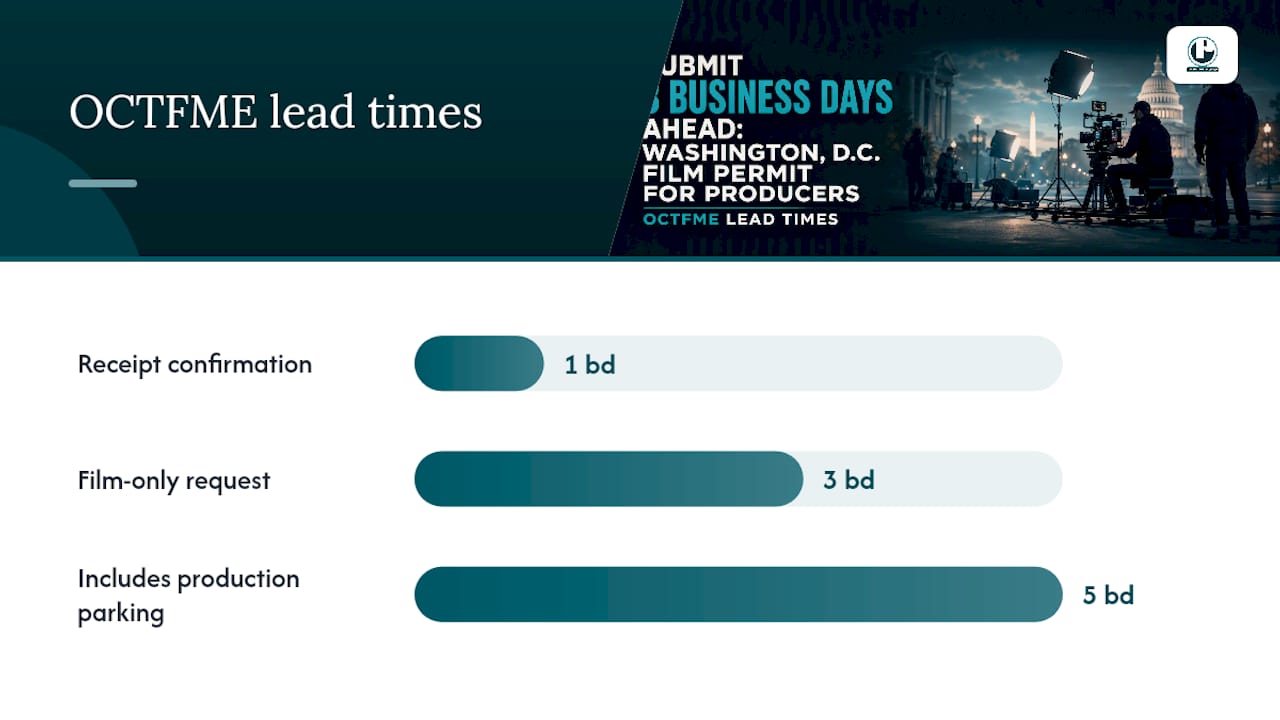
Submit to film@dc.gov and watch for acknowledgment. OCTFME typically confirms receipt within about a day.
Track the processing clock: film-only requests need submission at least three business days before your first shoot day, while any request including production parking needs five business days.
If your shoot involves street closures, traffic control, or police support, flag it clearly in the application. OCTFME routes those requests to other District safety agencies, and that coordination adds real processing time on top of the standard window.
Pro Tip: Submit before noon on a weekday. Applications received after 12:00 pm, on weekends, or on a holiday get treated as arriving the next business day, which quietly eats into your lead time without you noticing until it’s too late.
What Does a DC Film Permit Cost?
OCTFME’s fee structure scales with your production’s footprint, not a flat rate for every shoot.
Application fee: $30, due when you submit
Film permit fee: ranges from $150 for crews under 10 people on the first day up to $600 for productions with more than 70 cast and crew, with per-project caps that limit total cost on multi-day shoots
Additional-day fees: apply on top of the first-day rate for each extra day of occupancy
Payment timing: you pay only after approval, through an invoice link that accepts MasterCard and Visa; in-person cashier payment exists but moves slower than the online option
On insurance, OCTFME requires a general liability insurance policy that names the Government of the District of Columbia as additional insured, with minimum coverage amounts specified by the agency. Student productions may substitute a signed letter from an instructor or department head on school letterhead instead of a full Certificate of Insurance.
Which Activities Trigger Special Permit Approvals?
Certain elements push your application into a longer, more detailed review. Know these before you submit, not after you get a rejection notice.
Aerial and drone work needs an OCTFME support letter, and separately, FAA authorization or a Part 107 waiver may still apply. Start this process early since the airspace approval runs on its own timeline outside D.C.'s permit office.
Weapons, gunfire, or pyrotechnics require a detailed scene description, not a vague mention in your synopsis. Describe the prop type, the blank load if firearms are involved, and how the effect will be executed safely.
Minors on set and student productions accept alternative documentation, including that instructor letter in place of insurance, but the safety plan requirement doesn’t relax just because the crew is smaller.
Vehicle-mounted camera rigs need a schematic showing the mount and any protruding equipment, and depending on speed and location, may require uniformed police support to manage surrounding traffic.
What Safety and Police Support Does Your Permit Require?
Every OCTFME permit carries an operational baseline you’re expected to meet on the day. You need a named safety compliance officer on-site, and your written safety plan should match what actually happens on set. A permit that describes a static interview and a set that turns into a chase scene is a fast way to get shut down mid-day.
When your shoot needs traffic control, street closures, or uniformed presence, that request typically routes through the Metropolitan Police Department Special Operations Division. Identify the exact lanes, crosswalks, meter numbers, and bus zones affected. That level of specificity is what internal reviewers at DDOT and MPD actually check against before signing off, and vague descriptions get bounced back for clarification.
Temporary structures, from lighting rigs to tented staging areas, also need to be flagged during prep and strike windows so pedestrian flow isn’t disrupted without warning.
What Mistakes Delay a DC Film Permit Application?
Most delays trace back to the same handful of avoidable errors. Fix these before you hit submit:
Don’t write “TBD” anywhere. Exact block ranges, addresses, and prep/strike times are non-negotiable. Vague entries get returned for correction, and that resets your clock.
Double-check your insurance language. The Government of the District of Columbia needs to appear as additional insured, verbatim, not just referenced generically.
Write complete scene descriptions for anything involving weapons, special effects, or vehicle rigs. A one-line summary won’t satisfy the safety review.
Respect the submission cutoff. Remember the noon rule, and don’t submit on a weekend expecting same-day processing.
Follow up if confirmation doesn’t arrive within a day or two. Silence usually means something in your application needs attention, not that it’s quietly moving forward.
Pro Tip: Producers who supply exact meter numbers and parking details alongside their location description almost always clear review faster, because that’s the same information DDOT needs and you’ve already handed it to them.
Who Actually Needs a Film Permit in Washington, D.C.?
The commercial versus personal distinction is where a lot of confusion starts, and it’s worth being precise about it. If you’re filming for a client, a brand, a broadcast outlet, a documentary intended for distribution, or any project generating revenue, you need a permit. That’s true whether you’re a two-person crew with a mirrorless camera or a full unit with grip trucks and a generator.
Personal, non-commercial use, like a tourist filming a vacation video with a phone, generally doesn’t require a permit under District rules. The line gets fuzzier once you add a tripod, additional crew, or anything that occupies public space beyond a person standing on a sidewalk. NPS in particular treats group size as a trigger, and activity involving more than eight people or any exclusive use of a monument area typically needs a permit even without a big production budget.
Student projects sit in a middle ground. OCTFME accommodates them with the instructor letter option instead of full insurance, recognizing that a film school thesis project doesn’t carry the same liability profile as a commercial shoot. But the underlying requirement doesn’t disappear. Student crews on public D.C. property still need to apply, still need a safety plan, and still need to respect the same block-range specificity everyone else does.
If you’re unsure which category your project falls into, OCTFME’s Film Permit FAQ covers most of the edge cases, and a phone call to their office before you submit is faster than guessing wrong.
Get an Experienced Local Crew to Handle the Paperwork
There’s a version of this process where you do it all yourself: reading jurisdiction maps, drafting a safety plan from scratch, chasing down a Certificate of Insurance with the right additional-insured language, and hoping your block ranges are specific enough on the first try. It works, but it eats days you’d rather spend prepping the actual shoot. Experienced production companies have spent years producing video across the D.C. metro area, and permit logistics are a core part of the production process rather than an afterthought.
When you hire a local production company, they can manage the permit application, coordinate insurance requirements, assign a safety compliance officer, and handle on-the-ground logistics so your crew arrives at a cleared location. Our virtual events case study shows the kind of multi-location coordination we handle regularly for clients who don’t have the bandwidth to manage jurisdiction paperwork on top of everything else.
Hiring a local partner makes the most sense for larger shoots, anything touching federal or Capitol jurisdiction where mistakes carry real consequences, or productions working against a tight timeline that can’t absorb a permit rejection. If that sounds like your project, browse our music video production work and reach out for a quote before you lock your shoot dates.
Official DC Film Permit Resources
NPS National Mall filming permits and Superintendent’s Compendium
Contact: film@dc.gov, or view fee and payment details
Sources
FAQ
What do you need to get a film permit in D.C.?
You need a completed OCTFME application with exact location and time details, a written safety plan, a named safety compliance officer, and either a Certificate of Insurance naming the Government of the District of Columbia as additional insured or a qualifying student project letter.
Can you film in D.C. without a permit?
Casual, non-commercial filming, like a visitor recording with a phone, generally doesn’t need a permit, but any organized, commercial, or crew-based production on public space does, and NPS-managed sites often require one even for small groups using tripods.
How much does a DC film permit cost?
The application fee is $30, and film permit fees range from $150 for productions with fewer than 10 cast and crew on the first day up to $600 for crews over 70, with additional-day charges and per-project caps on top.
How long does it take to get a DC film permit?
Film-only requests need submission at least three business days before your first shoot day, while requests that include production parking need five business days, and applications submitted after noon or on a weekend count as received the next business day.
What if my shoot spans D.C. streets and a federal monument?
You apply separately to each agency controlling the ground you’ll use. OCTFME covers District streets and parks, while the National Park Service covers monuments and memorial grounds, and there’s no single combined permit across both.
Recommended
Comments