

Video Marketing Campaign Workflow: Your 2026 Launch Guide
- Charlie Puritano
- 1 minute ago
- 9 min read

A launch video marketing campaign workflow is a phased, modular process that takes a video from strategic concept to measurable results across a defined 12–16 week timeline. 87% of businesses now use video marketing, yet most campaigns underperform because teams skip the structural discipline that separates a launch from a real campaign. The difference is not budget or talent. It is process. A well-built video content workflow gives you repeatable results, faster creative testing, and a clear path from first concept to post-launch optimization.
What are the essential phases of a launch video marketing campaign workflow?
A successful campaign timeline runs 12–16 weeks across four mandatory phases, each with a hard gate review before the next phase begins. Skipping those gate reviews is the single most common reason campaigns fail at launch.
Phase 1: Strategy and positioning (weeks 1–3)

This phase produces three deliverables: a positioning brief, a messaging hierarchy, and a channel plan. The positioning brief defines who you are talking to, what problem you solve, and why your offer wins. The messaging hierarchy ranks your key claims so every video script pulls from the same source of truth. The channel plan maps each video format to the right platform before a single frame is shot.
Phase 2: Creative production (weeks 4–7)
The production brief goes out no later than week 2, even though shooting starts in week 4. Quality 30-second videos require 3–5 weeks of scripting, shooting, and editing. Starting late creates a bottleneck that compresses every downstream phase. This is where most marketing teams lose control of their timeline.
Phase 3: Pre-launch activation (weeks 8–11)
Pre-launch is where you build the audience before the campaign goes live. Tactics include email list building, influencer seeding, paid social warm-up, and PR outreach. You can find a detailed breakdown of pre-launch content tactics that work specifically for video-led campaigns. The goal is to arrive at launch week with a warm audience already primed to act.
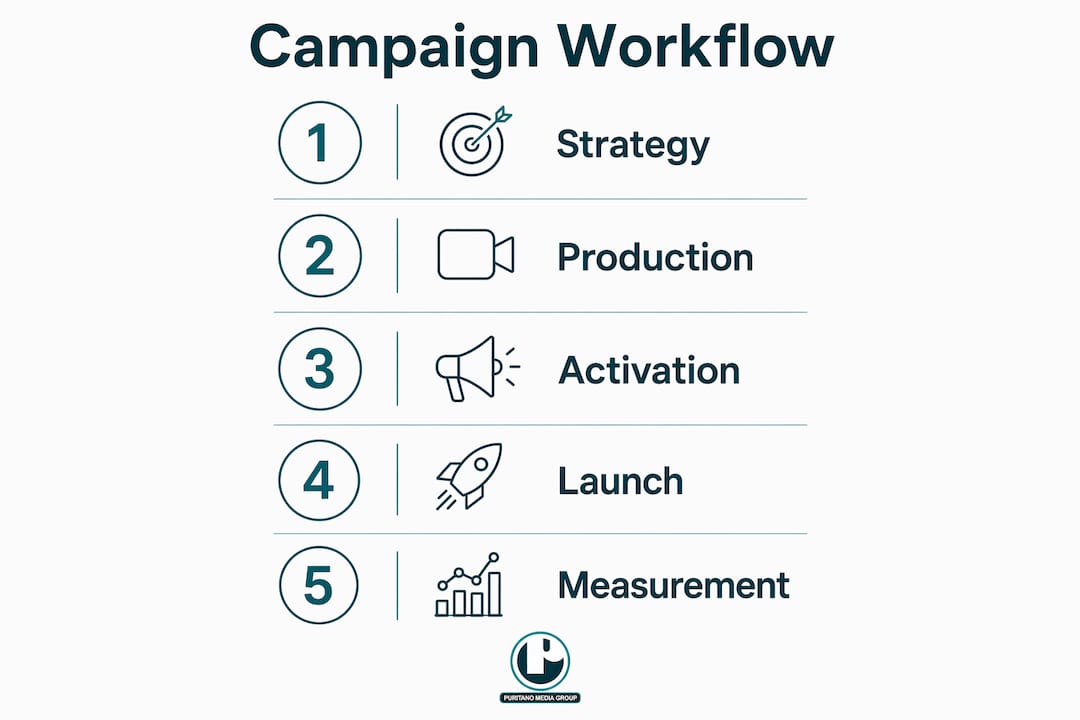
Phase 4: Launch and post-launch measurement (weeks 12–16)
Launch week runs on a daily cadence: publish, monitor, adjust. Post-launch shifts to weekly and monthly reviews focused on what the data tells you to change. This phase is not the end of the campaign. It is the beginning of the learning loop.
Pro Tip: Set a hard gate at the end of each phase. If the deliverables are not complete and approved, do not move forward. One week of delay here saves three weeks of rework later.
Confirm positioning brief is signed off before any script is written.
Confirm production assets are locked before pre-launch activation begins.
Confirm tracking is verified before launch week starts.
How does a modular video content workflow improve campaign performance?
Modular video workflows improve launch success rates by 30% compared to linear scripting. That number reflects a real structural advantage: modular workflows let you test individual components without reshooting entire videos.
A modular video is built from three separable parts.
Hook: The first 3–5 seconds. This is the only part that determines whether someone keeps watching.
Body: The core message, demonstration, or proof point. This section carries the argument.
CTA (call to action): The closing instruction. This drives the conversion behavior you want.
Linear scripting locks all three together. If the hook fails, you reshoot everything. Modular production separates them so you can swap a hook without touching the body or CTA.
The testing sequence matters. Run hook tests first across your paid social warm-up audience. Identify the top two performers by engagement rate. Then test body variations against those winning hooks. Finally, test CTA variations against the winning hook-body combinations. This sequence prevents muddy test designs where multiple variables change at once and you cannot tell what drove the result.
High-performing video ads target engagement rates above 2.5%, click-through rates between 1%–3%, and return on ad spend above 3x within the first 7 days. These benchmarks tell you when to scale a winning combination and when to cut a losing one before it drains budget.
Pro Tip: Pace your rollout by audience intent. Warm audiences who already know your brand can handle a direct CTA in the body. Cold audiences need the hook and body to do more work before the CTA lands.
The asset management side of a modular workflow requires discipline. Tag every clip by component type, product, and intended platform at ingestion. AI-assisted tagging tools speed this up considerably. Without clean tagging, your asset library becomes unusable within two campaigns.
What are the best practices for aligning video content to buyer journey stages?
Video content aligned to funnel stages follows a 60/25/15% split: 60% awareness content, 25% consideration content, and 15% conversion content. Most teams invert this ratio by accident. They produce too many conversion videos and not enough content to build the audience that will watch them.
Understanding your buyer personas before you assign video types to funnel stages saves significant rework. Persona clarity determines which proof points belong in consideration content versus which belong in conversion content.
Awareness stage (60% of output)
Educational videos that solve a specific problem your audience already has
Short-form social content that introduces your brand without asking for anything
Thought leadership content distributed through organic social and paid reach campaigns
Consideration stage (25% of output)
Product demos that show the mechanism, not just the outcome
Customer testimonials that address the specific objections your audience raises
Comparison content that positions your offer against the category, not individual competitors
Conversion stage (15% of output)
Direct response videos with a single, clear CTA
Retargeting videos that reference what the viewer already watched or clicked
Landing page videos that reinforce the offer and reduce friction at the point of decision
The video content funnel works best when distribution matches stage intent. Awareness content belongs on social feeds and YouTube pre-roll. Consideration content belongs in email nurture sequences and retargeting campaigns. Conversion content belongs on landing pages and in cart abandonment flows.
Funnel stage | Primary metric | Distribution channel |
Awareness | View rate, reach | Paid social, organic video |
Consideration | Engagement rate, CTR | Email nurture, retargeting |
Conversion | Conversion rate, ROAS | Landing pages, cart flows |
How to implement tracking and measurement for your video campaigns
Tracking is not optional. It is the mechanism that turns a campaign into a learning loop. A reliable tracking setup expects 10–15% data discrepancies between platforms and your CRM. A discrepancy above 40% signals a broken setup that needs immediate resolution before you make any budget decisions.
The core KPIs to track by channel:
Paid social: Engagement rate, video completion rate, CTR, cost per click, ROAS
Email: Open rate, click-to-open rate, video play rate, conversion rate
Landing pages: Time on page, video play rate, form completion rate, bounce rate
Organic video: Watch time, subscriber growth, shares, comment sentiment
Document every tag, conversion event, and UTM parameter in a central tracking document. This single source of truth prevents the conflicted data that derails optimization decisions. When two team members pull different numbers from different platforms, the problem is almost always missing or inconsistent UTM parameters.
Pro Tip: Run a full tracking audit 48 hours before launch week begins. Fire every conversion event in a test environment and confirm it registers correctly in your analytics platform and CRM before any real traffic hits the page.
The measurement cadence should match the campaign phase. During launch week, review data daily. After launch week, shift to weekly reviews focused on component performance. Monthly reviews should assess whether the overall campaign is hitting its ROAS and conversion targets, and whether the creative needs a full refresh.
What are common mistakes to avoid when launching video campaigns?
The most damaging mistakes happen before launch week, not during it. Late video production starts create a cascade of compressed timelines that force teams to skip gate reviews and ship undercooked creative.
Starting production in week 4 or later without a signed brief from week 2 is the most common bottleneck.
Skipping hard gate reviews between phases lets unresolved problems compound across the campaign.
Poor asset management without consistent tagging makes modular testing impossible at scale.
Muddy test designs that change multiple variables at once produce data you cannot act on.
Using standard YouTube embeds on landing pages hurts load speed and leaks traffic. Dedicated CDN hosting improves load times, user experience, and SEO performance for video campaigns.
A connected workflow with a consistent publishing schedule improves output quality and engagement by enabling fast iterations and data-driven decisions. Inconsistent publishing breaks the audience momentum you built during pre-launch activation.
When engagement rates fall below 2.5% or CTR drops below 1%, the fix is almost always in the hook. Start there before touching the body or CTA. If conversion rates are low despite strong engagement, the problem is usually in the CTA or the landing page, not the video itself. Isolate the variable before you change anything.
“Launch is not the campaign endpoint. It is the beginning of a learning loop where iterative, data-driven changes improve performance with every cycle. Teams that treat launch as a finish line miss the compounding gains that come from disciplined post-launch iteration.”
For creative refresh, set a trigger rather than a calendar date. When engagement rates drop 20% below their peak for two consecutive weeks, that is your signal to introduce new hooks. Refreshing creative on a fixed schedule wastes budget when existing content is still performing.
Key Takeaways
A structured, modular launch video marketing campaign workflow is the single most reliable way to improve campaign performance, reduce rework, and build measurable results across every funnel stage.
Point | Details |
Follow the 12–16 week timeline | Run four mandatory phases with hard gate reviews to prevent compounding failures. |
Start production by week 2 | Issue the production brief early; quality video needs 3–5 weeks to complete. |
Use modular video structure | Separate hooks, bodies, and CTAs to enable rapid testing without full reshoots. |
Align content to funnel stages | Use the 60/25/15% split across awareness, consideration, and conversion content. |
Audit tracking before launch | Resolve discrepancies above 15% before launch week to protect data integrity. |
What I’ve learned after two decades of video campaign work
Here is the uncomfortable truth about video marketing: most campaigns fail in the planning phase, not the production phase. Teams spend weeks debating creative concepts while the production clock runs out. By the time the brief is finalized, there is no time left for the 3–5 week production cycle, so everything gets rushed and the creative suffers.
The discipline that actually moves the needle is positional clarity in week one. When you know exactly who you are talking to and what single claim you need them to believe, every downstream decision gets faster and cheaper. Script reviews take 20 minutes instead of two hours. Editing rounds drop from five to two. The positioning brief is not a bureaucratic document. It is the most valuable hour you will spend on the entire campaign.
I have also seen teams treat the post-launch phase as a wind-down. They ship the campaign, watch the dashboard for a week, and move on to the next project. That is where the real money gets left on the table. The ROI gains from corporate video campaigns compound when you treat post-launch data as the input for your next creative cycle. The teams that win consistently are the ones who build a learning loop, not a launch event.
Modular workflows are not just a production technique. They are an organizational habit. Once your team internalizes the hook-body-CTA structure, briefing gets faster, testing gets cleaner, and creative decisions become data-driven rather than opinion-driven. That shift alone is worth more than any single campaign result.
How Puritano can support your next video campaign
Puritano Media Group has spent over two decades producing video content that performs across every stage of the marketing funnel, from music video production to virtual event coverage and branded campaign content. The team brings the same phased discipline described in this guide to every project: clear positioning, production timelines that respect the creative process, and deliverables built for testing and iteration. If you are ready to move from ad hoc video production to a repeatable campaign workflow, Puritano is the production partner that understands both the creative and the operational sides of what makes a launch work.
FAQ
What is a video marketing campaign workflow?
A video marketing campaign workflow is a structured, phased process covering strategy, production, pre-launch activation, and post-launch measurement. The standard timeline runs 12–16 weeks with gate reviews between each phase.
How long does video production take for a campaign?
Quality 30-second campaign videos require 3–5 weeks, including scripting, shooting, and editing. The production brief should go out by week 2 at the latest to avoid timeline bottlenecks.
What is a modular video workflow?
A modular video workflow separates a video into three independently testable components: the hook, the body, and the CTA. This structure allows teams to test and swap individual elements without reshooting the entire video.
How should I split video content across the funnel?
The recommended split is 60% awareness content, 25% consideration content, and 15% conversion content. Most teams produce too many conversion videos and not enough content to build the audience that will watch them.
What tracking discrepancy is acceptable between platforms?
A discrepancy of 10–15% between platform data and your CRM is normal. Any discrepancy above 40% signals a broken tracking configuration that needs to be resolved before you make budget decisions.
Recommended