

How to Make a Documentary for Your Organization
- Charlie Puritano
- 1 day ago
- 8 min read
Commission a full-service production company and give them a clear project brief that defines your objective, audience, core message, key characters, and distribution plan. That single document does more to protect your budget and timeline than any contract clause. From there, three actions immediately move the project forward:
Draft a one-page brief covering objective, audience, core message, story summary, key interview subjects, desired run length, distribution platforms, timeline, and initial budget range.
Request portfolio samples and references from at least two or three production companies whose work reflects your sector (nonprofit, government, corporate).
Schedule a scoping call and ask specifically for a treatment outline, a rough timeline, a ballpark budget range, and references from comparable organizational projects.
Pro Tip: Ask every candidate what questions they have about your mission before they pitch you on their gear. A production company that leads with smart story questions is a far better sign than one that leads with camera specs.
What does the documentary production process actually look like?
Documentary film production for organizations moves through five phases. Knowing who owns each one keeps the project on schedule.
Development is where the production company absorbs your brief, conducts research, and builds a treatment. The treatment is the most important document in the commission because it locks in narrative structure, interview subjects, locations, and visual approach before a single shoot day is scheduled. Budget estimates flow directly from it.
Pre-production covers scheduling, location scouting, crew planning, release forms, and logistics. Your team’s job here is to facilitate access: connect the crew to interview subjects, flag any sensitive locations, and confirm your internal approval chain.
Production is shoot days. Smaller, respectful crews using compact professional equipment consistently produce more authentic on-camera moments than large intrusive rigs. Plan for b-roll capture alongside interviews, and decide in advance whether a communications team member will attend each shoot.

Post-production runs from assembly edit through rough cut, revisions, sound design, color grading, captioning, and final masters. This is where your review checkpoints matter most.
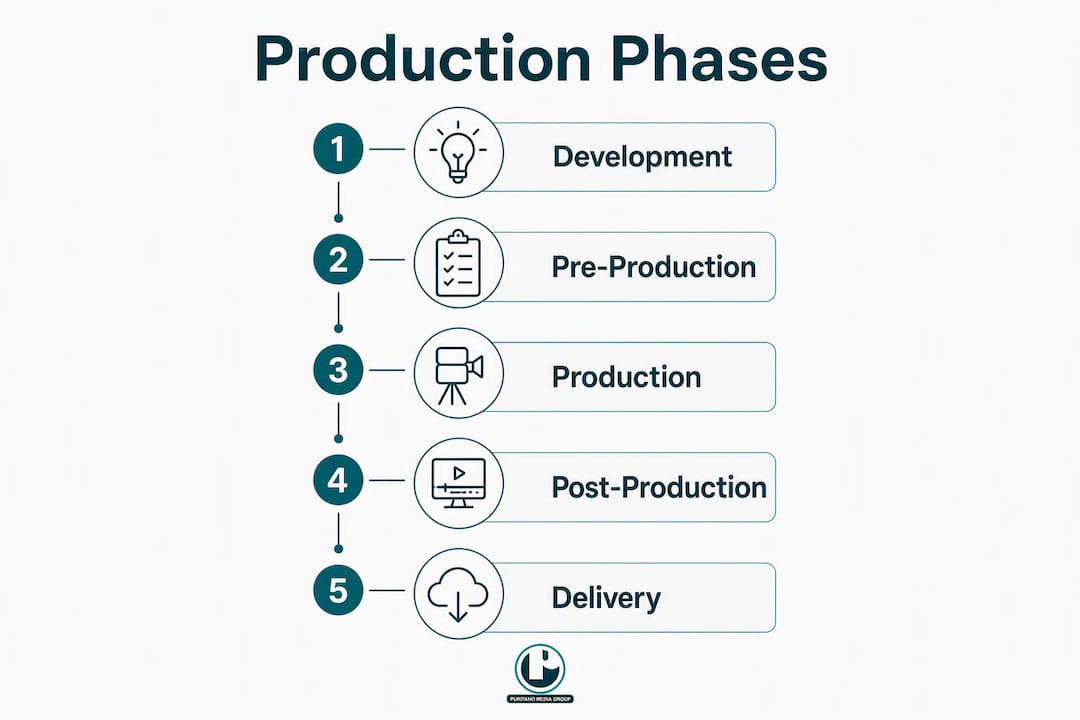
Delivery includes the final master file, mezzanine copy, social cuts, caption files (SRT), transcripts, and any behind-the-scenes stills. Nail down the full deliverables list before signing the contract, not after.
How do you write a project brief that actually works?
A well-written brief is the difference between a production company that pitches you a generic concept and one that proposes something genuinely shaped around your mission. Include these fields and you will attract the right partners:
Project objective — what the film must accomplish (raise awareness, drive donations, support a grant application, train staff).
Target audience — who will watch it and where.
Core message — the single idea viewers should carry away.
Story summary — two to three sentences on the narrative you envision.
Key characters/interview subjects — names or roles of the people whose voices anchor the story.
Desired run length and versions — flagship cut plus any social edits.
Distribution plan — platforms, events, broadcast, or internal use.
Timeline — hard deadlines and preferred delivery date.
Initial budget range — even a broad range helps production companies self-select appropriately.
What not to prescribe: shot lists, rigid scripts, or specific camera angles. Define the problem and the outcome you need; let the production company propose the narrative approach. That creative latitude is what separates a documentary from a scripted corporate video.
Brief checklist before you send it:
Existing brand assets and guidelines attached
Sample editorial tone or reference films included
Internal contact list and decision-maker identified
Approval process and number of revision rounds stated
Any access restrictions or sensitive subject matter flagged
Pro Tip: Read Puritano’s guide on writing a video production brief before your first draft. It includes a template that maps directly to the fields above.
How should your team collaborate during production?
The organizations that get the best films are the ones that stay involved at the right moments without micromanaging the creative process. Marketing and communications teams should plan to attend key shoots and rough-cut reviews to keep messaging aligned while preserving the filmmaker’s editorial space.
The key checkpoints are: scoping call, treatment approval, pre-shoot readout, interview attendance (observer role, not director), rough-cut review, and final approval. Limit formal revision rounds to two or three, and always deliver consolidated written feedback rather than scattered verbal notes. A single document from one decision-maker is worth ten email threads from five stakeholders.
On set, your role is to observe and be available for factual corrections, not to redirect the interview. If a subject says something factually wrong, flag it to the director quietly. If the story is going somewhere unexpected but honest, let it. That tension is often where the best documentary moments live.
What should you budget and how long will it take?
For organizational documentary film production in the U.S., budgets for mission films typically range from $3,000 for a lean single-day shoot to $15,000+ for a cinematic multi-day production. Many nonprofits find their sweet spot at $5,000–$8,000, which delivers professional production value without overextending.
Project type | Typical budget range | Approximate timeline |
Lean single-subject film (1–3 min) | $3,000–$5,000 | several weeks |
Mid-range mission/brand documentary (5 min) | $5,000–$8,000 | multiple weeks |
Cinematic multi-location documentary (15+ min) | $8,000–$15,000+ | extended timeline |
Broadcast distribution adds cost: broadcast-spec color grading, audio mixing to spec, and closed-caption files all require additional post-production time. Web and social deliverables are less expensive but still need to be scoped explicitly.
Standard deliverables to negotiate into every contract:
High-resolution master (ProRes or DNxHR)
Mezzanine copy for archival
H.264/H.265 compressed web deliverable
Social cuts (60s, 30s, 15s)
Vertical versions for mobile/social where needed
SRT caption file and full transcript
Behind-the-scenes stills
How do you evaluate and choose the right production partner?
Prioritize storytelling depth, documentary experience, transparent pricing, and a clear pre-production process that includes treatments. A portfolio full of commercial spots with no documentary-style samples is a red flag. So is opaque pricing, no references, or reluctance to discuss rights and revision terms upfront.
A great production partner asks smart questions about your mission, audience, and goals rather than leading with equipment lists. Pay attention to how they listen in the scoping call.
Questions to ask every candidate:
Can you share a treatment from a comparable organizational project?
What does your revision process look like, and how many rounds are included?
Who owns the footage and final files after delivery?
What insurance do you carry, and can you provide a certificate of insurance?
Can you provide two references from nonprofit, government, or corporate clients?
Use a simple scorecard to compare proposals across storytelling quality, process clarity, budget transparency, and reference quality. Digital storytelling that builds brand authority depends on narrative depth, and your vendor evaluation should weight that heavily.
What legal and logistical items must you resolve before shooting?
The production company should carry general liability and equipment insurance. Request a certificate of insurance before any shoot day, particularly for government facilities or locations with permit requirements.
Pre-production legal checklist:
Signed talent release forms for every interview subject and identifiable on-screen person
Location permits obtained and confirmed in writing
Consent protocols documented for any vulnerable populations or minors (obtain releases before filming, not after)
Music licensing or original score confirmed
Usage rights negotiated as perpetual and platform-agnostic where your distribution plan requires it
Revision rounds and creative control clauses written explicitly into the contract
Projects involving vulnerable populations require additional ethical protocols and extra pre-production time. Build that buffer into your schedule. Rushing consent processes creates legal exposure and damages trust with the communities you are trying to represent.
Pro Tip: Booking a documentary shoot in the Washington, D.C. region involves specific permit considerations for federal and public spaces. Confirm permit requirements at least four weeks before your shoot date.
Accessibility is not optional. Captions and transcripts are required for many government and nonprofit communications under Section 508 and the ADA. Include them in your deliverables list from day one.
How should you plan deliverables for different distribution channels?
Distribution goals shape edit structure, deliverables, and budget allocation from the start. Decide where the film will live before pre-production, not after the rough cut is locked.
A practical sequencing approach: flagship film first, then an event cut (typically 3–5 minutes for conference or gala use), then 60/30/15-second social cuts, then vertical versions for Instagram Reels or TikTok if your audience is there. Each version should be scoped in the original contract so the editor builds with those cuts in mind from the assembly stage.
Broadcast requires specific codec and audio specs (often ProRes 4444 or DNxHD, stereo and 5.1 audio mixes). Web masters compress to H.264 or H.265. Social cuts need burned-in captions because most platforms autoplay without sound. Include metadata, stills, and cut-down files in the scope so you can repurpose the asset for years without returning to the production company for new exports. For more on channel-specific distribution strategy, plan those decisions alongside your deliverables list.
Key Takeaways
A clear project brief is the single most important step an organization can take before commissioning a documentary production.
Point | Details |
Start with a strong brief | Include objective, audience, core message, story summary, key characters, distribution plan, and budget range. |
Budget realistically | U.S. mission films range from $3,000 to $15,000+; the $5,000–$8,000 range covers most nonprofit needs. |
Govern reviews carefully | Limit formal revision rounds to two or three and deliver consolidated written feedback from one decision-maker. |
Lock legal items early | Secure talent releases, location permits, insurance certificates, and usage rights before any shoot day. |
Puritano as your partner | Puritano brings over two decades of full-service production experience across nonprofit, government, and corporate documentary work. |
What the production side actually looks like from inside the room
Most organizations come to a documentary commission with a clear message and genuine uncertainty about how much creative latitude to give the production company. Here is my honest take: the organizations that try to control the narrative too tightly almost always end up with a film that feels like a press release. The ones that brief well, hire well, and then step back at the right moments end up with something people actually watch.
The treatment review is where that balance gets set. If the production company’s treatment surprises you a little, that is usually a good sign. It means they found an angle you had not considered. Your job at that stage is to check it against your mission and your facts, not to rewrite it into something safe.
Government and nonprofit work carries an added layer of responsibility. The people on camera are often representing communities, not just organizations. That means the ethical protocols around consent and representation are not bureaucratic box-checking. They are the foundation of a film that holds up over time.
We have seen firsthand at Puritano that the projects with the most impact tend to share one trait: the client trusted the story enough to let it breathe. Strong storytelling is what transforms a corporate video into something that actually moves people, and documentaries live or die on that distinction.
Puritano is built for exactly this kind of project
Organizations that need to produce a documentary film with real credibility, not just polished footage, need a production partner with documentary-specific experience across nonprofit, government, and corporate work. Puritano Media Group brings over two decades of full-service production to every engagement: development, pre-production, shoot days, post-production, and delivery of the full deliverables package your distribution plan requires.
What to request in your scoping call: treatment examples from comparable projects, a sample budget breakdown, references from at least two organizational clients, and a proposed timeline from brief to delivery.
Browse Puritano’s production portfolio to see the range of creative execution, then contact the team to schedule a scoping conversation. Bring your one-page brief and walk away with a realistic treatment, timeline, and budget range.
Useful sources and further reading
What Is a Video Production Brief: Template for Project Owners — Puritano: Practical brief template with field-by-field guidance for organizational buyers.
How to Brief a Video Production Team Like a Pro — Puritano: Deeper briefing guidance with real examples for communications teams.
Community Impact Video Storytelling Guide for Nonprofits — Puritano: Mission-driven storytelling approaches and ethical considerations for nonprofit productions.
The Complete Guide to Producing a Branded Documentary Shoot — Roo Smith: Covers brief structure, creative latitude, and the case for not over-prescribing execution.
What Marketing and Communications Teams Should Know Before Hiring a Documentary-Style Video Crew — Mott Visuals: Practical advice on crew size, on-set collaboration, and rough-cut review protocols.
How to Commission a Documentary for Your NGO — Astral Studios: Treatment-first commissioning process and consent protocols for vulnerable populations.
How to Plan a Mission Film for Your Nonprofit — Kolstad Media: U.S. budget ranges, vendor evaluation criteria, and the value of mission-aligned storytelling.
How to Hire a Documentary Film Production Company — Global Filmz Studios: Checklist for evaluating production partners on storytelling depth, process transparency, and distribution planning.
Recommended