

Web Site Videos: A Production Guide for Marketing Teams
Updated: Aug 4

Website videos are purpose-built video assets embedded in your site to drive a specific business outcome — brand awareness, lead generation, or conversion — and the single most important first step is to name that outcome before you brief anyone. Puritano Media Group works with marketing directors, communications teams, nonprofits, and government agencies across the U.S. to produce bespoke video assets built around exactly that kind of clarity. Before you pick a format or call a vendor, identify the one page or funnel the video will serve, define your audience, and write down your target metric. That’s your brief.
What types of web site videos should you use?
Matching format to goal is where most teams go wrong. Here’s a practical breakdown:
Homepage hero (30–60 seconds): Sets brand tone and drives time-on-site. Primary KPI: average session duration and bounce rate.
Explainer (60–120 seconds): Clarifies a product, service, or mission for mid-funnel visitors. KPI: scroll depth and demo requests.
Product or service demo (60–180 seconds): Shows the offering in action. KPI: conversion rate on the adjacent CTA.
Testimonial (30–90 seconds): Builds credibility with social proof. KPI: assisted conversions and form completions.
About/company culture (60–120 seconds): Supports recruiting and trust-building. KPI: career page engagement.
Landing-page CTA video (15–45 seconds): Reinforces a single offer. KPI: click-through rate on the primary CTA.
Background loop (15–30 seconds, muted): Adds visual energy without competing with copy. KPI: qualitative UX feedback and session depth.
Product carousel or feature highlight (15–30 seconds each): Supports e-commerce and SaaS product pages. KPI: add-to-cart or trial-start rate.
Short, purpose-driven videos with strong thumbnails consistently outperform longer, unfocused ones. Placement matters just as much as length — a testimonial buried in a footer converts far less than the same clip placed directly above a pricing table.
How does bespoke website video production actually work?
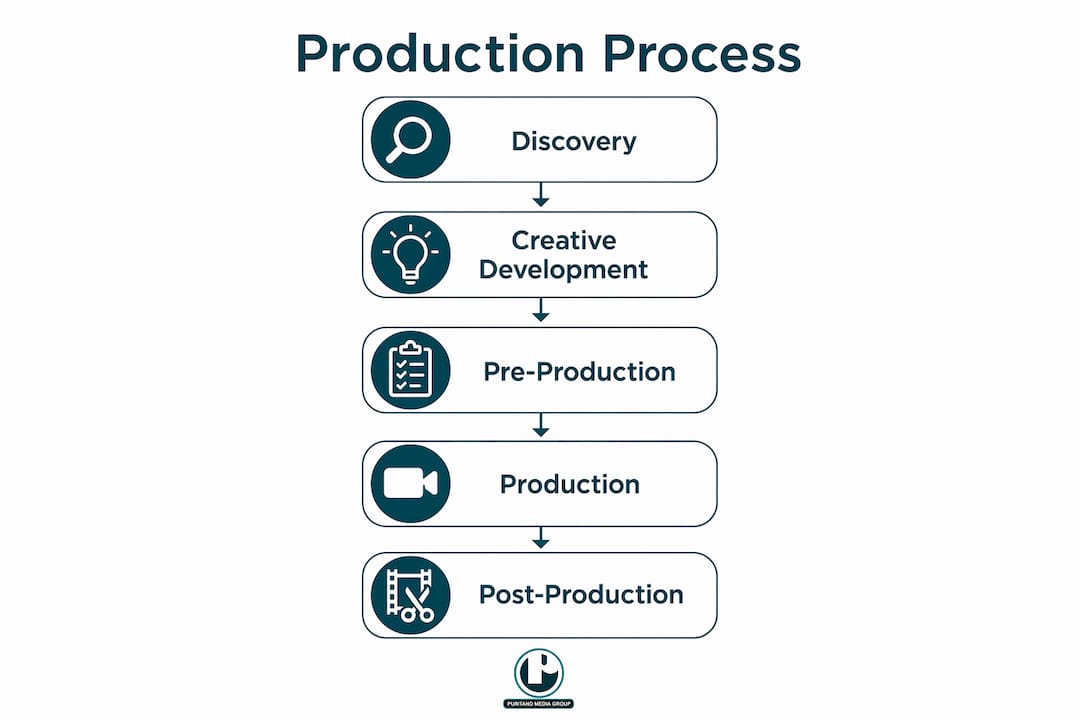
Bespoke production follows a clear sequence: discovery, creative development, pre-production, production, post-production, and delivery with revision rounds. Each phase has defined client actions and internal milestones, which is what separates a professional engagement from a rushed shoot.
Discovery covers audience analysis, messaging hierarchy, and success metrics. Creative development produces a script, shot list, and mood board for client approval. Pre-production locks locations, talent, crew, and schedule. Production is the shoot itself. Post-production covers editing, color, sound design, motion graphics, captions, and quality review. Delivery packages all final assets per agreed specs.
For a single hero or explainer video, a realistic schedule runs several weeks from signed contract to final delivery. Complex multi-location shoots or documentary-style case studies take longer. The full collaborative workflow — from goal-setting through strategic distribution — is what distinguishes bespoke production from automated tools that simply animate existing copy.
Pro Tip: Lock your internal reviewers before production starts. Scope creep almost always enters through revision rounds, not the shoot itself. Agree on the number of revision rounds in writing, name the decision-maker, and set a reasonable response window.
How do you link a website video to real business goals?
Define one primary business objective first, then select 2–3 KPIs to measure impact. A strategic video program ties format selection and measurement to revenue outcomes, not just view counts.
KPI | Why it matters | How to measure it |
View rate | Shows whether the video earns attention | Video platform analytics (YouTube, Vimeo, native player) |
Engagement rate | Reveals watch depth and content relevance | Average percentage viewed; drop-off reports |
Click-through rate | Measures CTA effectiveness | GA4 event tracking on linked buttons |
Conversion rate | Ties video directly to revenue | Goal completions in GA4; CRM attribution |
Assisted conversions | Shows video’s role in multi-touch journeys | Attribution reports in GA4 or your CRM |
Before launch, confirm that GA4 events are firing on play, 25%, 50%, 75%, and completion. Tag each video asset with UTM parameters when distributing across channels. For B2B sales funnels, assisted conversions often tell a more accurate story than last-click attribution alone.
What should you budget for bespoke website videos?
Price varies widely, and the honest answer is that scope drives cost more than any single line item. Here are the primary cost drivers:
Crew and equipment: Camera operators, directors, lighting, and audio add up fast on location.
Talent: On-camera spokespeople, voiceover artists, and actors carry separate fees and usage rights.
Locations: Permitted shoots, studio rentals, and travel all affect the bottom line.
Animation and motion graphics: Custom illustration and 2D/3D animation typically cost more per minute than live-action.
Revision rounds: Every unplanned round adds hours; agree on the number upfront.
Deliverable count: Multiple aspect ratios, cutdowns, and captioned versions multiply post-production time.
As a rough guide: entry-level bespoke explainers generally cost a few thousand dollars. Mid-range hero videos with professional talent and animation cost significantly more. High-end documentary-style or multi-location productions can be substantially more expensive. Government and nonprofit projects often have procurement requirements that affect timeline and payment structure — government video procurement follows different rules than a standard commercial engagement.
Where you can economize without hurting quality: consolidate shoot days, use existing locations, limit the number of on-camera talent, and plan cutdowns during pre-production rather than retrofitting them in post.
What deliverables and technical specs should your contract include?
A production contract should specify every deliverable before a single frame is shot. Standard deliverables include: a full-resolution master file, web-ready MP4 (H.264, 1080p minimum), WebM for broader browser compatibility, closed captions (SRT or VTT), a written transcript, a poster/thumbnail image, and at least one cutdown per agreed social format.
Deliverable | Format | Resolution | Notes |
Master file | ProRes or MP4 | 4K or 1080p | Archive copy; never compressed for web |
Web delivery | MP4 | 1080p | Primary embed format |
Browser fallback | WebM | 1080p | Required for full cross-browser support |
Captions | SRT / VTT | N/A | WCAG 2.1 AA compliance |
Transcript | Plain text or PDF | N/A | Accessibility and SEO |
Poster image | JPEG (progressive) | Match video dimensions | Shown before playback begins |
Social cutdowns | MP4 per platform spec | 1080x1080 or 9:16 | Square and vertical variants |
The HTML <video> element requires both MP4 and WebM source tags plus a poster attribute to maximize cross-browser playback. Captions are not optional for public-sector or federally funded projects — WCAG 2.1 AA compliance is a legal baseline, not a nice-to-have. Always request the poster image as a separate deliverable; it loads before the video and directly affects perceived page performance.
How do you repurpose one video into multiple assets?
Design your deliverables package with repurposing in mind from day one. A master file plus social cutdowns plus captions plus a thumbnail set gives you the raw material to distribute across every channel without a second shoot.
Create a 15–30 second social cut from the strongest 30 seconds of the master for LinkedIn, Instagram, and YouTube Shorts.
Export a square (1:1) version for Facebook and Instagram feed placements.
Pull a vertical (9:16) cut for Instagram Reels, TikTok, and YouTube Shorts.
Use still frames as social graphics, email headers, and blog thumbnails.
Embed the full video on the homepage or landing page and the short cut on product pages.
Add the transcript to the page for SEO and accessibility.
Include the short cut in email nurture sequences to re-engage mid-funnel contacts.
Host the master on Vimeo or YouTube and embed rather than self-host to reduce bandwidth costs and improve page load performance.
For detailed repurposing tactics, video content repurposing best practices covers platform-specific formatting and sequencing strategies.
When does bespoke production beat automated video tools?
Choose bespoke production when credibility, brand control, and long-term asset value are on the line. Automated tools fit lightweight, high-volume needs — social filler, internal updates, quick product announcements where brand risk is low.
The difference shows up most clearly in B2B and government contexts. An automated tool can animate your existing copy into motion graphics in minutes. What it cannot do is conduct a stakeholder interview, capture authentic location footage, or build the narrative arc that makes a case study feel trustworthy rather than templated.
Branded video quality affects how an organization is perceived long after the campaign ends. For a government agency or a national nonprofit, a poorly produced video is not neutral — it signals a lack of seriousness. Bespoke assets, treated as long-term content investments, consistently deliver higher ROI when repurposed across channels over 12–24 months.
How do you choose the right video production partner?
Prioritize demonstrable portfolio relevance, process clarity, and a measurement focus. A vendor who cannot explain how they’ll track success is a different animal from one who asks about your KPIs in the first conversation.
Does your portfolio include work in my sector (corporate, nonprofit, government)?
Walk me through your production workflow from brief to delivery.
Who owns the footage and final assets after delivery?
What is your revision policy, and how many rounds are included?
What is your typical timeline for a project of this scope?
Can you provide two or three client references from similar projects?
How do you handle scope changes mid-project?
Red flags to watch for: no client references, vague deliverable descriptions, pricing that shifts after the proposal, no written revision policy, and reluctance to specify who owns the raw footage. On the contract side, insist on: explicit usage rights and licensing terms, a full deliverable spec list, milestone-based payment schedule, and a defined revision round count. Full-service video partnerships that integrate strategy, production, and post under one roof tend to produce more consistent results than assembling a team piecemeal.
Why marketing teams hire Puritano Media Group
Puritano Media Group is a full-service video production company based in the Washington, D.C. metropolitan area, serving clients nationally across corporate, nonprofit, association, and government sectors. With over two decades of production experience, the team handles everything from discovery and scripting through shoot, post-production, and final delivery — including corporate videos, TV commercials, e-learning modules, live event coverage, social media content, and documentary-style case studies.
Puritano’s work spans the full range of organizational video needs: brand storytelling for national associations, training and compliance videos for government agencies, and high-production campaign content for marketing teams that need assets built to last — not just to fill a content calendar.
The Puritano portfolio demonstrates the range of creative and technical work the team produces. For nonprofits and associations, Puritano brings specific experience in video marketing for trade associations and mission-driven storytelling. To request a portfolio review or a scoped proposal, contact the team directly through the website.
Key Takeaways
Bespoke website video production delivers the highest long-term ROI when you define one clear business objective, match the format to that goal, and treat the final assets as a multi-channel investment from day one.
Point | Details |
Define the objective first | Name one business goal (awareness, leads, or conversions) before choosing a format or briefing a vendor. |
Match format to page type | Hero videos suit homepages (30–60s); demos and testimonials convert best on product and landing pages. |
Set KPIs before production | Track view rate, engagement rate, CTR, and conversion rate; use GA4 events and CRM attribution. |
Budget realistically | Entry-level bespoke explainers generally cost a few thousand dollars. High-end documentary-style or multi-location productions can be substantially more expensive, sometimes reaching tens of thousands of dollars depending on scope and production value. |
Puritano for bespoke production | Puritano Media Group serves business, nonprofit, and government clients nationally with full-service video production. |
What production teams wish you knew before you started
The most common mistake we see is treating video as a deliverable rather than a strategic asset. Teams rush to production without locking the audience, the CTA, or the success metric — and then wonder why the video doesn’t move the needle. The brief is the most important document in any project, and it costs nothing to get right.
Review discipline is the other one. Stakeholder feedback that arrives in three separate emails, two days apart, from four different people is a scope problem disguised as a communication problem. Name one decision-maker per review round and hold to it.
On the technical side: poster images are not optional. A video that loads as a blank black rectangle before playback starts looks broken, even when it isn’t. And muted autoplay is a technical requirement for background loops in modern browsers, not a creative choice. Plan for it in pre-production, not as a post-launch fix.
Pro Tip: Test your embedded video on mobile before launch. High-bitrate background videos that look great on desktop can tank page load speed on a 4G connection. Compress background loops aggressively — 5–10 MB is a reasonable ceiling for a 15–30 second loop.
Puritano Media Group: request a scoped proposal
Puritano delivers bespoke website video production for organizations that need assets built to perform — not just to look good. From a single homepage hero to a full campaign package with social cutdowns, captions, and distribution strategy, the team works on a project-based model with no long-term subscription required. Packaged agreements are available for ongoing social content and event coverage. Browse the Puritano portfolio to see the range of work, then reach out to request a scoping call or submit an RFP. The team will respond with a production approach, timeline estimate, and budget range scoped to your project.
Useful sources
Adobe: Full-Funnel Video Marketing Strategy — Framework for mapping video formats to funnel stages and measuring business impact.
Claap: How to Use and Embed Video on Websites — Practical embedding guidance, length recommendations, and hosting trade-offs.
MDN Web Docs: HTML <video> Element — Technical reference for cross-browser video embedding, poster attributes, and autoplay behavior.
AdRoll: Guide to Building a Video Marketing Strategy — Step-by-step strategy framework covering goals, formats, and KPI tracking.
HubSpot: State of Video Marketing — Industry analysis on video demand, budget trends, and quality as a differentiator.
Puritano Media Group Portfolio — Production samples across corporate, nonprofit, and creative categories.
Recommended
Comments